Detailed Explanation of BaZi Patterns: Core Components and Practical Case Analysis
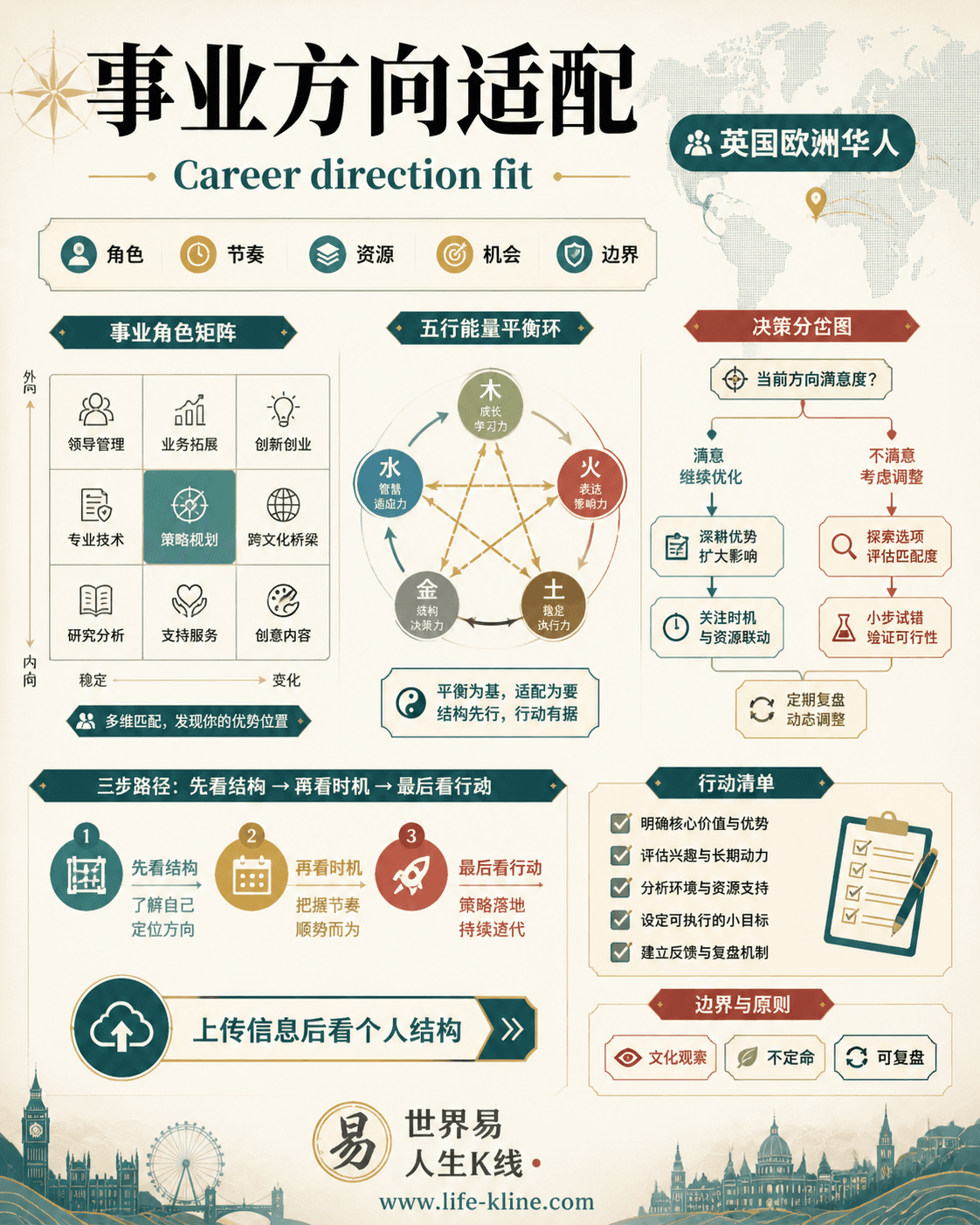
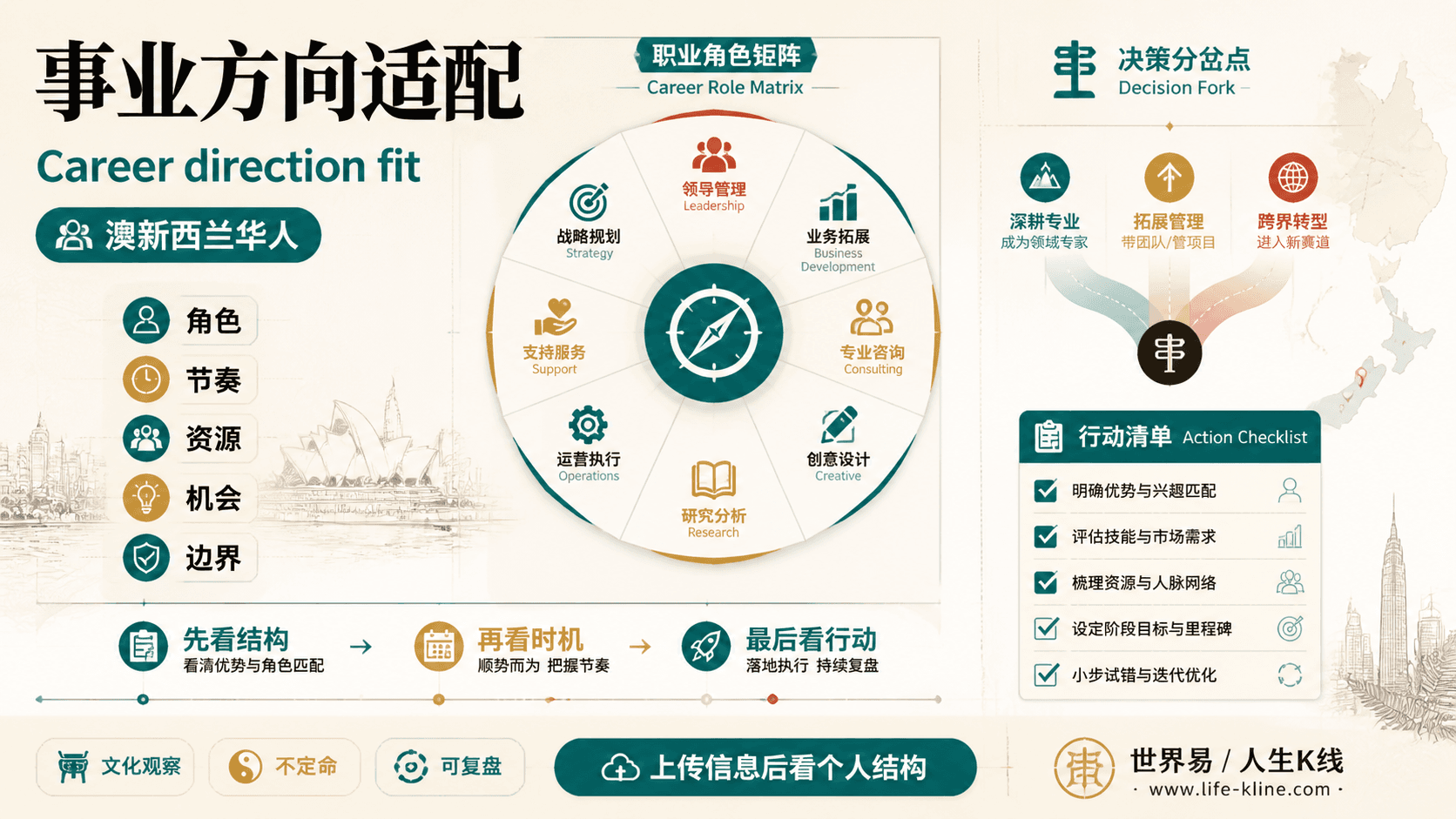
把这篇文章落到自己身上验证:先看结构,再进入个人分析,不做泛泛阅读。
What is a BaZi Pattern
BaZi pattern refers to analyzing the combination of Heavenly Stems (天干) and Earthly Branches (地支) of an individual's birth year, month, day, and hour to reveal the strength of the Day Master (日主) and its relationship with the other Ten Gods (十神), thereby determining the overall structural type of the chart and the selection of Yong Shen (favorable elements) and Ji Shen (unfavorable elements). The identification of the pattern is the core of BaZi metaphysics and directly affects the judgment of one’s life fortune.
Originating from ancient Chinese metaphysics, BaZi pattern theory is based on the mutual generation and restriction of the Five Elements (Wood, Fire, Earth, Metal, Water) and the interactions of the Ten Gods. It emphasizes the Day Master as the center of the chart, with other stems and branches assisting to form different pattern types such as Bi Jian (比肩) pattern, Cong Sha (从杀) pattern, Yang Ren (羊刃) pattern, etc. Each pattern represents distinct personality traits and destiny tendencies.
By determining the pattern, one can clarify the degree of the Day Master’s strength or weakness, reasonably select the Yong Shen to harmonize the imbalance of the Five Elements, and avoid the destructive effects of the Ji Shen, thus achieving the purpose of enhancing auspiciousness and avoiding misfortune. The pattern not only determines an individual’s character and potential but also profoundly influences the auspiciousness and inauspiciousness of Da Yun and Liu Nian.
How to Analyze BaZi Patterns: Core Elements
The analysis of BaZi patterns starts with the Heavenly Stem of the Day Master, judging its Five Elements attribute and strength. This requires a comprehensive evaluation combined with the month command (月令), hour branch (时支), and the generating or controlling relationships among the year pillar (年柱). The strength of the Day Master determines the basic direction of the pattern; for example, if it is relatively strong, it is suitable to drain (泄), and if relatively weak, it should be supplemented (补).
Next is the identification of the pattern type. For instance, the Cong Sha (从杀) pattern usually indicates the Day Master is controlled by the Sha star (Qi Sha or Zheng Sha), requiring Metal and Earth to restrain it and maintain chart balance; the Bi Jian (比肩) pattern shows a vigorous Day Master with a certain degree of independence but needs Wood and Water to harmonize; the Yang Ren (羊刃) pattern indicates a relatively strong Day Master with powerful energy but vulnerable to disruptions caused by Ji Shen.
The selection of Yong Shen is crucial as it regulates and assists the Day Master’s Five Elements, helping the chart tend toward stability and harmony. Ji Shen are restrictive elements in the chart; excessive Ji Shen can lead to unfavorable destiny. Therefore, a complete pattern judgment must comprehensively evaluate Yong Shen and Ji Shen.
Finally, the influence of Da Yun (decade luck cycles) and Liu Nian (annual fortune) on BaZi patterns cannot be ignored. Da Yun represents a ten-year period reflecting the overall trend of destiny, while Liu Nian refers to changes in a single year affecting that year’s fortune. Whether Da Yun and Liu Nian harmonize with the pattern determines the smoothness or adversity during that period.
Overall, the interpretation of BaZi patterns is a multidimensional integration. It requires observing both the static structure of the natal chart and the dynamic changes of Da Yun and Liu Nian to provide scientifically reasonable metaphysical guidance for the individual.
Three Real BaZi Chart Cases
Case 1: In this female’s BaZi chart, the Day Master is 甲 (Jia) Wood, with medium strength, belonging to the Cong Sha (从杀) pattern. Metal and Earth are the Yong Shen, while Water and Wood are Ji Shen. She is currently in the 甲辰 (Jia Chen) Da Yun, which is a stable luck cycle suitable for maintaining achievements. During the 丙午 (Bing Wu) Liu Nian, the interaction between Da Yun and Liu Nian indicates overall stability, but the annual fortune requires flexibility and adjustment. This case demonstrates the importance of maintaining chart balance through reasonable Yong Shen configuration in the Cong Sha pattern and highlights the supportive role of Da Yun and Liu Nian in pattern stability.
Case 2: This male’s BaZi chart has 己 (Ji) Earth as the Day Master, which is relatively strong, forming a Bi Jian (比肩) pattern. Wood and Water are the Yong Shen, and Fire is the Ji Shen. He is currently in the 丙午 (Bing Wu) Da Yun, a period of adverse luck that requires caution against major changes. The Da Yun is relatively weak during the 丙午 Liu Nian, so the annual fortune must be handled carefully. This chart illustrates the importance of selecting appropriate Yong Shen to counter Ji Shen when the Day Master is strong in the Bi Jian pattern and emphasizes the warning effect of Da Yun and Liu Nian on the pattern.
Case 3: This male’s BaZi chart has 壬 (Ren) Water as the Day Master, which is relatively strong, forming a Yang Ren (羊刃) pattern. Earth and Fire are the Yong Shen, and Metal is the Ji Shen. He is currently in the 甲申 (Jia Shen) Da Yun, a stable luck cycle suitable for maintaining achievements. During the 丙午 (Bing Wu) Liu Nian, the interaction with Da Yun requires flexibility. This case reflects the characteristics of a strong Day Master in the Yang Ren pattern and the rational application of Yong Shen and Ji Shen, showing that under a stable Da Yun combined with Liu Nian changes, the chart can maintain good balance and stability.
Common Misconceptions
Many people mistakenly believe that the strength of the Day Master alone determines the quality of destiny. In fact, metaphysics emphasizes the overall balance of the pattern. Whether the Day Master is strong or weak, it must be adjusted with Yong Shen and Ji Shen; otherwise, it is prone to imbalance. A strong Day Master without Yong Shen restraint may become unbalanced; a weak Day Master without noble support (贵人) will face limitations in life.
Another misconception is to ignore the dynamic influence of Da Yun and Liu Nian on the pattern, assuming the BaZi pattern is immutable. In reality, Da Yun and Liu Nian act like the rhythm of destiny, capable of stimulating or suppressing the potential of the pattern, determining the ups and downs in real life.
Some also mistakenly believe that without knowing the birth hour, BaZi cannot be calculated. Although lacking the hour pillar reduces accuracy, by using the method of reverse-calculating the hour pillar and analyzing the three pillars, a relatively effective metaphysical judgment can still be obtained. One should not give up studying metaphysics due to incomplete information.
Finally, some beginners fail to correctly understand the relationship between Yong Shen and Ji Shen, mistakenly treating Ji Shen as elements that must never appear. In fact, Ji Shen are Five Elements that need to be controlled and neutralized. Proper use of Ji Shen can achieve chart balance.
Practical Suggestions
In actual metaphysical analysis, one should first accurately obtain complete birth information, including the birth hour, to ensure the completeness of the Four Pillars BaZi. If the birth hour is unknown, the reverse-calculation method can be used to assist judgment and improve accuracy.
Secondly, when analyzing BaZi patterns, systematically judge the Day Master’s strength, pattern type, Yong Shen, and Ji Shen to avoid one-sided interpretations. Combine the changes of Da Yun and Liu Nian to dynamically assess the chart’s trend, so as to provide practical and feasible advice to the individual.
Finally, metaphysics is a discipline to assist life and should not be superstitiously followed. One should rationally view the metaphysical results based on personal circumstances, leverage the positive effects of Yong Shen, avoid the negative impact of Ji Shen, and achieve Five Elements balance in the chart to enhance auspiciousness and avoid misfortune.
FAQ
Question 1: What does BaZi fortune-telling mainly look at? Answer: BaZi fortune-telling primarily analyzes the Four Pillars of Year, Month, Day, and Hour converted from the Gregorian calendar to the lunar calendar, combined with the generating and controlling relationships of the Heavenly Stems and Earthly Branches and the strength of the Five Elements. A complete BaZi reading covers the strength of the Day Master, the selection of Yong Shen, the Ten Gods pattern, the trends of Da Yun and Liu Nian, as well as the auspiciousness and inauspiciousness of spousal and offspring palaces, comprehensively revealing personal destiny characteristics.
Question 2: Can BaZi be calculated without knowing the birth hour? Answer: Knowing only the three pillars of Year, Month, and Day can still provide a rough framework of destiny, but the accuracy decreases by about 30% to 50%. It is recommended to verify the birth hour with parents or household registration systems if possible. If it cannot be confirmed, the reverse-calculation method using key events in the recent five years can be employed. This method is commonly used by metaphysics practitioners.
Question 3: How often does Da Yun change? Answer: Da Yun usually changes every ten years. Starting from the birth month pillar, the direction is determined by the Yin-Yang of the birth year and gender, then the stems and branches are advanced or reversed every ten years. Da Yun has a significant impact on one’s life rhythm and circumstances, generally more decisive than Liu Nian, influencing the overall fortune during a period.
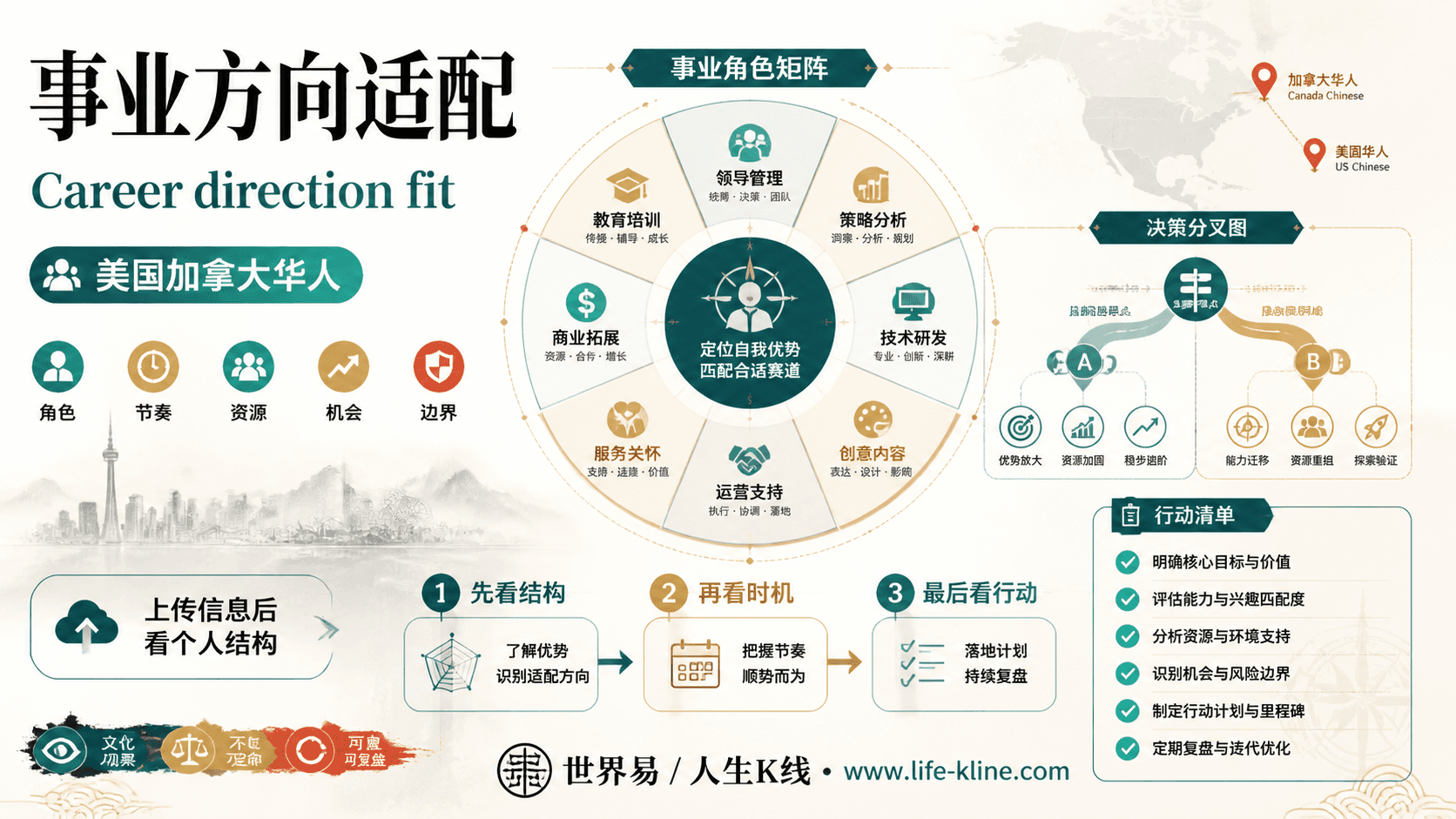
事业方向适配|美国加拿大华人
这张图把《Detailed Explanation of BaZi Patterns: Core Components and Practical Case Analysis》里的命理概念转成关系、边界和应用场景,适合先看图建立结构,再回到知识文章正文理解细节。
事业方向适配不应被写成固定结论。更适合美国加拿大华人的读法,是把传统术语翻译成结构、时机、环境、行动和复盘。
查看图片解读