Complete Guide to Day Master Strength: Detailed Explanation and Practical Application of Day Master Power in BaZi Charts
把这篇文章落到自己身上验证:先看结构,再进入个人分析,不做泛泛阅读。
What is Day Master Strength
The Day Master refers to the Heavenly Stem (天干, Tian Gan) of the day of birth in a BaZi chart, representing the individual's own Five Elements attribute. The strength of the Day Master, known as Day Master strength or weakness, measures the power level of the Day Master within the entire chart, reflecting the person's constitution, personality, and vitality.
Judging Day Master strength is a core step in BaZi metaphysics. It uses the principles of mutual generation and restriction among Heavenly Stems and Earthly Branches (地支, Di Zhi), as well as the Five Elements interactions, combined with the strength of the other three pillars’ stems and branches, to comprehensively assess the Day Master’s power.
A strong Day Master has robust self-expression and stress resistance and is suitable to be balanced by elements that drain or control it (泄耗五行). A weak Day Master requires support from the Yong Shen (favorable elements) to enhance its strength and avoid being suppressed by the Ji Shen (unfavorable elements).
Day Master strength directly affects the formation of the chart’s pattern, the selection of Yong Shen, and the subsequent trends in Da Yun and Liu Nian, forming the foundation for accurate BaZi interpretation.
Therefore, understanding and mastering Day Master strength not only helps metaphysicians make scientific judgments but also assists individuals in better planning life development and coping with changes.
How to Assess Day Master Strength: Core Factors
To determine Day Master strength, first clarify the Five Elements attribute of the Day Master and its generating and controlling relationships. Analyze the quantity, strength, and interactions of the Five Elements within the Heavenly Stems and Earthly Branches of all four pillars to identify whether the Day Master is relatively strong or weak.
Next, consider the pattern type (格局, Ge Ju) to understand the Day Master’s role and function within the chart. For example, patterns such as Shang Guan (伤官格), Yang Ren (羊刃格), or Shi Shen (食神格) influence the Day Master’s expression and strength status.
The choice of Yong Shen is an important method to regulate Day Master strength. A strong Day Master is best balanced by elements that drain or consume it, while a weak Day Master needs supportive or controlling elements to harmonize the chart and ensure Five Elements balance.
Da Yun (decade luck cycles) and Liu Nian (annual fortunes) significantly affect Day Master strength. Da Yun periodically alters the power distribution in the chart, while Liu Nian acts as a catalyst in specific years. Their interaction with Day Master strength determines the auspiciousness or adversity of the year.
Finally, excluding Ji Shen (unfavorable elements) is equally crucial. Ji Shen are often the suppressive forces in the chart; excessive or overly strong Ji Shen can overwhelm the Day Master, causing imbalance and requiring careful handling.
Three Real BaZi Chart Cases
Case 1: The Day Master is Xin Metal (辛, Xin), relatively weak, with a Shang Guan (伤官) pattern. The Yong Shen is Earth, and the Ji Shen are Water and Wood. Currently in the Yi Si (乙巳) Da Yun (ages 21-30), with a relatively weak fortune; the Liu Nian is Bing Wu (丙午). This chart shows insufficient Xin Metal strength, requiring Earth’s support to enhance itself. The Yi Si Da Yun aligns with the Day Master’s weakness, advising the individual to act cautiously and avoid interference from Water and Wood Ji Shen to maintain Day Master stability. This exemplifies how a weak Day Master influences fortune.
Case 2: The Day Master is Ji Earth (己, Ji), relatively strong, with a Yang Ren (羊刃) pattern. The Yong Shen are Wood and Water; the Ji Shen is Fire. Currently in the Yi You (乙酉) Da Yun (ages 15-24), with auspicious fortune; the Liu Nian is Bing Wu (丙午). In this chart, the Ji Earth Day Master is vigorous and requires Wood and Water Yong Shen to drain and balance it, avoiding excessive Fire consumption. The Yi You Da Yun brings good career and wealth development, and the Liu Nian supports this trend, demonstrating how a strong Day Master can advance smoothly through proper Yong Shen and Da Yun coordination.
Case 3: The Day Master is Xin Metal (辛, Xin), relatively weak, with a Shi Shen (食神) pattern. The Yong Shen is Earth, and the Ji Shen are Water and Wood. Currently in the Wu Wu (戊午) Da Yun (ages 41-50), with auspicious fortune; the Liu Nian is Bing Wu (丙午). Although the Xin Metal Day Master is weak, it gains good development under Earth’s Yong Shen support during the Wu Wu Da Yun. The Bing Wu Liu Nian complements the Da Yun, illustrating how adjusting Yong Shen and Da Yun coordination allows a weak Day Master to achieve career and wealth progress. This shows that Day Master strength is not absolute but depends on overall chart harmony.
These three cases are based on real charts, fully demonstrating the practical impact of Day Master strength on pattern formation, Yong Shen selection, and Da Yun & Liu Nian effects, helping to understand the critical significance of Day Master power in BaZi metaphysics.
Common Misconceptions
Many mistakenly believe a strong Day Master is absolutely beneficial and a weak Day Master absolutely harmful. In reality, strength is only one aspect of the chart; the key is whether suitable Yong Shen can harmonize it. An overly strong Day Master without proper draining elements can cause imbalance and impulsive personality traits.
Another common error is ignoring the dynamic influence of Da Yun and Liu Nian on Day Master strength. Da Yun and Liu Nian change the balance of Five Elements over time. Simply analyzing the natal BaZi without considering luck cycles cannot comprehensively grasp the destiny trajectory.
Some learners neglect identifying Ji Shen, assuming a strong Day Master can resist all adversities. In fact, Ji Shen’s suppressive effects greatly impact the Day Master, especially for weak Day Masters who must be vigilant against Ji Shen oppression.
Finally, some think that without an accurate birth hour, Day Master strength cannot be judged. Although the Hour Pillar is important, even if it is missing, reverse calculation and comprehensive analysis can still provide a reasonably accurate assessment of Day Master strength.
Practical Recommendations
In actual BaZi analysis, first accurately identify the Day Master’s Five Elements attribute, combine the entire four pillars’ context, determine its strength level, and clarify the Yong Shen and Ji Shen to lay a foundation for further analysis.
Dynamically adjust the understanding of Day Master strength according to changes in Da Yun and Liu Nian, paying special attention to the impact of luck transition periods on the individual, and advise accordingly to act with the trend or cautiously.
For Day Masters with different strength statuses, suggest that the individual pay attention to supplementing or restraining the corresponding Five Elements in daily life. For a weak Day Master, strengthen the environment and habits related to the Yong Shen elements; for a strong Day Master, avoid excessive Ji Shen interference.
If the exact birth hour is unknown, try to deduce the Hour Pillar through family memories or significant life events to ensure accuracy in judging Day Master strength, thereby enhancing the authority and practicality of BaZi analysis.
FAQ
What does BaZi fortune-telling actually analyze? BaZi fortune-telling is based on the combination of Heavenly Stems and Earthly Branches of the birth year, month, day, and hour. By analyzing the generating and controlling relationships among the stems and branches and the strength or weakness of the Five Elements, it determines the Day Master’s power and the Ten Gods (十神) pattern. A complete BaZi interpretation covers Day Master strength, Yong Shen selection, pattern types, Da Yun and Liu Nian trends, and key palace auspiciousness, serving as an important tool to comprehensively grasp personal destiny.
Can BaZi be calculated without knowing the birth hour? A three-pillar BaZi (year, month, day) can provide a rough analysis but with 30% to 50% less accuracy. It is recommended to verify the birth hour through family or official records. If it cannot be determined, reverse calculation using major events from the past five years is a common remedial method used by metaphysicians to approximate the Hour Pillar, significantly improving the precision of BaZi judgment.
How often does Da Yun change? Da Yun usually changes every ten years, starting from the birth month. The direction (forward or backward) depends on Yin-Yang attributes and gender, with each ten-year period represented by a new Heavenly Stem and Earthly Branch combination. Da Yun has a significant influence on the individual’s current life and fortune, much more than the annual Liu Nian. Correctly understanding and applying Da Yun changes is key to BaZi metaphysics practice.
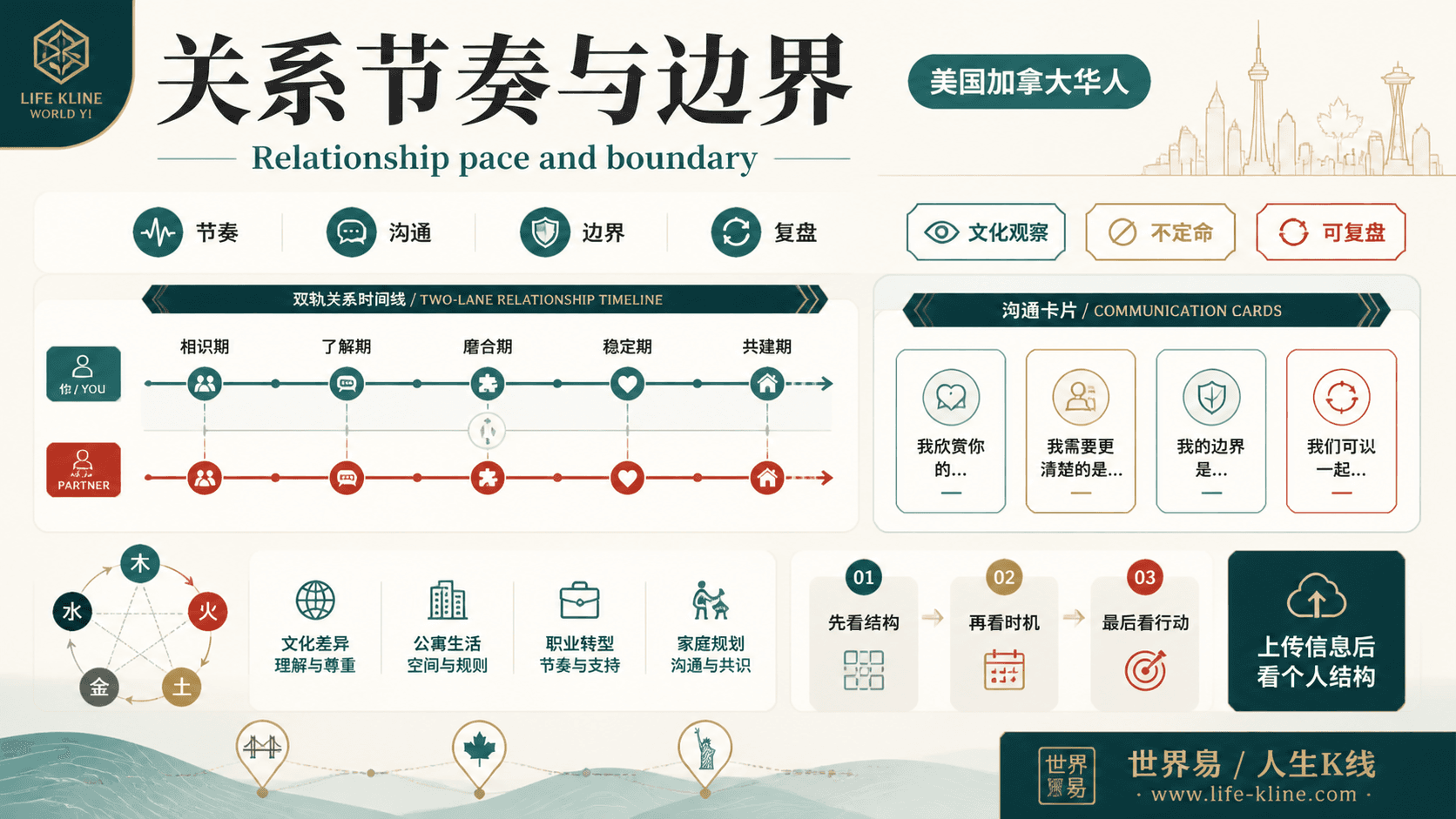
关系节奏与边界|美国加拿大华人
这张图把《Complete Guide to Day Master Strength: Detailed Explanation and Practical Application of Day Master Power in BaZi Charts》里的命理概念转成关系、边界和应用场景,适合先看图建立结构,再回到知识文章正文理解细节。
关系节奏与边界不应被写成固定结论。更适合美国加拿大华人的读法,是把传统术语翻译成结构、时机、环境、行动和复盘。
查看图片解读