Detailed Explanation of Ascendant Signs: A Complete Guide to Western Astrology and Metaphysics Integration
把这篇文章落到自己身上验证:先看结构,再进入个人分析,不做泛泛阅读。
What Is the Ascendant Sign
The Ascendant sign refers to the zodiac sign that is exactly rising on the eastern horizon at the moment of a person’s birth. It is determined based on the precise birth time and location, so the Ascendant sign changes approximately every two hours. The Ascendant is considered a symbol of how an individual presents themselves outwardly and their behavior toward the external world.
In Western astrology, the Sun sign usually represents a person’s core personality and life purpose, while the Ascendant sign focuses more on external expression, social style, and first impressions. In other words, the Ascendant is the individual’s “face” interacting with the outside world, reflecting how they express themselves in social environments.
The origin of the Ascendant sign can be traced back to ancient astrology. It is closely related to the twelve zodiac houses and helps astrologers divide the twelve houses by observing the horizon position at birth time, thereby refining the interpretation of the natal chart.
Because the Ascendant sign depends on an accurate birth time, even a slight deviation can cause misjudgment of the Ascendant. Therefore, accurately recording the birth time is a prerequisite for precise astrological analysis.
Overall, the Ascendant sign is an indispensable core element in Western astrology, together with the Sun sign and Moon sign forming a complete personal natal chart. These three complement each other to comprehensively reveal an individual’s internal and external characteristics.
How to Determine the Ascendant Sign: Core Elements
To accurately determine the Ascendant sign, obtaining the precise birth time and place is essential. The calculation of the Ascendant is based on the degree and position of the eastern horizon at birth, so without an exact birth time, it is impossible to accurately divide the twelve houses and Ascendant sign.
The Ascendant not only marks a person’s external presentation but is also closely related to the first house, influencing one’s attitude toward life, outward image, and interaction style with others. It is the key to revealing the individual’s self-expression in the natal chart.
When interpreting a natal chart, besides confirming the Ascendant sign, attention should also be paid to the ruling planet of the Ascendant and the sign and house it occupies, as they jointly influence the individual’s behavioral patterns and life path.
The relationship between the Ascendant and Sun signs is crucial. The Sun sign represents inner motivation and core identity, while the Ascendant reflects the external social appearance and mode of expression. Their combination can profoundly reveal a person’s inner and outer unity and conflicts.
Additionally, the Moon sign, symbolizing emotions and the subconscious, should be considered together with the Ascendant and Sun signs to form a multi-layered, comprehensive understanding of the individual.
Three Real Natal Chart Cases
Case One: Female, aged 30-35, Day Master Geng (庚, Metal) slightly strong, pattern is Yang Ren (羊刃) pattern, Yong Shen (favorable elements) are Fire and Wood, Ji Shen (unfavorable element) is Earth. Currently in the Xin Chou (辛丑) Da Yun (27-36 years), the decade luck is stable and suitable for consolidation. The Liu Nian (annual fortune) is Bing Wu (丙午). The interaction between the Da Yun and Liu Nian provides adaptability. Combining the concept of the Ascendant sign, it can be understood that her outward expression may show strong personality and vitality. The Fire and Wood Yong Shen help drive her action and growth motivation, while the Yang Ren pattern symbolizes sharpness and aggressiveness in her character, complementing the Ascendant’s external traits.
Case Two: Female, aged 45-50, Day Master Ren (壬, Water) slightly weak, pattern is Zheng Yin (正印) pattern, Yong Shen is Water, Ji Shen are Wood and Fire. Currently in the Yi Wei (乙未) Da Yun, the luck is relatively weak and requires caution. The Liu Nian is Bing Wu (丙午), which also calls for careful attitude. In this natal chart, the Day Master is weak, and the Yong Shen Water emphasizes nourishment and support, reflecting a gentler inner strength. Combined with the Ascendant sign, this may mean her outward expression is mild and reserved, relying on environmental support and protection. The Zheng Yin pattern’s steady traits also influence a stable and introverted social image.
Case Three: Female, aged 50-55, Day Master Geng (庚, Metal) slightly strong, pattern is Bi Jian (比肩) pattern, Yong Shen are Fire and Wood, Ji Shen is Earth. Currently in the Yi Chou (乙丑) Da Yun, at a stable consolidation stage. The Liu Nian is Bing Wu (丙午), with notable adaptability. This natal chart’s strong Day Master and Bi Jian pattern reflect strong self-awareness and independence. The Fire and Wood Yong Shen support her proactive traits. The Ascendant sign in this chart may manifest as confident and outgoing, able to actively respond to environmental changes, showing a vivid and energetic outward image.
These three cases all integrate the BaZi (Four Pillars) metaphysics elements of Day Master strength, pattern, and Yong Shen, illustrating the interactive relationship between the Ascendant sign’s external expression and metaphysical energies, demonstrating an organic fusion of Western astrology and Chinese metaphysics.
Common Misconceptions
Many people mistakenly think the Ascendant sign and Sun sign have the same meaning, but in fact, they represent different layers. The Sun sign focuses on the inner core, while the Ascendant is the external presentation. Confusing the two can lead to misjudgments about personality.
Another common misconception is ignoring the importance of birth time. Many only know their birth date but not the exact time, resulting in an inability to accurately determine the Ascendant sign, causing incomplete or erroneous natal chart interpretations.
Some astrology enthusiasts overemphasize the uniqueness of a single sign while neglecting the complex interactions between the Ascendant sign, other planets, and houses, leading to one-sided interpretations that fail to reflect the true individual traits.
There are also people who mistakenly believe the Ascendant sign can be interpreted independently, ignoring that it must work together with the Sun and Moon signs to form a complete natal chart analysis system.
Practical Advice
To accurately understand your Ascendant sign, it is recommended to obtain a precise birth time, preferably confirmed through authoritative sources such as hospital birth records or maternal and infant handbooks, to avoid errors caused by time inaccuracies.
When analyzing a natal chart, the combined interpretation of the Sun sign, Moon sign, and Ascendant sign should be used to comprehensively grasp an individual’s inner drives, emotional needs, and external expression, avoiding one-sided understanding.
Integrating the BaZi (Four Pillars) metaphysics elements such as Day Master strength, pattern, and Yong Shen can provide a deeper cultural background for interpreting the Ascendant sign, especially when judging personal fortune and personality traits, achieving an effective fusion of Eastern and Western metaphysics.
FAQ
Question 1: Which is more important, the Sun sign or the Ascendant sign? Answer: Simply put, the Sun sign is determined by the birth month and represents the individual’s core and goals; the Ascendant sign is the zodiac sign rising on the eastern horizon at birth, changing approximately every two hours, reflecting how the individual presents themselves to the world. Both are very important. The Moon sign supplements emotional and subconscious layers. Together, these three form a complete personal natal chart.
Question 2: Can a natal chart be viewed without birth time? Answer: You can view the Sun sign, Moon sign, and the signs of various planets, but you cannot accurately divide the twelve houses because house calculation depends on precise birth time. Without the time, judgments about key houses such as the career house will be affected. It is recommended to try to find the exact birth time for a comprehensive chart interpretation.
Question 3: How does the Ascendant sign influence personal metaphysics? Answer: The Ascendant sign represents a person’s outward image and social interaction style, complementing the patterns and Yong Shen in metaphysics. By combining the Day Master’s strength and pattern in the natal chart, one can more accurately understand how the Ascendant expresses personality and destiny trends.
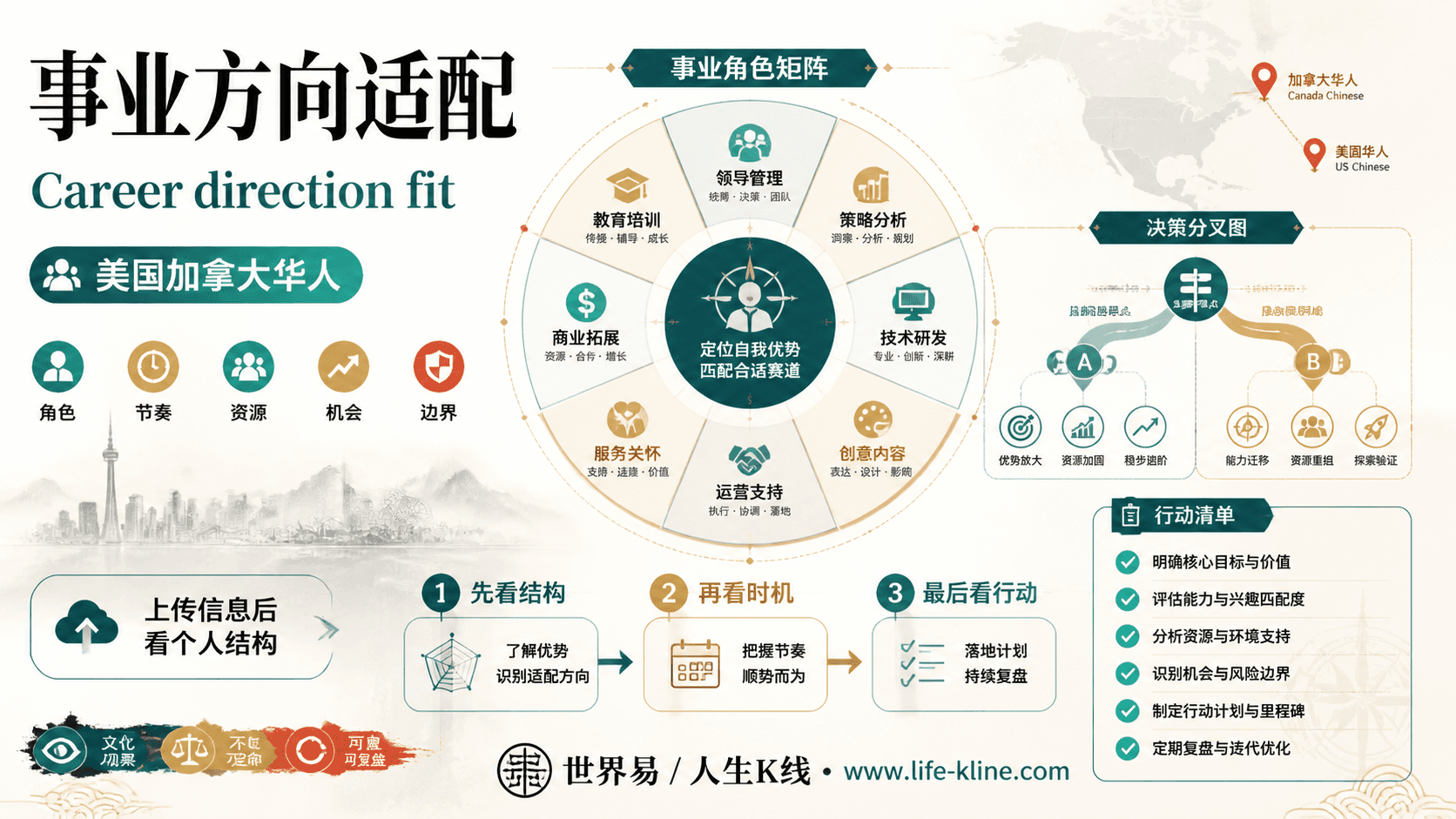
事业方向适配|美国加拿大华人
这张图把《Detailed Explanation of Ascendant Signs: A Complete Guide to Western Astrology and Metaphysics Integration》里的命理概念转成关系、边界和应用场景,适合先看图建立结构,再回到知识文章正文理解细节。
事业方向适配不应被写成固定结论。更适合美国加拿大华人的读法,是把传统术语翻译成结构、时机、环境、行动和复盘。
查看图片解读