Zi Wei Main Star Tian Ji: Fate Analysis and Application Guidance
把这篇文章落到自己身上验证:先看结构,再进入个人分析,不做泛泛阅读。
Concept Definition
Tian Ji is one of the fourteen main stars in Zi Wei Dou Shu, classified as an auspicious star transformed from the Southern and Northern Dipper, with the Five Element attribute of Yin Wood. Its transformed energy is called “goodness.” As a brother star and star of wisdom, Tian Ji symbolizes intelligence and adaptability, representing the wisdom of planning and flexibility. Its nature is active, favoring movement rather than stillness, emphasizing seeking opportunities and advantages through change.
Within the Zi Wei Dou Shu system, Tian Ji does not exist independently but requires coordination with other stars such as Zuo Fu and You Bi, Wen Chang and Wen Qu, and auxiliary stars like Tian Kui and Tian Yue to form a complete natal chart pattern. This cooperative relationship determines Tian Ji’s specific manifestations and functions in different palaces and charts.
The judgment of Tian Ji’s auspiciousness or inauspiciousness must be combined with the Four Transformations—Hua Lu (transformation of prosperity), Hua Quan (transformation of authority), Hua Ke (transformation of merit), and Hua Ji (transformation of obstacles). The combination and variation of these Four Transformations directly affect Tian Ji’s auspicious attributes, thereby influencing the Day Master’s intelligence expression and life change trends.
Traditional Fate Meaning
In traditional Zi Wei Dou Shu, Tian Ji is regarded as a symbol of wisdom and strategy, governing a person’s intelligence, quick adaptability, and skillful planning ability. It represents mental flexibility and agility, suitable for finding solutions in changing environments, hence it is called the “star of wisdom.”
As a brother star, Tian Ji also symbolizes brotherhood and cooperative spirit in interpersonal relationships, emphasizing achieving unity and win-win outcomes through flexible communication and planning. Its Five Element attribute of Yin Wood implies softness with firmness, possessing generative and adjusting functions, helping the Day Master continuously adjust strategies in career and life.
Traditionally, Tian Ji is suited to movement rather than stillness, meaning the Day Master is inclined toward a proactive and adaptable life attitude, avoiding missed opportunities caused by rigidity. This characteristic reflects the dynamic wisdom and flexible adaptability that Tian Ji represents in the natal chart.
Practical Configuration and Interpretation
In practical Zi Wei Dou Shu applications, the auspiciousness or inauspiciousness of Tian Ji must be analyzed comprehensively according to its palace location and the Four Transformations it generates. Hua Lu represents auspiciousness and wealth, Hua Quan symbolizes power and control, Hua Ke governs reputation and literary talent, while Hua Ji generally indicates obstacles and hindrances. When Tian Ji obtains auspicious Four Transformations, it often manifests outstanding wisdom and strategy, facilitating the Day Master’s smooth achievement of goals.
Moreover, Tian Ji’s coordination with auxiliary stars such as Zuo Fu and You Bi, Wen Chang and Wen Qu, Tian Kui and Tian Yue further perfects the natal chart structure, enhancing its wisdom and adaptability expression. For example, the support of Wen Chang and Wen Qu can improve Tian Ji’s literary agility, while Tian Kui and Tian Yue assist Tian Ji in leadership and supportive roles.
Practically, Tian Ji thrives in seeking change through movement, suitable for careers requiring flexible adaptability and strong planning abilities, such as planning, consulting, and management. If the Day Master skillfully utilizes Tian Ji’s wisdom and adaptability traits, they can navigate complex environments with ease, seize opportunities, and turn dangers into safety.
Common Misconceptions
Many fate enthusiasts mistakenly believe Tian Ji only represents intelligence and wisdom, overlooking its essential attribute of “favoring movement over stillness.” In fact, Tian Ji emphasizes change and adaptability; being static or rigid limits the expression of wisdom and causes missed opportunities.
Another common misconception is neglecting the decisive role of the Four Transformations in determining Tian Ji’s auspiciousness. Tian Ji’s manifestation is not simply auspicious or inauspicious alone but must be accurately judged by combining the influences of Hua Lu, Hua Quan, Hua Ke, and Hua Ji to determine its auspiciousness and the Day Master’s specific fortune.
FAQ
Question: Why is Tian Ji’s Five Element attribute Yin Wood? Answer: Tian Ji belongs to the auspicious transformations of the Southern and Northern Dipper, with the Five Element attribute designated as Yin Wood. Yin Wood represents softness with generative power, aligning with Tian Ji’s traits of planning and wisdom.
Question: How does Tian Ji coordinate with auxiliary stars to influence the natal chart? Answer: Tian Ji coordinates with auxiliary stars such as Zuo Fu and You Bi, Wen Chang and Wen Qu, Tian Kui and Tian Yue, forming a more complete natal chart pattern that enhances wisdom, adaptability, and supportive abilities, improving overall auspiciousness.
Question: Why is Tian Ji said to favor movement over stillness? Answer: Tian Ji governs wisdom and adaptability, thriving in dynamic changes. Being static or rigid restricts its wisdom expression; thus, it favors movement rather than stillness.
Question: How to judge Tian Ji’s auspiciousness through the Four Transformations? Answer: Tian Ji’s auspiciousness must be comprehensively analyzed by combining the Four Transformations of Hua Lu (auspiciousness), Hua Quan (power), Hua Ke (reputation), and Hua Ji (obstacles). The combination directly affects Tian Ji’s specific manifestations.
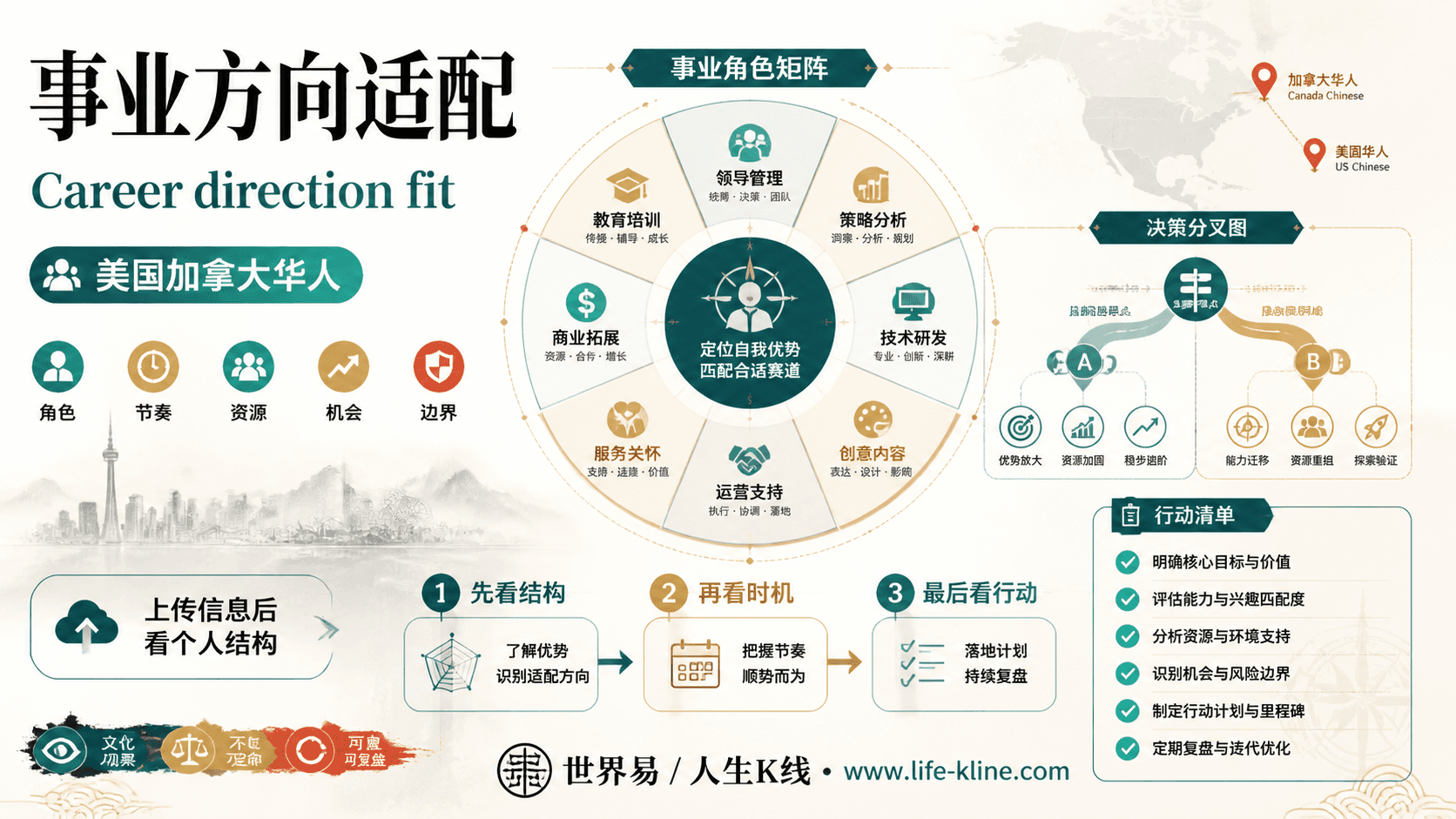
事业方向适配|美国加拿大华人
这张图把《Zi Wei Main Star Tian Ji: Fate Analysis and Application Guidance》里的命理概念转成关系、边界和应用场景,适合先看图建立结构,再回到知识文章正文理解细节。
事业方向适配不应被写成固定结论。更适合美国加拿大华人的读法,是把传统术语翻译成结构、时机、环境、行动和复盘。
查看图片解读