The Astrological Significance and Practical Application of Qi Sha, a Major Star in Zi Wei Dou Shu
把这篇文章落到自己身上验证:先看结构,再进入个人分析,不做泛泛阅读。
Concept Definition
Qi Sha is one of the fourteen major stars in Zi Wei Dou Shu, belonging to the sixth star of the Southern Dipper, with the Five Elements attribute of Yin Metal. Its transformed energy (hua qi) is called the “General” (将, Jiang), reflecting its identity as a General Star, symbolizing control and leadership abilities. In the star system, Qi Sha is regarded as a stern and killing star, possessing strong traits of firmness and independence.
As a principal star, Qi Sha occupies an important position in the Zi Wei Dou Shu natal chart. Its auspiciousness or inauspiciousness often depends on its palace location and its combinations with other stars, especially its relationship with the Four Transformations (hua lu, hua quan, hua ke, hua ji). Through these influences, the nature and function of Qi Sha can vary, forming different astrological patterns.
Furthermore, the manifestation of Qi Sha in the chart must also consider auxiliary stars such as Zuo Fu (Left Assistant), You Bi (Right Assistant), Wen Chang, Wen Qu, as well as Tian Kui and Tian Yue. The cooperation of these auxiliary stars with Qi Sha constitutes a complete and detailed astrological structure, providing a more comprehensive basis for interpreting the character and fortune of the chart owner.
Traditional Astrological Significance
In traditional Zi Wei Dou Shu astrology, Qi Sha is regarded as a General Star, representing authority and decisiveness. Its Yin Metal attribute carries a stern and killing energy, symbolizing firmness and an unyielding spirit. The personality of Qi Sha often manifests as independent and autonomous, sometimes even sharp-edged, prone to experiencing life’s ups and downs and challenges.
The stern and killing nature of Qi Sha means that in the natal chart it embodies both positive leadership and pioneering abilities, as well as potential conflicts and hardships. Classical texts consider it an important star that governs power and executive ability, thus playing a key role when analyzing the chart owner’s career and interpersonal relationships.
At the same time, the auspiciousness or adversity of Qi Sha often depends on the changes in its transformed energies among the Four Transformations. The support of hua lu, hua quan, and hua ke generally allows Qi Sha’s fierce character to be expressed positively, while hua ji may bring obstacles and troubles. Traditional astrology emphasizes careful observation of these variations to accurately determine the chart owner’s destiny trajectory.
Practical Configuration and Interpretation
In practical natal chart analysis, the position of Qi Sha is extremely critical. Qi Sha located in different palaces will exhibit different characteristics and influences. For example, Qi Sha in the Career Palace often symbolizes a chart owner with a strong drive and leadership desire, but may also face more challenges and competition.
By combining the changes of the Four Transformations, the auspiciousness of Qi Sha can be judged more accurately. When hua quan is present on Qi Sha, its authority and executive power are greatly enhanced; hua lu strengthens the smoothness and protection of fortune; hua ke helps improve wisdom and reputation; while hua ji requires caution to prevent impulsive and excessive behaviors that could cause difficulties.
The cooperation of auxiliary stars is equally important. The assistance of Zuo Fu and You Bi can soften Qi Sha’s fierceness, adding support and harmony; literary stars such as Wen Chang and Wen Qu help enhance wisdom and literary talent, balancing Qi Sha’s stern aura; noble stars like Tian Kui and Tian Yue bring benefactors’ help, reducing conflicts and pressure caused by Qi Sha.
Common Misconceptions
Many metaphysics enthusiasts mistakenly believe that Qi Sha solely represents an inauspicious or negative star. In fact, Qi Sha has a complex and multifaceted nature. Its firmness and independence do not necessarily bring bad luck; with proper configuration and transformed energy changes, it can become a powerful supportive star.
Another common misconception is to ignore the role of auxiliary stars and judge the auspiciousness of Qi Sha independently. The relationship between Qi Sha and auxiliary stars is extremely important; interpreting Qi Sha alone often leads to one-sided judgments and fails to reflect the overall pattern and true situation of the natal chart.
FAQ
Question: What is the Five Elements attribute of Qi Sha? Answer: Qi Sha belongs to Yin Metal in the Five Elements, and its transformed energy is called the General Star.
Question: Why is Qi Sha called a stern and killing star? Answer: Because its star nature carries firmness and a killing aura, symbolizing authority and decisiveness, it is thus called a stern and killing star.
Question: How to judge the auspiciousness of Qi Sha? Answer: It requires combining its palace location and the changes of the Four Transformations—hua lu, hua quan, hua ke, hua ji—as well as the cooperation of auxiliary stars for a comprehensive judgment.
Question: What is the effect of Qi Sha cooperating with auxiliary stars? Answer: Auxiliary stars such as Zuo Fu, You Bi, Wen Chang, and Wen Qu can soften Qi Sha’s fierceness, add support and wisdom, and form a complete natal chart pattern.
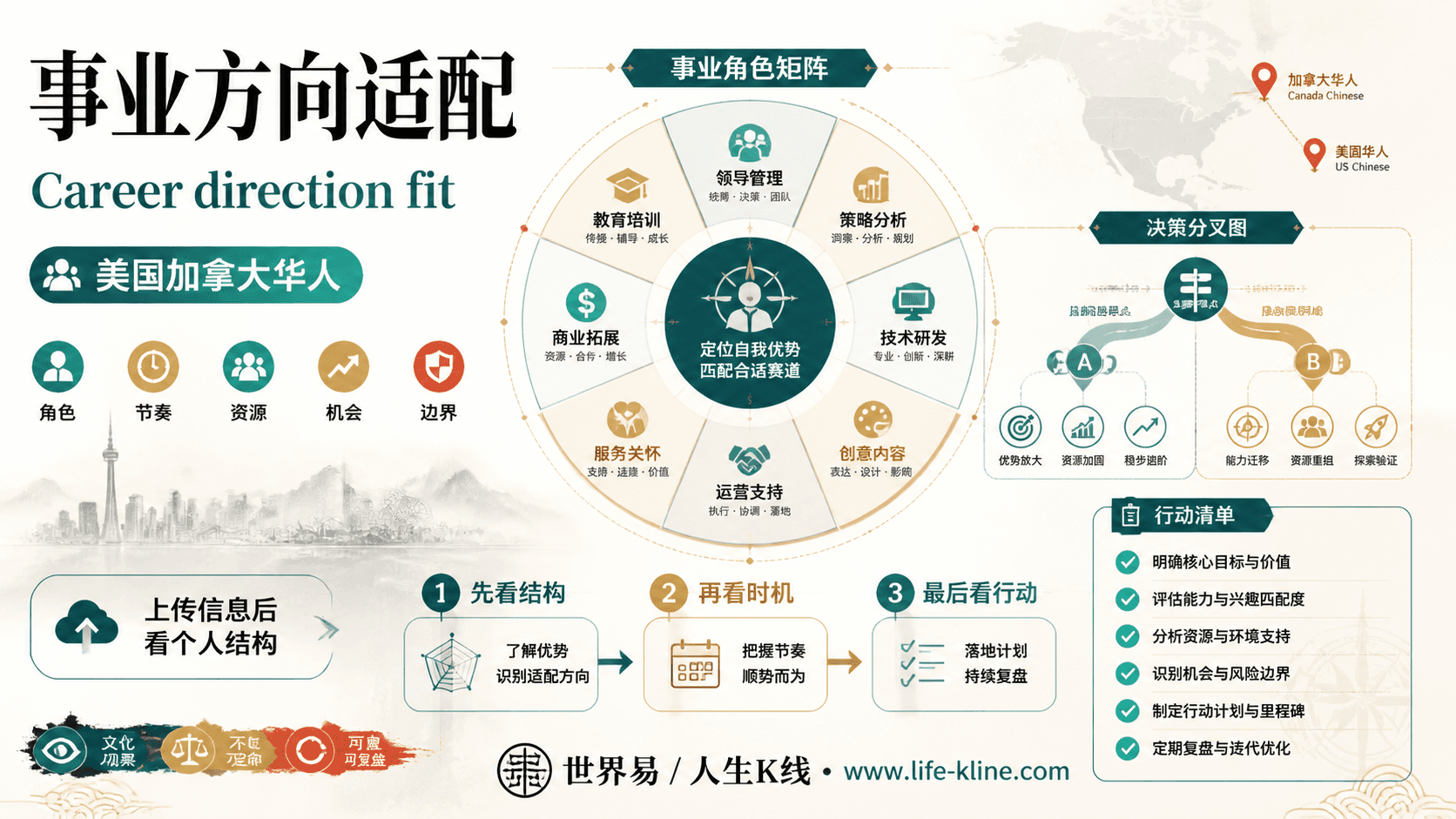
事业方向适配|美国加拿大华人
这张图把《The Astrological Significance and Practical Application of Qi Sha, a Major Star in Zi Wei Dou Shu》里的命理概念转成关系、边界和应用场景,适合先看图建立结构,再回到知识文章正文理解细节。
事业方向适配不应被写成固定结论。更适合美国加拿大华人的读法,是把传统术语翻译成结构、时机、环境、行动和复盘。
查看图片解读