The 'Ping' Deity in the Twelve Gods of Jianchu: Analysis of Stability, Balance, and Date Selection Applications
把这篇文章落到自己身上验证:先看结构,再进入个人分析,不做泛泛阅读。
Concept Definition
'Ping' is an important deity (Shen Sha) among the Twelve Gods of Jianchu in traditional Chinese metaphysics, representing the nature of stability and balance. In ancient date selection studies, the Twelve Gods of Jianchu rotate daily, each with specific auspicious and taboo activities along with symbolic meanings. As the deity of stability and balance, 'Ping' advocates fairness and steadiness, emphasizing harmonious states of affairs.
In practical application, 'Ping' is regarded as an auspicious deity suitable for promoting steady progress. It encourages peaceful and prudent behavior, especially fitting for matters requiring long-term planning and sustained development. At the same time, 'Ping' has clear taboos, particularly being unsuitable for major events related to emotions and marriage.
Traditional Metaphysical Significance
From the perspective of classical texts and traditional date selection studies, 'Ping' symbolizes a balanced state of affairs, representing an ideal of stability and constancy. It reflects the ancient observation of the rhythms of Heaven, Earth, and Time, indicating that on certain days, the Qi (energy) of Heaven and Earth tends toward equilibrium, making it suitable for undertaking tasks that require a solid foundation and lasting results.
Therefore, 'Ping' governs fairness and stability and is often used to select auspicious days for activities such as construction and taking office. These activities require environmental and mental steadiness to ensure smoothness and longevity. The taboo against marriage on 'Ping' days indicates its unsuitability for events involving emotional fluctuations, avoiding adverse effects caused by disharmonious daily Qi.
Within the metaphysical system, the Twelve Gods of Jianchu are combined with the daily Heavenly Stems and Earthly Branches (Gan Zhi) to more precisely determine the auspiciousness and taboos of the day. When combined with an individual's BaZi (Eight Characters), 'Ping' can assist date selectors in choosing days harmonious with one’s personal fate, achieving the goal of attracting good fortune and avoiding misfortune.
Practical Configuration and Interpretation
In actual date selection practice, the first step is to determine whether the day’s Jianchu deity is 'Ping'. If it is a 'Ping' day, it is suitable to arrange activities such as construction and taking office that require a stable Qi field. Selecting a 'Ping' day for construction can promote smooth progress and structural stability; for taking office, it benefits steady career development and reduces obstacles.
At the same time, note that 'Ping' days are taboo for marriage, so when choosing auspicious wedding dates, the presence of the 'Ping' deity should be avoided. By integrating the daily Heavenly Stems and Earthly Branches with the individual’s BaZi for comprehensive interpretation of 'Ping' days, one can more accurately grasp the auspiciousness and applicable scope of the day, enhancing the scientific and practical value of date selection.
In modern metaphysical applications, date selection masters often combine 'Ping' with other Jianchu deities to form a complete date selection system. Utilizing calendar software or classical records, they precisely identify 'Ping' days to provide reference for important life decisions.
Common Misunderstandings
Many people mistakenly believe that 'Ping' days are suitable for all major activities. In fact, while 'Ping' governs stability, it explicitly forbids marriage. Ignoring this point may lead to improper date selection, affecting marital harmony and family well-being.
Another misunderstanding is using the 'Ping' deity in isolation without combining it with the daily Heavenly Stems, Earthly Branches, and BaZi for comprehensive judgment. The Twelve Gods of Jianchu complement the Gan Zhi and BaZi; single-factor application often leads to misjudgment and reduces the accuracy of date selection.
FAQ
Question: Why is the 'Ping' deity taboo for marriage? Answer: The 'Ping' deity governs stability and balance, but marriage involves emotions and changes that can disrupt this stable state. Therefore, traditional date selection considers 'Ping' days unsuitable for weddings.
Question: How to use the 'Ping' deity in date selection combined with BaZi? Answer: First confirm whether the day is a 'Ping' day, then combine it with the individual’s BaZi—specifically the Five Elements and Ten Gods (Shi Shen)—to judge if the day aligns with the person’s fate, choosing the most suitable day for important matters.
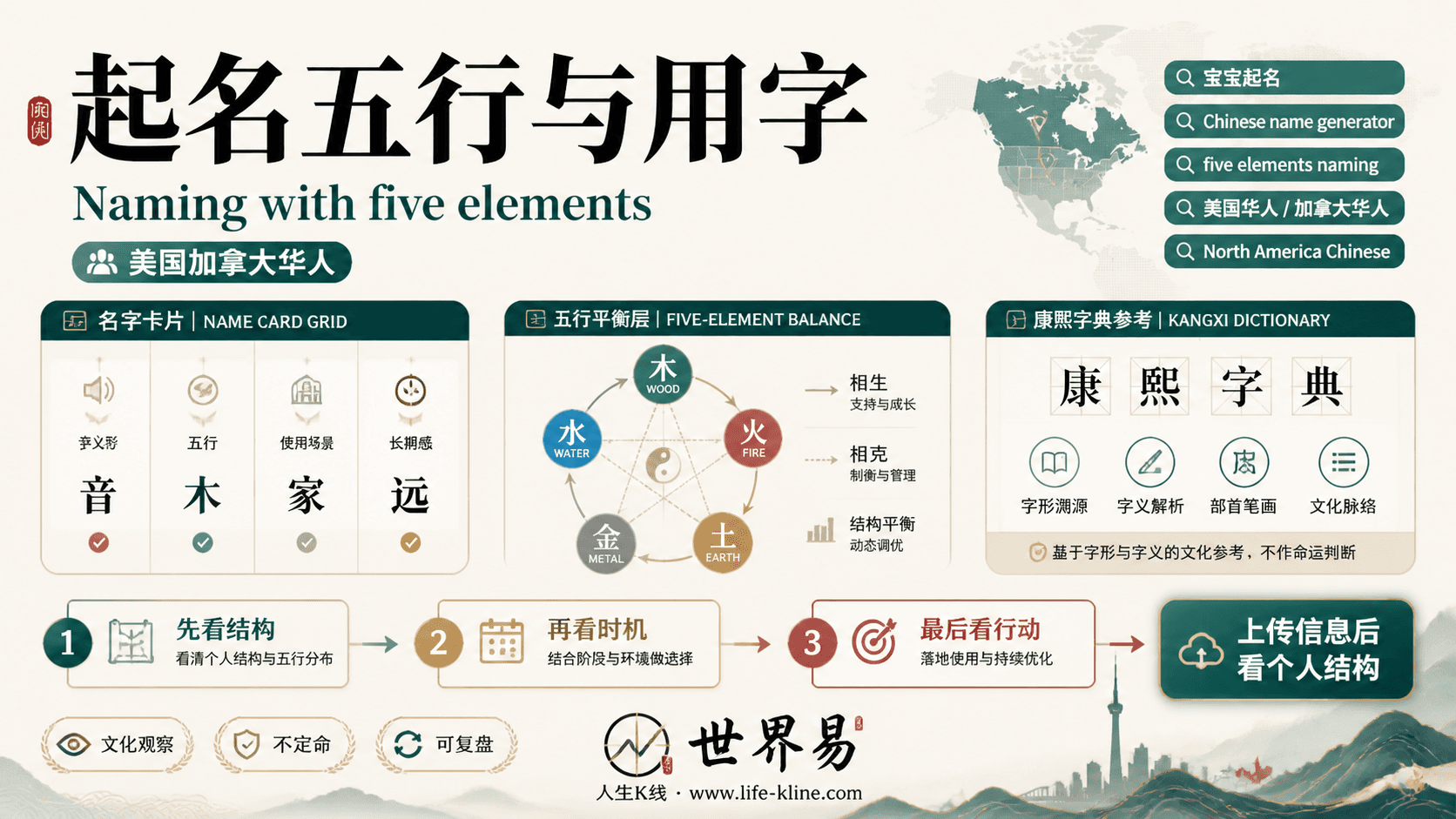
起名五行与用字|美国加拿大华人
这张图把《The 'Ping' Deity in the Twelve Gods of Jianchu: Analysis of Stability, Balance, and Date Selection Applications》里的命理概念转成关系、边界和应用场景,适合先看图建立结构,再回到知识文章正文理解细节。
起名五行与用字不应被写成固定结论。更适合美国加拿大华人的读法,是把传统术语翻译成结构、时机、环境、行动和复盘。
查看图片解读