A Metaphysical Analysis of Entrepreneurship and Employment Decisions During Youth's Initial Formation Period
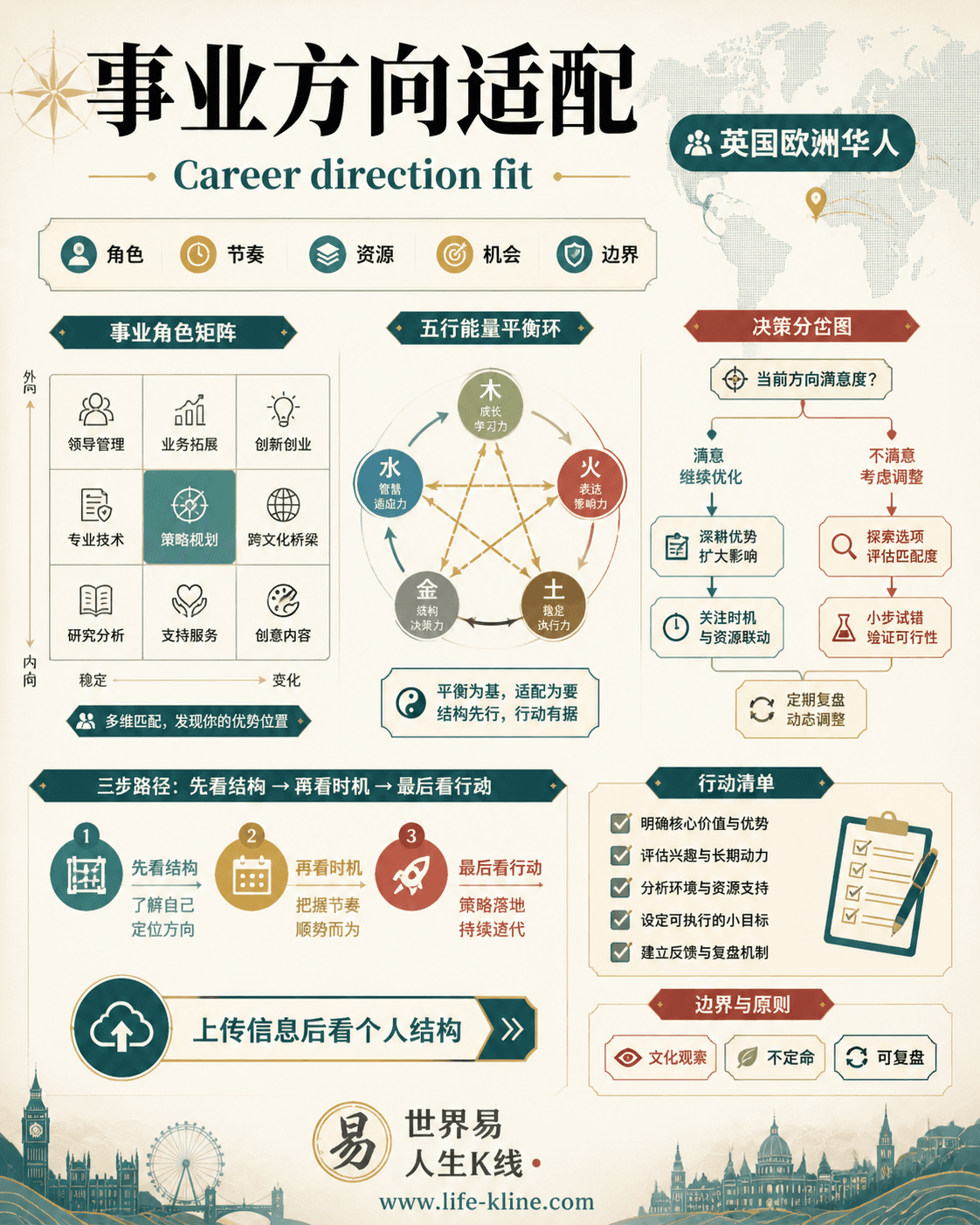
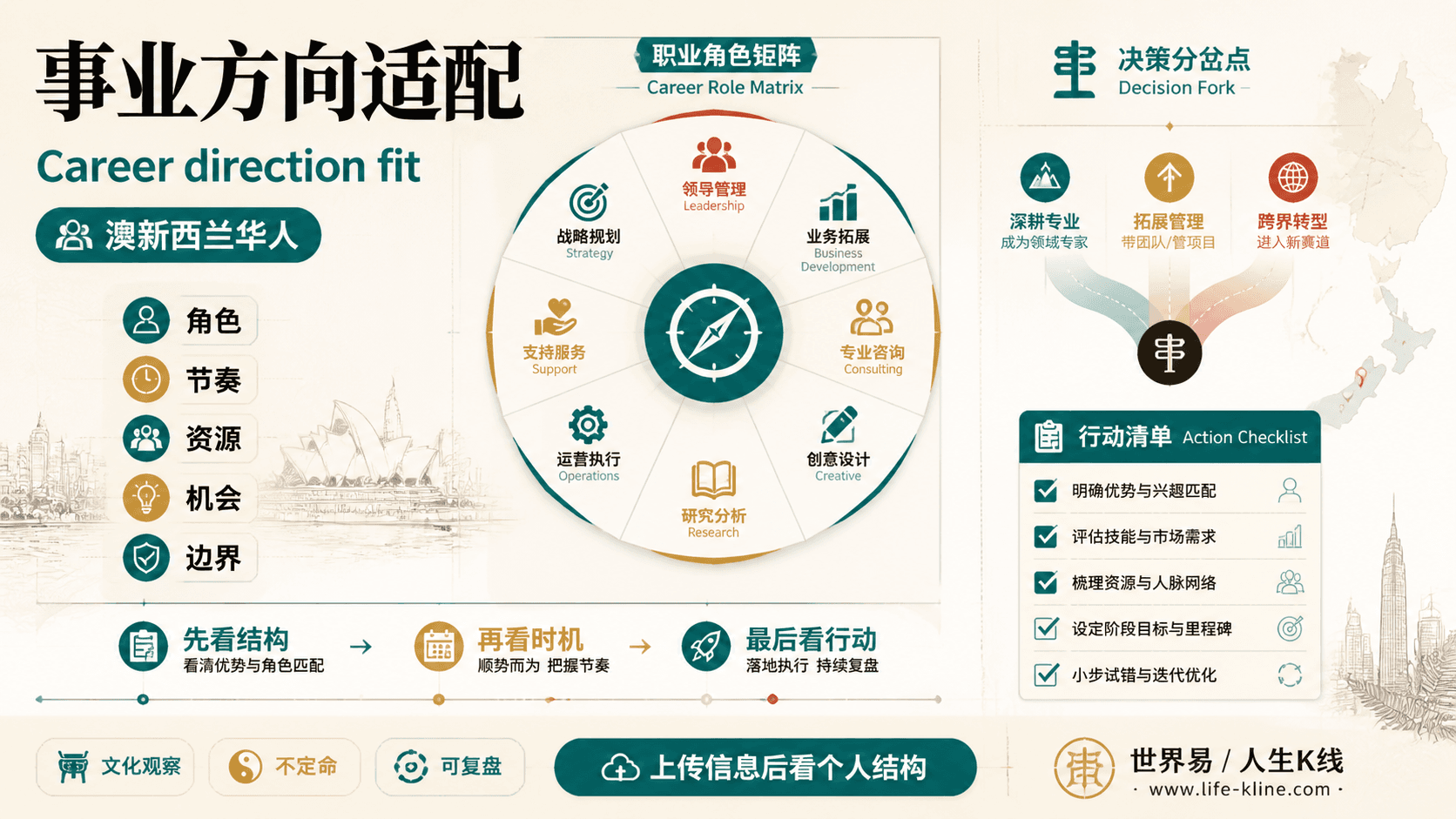
把这篇文章落到自己身上验证:先看结构,再进入个人分析,不做泛泛阅读。
Why This Decision Is Especially Difficult at This Life Stage
The youth’s initial formation period (ages 18-25) is a critical phase for establishing self-identity and professional direction. During this time, young people face pressures from identity transitions and economic independence, while also bearing family and societal expectations. Career choices not only affect personal futures but also impact intimate relationships and psychological stability.
Society generally expects youth to achieve economic autonomy and establish a career foundation during this period. However, reality often involves limited resources, insufficient experience, and unstable mindsets. Entrepreneurship entails greater risks and uncertainties, whereas employment offers relatively stable income and growth environments. This trade-off naturally becomes a central point of concern.
From a metaphysical standpoint, the natal chart’s pattern, Day Master strength, and Yong Shen configuration become amplified or suppressed amid real-world contradictions during youth. The chart’s prosperity or decline and pattern characteristics influence an individual’s stress tolerance, innovation vitality, and environmental adaptability, determining the potential for entrepreneurship and the rationality of stable employment.
Simultaneously, the dynamics of Da Yun (decade luck cycles) and Liu Nian (annual fortune) provide a temporal reference for career decisions. The youth stage’s Da Yun often represents turning points, and Liu Nian may bring opportunities or obstacles. In-depth metaphysical interpretation helps identify optimal timing for action, enabling youth to find the most suitable career path amid complex realities.
Three Core Dimensions of Metaphysical Judgment
First, the Day Master’s strength and pattern are key to assessing personal energy and potential career foundation. A relatively strong Day Master usually possesses strong self-motivation and adaptability, while a weaker Day Master relies more on external resources or environmental support. Patterns such as Yang Ren (Goat’s Blade) pattern, Shang Guan (Hurting Officer) pattern, and Bi Jian (Peer) pattern represent different personality tendencies and career attributes, affecting suitability for entrepreneurship or employment.
Second, the choice of Yong Shen (favorable elements) reflects the direction of chart regulation and balance. A strong Yong Shen can assist the Day Master’s development, enhancing career stability or innovation capacity. Ji Shen (unfavorable elements) bring obstacles or depletion and must be treated cautiously. The strength of Yong Shen and its environmental context determine the advantages and risks in career decision-making.
Third, the interaction between Da Yun and Liu Nian provides temporal support or challenges. Da Yun reflects the phase-specific fate trajectory; stable Da Yun favors maintaining status quo and benefits stable employment, while highly auspicious Da Yun suits proactive entrepreneurship. Liu Nian reflects the year’s environmental changes, making adaptability crucial. This is vital for timing entrepreneurship or employment decisions during youth.
Combining these three dimensions with the unique pressures and developmental needs of the youth’s initial formation period, metaphysics effectively indicates an individual’s risk tolerance for entrepreneurship or growth potential for stable employment, helping youth make more scientific career entry choices.
Three Real Natal Chart Case Studies
Case 1: This male’s natal chart has a relatively strong Day Master 癸水 (Gui Water), with a Yang Ren (Goat’s Blade) pattern. The Yong Shen are Earth and Fire, while the Ji Shen is Metal. Currently, he is in the 丁酉 (Ding You) Da Yun (ages 20-29), year 6. This Da Yun is stable and favors preservation, while the Liu Nian is 丙午 (Bing Wu), indicating a need for adaptability. Considering the youth stage’s real constraints, the strong Day Master combined with the Yang Ren pattern brings strong self-awareness and initiative, suitable for proactive efforts. However, the current stable Da Yun suggests entrepreneurship risks should not be too high, favoring steady progress. It is recommended to first assess the match between current resources and environment; if supportive, small-scale entrepreneurship can be attempted. Otherwise, stable employment to accumulate experience is advised, with plans to increase entrepreneurial efforts when the Da Yun becomes more favorable.
Case 2: This female’s natal chart has a relatively weak Day Master 戊土 (Wu Earth), with a Shang Guan (Hurting Officer) pattern. Her Yong Shen is Fire, while Ji Shen are Metal and Water. She is currently in the 乙卯 (Yi Mao) Da Yun (ages 31-40), year 9. Although slightly beyond the youth initial formation period, projecting her chart features back to ages 18-25 shows the weak Day Master indicates insufficient foundational energy requiring environmental support. The Shang Guan pattern suggests an innovative personality, but the presence of strong Ji Shen limits this, making entrepreneurship riskier. In real-world dilemmas, entrepreneurship pressure is high with weaker psychological and financial endurance, making stable employment preferable initially to build a foundation. When the Yong Shen Fire strengthens, career breakthroughs can be reconsidered. Judgments should first confirm the stability of support systems to avoid blind ventures.
Case 3: This female’s natal chart has a relatively strong Day Master 丁火 (Ding Fire), with a Bi Jian (Peer) pattern. Yong Shen are Water and Metal, while Ji Shen is Wood. She is currently in the 壬子 (Ren Zi) Da Yun (ages 46-55), which is very auspicious, with Liu Nian 丙午 (Bing Wu) aligning favorably. Although well beyond youth, mapping her chart traits back to ages 18-25 suggests a strong Day Master with robust self-expression and competitiveness. The Bi Jian pattern enhances independence and teamwork spirit, while the Yong Shen Water and Metal harmonize to improve environmental adaptability and risk control. Such a chart in youth is suitable for entrepreneurial challenges, with higher chances of success if Da Yun or Liu Nian are favorable. Judgments should first evaluate resource integration and stress tolerance; if conditions mature, active entrepreneurship is recommended, otherwise employment can serve as a platform to accumulate capital and networks.
These three cases illustrate how different combinations of Day Master strength, patterns, and Yong Shen influence entrepreneurship or employment decisions during youth. Integrating natal chart analysis with real-life stages enables more accurate grasp of the optimal career starting path.
Common Misjudgments and Blind Spots at This Stage
A common misjudgment during the youth initial formation period is equating Day Master strength simply with entrepreneurship ability. Some individuals with strong Day Masters may face stable Da Yun or incompatible Yong Shen, making blind entrepreneurship prone to failure. Conversely, those with weaker Day Masters but strong Yong Shen and good environmental support can also achieve stable entrepreneurship; such nuances are often overlooked.
Another blind spot is neglecting the dynamic interaction between real-world constraints and metaphysics. Youth face significant social pressures and limited resources; entrepreneurship carries high risks. Relying solely on metaphysical patterns while ignoring real conditions often leads to wasted resources and psychological setbacks. Metaphysics should serve as an auxiliary tool combined with practical evaluation.
There is also a misconception of overinterpreting Da Yun and Liu Nian, assuming stable Da Yun means entrepreneurship is entirely unsuitable. In fact, stable Da Yun periods may still offer small opportunities for trial entrepreneurship, depending on Liu Nian and Yong Shen support for adaptability. Ignoring this subtlety risks missing good chances.
Therefore, entrepreneurship and employment decisions during youth must avoid oversimplified metaphysical judgments, integrating real environment and multiple metaphysical factors to prevent misleading by single indicators, ensuring more scientific and timely decisions.
Practical Judgment Sequence
First, confirm the Day Master’s strength and pattern type to assess personal foundational energy and personality traits. A relatively strong Day Master and favorable patterns lean toward entrepreneurship, while a weaker Day Master prioritizes evaluating stable employment possibilities.
Second, analyze the status of Yong Shen and Ji Shen to evaluate chart harmony and external resource support. Strong Yong Shen with good environmental alignment increases entrepreneurial opportunities; strong Ji Shen or constrained Yong Shen suggests maintaining stable employment.
Finally, combine the current Da Yun and Liu Nian to judge timing auspiciousness. Stable Da Yun favors preservation; when Liu Nian supports change, moderate entrepreneurial attempts may be suitable. Highly auspicious Da Yun and favorable Liu Nian better support active entrepreneurship projects. Overall, prioritize accumulating experience and resources, acting when timing matures to avoid blind risks.
Following this judgment sequence, youth can scientifically assess their strengths and external environment, balancing risks and growth to make the most appropriate entrepreneurship or employment decisions.
FAQ
Question 1: Does a relatively strong Day Master always mean suitability for entrepreneurship? Answer: Not necessarily. Although a strong Day Master usually indicates strong initiative and stress tolerance, comprehensive judgment including Yong Shen, Ji Shen, Da Yun, and Liu Nian is required. If Da Yun is stable or Ji Shen is strong, entrepreneurship risks remain high.
Question 2: Is a stable Da Yun period suitable for entrepreneurship? Answer: Generally, stable Da Yun periods favor maintaining status quo, with higher entrepreneurship risks. However, if Liu Nian brings favorable changes and Yong Shen is strong, small-scale or low-risk entrepreneurial projects can be attempted with adaptability.
Question 3: How to judge when it is better to wait? Answer: When Yong Shen is constrained, Ji Shen is strong, and Da Yun and Liu Nian are unfavorable, waiting and resource accumulation should be prioritized. This period suits stable employment to improve skills and networks, preparing for more favorable Da Yun in the future.
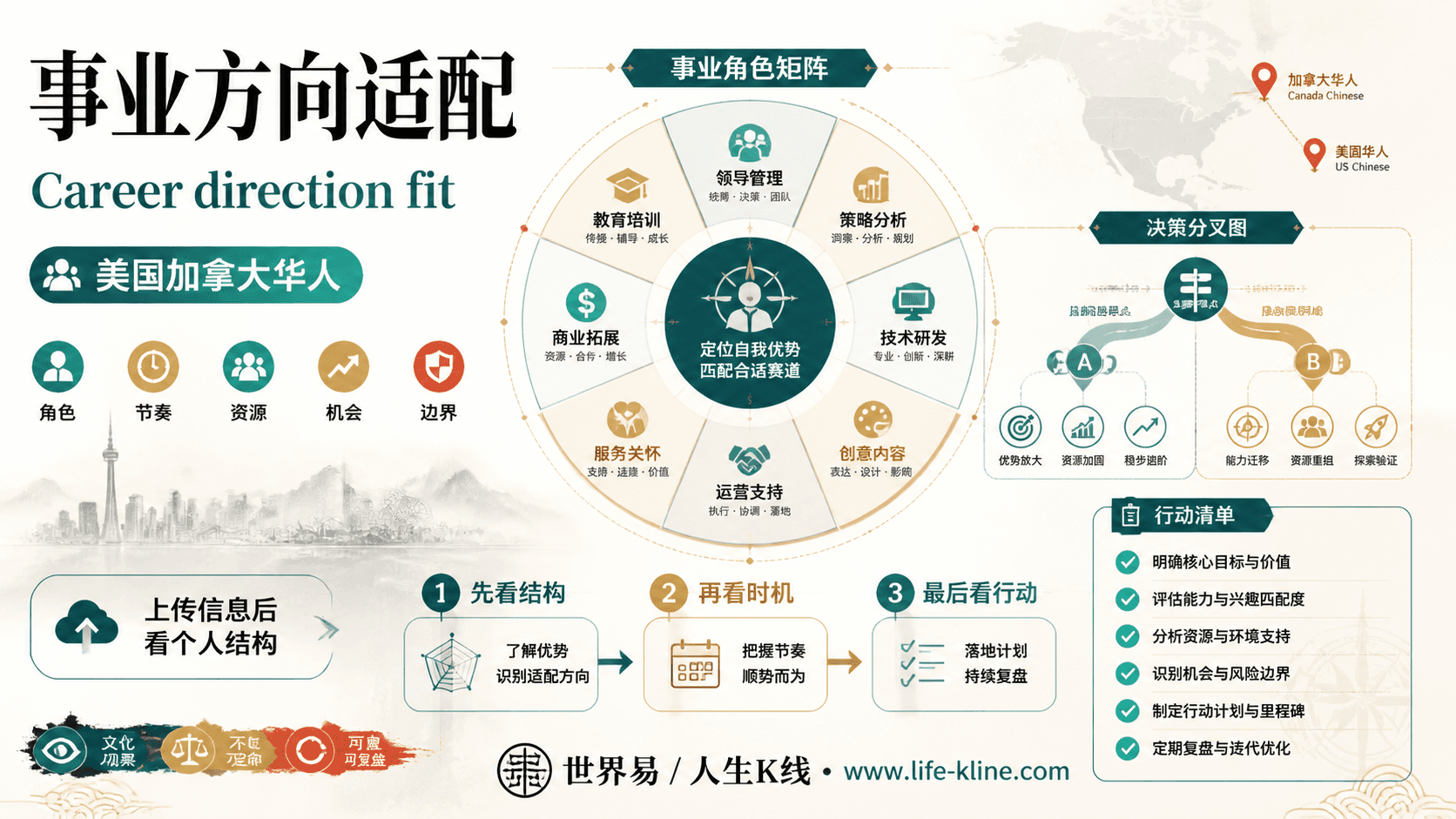
事业方向适配|美国加拿大华人
这张图把《A Metaphysical Analysis of Entrepreneurship and Employment Decisions During Youth's Initial Formation Period》里的命理概念转成关系、边界和应用场景,适合先看图建立结构,再回到知识文章正文理解细节。
事业方向适配不应被写成固定结论。更适合美国加拿大华人的读法,是把传统术语翻译成结构、时机、环境、行动和复盘。
查看图片解读