Astrological Rhythm Analysis and Decision Support for Timing U.S. Immigration Status Transitions
把这篇文章落到自己身上验证:先看结构,再进入个人分析,不做泛泛阅读。
Why This Decision Is Especially Difficult in This Destination
The U.S. immigration status transition, especially from work visa to permanent resident (PR) and then citizenship, faces multiple complex challenges. The uncertainty of visa backlogs often leads to extended waiting periods, affecting personal career planning and family stability. The strong tax transparency imposes significant compliance pressure on cross-border income and asset declarations; mishandling can result in potential financial risks. The healthcare system is mainly self-pay, with insufficient coverage increasing living costs and risks, particularly during status transitions.
Additionally, issues such as gun violence and political uncertainty in the U.S. create psychological anxiety and a lack of security, becoming invisible burdens for migrants. Educational resource stratification is obvious, and delays in status transitions may affect children's school admission eligibility and education quality. These multiple factors overlap, forming a highly complex migration game environment where decision-makers easily fall into conflicts between short-term benefits and long-term risks.
The BaZi structure, including the strength of the Day Master, pattern types, Yong Shen (favorable elements), and the interaction of Da Yun and Liu Nian, can to some extent reflect an individual's resource mobilization and environmental adaptability rhythms. By identifying combinations of Cai Xing (wealth stars), Bi Jian (peer stars), Guan Sha (official stars), Yin Xing (resource stars), and Yi Ma (traveling horse star), one can gain insights into critical windows and potential costs along the immigration path. As a rhythm-assisting tool, BaZi helps decision-makers reasonably adjust timing and avoid impulsive actions.
However, cross-border migration involves professional fields such as laws and regulations, tax policies, visa compliance, and foreign exchange control. BaZi judgments can only serve as references and cannot replace professional immigration, legal, tax, and financial consultations. Understanding the overlay of the complex U.S. institutional environment and individual BaZi rhythms helps form more robust immigration transition plans.
Three Core Dimensions of BaZi Judgment
First, the combination of the Day Master and Yi Ma (traveling horse star) reflects an individual's mobility and adaptability. During U.S. immigration transitions, charts with Yi Ma characteristics often better accommodate visa backlog fluctuations and policy changes, flexibly adjusting strategies. Meanwhile, the strength of the Day Master determines the selection of Yong Shen, influencing overall energy balance and stress resistance. A relatively strong Day Master like 癸水 (Gui Water), combined with Yong Shen Earth, indicates the need to stabilize foundations, suitable for maintaining status and waiting for visa priority.
Second, Cai Xing (wealth stars) are crucial in representing financial pursuits abroad. Charts with Pian Cai (indirect wealth) or Zheng Cai (direct wealth) patterns show sensitivity to investment immigration or economic resources. When wealth stars are strong, they can effectively drive investment decisions but also require caution against Ji Shen (unfavorable elements) that may cause financial risks. Bi Jian stars represent peer competition or resource sharing; in immigration paths, this may involve spousal or family collaboration.
Third, Guan Sha (official stars) are closely related to pressures from foreign status. A strong Guan Sha often indicates significant career and identity pressures, with visa approvals and identity verifications potentially increasing individual burdens. Yin Xing (resource stars) represent policy resources and support forces; the appearance or disappearance of Yin Xing in Da Yun and Liu Nian signals auspicious or inauspicious timing for status transitions. Integrating the clashes and combinations of Da Yun and Liu Nian helps prioritize whether to act or maintain status.
Overall, combining the Day Master, pattern, Yong Shen, and Da Yun/Liu Nian—especially focusing on the balance between Cai Xing and Guan Sha, and the mobility energy of Yi Ma—can assist in interpreting rhythmic signals in U.S. immigration status transitions, guiding rational decision-making.
Three Real BaZi Case Studies
Case 1: This gentleman's Day Master is 癸水 (Gui Water), relatively strong and classified as a specialized strong pattern. His main Yong Shen is Earth, with Wood as Ji Shen. He is currently in the 辛未 (Xin Wei) Da Yun (ages 41-50), a stable period suitable for maintaining status, with the Liu Nian being 丙午 (Bing Wu), requiring adaptability. According to his BaZi characteristics, he is suited to steadily advance his immigration path, avoiding aggressive changes. The Xin Wei Da Yun's meaning of maintaining status suggests visa backlogs and policy environments are stable but not suitable for risky moves. The Bing Wu Liu Nian brings some variability, necessitating flexible responses to visa procedures or investment condition changes. His Yong Shen Earth represents a stable foundation; it is recommended to focus on optimizing tax compliance and healthcare coverage, carefully evaluating citizenship timing to avoid identity gaps caused by policy fluctuations.
Case 2: This gentleman's Day Master is 癸水 (Gui Water), relatively strong, with a Pian Cai (indirect wealth) pattern. His main Yong Shen are Earth and Fire, with Metal as Ji Shen. He is currently in the 甲申 (Jia Shen) Da Yun (ages 27-36), a stable period suitable for maintaining status, with the Liu Nian also being 丙午 (Bing Wu), requiring adaptability. The Pian Cai pattern indicates a strong capacity for foreign investment and economic resource mobilization, making investment immigration a suitable path for identity advancement. The Jia Shen Da Yun supports career development and capital accumulation, but the Ji Shen Metal warns of tax compliance risks and capital transparency issues. The Bing Wu Liu Nian brings opportunities for flexible adaptation; it is advised to accelerate immigration applications during policy windows while coordinating with professional immigration and financial planning to ensure capital security and visa compliance.
Case 3: This lady's Day Master is 己土 (Ji Earth), relatively strong, with a Zheng Cai (direct wealth) pattern. Her main Yong Shen are Wood and Water, with Fire as Ji Shen. She is currently in the 乙未 (Yi Wei) Da Yun (ages 23-32), an auspicious period with progress in career and financial luck, and the Liu Nian is 丙午 (Bing Wu), favoring action. The Zheng Cai pattern represents stable and continuous financial income, suitable for educational and career development paths. The Yi Wei Da Yun is auspicious, indicating favorable timing for status transitions, especially suitable for the younger group transitioning from student visas. The Yong Shen Wood and Water help alleviate pressure from Ji Shen Fire, enhancing adaptability. It is recommended to actively utilize the favorable Da Yun and Liu Nian conditions, coordinate educational resource planning and immigration strategies, steadily advancing from student visa to work visa and ultimately to PR and citizenship.
These three cases illustrate how different Day Masters and patterns correspond to varying advantages and challenges in the U.S. immigration path. A relatively strong Day Master combined with balanced Yong Shen and the interaction of Da Yun and Liu Nian can assist in judging the rhythm and critical windows of status transitions, guiding rational planning and risk control.
Common Misjudgments and Blind Spots in This Destination
Many applicants in the U.S. immigration status transition process often overlook the volatility of visa backlogs, making premature status change decisions that lead to prolonged waiting and identity gap risks. BaZi indicates the importance of maintaining status timing, but in reality, anxiety often causes blind applications, increasing complexity. Ignoring tax transparency and cross-border declaration obligations also easily results in severe financial consequences; Ji Shen signals in BaZi are often neglected.
Another blind spot is underestimating healthcare costs and educational resources. During uncertain status periods, self-pay medical burdens are huge, and children's school admission qualifications may be limited, increasing family pressure. The absence of Yi Ma and Yin Xing in BaZi signals insufficient mobility and support, which is rarely emphasized in practice. Moreover, psychological stress caused by political uncertainty and security issues often affects decision rationality and resilience; BaZi's Guan Sha pressure corresponds to real-world identity approval obstacles.
Some applicants mistakenly treat BaZi as absolute prophecy, ignoring its auxiliary nature, resulting in overreliance on rhythmic cues and neglecting legal and financial professional advice. Cross-border migration involves multi-domain compliance; BaZi should be used as a rhythm reference alongside professional consultation to build robust plans.
Practical Judgment Sequence
First, clarify the current Da Yun and Liu Nian status, combining the Day Master's strength and Yong Shen to assess the individual's overall energy tendency. If in a stable maintenance period, priority should be given to consolidating the existing visa status, avoiding identity gap risks caused by blind transitions. When Liu Nian signals adaptability, it is suitable to evaluate policy windows, prepare relevant documents, and consult professional immigration lawyers and financial advisors.
Second, focus on balancing Cai Xing (wealth stars) and Guan Sha (official stars), prioritizing tax risk and cross-border fund compliance checks. Ensure investment paths or work income declarations are legal and compliant to avoid financial issues affecting status approvals. Adjust fund structures if necessary, cooperating with professional tax planning to mitigate negative impacts from Ji Shen.
Finally, pay attention to the appearance and disappearance of Yi Ma and Yin Xing, judging mobility and policy support strength. It is advisable to actively apply for status transitions during periods of strong Yin Xing, leveraging policy benefits and educational resource advantages, steadily advancing from student visa to work visa to PR. When encountering Guan Sha obstacles, maintain patience, adjust strategies, and avoid aggressive actions. Overall, professional compliance is the premise, with BaZi rhythm assisting in timing actions to form a rational decision-making process.
FAQ
Question 1: Can BaZi accurately predict when the U.S. visa backlog will end? Answer: BaZi provides rhythm references that can indicate possible favorable or obstructive phases within Da Yun and Liu Nian cycles, but visa backlogs are heavily influenced by policies and administrative processes, making precise prediction via BaZi impossible. It is recommended to combine professional immigration consultation and the latest policy updates for judgment.
Question 2: How to combine BaZi to assess risks and timing for investment immigration? Answer: In investment immigration paths, charts with Pian Cai patterns and Yong Shen Earth and Fire indicate financial flow and risk tolerance. Combined with the stability of Da Yun and Liu Nian, this can assist in judging suitable windows for capital investment and status application, but must be synchronized with tax compliance and fund security evaluations to avoid financial risks caused by Ji Shen.
Question 3: What key nodes does BaZi indicate during student visa to status transitions? Answer: Student visa to status transitions suit charts with Zheng Cai patterns and Yong Shen Wood and Water, with auspicious Da Yun periods like Yi Wei. Strong Yin Xing in BaZi represents policy support and resource assistance; these times should be seized for active applications. Coordination with school and legal advisors is necessary to ensure smooth status transitions.
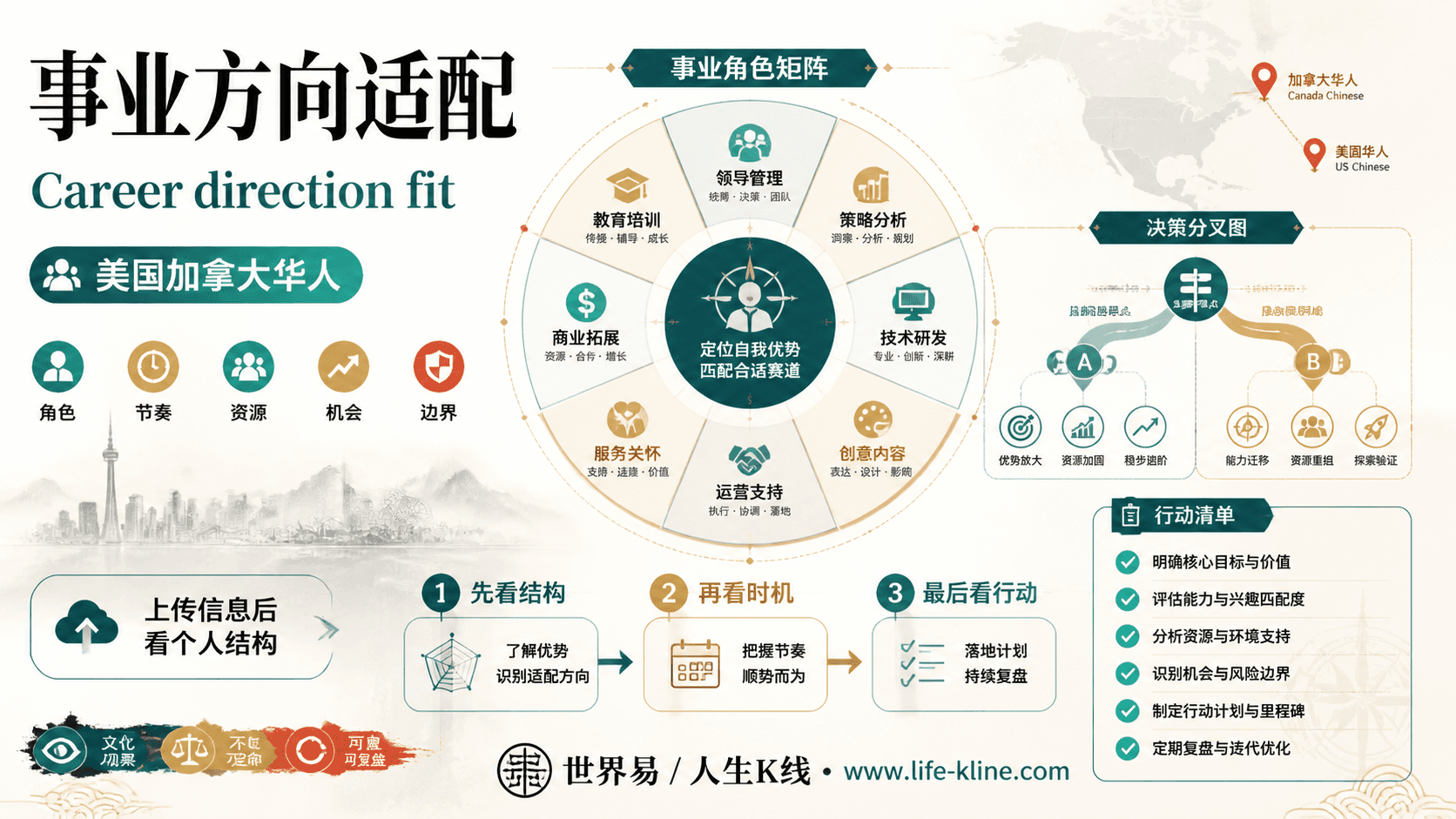
事业方向适配|美国加拿大华人
这张图把《Astrological Rhythm Analysis and Decision Support for Timing U.S. Immigration Status Transitions》里的命理概念转成关系、边界和应用场景,适合先看图建立结构,再回到知识文章正文理解细节。
事业方向适配不应被写成固定结论。更适合美国加拿大华人的读法,是把传统术语翻译成结构、时机、环境、行动和复盘。
查看图片解读