Analysis of Wealth Preservation Discipline and Metaphysical Decision-Making for Chinese in North America
把这篇文章落到自己身上验证:先看结构,再进入个人分析,不做泛泛阅读。
Why This Scenario Is Especially Difficult for Overseas Chinese
Chinese in North America face unique and complex practical constraints in wealth preservation. First, financial risks arise from exchange rate fluctuations. The rise and fall of the US Dollar and Canadian Dollar directly affect the value of cross-border assets. Especially with frequent family remittances, any exchange rate change can amplify capital loss risks. Second, the complexity of tax systems poses another major challenge. Both the US and Canada have strict tax reporting and regulatory mechanisms. Overseas Chinese must carefully manage domestic and overseas wealth flows to avoid legal pitfalls, and tax burdens often limit wealth growth.
Moreover, cultural differences also impact wealth management. The mainstream North American society emphasizes independent financial management and risk diversification, while many overseas Chinese still adhere to traditional wealth accumulation and inheritance models, causing friction between preservation strategies and the local environment. Additionally, family separation across regions and frequent cross-border remittances increase pressure to balance familial needs while avoiding high fees and policy restrictions, intensifying wealth preservation challenges.
BaZi structures play an amplifying or mitigating role in this scenario. On one hand, the strength of the Day Master and the gain or loss of the Yong Shen reflect an individual's potential and challenges in wealth management; on the other hand, the interaction of Da Yun (decade luck cycle) and Liu Nian (annual fortune) reveals timing and risk periods for wealth preservation. Integrating BaZi with real-world conditions can provide practical and effective wealth protection solutions for Chinese in North America.
Three Core Dimensions of Metaphysical Judgment
Firstly, the Day Master and the pattern determine the individual's fundamental metaphysical energy and wealth attributes. The strength of the Day Master affects control over wealth or resources. Different patterns such as Zhuan Wang Ge (special strong pattern), Zheng Guan Ge (Proper Officer pattern), and Zheng Cai Ge (Proper Wealth pattern) represent different paths of wealth accumulation and preservation characteristics. The Yong Shen, as the key element for metaphysical balance, symbolizes the element that regulates wealth and fortune fluctuations. Proper selection and application of the Yong Shen are crucial for wealth protection.
Secondly, Da Yun and Liu Nian serve as the temporal coordinates for wealth preservation. Da Yun reflects the overall strength of fortune within a ten-year cycle, while Liu Nian indicates specific annual changes in the wealth environment. When Da Yun is weak, caution is advised with a focus on preservation; during stable Da Yun periods, strategies can be moderately adjusted; if Liu Nian conflicts with Da Yun or is weak, wealth risks increase and preemptive measures are necessary.
Lastly, the palace environment reflects the correspondence between the BaZi chart and external realities. The complex wealth preservation environment for overseas Chinese is mirrored in the relationships between Ji Shen (unfavorable element) and Yong Shen within the palaces, reflecting pressures and opportunities from exchange rates, taxation, and cross-border capital flows. By synthesizing these metaphysical dimensions, one can more accurately grasp key points and timing for adjusting wealth protection strategies.
Three Real BaZi Case Studies
Case 1: This female chart has a Day Master of Bing Fire (丙, Bing), which is relatively strong, belonging to the Zhuan Wang Ge (special strong pattern). The Yong Shen is Wood, and the Ji Shen (unfavorable element) is Metal. She is currently in the Geng Wu Da Yun (庚午, Geng Wu decade luck cycle), which is relatively weak, and the Liu Nian is Bing Wu (丙午). The overall fortune advises caution. In the North American context, she faces exchange rate and tax pressures. The Zhuan Wang Ge with strong Fire requires Wood to disperse and harmonize, but the weak Da Yun indicates higher risk in wealth preservation currently. Frequent family remittances may increase financial burdens. The metaphysical characteristics amplify the need for caution in wealth protection. It is recommended to focus on regulating the Yong Shen Wood and the interaction between Da Yun and Liu Nian, avoiding blind investments or large capital movements. The judgment sequence should first assess the impact of the current Da Yun and Liu Nian on the Yong Shen Wood, then consider real tax policies to decide whether to adjust remittance frequency and scale.
Case 2: This male chart has a Day Master of Gui Water (癸, Gui), which is relatively weak, with a Zheng Guan Ge (Proper Officer pattern). The Yong Shen is Metal, and the Ji Shen are Wood and Fire. He is in the Gui Chou Da Yun (癸丑), which is stable, and the Liu Nian is Bing Wu (丙午). Overall fortune is relatively stable. In the North American environment, the weak Gui Water Day Master needs Metal to generate and support it. Facing multiple pressures from exchange rates and taxes, the Zheng Guan Ge emphasizes preservation and compliance, suitable for steady financial management and reasonable tax avoidance. The Liu Nian Bing Wu with strong Fire may bring uncertainties, but the stable Da Yun provides protection for wealth preservation. The chart characteristics manifest as timely risk prevention while maintaining stable investment. It is advised to first confirm the support level of the Yong Shen Metal in the current environment, then combine with tax compliance to reasonably arrange timing and amounts of cross-border funds, avoiding risks brought by the Ji Shen Wood and Fire.
Case 3: This female chart has a Day Master of Jia Wood (甲, Jia), which is balanced, with a Zheng Cai Ge (Proper Wealth pattern). The Yong Shen is Water, and the Ji Shen is Metal. She is currently in the Bing Yin Da Yun (丙寅), which is stable, and the Liu Nian is Bing Wu (丙午). The overall fortune is adaptable. Under the North American Chinese background, the balanced Jia Wood Day Master and the Zheng Cai Ge emphasize wealth accumulation and management. The Yong Shen Water helps nourish Wood, preventing excessive financial pressure. Facing exchange rate fluctuations and tax regulations, the chart indicates an ability to flexibly adjust wealth preservation strategies. The metaphysical characteristics make her more suitable for flexible responses rather than rigid operations in wealth protection. The judgment sequence should first evaluate the performance of the Yong Shen Water in the Liu Nian, then combine with current exchange rate trends to flexibly adjust remittance and investment plans, ensuring steady wealth flow.
Common Misconceptions of Overseas Chinese in This Scenario
Many Chinese in North America overly rely on short-term exchange rate fluctuations to conduct frequent cross-border fund operations, neglecting tax compliance and long-term wealth planning, which amplifies potential risks. From a metaphysical perspective, lack of detailed analysis of Da Yun, Liu Nian, Yong Shen, and Ji Shen often leads to blind actions during low fortune periods, resulting in wealth loss.
Additionally, some ignore warnings from Ji Shen in their charts, such as excessively pursuing short-term gains that trigger Ji Shen Metal or Fire, which accelerates wealth loss. Others fail to adjust preservation strategies based on BaZi, relying solely on traditional financial habits, making it difficult to adapt to the complex tax and exchange rate environment in North America.
Furthermore, the emotional burden and financial pressure of family remittances are often underestimated, causing decision-making to overlook metaphysical cautionary signals. Frequent remittances without considering risk changes brought by Da Yun and Liu Nian ultimately affect steady wealth accumulation.
Practical Judgment Sequence
First, clarify the impact of the current Da Yun and Liu Nian on the Day Master and Yong Shen, judging whether the overall fortune is strong, stable, or weak, to determine the risk level of wealth preservation. When Da Yun is weak, conservative strategies should be prioritized to reduce capital flow and investment risks; during stable Da Yun periods, strategies can be moderately adjusted to adapt to environmental changes.
Second, combine the relationship between Yong Shen and Ji Shen in the chart to evaluate which factors in the current environment favor wealth preservation and which should be avoided. When the Yong Shen is strong, consider appropriately increasing capital flow or investments; when Ji Shen is strong, strictly control capital inflows and outflows to guard against external shocks.
Finally, integrate real North American tax policies, exchange rate trends, and family financial needs to formulate specific wealth preservation plans. Act when timing is right, avoiding blind operations during Da Yun and Liu Nian conflicts or periods of strong Ji Shen. Dynamically adjust strategies to maintain long-term stable wealth growth.
FAQ
Question 1: How can Chinese in North America use BaZi to determine when it is suitable for large remittances? Answer: One should combine personal Da Yun and Liu Nian, especially focusing on the gain or loss of the Yong Shen and the strength of the Ji Shen. When Da Yun is stable and Liu Nian supports the Yong Shen, risks are lower and larger remittances are appropriate. Conversely, caution is advised to avoid large capital movements during periods of strong Ji Shen or weak Da Yun.
Question 2: How to use BaZi in wealth preservation to avoid tax risks? Answer: The manifestation of Ji Shen in BaZi often reflects potential risks. By identifying periods when Ji Shen Metal or Fire is strong, one can increase compliance awareness and plan capital flows reasonably to avoid tax issues caused by non-compliance.
Question 3: What impact do exchange rate fluctuations have on Yong Shen and Ji Shen in BaZi? Answer: Exchange rate fluctuations represent changes in the external environment, amplifying the regulating effect of Yong Shen and the impact of Ji Shen. For example, if the element represented by the Yong Shen is supported, risks from exchange rate fluctuations can be mitigated; if Ji Shen is strong, exchange rate changes may exacerbate wealth loss. Therefore, strategies should be developed within the BaZi framework combined with market dynamics.
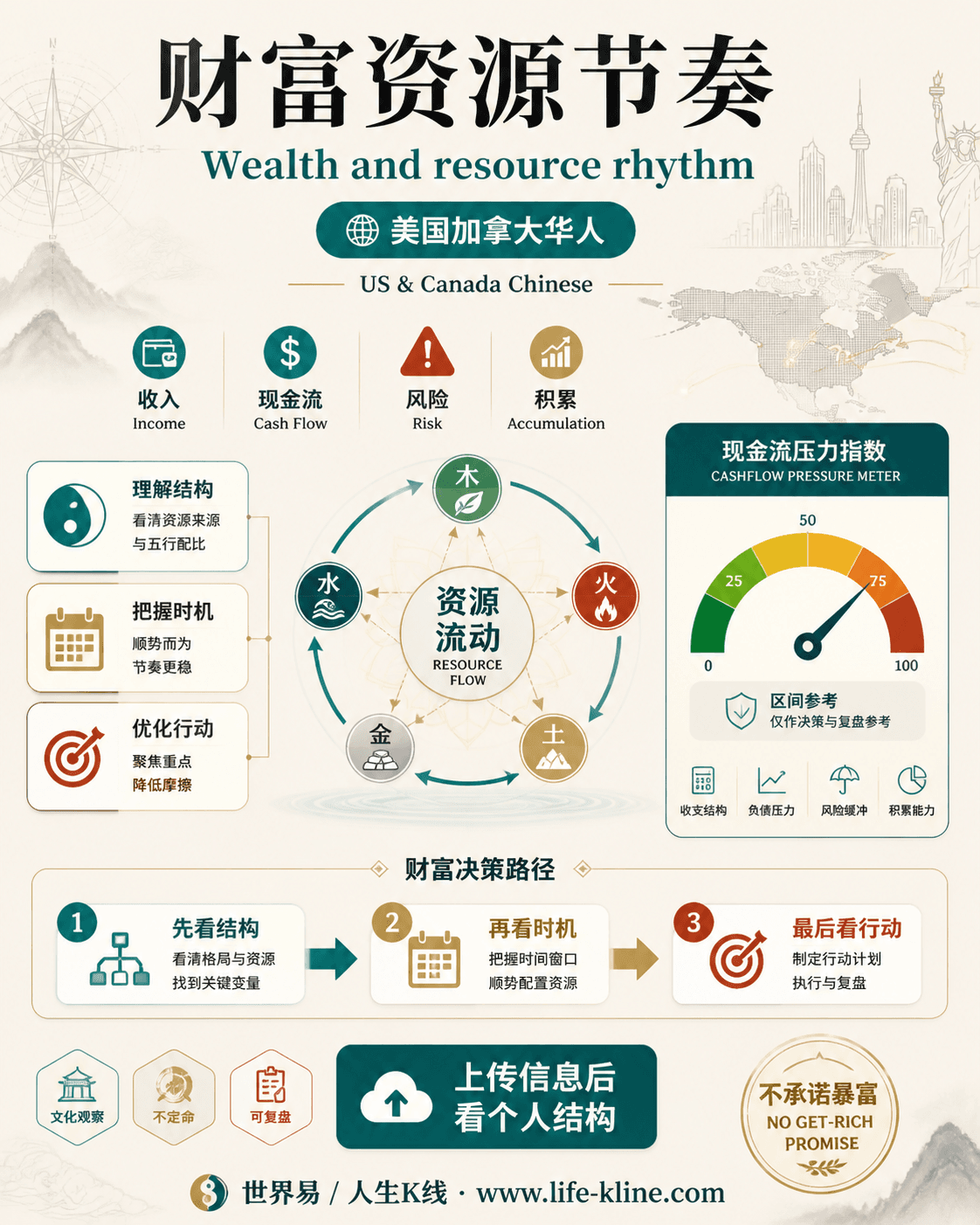
财富资源节奏|美国加拿大华人
这张图把《Analysis of Wealth Preservation Discipline and Metaphysical Decision-Making for Chinese in North America》里的命理概念转成关系、边界和应用场景,适合先看图建立结构,再回到知识文章正文理解细节。
财富资源节奏不应被写成固定结论。更适合美国加拿大华人的读法,是把传统术语翻译成结构、时机、环境、行动和复盘。
查看图片解读