Cross-Border Investment Rhythm for North American Chinese: Metaphysical Perspectives and Decision-Making Strategies
把这篇文章落到自己身上验证:先看结构,再进入个人分析,不做泛泛阅读。
Why This Scenario Is Especially Difficult for Overseas Chinese
For North American Chinese, cross-border investment first faces the complexity of international capital flows. For example, the tax policies of the US and Canada differ significantly, coupled with exchange rate fluctuations, causing investment returns to be affected by multiple factors, thereby increasing decision-making difficulty. Additionally, the fast-paced lifestyle in North America and time zone differences create challenges in coordinating with the domestic investment environment, especially causing delays in information transmission and timing control.
On the cultural level, traditional Chinese metaphysics emphasizes timing and the choice of Yong Shen (favorable element), whereas Western investment focuses more on data and risk management, resulting in a clear difference in thinking models. This cultural conflict often causes overseas Chinese to struggle to balance metaphysical judgment with practical operations during cross-border investments, particularly when managing the rhythm of capital inflow and outflow, leading to strategic deviations.
At the same time, the metaphysical structure itself is either amplified or suppressed in the North American Chinese context. For example, the strength or weakness of the Day Master reflects personal energy levels, corresponding to risk tolerance and active periods in cross-border investment, while the favorable or unfavorable phases of Da Yun (decade luck cycle) and Liu Nian (annual fortune) reveal the prosperity or decline cycles of capital inflow and outflow. Real constraints such as family distance and tax pressure further amplify these metaphysical characteristics’ influence on decision rhythm, making the choice of investment timing more urgent and cautious.
Three Core Dimensions of Metaphysical Judgment
The Day Master and pattern are among the core elements of metaphysical judgment. Facing cross-border investment, the strength of the Day Master directly affects one’s capacity to bear risks and seize opportunities. For example, those with a relatively strong Day Master are suited to actively grasp opportunities, while those with a weaker Day Master should adopt a more stable and conservative approach. Different patterns reflect the inherent financial fortune of the individual; for instance, the Qi Sha (Seven Killings) pattern often corresponds to competition and challenges, suitable for flexible adaptation.
Yong Shen (favorable element) and Ji Shen (unfavorable element) reveal ways to balance the BaZi chart. The choice of Yong Shen indicates the direction of investment timing and guides the Day Master to avoid impulsive or erroneous judgments. Ji Shen represents limitations and potential risks, especially in cross-border investment tax risks and exchange rate fluctuations. The mutual overcoming relationship between Yong Shen and Ji Shen helps adjust strategy and timing.
Da Yun (decade luck cycle) and Liu Nian (annual fortune) are dynamic temporal parameters reflecting the rise and fall of the BaZi’s luck. Cross-border investment emphasizes rhythm control; Da Yun provides medium to long-term trends, while Liu Nian reflects short-term fluctuations. If North American Chinese can integrate the current Da Yun and Liu Nian interactions and refer to the wealth, officer, and resource combinations in the BaZi chart, they can more accurately select entry and exit points for investment, avoiding blind following and missed opportunities.
Three Real BaZi Case Studies
Case 1: The gentleman’s Day Master is Xin Metal (辛, Xin), relatively weak, with a Qi Sha (Seven Killings) pattern. His Yong Shen is Earth, and Ji Shen are Water and Wood. Currently, he is in the 7th year of the Yi You (乙酉, Yi You) Da Yun, with stable luck, suitable for consolidation. Considering the North American reality, such as fixed periods for cross-border tax and exchange rate fluctuations, the relatively weak Day Master in the Yi You Da Yun is best suited for steady progress, avoiding frequent changes. The cross-border investment rhythm should be defensive, leveraging the stability characteristic of the Yong Shen Earth to prevent the amplification of uncertainties caused by Ji Shen Water and Wood. The suggested judgment sequence is to first confirm the steadiness of Da Yun, then combine the mobility of Liu Nian, selecting periods without Ji Shen influence for action.
Case 2: The gentleman’s Day Master is Bing Fire (丙, Bing), relatively weak, with a Qi Sha (Seven Killings) pattern. His Yong Shen is Wood, and Ji Shen are Earth and Metal. Currently, he is in the 2nd year of the Wu Zi (戊子, Wu Zi) Da Yun, with overall weak luck and a need for caution. Considering the North American investment environment, he must pay special attention to tax burdens and market volatility pressures. The weak Fire Day Master and slightly weak Da Yun indicate that his cross-border investment rhythm should slow down, avoiding aggressive entry. Although the Liu Nian Bing Wu (丙午, Bing Wu) brings momentum, due to the weak Da Yun, it is advisable to guard and wait for the right time. The judgment recommendation is to closely observe conflicts between Liu Nian and Da Yun Ji Shen, choosing windows where Yong Shen Wood is strong and Ji Shen is suppressed to act.
Case 3: The lady’s Day Master is Ren Water (壬, Ren), relatively weak, with a Bi Jian (比肩, Peer) pattern. Her Yong Shen is Metal, and Ji Shen are Wood and Fire. Currently, she is in the 4th year of the Wu Wu (戊午, Wu Wu) Da Yun, with overall stable luck suitable for consolidation. Considering that North American Chinese often face family fund management and tax compliance issues, her relatively weak Ren Water Day Master is suited to utilize the stabilizing attribute of Yong Shen Metal, combined with the adaptive nature of Liu Nian Bing Wu (丙午, Bing Wu), to adopt a flexible yet cautious investment rhythm. Metaphysical characteristics are amplified by cross-border tax burdens and exchange rate risks, requiring focused attention on the pressures brought by Ji Shen Wood and Fire. The specific judgment sequence is to prioritize Da Yun stability, secondly consider Yong Shen strength in Liu Nian, and finally confirm whether Ji Shen pressure is significant to decide precise entry timing.
Common Misconceptions Among Overseas Chinese in This Scenario
Many North American Chinese ignore the importance of the Day Master’s strength in their personal BaZi when conducting cross-border investments, blindly following market rhythms, resulting in mistimed capital inflows and outflows and exacerbated losses. Especially during unfavorable Da Yun and Liu Nian phases, excessive risk-taking often destabilizes situations that should be approached defensively.
Another misconception is underestimating the relationship between Yong Shen and Ji Shen. Some mistakenly treat Ji Shen factors as immutable taboos, neglecting the regulatory effects of Liu Nian or Da Yun on Ji Shen. Without integrating the overall dynamic changes of the BaZi chart, judgments tend to be one-sided, causing deviations in investment rhythm.
Additionally, some Chinese become anxious due to cross-border tax and exchange rate issues, often pursuing quick gains excessively, ignoring the metaphysical principles of consolidation and rhythm control, which leads to counterproductive results. The fundamental reason for these misconceptions is the failure to coordinate metaphysics with real-world constraints.
Practical Judgment Sequence
First, verify the strength of the Day Master and the pattern within one’s BaZi to determine personal risk tolerance and suitable decision rhythm. A relatively strong Day Master is suitable for actively seizing opportunities, while a weaker Day Master should focus on steady defense, avoiding blind following.
Second, examine the nature of the current Da Yun and changes in Liu Nian to judge whether Liu Nian supports the Yong Shen or intensifies the Ji Shen. Da Yun provides medium to long-term trends, Liu Nian reflects short-term fluctuations; combining both is key to formulating an action plan.
Finally, integrate real-world factors, especially tax policies, exchange rate conditions, and family fund flow demands in North American cross-border investment, to evaluate whether metaphysical favorable timing can effectively translate into practical advantages. Only when metaphysics, timing, and real environment align can actions achieve higher success rates, avoiding risks of entering too early or too late.
FAQ
Question 1: What kind of Day Master is suitable for actively conducting cross-border investment? Answer: Generally, those with a relatively strong Day Master have better risk tolerance and are suitable for actively seizing opportunities. However, it is necessary to combine the dynamics of Da Yun and Liu Nian to confirm that the Yong Shen is supported and Ji Shen influence is minimal before acting.
Question 2: How does the combination of wealth, officer, and resource in Liu Nian guide investment entry timing? Answer: The prosperity or decline of wealth, officer, and resource reflects capital flow and career luck. Suitable combinations indicate a smooth investment environment, conducive to capital movement. It is necessary to comprehensively judge with Da Yun stability; seize timing when Liu Nian is favorable, otherwise consolidate.
Question 3: How to balance metaphysical judgment with the practical constraints of North American cross-border investment? Answer: Use Yong Shen and Ji Shen as a reference framework, combined with tax policies, exchange rate fluctuations, and family fund flow demands to choose timing for action. Avoid relying solely on metaphysics or data alone; synchronized decision-making of both is most prudent.
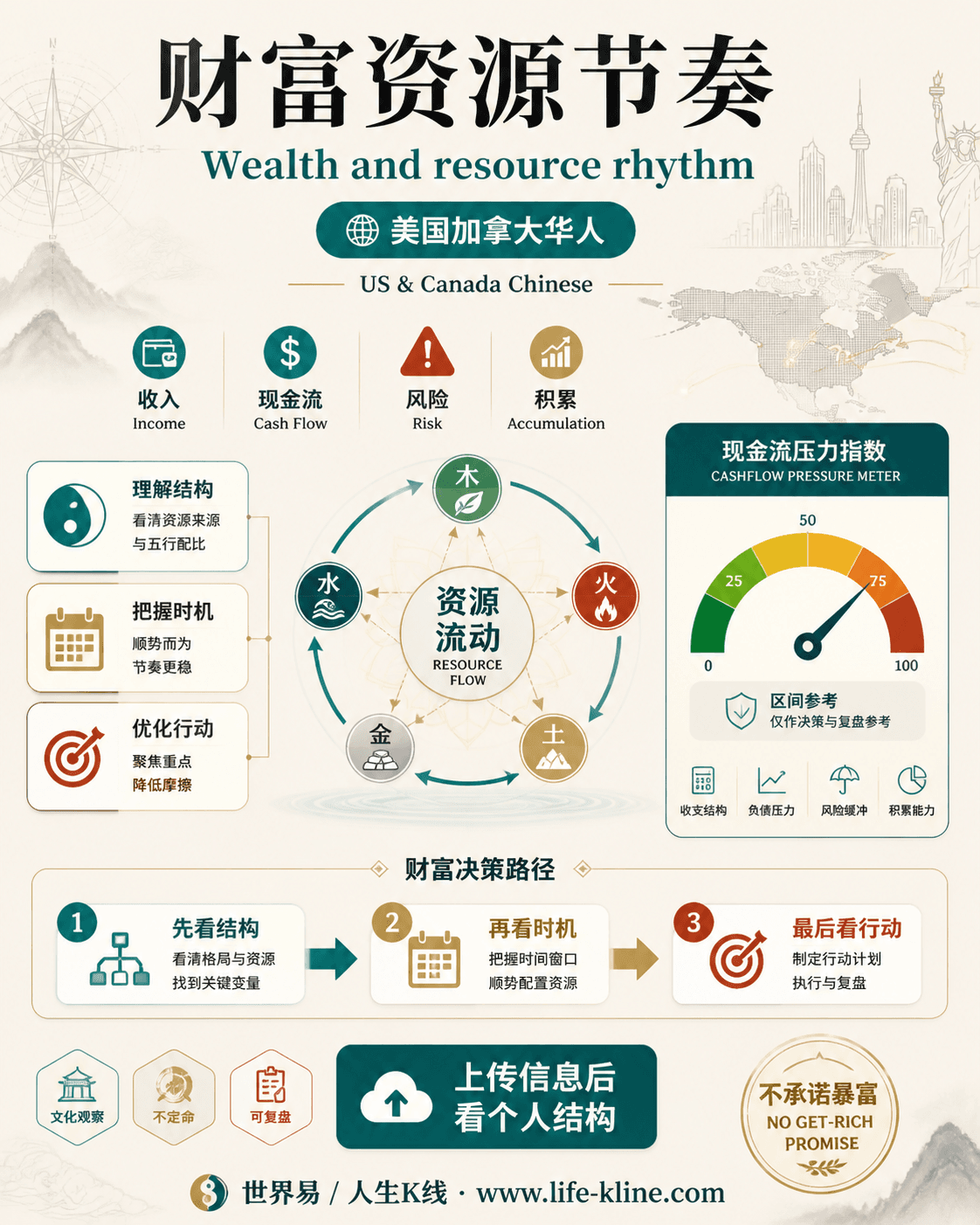
财富资源节奏|美国加拿大华人
这张图把《Cross-Border Investment Rhythm for North American Chinese: Metaphysical Perspectives and Decision-Making Strategies》里的命理概念转成关系、边界和应用场景,适合先看图建立结构,再回到知识文章正文理解细节。
财富资源节奏不应被写成固定结论。更适合美国加拿大华人的读法,是把传统术语翻译成结构、时机、环境、行动和复盘。
查看图片解读