Analysis of the Second Migration Decision for Chinese in North America: Stability and Change from a Metaphysical Perspective
把这篇文章落到自己身上验证:先看结构,再进入个人分析,不做泛泛阅读。
你现在搜索的,
其实是一个要落到自己身上的判断。
当前页面主要回答「Overseas Chinese」这类搜索问题;真正有价值的下一步是把这套结构带进自己的报告、工具与案例验证。
Why This Scenario Is Especially Difficult for Overseas Chinese
The second migration decision for Chinese in North America is more complex than the first because the initial migration already consumed significant resources and effort, with family structure, tax status, children's education, and career development having established stable arrangements. Considering another migration at this stage often faces dual challenges of cross-border laws, exchange rate fluctuations, and cultural adaptation. Migration is not merely a spatial change but a reshaping of lifestyle and social relationships, with significantly increased risks and uncertainties.
Cultural differences and community belonging are particularly important among Chinese in North America. Once the social circles and living habits formed after the first migration are disrupted, psychological stress and family conflicts may arise, especially for middle-aged Chinese who value stability and security. Meanwhile, the complex North American tax system means that migration across cities or countries may trigger changes in tax residency status, bringing economic costs and legal risks, making migration decisions more cautious.
In this context, BaZi structures become especially critical. During the first migration, if the Yong Shen (favorable element) and Da Yun (decade luck cycle) were followed, migration tended to be beneficial. The second migration requires more consideration of the steadiness of Da Yun and fluctuations in Liu Nian (annual fortune) to avoid impulsive actions. The Yong Shen and Ji Shen (unfavorable element) revealed by BaZi can be amplified into decision-making obstacles or risk points when encountering adverse factors such as taxation, family, or exchange rates in reality.
Therefore, Chinese in North America must simultaneously consider metaphysical guidance and real-world constraints in their second migration decisions, rationally weighing the pros and cons of stability versus change. Understanding BaZi and adapting it to reality determine whether migration will proceed smoothly and successfully.
Three Core Dimensions of Metaphysical Judgment
First, the Day Master and pattern determine an individual's fundamental energy state and behavioral preferences. The strength of the Day Master reflects inner power; a relatively strong Day Master often has strong self-drive and adaptability. Patterns such as Yang Ren (Sheep Blade) pattern, Jie Cai (Rob Wealth) pattern, or Qi Sha (Seven Killings) pattern represent different types of aggression or conservatism, influencing psychological and behavioral tendencies when facing change.
Second, Yong Shen (favorable element) and Ji Shen (unfavorable element) reveal the balance points within BaZi. Yong Shen represents supporting forces, while Ji Shen is the element that should be avoided or harmonized. In migration decisions, following the Yong Shen can enhance the smoothness of actions, whereas encountering Ji Shen in reality may cause adverse effects. Da Yun (decade luck cycle) and Liu Nian (annual fortune) represent temporal dimensions: Da Yun shows longer-term trends, and Liu Nian reflects the specific fortune changes of a given year.
Lastly, although not explicitly listed, the palace environment can be understood as the individual's living environment and external conditions. For Chinese in North America, this includes family proximity, tax residency status, and social resources. The combined effect of metaphysical auspiciousness and real environment determines the probability of migration success. Correctly understanding these interactions helps precisely grasp the timing of migration and avoid the risks of an "early second migration."
In summary, accurately analyzing the intrinsic characteristics of the Day Master and pattern, combined with the needs of Yong Shen and Ji Shen, and judging timing through Da Yun and Liu Nian, are key steps in formulating the second migration decision.
Three Real BaZi Chart Cases
Case 1: This gentleman’s Day Master is Jia (甲, Yang Wood), relatively strong, with a Yang Ren (Sheep Blade) pattern. His Yong Shen are Metal and Earth, and his Ji Shen is Water. He is currently in the 10th year of the Geng Chen (庚辰) Da Yun, with very auspicious fortune and smooth affairs. Within the context of Chinese life in North America, he has stabilized development after the first migration. The Metal Yong Shen represents external resources and rules, while Earth relates to foundation and stability. The current Da Yun supports further development, and the Bing Wu (丙午) Liu Nian also aligns well, indicating that if he migrates a second time, it is advisable to follow the Da Yun's Yong Shen and choose environments favorable to Metal and Earth, such as economically stable cities or communities, which will benefit both career and family. Otherwise, migrating too early may activate the Water Ji Shen, bringing emotional or environmental instability risks. The recommended judgment sequence is first to assess whether the current city has sufficient Metal and Earth resources, then examine whether the intended location supports the Yong Shen, and finally combine with family needs to determine the timing of action.
Case 2: This gentleman’s Day Master is Yi (乙, Yin Wood), relatively strong, with a Jie Cai (Rob Wealth) pattern. His Yong Shen is Fire, and Ji Shen is Water. He is currently in the 8th year of the Ji Wei (己未) Da Yun, with stable fortune favoring maintenance. The Yi Wood Day Master is relatively strong, and the Jie Cai pattern reflects strong competitiveness and self-drive, but the current Da Yun favors stability. The Fire Yong Shen represents energy and propulsion, requiring cautious use. In North American reality, he may have established a basic living circle and career foundation, and too frequent migration could disrupt this stable layout, especially given the high costs related to taxation and family relations. The Bing Wu (丙午) Liu Nian brings some vitality, but the overall Da Yun is stable, suggesting no aggressive moves. The second migration should mainly focus on maintaining stability and adapt as needed. The recommended judgment sequence is first to confirm the stability of the current city and the strength of Fire Yong Shen support, then assess migration necessity based on Liu Nian changes, and finally incorporate family opinions to ensure the decision fits the overall rhythm.
Case 3: This lady’s Day Master is Wu (戊, Yang Earth), relatively strong, with a Qi Sha (Seven Killings) pattern. Her Yong Shen are Wood and Water, and Ji Shen is Fire. She is currently in the 2nd year of the Ji Hai (己亥) Da Yun, with stable fortune favoring maintenance. The Wu Earth Day Master is relatively strong, and the Qi Sha pattern reflects strong execution and aggression, but the opposition between Yong Shen Wood and Water and Ji Shen Fire requires balance. In North America, she may face dual pressures from family and career. If the second migration lacks sufficient Wood and Water support, such as environmental resources and emotional backing, the migration risk is high. The Ji Hai Da Yun is stable and just beginning, indicating a need for steady progress and avoidance of impulsive migration. The Bing Wu Liu Nian offers opportunities for adaptability, but overall maintenance is advised. The recommended judgment sequence is first to evaluate whether the new city has sufficient Wood and Water resources, especially family and social support, then combine with the current Da Yun rhythm to judge migration timing, avoiding negative effects triggered by the Fire Ji Shen.
Common Misconceptions Among Overseas Chinese in This Scenario
Many Chinese in North America mistakenly believe that a second migration means they can freely change cities or countries, overlooking the importance of social resources and living foundations established after the first migration. Ignoring the match between Yong Shen and real environment often leads to family separation, complex tax residency status, and increased economic pressure, resulting in an "early second migration" situation.
Another misconception is over-reliance on short-term changes in Liu Nian (annual fortune) while neglecting the long-term trends of Da Yun (decade luck cycle). Da Yun represents long-term environment and opportunities. A second migration that contradicts Da Yun trends often fails to achieve expected smoothness and stability. If Ji Shen is activated during migration, adverse factors are amplified, causing decision errors.
Additionally, some overlook cultural adaptation and the psychological endurance of family members. Migration is not only a physical spatial change but also involves psychological adjustment for individuals and families. If BaZi pattern clashes coincide with real cultural conflicts, stress may increase, negatively affecting migration outcomes.
Therefore, accurately understanding the integration of metaphysical indications and real life, and avoiding impulsive decisions, is the most common pitfall for Chinese in North America regarding their second migration.
Practical Judgment Sequence
First, evaluate the current Da Yun and the strength of Yong Shen support. The auspiciousness of Da Yun and the strength of Yong Shen directly affect the timing and success rate of migration. If Da Yun is a favorable trend and Yong Shen is well supported, migration risks are lower; otherwise, caution is needed to avoid an "early second migration."
Second, combine Liu Nian conditions and real-world environmental factors. Liu Nian reflects the fortune changes of the year, requiring observation of whether Liu Nian aligns with or conflicts with Da Yun. Meanwhile, real conditions such as tax residency, family situation, economic costs, and cultural adaptability must also be considered. Migration only has a solid foundation when both metaphysical and real factors are favorable.
Finally, clarify family members’ willingness and psychological endurance. Migration decisions are not just individual choices but collective family actions. BaZi pattern characteristics provide guidance on psychological and behavioral tendencies. Combining this with actual family conditions allows formulation of reasonable migration plans, avoiding negative outcomes caused by impulsiveness or blind decisions.
FAQ
Question 1: What is "early second migration"? Answer: "Early second migration" refers to migrating again impulsively or due to external pressure before fully leveraging the advantages of the Yong Shen in the current Da Yun stabilization period. This activates the Ji Shen, destabilizes the real environment, and ultimately causes adverse impacts on family, finances, or career.
Question 2: How do Yong Shen and Ji Shen specifically reflect migration risks in BaZi? Answer: Yong Shen represents supportive and smooth factors; following Yong Shen during migration enhances decision success. Ji Shen represents elements to avoid; if activated during migration, it often brings obstacles, conflicts, and failure risks. These must be regulated by integrating BaZi with real conditions.
Question 3: How to combine BaZi to judge the best migration timing? Answer: First, check if Da Yun is a favorable trend with strong Yong Shen support; second, observe whether Liu Nian aligns with or assists Da Yun; third, comprehensively assess real-world tax, family, and economic conditions. Only when both metaphysical and real environments show favorable signals is migration timing mature.
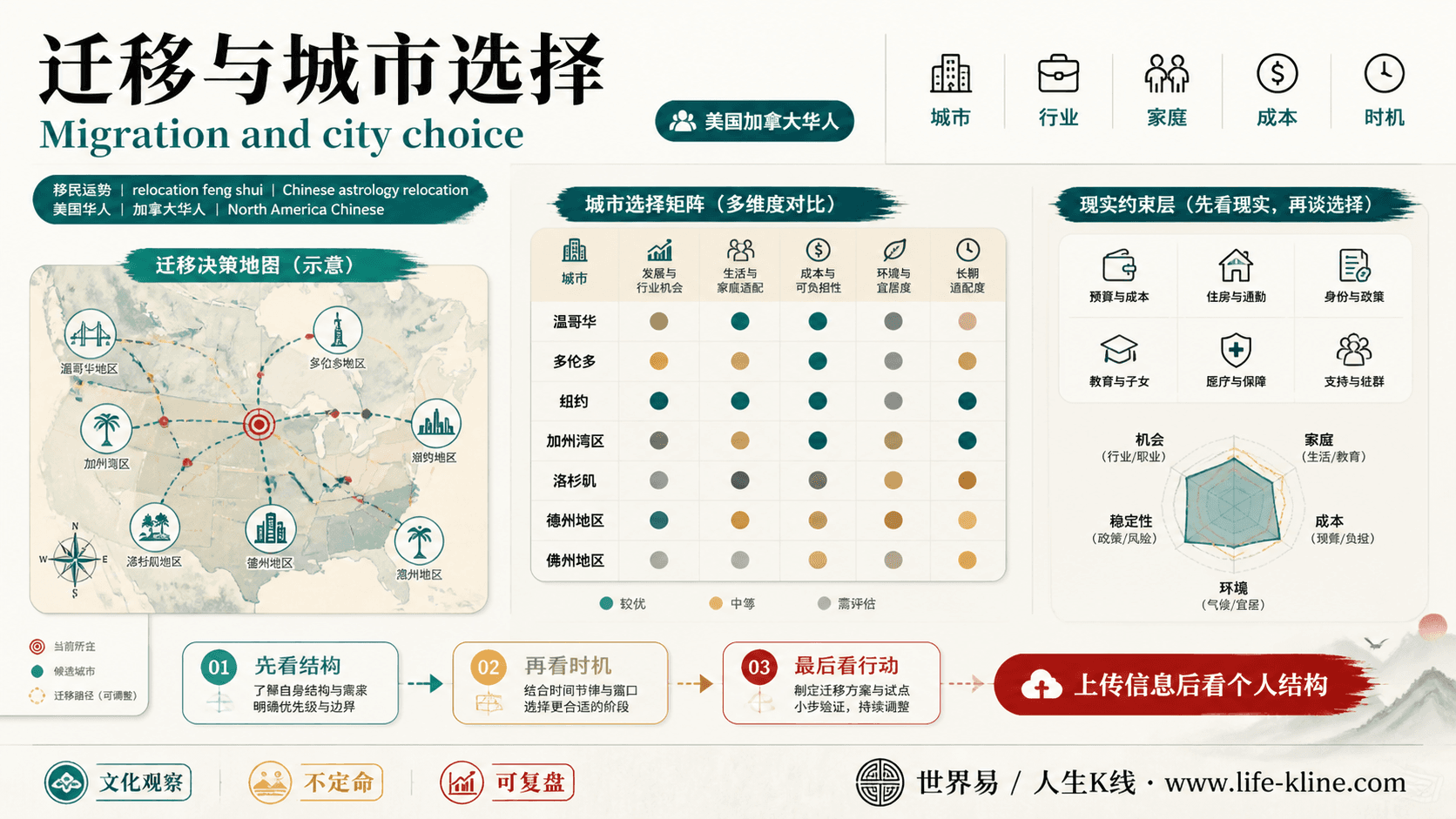
迁移与城市选择|美国加拿大华人
这张图把《Analysis of the Second Migration Decision for Chinese in North America: Stability and Change from a Metaphysical Perspective》里的命理概念转成关系、边界和应用场景,适合先看图建立结构,再回到知识文章正文理解细节。
迁移与城市选择不应被写成固定结论。更适合美国加拿大华人的读法,是把传统术语翻译成结构、时机、环境、行动和复盘。
查看图片解读