Environmental Matching for North American Chinese Migrants: Amplification and Suppression Analysis from a Metaphysical Perspective
把这篇文章落到自己身上验证:先看结构,再进入个人分析,不做泛泛阅读。
你现在搜索的,
其实是一个要落到自己身上的判断。
当前页面主要回答「Overseas Chinese」这类搜索问题;真正有价值的下一步是把这套结构带进自己的报告、工具与案例验证。
Why This Scenario Is Especially Challenging for Overseas Chinese
Migration decisions for North American Chinese involve multiple complex dimensions, such as differences in tax policies, cross-border exchange rate fluctuations, emotional stress from family separation, and cultural adaptation issues. These practical constraints make migration not merely a geographic move but a systemic project affecting the energy expression of the BaZi chart.
Cultural differences are particularly prominent in environmental matching for migration. The pace of life and social values in North America differ significantly from traditional Chinese culture, acting as external “amplifiers” or “suppressors” of the Yong Shen (favorable elements) and Ji Shen (unfavorable elements) in the BaZi chart, thus influencing the migrant’s adaptation and success in the new environment.
The strength of the Day Master, pattern types, and the relationship between Yong Shen and Ji Shen in the BaZi structure determine whether the migration environment suits the energy release of the individual. For example, a relatively weak Day Master may be further suppressed in resource-scarce or oppressive environments, while a strong Day Master may be well amplified in resource-rich settings.
Migration for overseas Chinese not only concerns personal development but also involves long-term family interactions and support systems. These interact dynamically with the palace environments and the Da Yun and Liu Nian cycles in the BaZi chart, creating complex influences that increase the difficulty of migration decisions.
Three Core Dimensions of Metaphysical Judgment
First, the Day Master and pattern form the foundation of metaphysical judgment. The strength of the Day Master determines the individual’s energy base, while the pattern reflects the life theme, such as Zheng Cai (Proper Wealth) pattern, Pian Cai (Indirect Wealth) pattern, or a purely strong pattern, indicating the main directions for career and wealth. Environmental matching in North America should consider the compatibility with the individual’s pattern.
Second, the Yong Shen (favorable elements) and Ji Shen (unfavorable elements) reveal which Five Elements the individual needs or should avoid. When the environment strengthens the Yong Shen, career and life tend to proceed smoothly; an environment favoring the Ji Shen may bring obstacles. North America’s diverse natural and social environments have significant impacts on these elements.
Finally, the Da Yun (decade luck cycle) and Liu Nian (annual fortune) reflect the temporal dynamics of fate, determining the timing of migration. Stable Da Yun favor maintaining and consolidating the current environment; auspicious luck cycles are good for expansion and progress; unfavorable years call for caution. Correctly matching Da Yun and Liu Nian with migration timing, combined with real-world conditions, is key to metaphysical judgment.
Three Real BaZi Chart Case Studies
Case 1: This gentleman’s Day Master is Wu Earth (戊 Wù), relatively weak, with a Zheng Cai (Proper Wealth) pattern. His Yong Shen is Fire, and Ji Shen are Metal and Water. He is currently in the Geng Wu (庚午 Gēng Wǔ) Da Yun and Bing Wu (丙午 Bǐng Wǔ) Liu Nian. In the North American environment, Fire represents vitality and motivation. Migrating to a warm climate with inclusive culture can help the Yong Shen manifest and resist interference from the Ji Shen Metal and Water. Since the Geng Wu Da Yun favors stability, migration should prioritize stable employment and living conditions, avoiding overly competitive markets. The recommended judgment sequence is to first assess whether the target location has sufficient Fire element resources, then comprehensively consider family distance and tax burdens.
Case 2: This gentleman’s Day Master is Yi Wood (乙 Yǐ), balanced, with a Pian Cai (Indirect Wealth) pattern. His Yong Shen is Water, and Ji Shen is Metal. He is currently in the Ren Xu (壬戌 Rén Xū) Da Yun and Bing Wu (丙午 Bǐng Wǔ) Liu Nian. Water as Yong Shen benefits from regions in North America rich in water resources and economically active, suitable for leveraging his Pian Cai advantage. The Ren Xu Da Yun is auspicious, indicating good career and wealth prospects. The migration timing is favorable for actively expanding his career. Practical considerations include paying attention to cross-border tax policies and exchange rate fluctuations to avoid obstacles from the Ji Shen Metal. The judgment recommendation is to first confirm the water element environment and financial policies of the target area, then select the migration timing based on Da Yun and Liu Nian.
Case 3: This lady’s Day Master is Xin Metal (辛 Xīn), relatively strong, with a purely strong pattern. Her Yong Shen is Earth, and Ji Shen is Wood. She is currently in the Ding Hai (丁亥 Dīng Hài) Da Yun and Bing Wu (丙午 Bǐng Wǔ) Liu Nian. Earth as Yong Shen represents stability and support. If the migration environment strengthens Earth element resources, it benefits maintaining her status and accumulating wealth. Ji Shen Wood is relatively strong in some North American regions, potentially suppressing her. The Ding Hai Da Yun is stable, favoring consolidation. It is recommended to choose migration locations with stable life rhythms and good community support to reduce Ji Shen interference. The judgment sequence should first verify Earth element resources and community stability at the target location, then evaluate the completeness of family support systems.
Common Misconceptions Among Overseas Chinese in This Scenario
Many Chinese migrants overlook the specific needs of Yong Shen and Ji Shen in their BaZi charts, focusing only on the auspiciousness or inauspiciousness indicated by Da Yun and Liu Nian. This leads to limited energy expression after migration, with career and life failing to meet expectations. In fact, the degree of environmental matching to the Yong Shen is decisive for migration success.
Another common misconception is neglecting the impact of cultural adaptation and family distance. While BaZi reveals individual potential, family support and cultural integration are crucial external factors that amplify positive energy. Ignoring these often results in emotional fluctuations and increased life stress after migration.
Some migrants overly pursue short-term financial gains, ignoring metaphysical advice that favors stability during consolidation periods. They blindly move into highly competitive and risky environments, which intensifies the influence of Ji Shen and causes career setbacks.
Practical Judgment Sequence
First, thoroughly analyze the Day Master’s strength, pattern, Yong Shen, and Ji Shen to clarify core metaphysical needs. Assess whether the Yong Shen element is strengthened and the Ji Shen element suppressed or amplified in the natural and social environment of the intended migration location.
Second, consider the current Da Yun and Liu Nian to judge the auspiciousness of the migration timing. Stable Da Yun favor consolidation and stable environments; auspicious Da Yun support proactive expansion; unfavorable years suggest waiting and observing. Avoid blindly following trends in migration decisions.
Finally, comprehensively evaluate practical constraints such as tax policies, exchange rate risks, family distance, and cultural adaptability to ensure metaphysical energy aligns harmoniously with the real environment. Adjust migration plans to prioritize Yong Shen needs, reasonably avoid Ji Shen influences, and improve the success rate of migration.
FAQ
Question 1: How do I determine which area in North America is more suitable for my Yong Shen? Answer: First, identify the Five Element attribute of your Yong Shen. Then examine the natural resources (such as climate and soil) and industry clusters of the target area. Choose environments that generate or harmonize with your Yong Shen. For example, a Fire Yong Shen suits regions with abundant sunshine and vibrant industries.
Question 2: Which has a greater impact on migration decisions, Da Yun or Liu Nian? Answer: Da Yun reflects longer-term fortune trends and determines the general direction and timing of migration. Liu Nian reflects the fortune of the specific year and is better for adjusting details and short-term strategies. Migration decisions should prioritize Da Yun, then refine with Liu Nian.
Question 3: What are the manifestations of a severely unfavorable Ji Shen environment? Answer: When the Ji Shen environment is intensified, the individual may encounter career obstacles, interpersonal conflicts, or health issues. The adaptation period after migration may be prolonged with greater emotional fluctuations. It is advisable to avoid areas where Ji Shen is excessively strong or mitigate its effects through lifestyle adjustments.
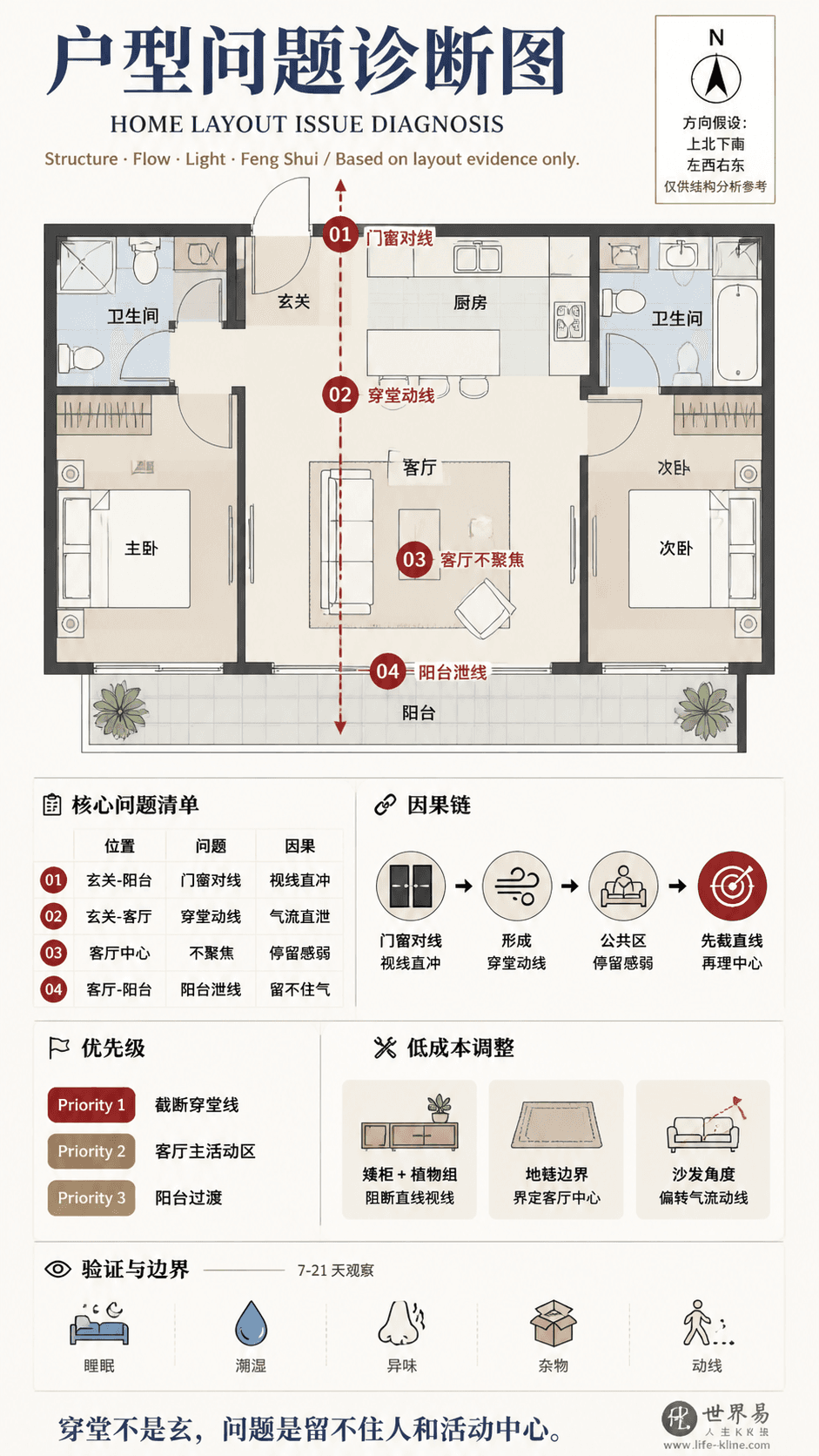
两房分卧式公寓|穿堂动线诊断图
这张图把《Environmental Matching for North American Chinese Migrants: Amplification and Suppression Analysis from a Metaphysical Perspective》里的命理概念转成关系、边界和应用场景,适合先看图建立结构,再回到知识文章正文理解细节。
常见北美两房分卧户型中,入户与阳台形成的直线动线容易削弱空间停留感。本文聚焦结构位置与低成本调整路径,帮助优化日常使用体验。
查看图片解读