Identifying Overwork Signals Among Chinese in North America: Early Warning for Day Master Weakness and Systemic Damage
把这篇文章落到自己身上验证:先看结构,再进入个人分析,不做泛泛阅读。
Why This Scenario Is Particularly Challenging for Overseas Chinese
Chinese in North America face unique challenges in high-intensity work environments. Cross-time zone work, complex tax filings, and long-distance family relationships significantly increase mental stress and physical burden. Especially in the United States and Canada, long working hours and high living costs further exacerbate the risk of overwork.
Cultural differences also intensify this issue. Overseas Chinese generally value diligence and achievement, often overlooking bodily fatigue signals. Differences between traditional Chinese medicine and Western medical concepts mean some traditional metaphysical health warnings are not timely understood or accepted, causing hidden health risks to be concealed.
The overlay of BaZi structure and real-world environment makes those with a relatively weak Day Master more susceptible to overwork signals under pressure. Particularly in the fast-paced life and work rhythm of North America, if the Yong Shen (favorable element) in the chart is unsupported, the weak Day Master easily causes imbalance in specific body systems first, subsequently affecting overall health.
Therefore, combining metaphysical judgment with real-world context, scientifically identifying overwork signals becomes key for overseas Chinese to maintain health and career stability. BaZi not only provides deep analysis of individual constitution but also helps locate specific pressure impact points on the body, guiding prevention and adjustment.
Three Core Dimensions of Metaphysical Judgment
First is the strength of the Day Master, which represents the fundamental vitality and stress endurance of the individual. A relatively weak Day Master is easily depleted in high-pressure environments, first breaking down the corresponding body systems. A relatively strong Day Master has better resistance, but excessive fatigue can still cause hidden damage.
Second are the pattern (ge ju) and Yong Shen (favorable element). The pattern reveals the energy distribution and operation mode of the BaZi chart, while the Yong Shen is the Five Element that regulates and nourishes the Day Master. When the Yong Shen is effective, it can mitigate pressure impact on the Day Master; otherwise, it increases overwork risk. In the complex North American environment, support from the Yong Shen is especially important.
Third are the Da Yun (decade luck cycle) and Liu Nian (annual fortune). Da Yun represents the overall luck in different life stages, while Liu Nian reflects environmental changes in the given year. When Da Yun and Liu Nian are favorable, pressure is high but manageable; conversely, cumulative pressure easily triggers health warnings. Overseas Chinese in North America need to adjust life strategies dynamically according to Da Yun and Liu Nian.
Additionally, palace environments (gong wei) serve as auxiliary judgment factors, reflecting energy conditions in different life areas within the chart. The status of specific palaces such as the Health Palace or Career Palace can further reveal manifestations and locations of overwork signals. Integrating these three dimensions forms a multi-layered assessment of overwork risk.
Three Real BaZi Chart Cases
Case 1: This female’s Day Master is 甲 (Jia) Wood, relatively weak, with a Shang Guan (Hurting Officer) pattern. The Yong Shen is Water, and the Ji Shen (unfavorable elements) are Fire and Earth. She is currently in the 壬子 (Ren Zi) Da Yun, which is favorable. Placed in a high-pressure North American work environment, long-term work stress critically affects her Water system. Since Water is the Yong Shen, if Water is depleted or imbalanced, the 甲 (Jia) Wood Day Master cannot be nourished, causing the kidneys and urinary system to be affected first. This resonates with the North American lifestyle of prolonged sitting and insufficient hydration. It is recommended to focus on the status of the Yong Shen Water when judging, observing early signs of kidney deficiency or water metabolism abnormalities, and proactively adjusting lifestyle and work rhythm.
Case 2: This female’s Day Master is 庚 (Geng) Metal, relatively strong, with a Yang Ren (Goat Blade) pattern. The Yong Shen is Water, and the Ji Shen is Earth. She is currently in the 甲戌 (Jia Xu) Da Yun, with stable luck. The high-efficiency work and life pace in North America require strong output; although the 庚 (Geng) Metal Day Master is strong and resistant to pressure, the Yang Ren pattern stimulates vigorous fighting spirit that can lead to overwork. The Yong Shen Water represents regulation and nourishment; if Water resources are insufficient, overwork signals mostly manifest as lung and respiratory system issues. Considering the cold North American winters and air quality, respiratory health must be closely monitored. Judgments should prioritize checking the status of the Yong Shen Water and timely rest supplementation to prevent lung damage.
Case 3: This female’s Day Master is 丁 (Ding) Fire, balanced, with a Zheng Yin (Proper Seal) pattern. The Yong Shen is Wood, and the Ji Shen is Water. She is currently in the 辛丑 (Xin Chou) Da Yun, with stable luck. The 丁 (Ding) Fire Day Master is balanced, and the Zheng Yin pattern indicates a stable support system. Wood as the Yong Shen represents the health of the liver and gallbladder system. Although life pressures in North America are significant, the stable Da Yun helps buffer overwork impacts. However, the Liu Nian 丙午 (Bing Wu) year has strong Fire energy, which may excessively consume the Yong Shen Wood, indicating increased liver function stress. Combined with irregular diet and rest in the North American work environment, overwork signals in this chart mainly focus on the liver and gallbladder system. Judgments should monitor signs of damage to the Yong Shen Wood and adjust lifestyle accordingly.
Common Misconceptions Among Overseas Chinese in This Scenario
Many Chinese in North America overly rely on superficial symptoms and neglect subtle early changes in body systems. In BaZi, overwork signals for those with a weak Day Master often first appear in the system corresponding to the Yong Shen. Failure to pay timely attention can lead to serious subsequent health problems.
Another misconception is focusing solely on the luck indicated by Da Yun and Liu Nian while ignoring the match between Yong Shen and pattern. Even if Da Yun is favorable, if the Yong Shen is damaged, overwork risk still exists. In the high-pressure overseas environment, neglecting metaphysical details can distort judgment and miss the optimal intervention window.
Additionally, cultural cognitive differences make it difficult for some Chinese to integrate metaphysical warnings with modern medicine, resulting in one-sided health management. Ignoring BaZi indications about body systems hinders forming scientific prevention and adjustment strategies, increasing hidden risks from overwork.
Practical Judgment Sequence
First, clarify the strength of the Day Master to establish a baseline for its endurance in the current high-pressure environment. For a weak Day Master, focus on the status of the Yong Shen, as it is the key energy supporting the Day Master; any depletion of the Yong Shen may be an early sign of overwork.
Second, combine the pattern to identify the energy flow characteristics in the chart and judge how pressure circulates among the Five Elements, determining which body systems may be damaged first. Analyze Da Yun and Liu Nian to assess the current pressure intensity and trends, deciding whether proactive lifestyle adjustments are needed or cautious waiting is advised.
Finally, integrate palace environments and real work-life conditions to refine specific health monitoring indicators and lifestyle adjustment plans. Regularly or periodically check the body systems corresponding to the Yong Shen—such as kidneys, lungs, or liver and gallbladder—to capture subtle signals early and prevent overwork accumulation from causing greater harm.
FAQ
Question 1: How can Chinese in North America with a weak Day Master quickly identify overwork signals? Answer: Focus on changes in the body system corresponding to the Yong Shen, such as fatigue, functional decline, or discomfort. Combine BaZi analysis with daily health monitoring to detect abnormalities early and avoid cumulative stress.
Question 2: Does favorable Da Yun mean low overwork risk? Answer: Not entirely. While Da Yun represents overall luck, damage to the Yong Shen and pattern characteristics still affect physical condition. A comprehensive assessment combining metaphysical details and actual environment is necessary.
Question 3: How to combine BaZi judgment and real-world adjustments to avoid overwork? Answer: Based on BaZi determination of Day Master strength and Yong Shen status, combined with North American high-pressure work and life pace, develop personalized rest and health management plans to scientifically regulate stress and effectively prevent overwork.
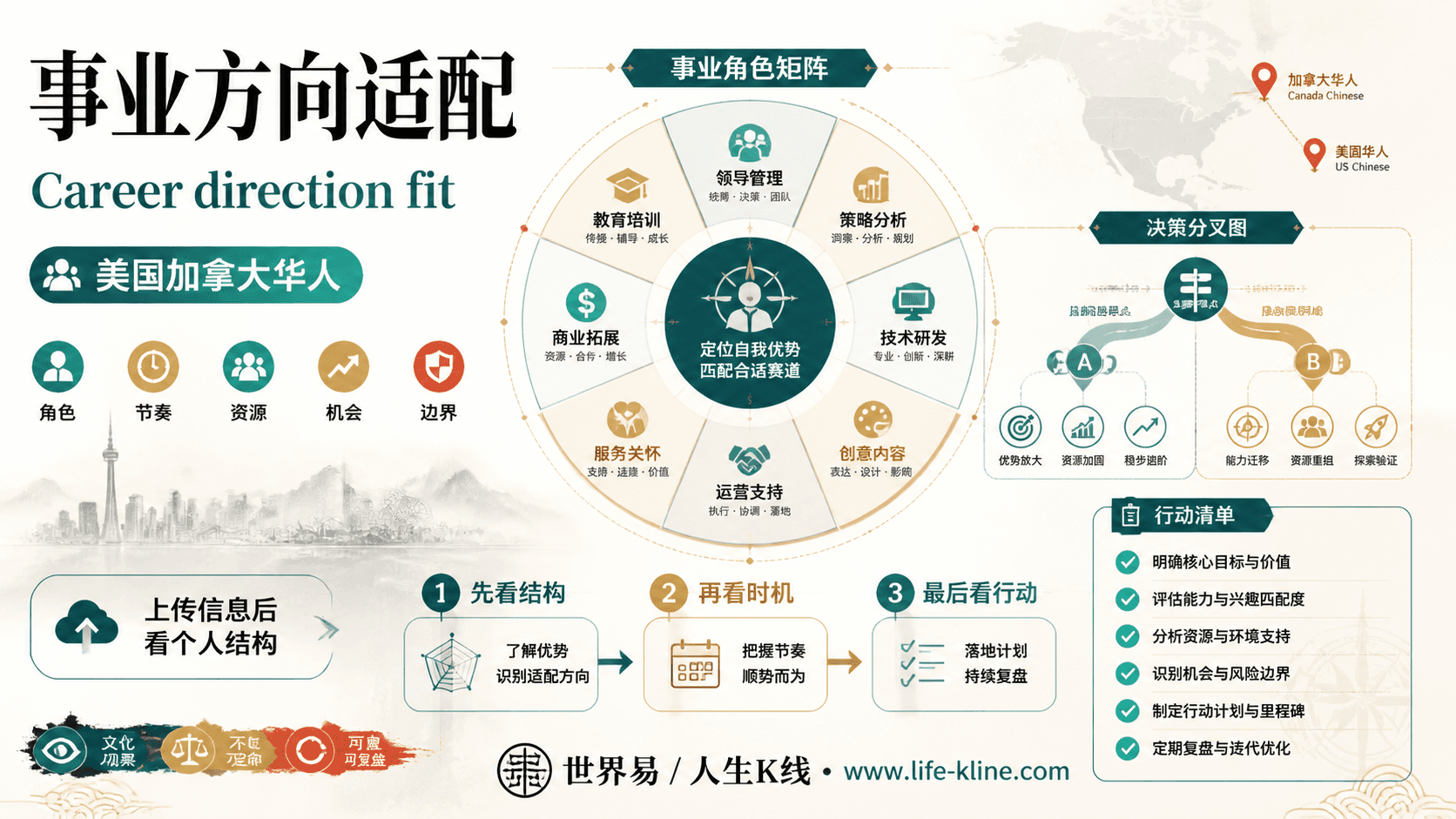
事业方向适配|美国加拿大华人
这张图把《Identifying Overwork Signals Among Chinese in North America: Early Warning for Day Master Weakness and Systemic Damage》里的命理概念转成关系、边界和应用场景,适合先看图建立结构,再回到知识文章正文理解细节。
事业方向适配不应被写成固定结论。更适合美国加拿大华人的读法,是把传统术语翻译成结构、时机、环境、行动和复盘。
查看图片解读