Decision-Making for Overseas Care of Parents Among North American Chinese: A Synchronized Analysis of Metaphysics and Reality
把这篇文章落到自己身上验证:先看结构,再进入个人分析,不做泛泛阅读。
你现在搜索的,
其实是一个要落到自己身上的判断。
当前页面主要回答「Overseas Chinese」这类搜索问题;真正有价值的下一步是把这套结构带进自己的报告、工具与案例验证。
Why This Scenario Is Especially Difficult for Overseas Chinese
The decision to care for aging parents overseas is particularly complex among North American Chinese, primarily due to the real geographical distance constraints. Long-haul flights across the Pacific are not only time-consuming and exhausting but also involve visa issues, work arrangements, and coordination of family affairs, often making returning home for care unsustainable in the short term.
Secondly, taxation and economic burdens are significant factors influencing decisions. Overseas residency status affects the flow of funds between children and parents; exchange rate fluctuations increase financial uncertainty, and prolonged care needs bring additional expenses. These factors often make remote support schemes the preferred compromise for many families.
Cultural differences and psychological burdens further complicate decision-making. Mainstream North American culture emphasizes independence and self-management, whereas traditional Chinese culture values filial piety and family bonds. Overseas Chinese often find themselves caught between these two, needing to meet their parents’ emotional needs while ensuring their own life stability.
In this context, the metaphysical structure plays a role in amplifying or offsetting challenges. The strength of the Day Master, the preference or avoidance of certain elements (Yong Shen and Ji Shen), and changes in Da Yun and Liu Nian reflect an individual’s energy state and coping ability. How to synchronize metaphysical judgment with real-world constraints is key to achieving scientific decision-making.
Three Core Dimensions of Metaphysical Judgment
First is the Day Master and the BaZi pattern. The Day Master represents the core personal energy, with its strength reflecting the capacity to bear pressure and utilize resources. The pattern reveals the overall fortune characteristics of the chart, determining the individual’s role and dominant direction within family and career.
Second are the Yong Shen (favorable elements) and Ji Shen (unfavorable elements). Yong Shen are the Five Elements that harmonize the chart and compensate for deficiencies, relating to personal health, emotions, and environmental adaptability; Ji Shen are elements to avoid or weaken, and if they conflict with the real environment, decision risks increase accordingly.
Third are the Da Yun (decade luck cycle) and Liu Nian (annual fortune). Da Yun represents long-term trends, while Liu Nian reflects short-term fluctuations. Their auspicious or inauspicious interactions determine the strength of an individual’s fortune at specific times, affecting the timing and intensity of decisions.
Although palace (house) environments are not directly provided, combining chart information with real circumstances allows inference of spatial and relational influences, especially how cross-border distance and family structure amplify or suppress metaphysical energies.
Three Real BaZi Chart Case Studies
Case 1: This gentleman’s Day Master is Ji (己, Earth), somewhat strong, belonging to the Yang Ren pattern. His Yong Shen are Wood and Water, and his Ji Shen is Fire. He is currently in the Yi Wei Da Yun (乙未, auspicious luck), with the Liu Nian Bing Wu (丙午) aligning harmoniously with the Da Yun. This chart shows inner resilience and a proactive career fortune; the Wood and Water Yong Shen indicate his need for external support and fluidity. In the North American reality, geographical distance and cross-border complexities challenge his Wood and Water elements, especially with the Fire Ji Shen in the Liu Nian causing emotional anxiety. In overseas parental care decisions, he should prioritize assessing his career stability and the feasibility of cross-border support, recommending securing career stability first before exploring a balance between remote support and necessary visits home.
Case 2: This lady’s Day Master is Bing (丙, Fire), somewhat strong, with a Zheng Cai (正财, Direct Wealth) pattern. Her preferred Yong Shen is Earth, and her Ji Shen is Wood. She is currently in the Bing Zi Da Yun (丙子), with the Liu Nian also being Bing Wu (丙午), indicating stable but maintenance-focused fortune. Her chart emphasizes steady accumulation of wealth and resources; the Earth Yong Shen helps stabilize the family foundation, while the Wood Ji Shen warns against overextension. Considering her North American Chinese background, the tax and economic pressures she faces correspond with the Earth element’s stabilizing nature. A remote support plan for parents aligns better with her maintenance needs, while frequent trips home may cause unnecessary depletion due to the Wood Ji Shen’s influence. She should focus on financial arrangements and the sustainability of long-term care, prioritizing economic stability and then utilizing technology to implement remote care.
Case 3: This lady’s Day Master is Jia (甲, Wood), balanced, with a Cong Cai (从财, Following Wealth) pattern. Her Yong Shen are Earth and Fire, and her Ji Shen are Water and Wood. She is currently in the Xin Chou Da Yun (辛丑), with the Liu Nian being Bing Wu (丙午), overall indicating stable fortune. The chart reflects her balanced ability in resource management and emotional regulation, but the Ji Shen Water and Wood elements may limit fluidity and adaptability. In the North American cross-border care context, geographical and cultural differences may exacerbate the Ji Shen’s emotional impact, especially the psychological stress caused by prolonged separation. She is suited to adopt a steady remote support approach while optimizing timing for necessary visits. It is recommended to determine action timing based on the auspiciousness of Da Yun and Liu Nian to avoid excessive emotional drain and resource waste.
Common Misconceptions Among Overseas Chinese in This Scenario
Many North American Chinese overly rely on emotional impulses when deciding on parental care, neglecting the realities of cross-border distance and financial burdens, resulting in frequent and costly trips that ultimately increase overall family stress.
Some overlook the strength configuration of the Day Master and Yong Shen in their BaZi charts, blindly choosing care methods that do not match their capacity. For example, individuals with a weak Day Master forcibly undertaking intensive caregiving are prone to physical and mental exhaustion.
Others fail to synchronize Da Yun and Liu Nian with real-world conditions, misjudging timing and thus acting at inappropriate moments, missing opportunities or increasing unnecessary risks and conflicts.
Additionally, neglecting the Ji Shen is common, especially failing to recognize their own emotional and environmental Ji Shen influences, and thus not taking effective adjustment measures, which greatly diminishes decision effectiveness.
Practical Judgment Sequence
Step one: Assess the strength of the Day Master and the needs of the Yong Shen in the personal BaZi chart, clarify one’s energy state and regulation priorities, and combine this with real economic and time costs to determine a sustainable caregiving model.
Step two: Integrate the current Da Yun and Liu Nian to evaluate auspiciousness, prioritizing periods when Da Yun is smooth and Liu Nian has no Ji Shen conflicts for key actions such as returning home to visit or arranging long-term care.
Step three: Consider family member support and cross-border policy restrictions comprehensively, flexibly adjusting the ratio of remote support to in-person care, focusing on avoiding negative impacts from Ji Shen to ensure decision sustainability and emotional stability.
FAQ
Question 1: How can overseas Chinese combine metaphysics to decide between returning home for care or remote support? Answer: One should first assess the strength of their Day Master and Yong Shen, combine this with the auspiciousness of Da Yun and Liu Nian to judge their capacity and timing, then weigh real cross-border distance and economic conditions to gradually determine whether returning home or primarily remote support is suitable.
Question 2: How do Ji Shen (unfavorable elements) specifically manifest in caregiving decisions? Answer: Ji Shen often represent emotional fluctuations or environmental resistance. For example, Fire Ji Shen may cause anxiety, while Wood Ji Shen might lead to excessive resource consumption. Identifying Ji Shen helps avoid unfavorable timing and reduce psychological burdens.
Question 3: How do Da Yun and Liu Nian affect the implementation of overseas parental care decisions? Answer: Da Yun reflects long-term trends, and Liu Nian shows the year’s fortune. When both are auspicious, proactive actions are suitable. If encountering Ji Shen conflicts, caution or delay is advisable to reduce risks and improve decision outcomes.
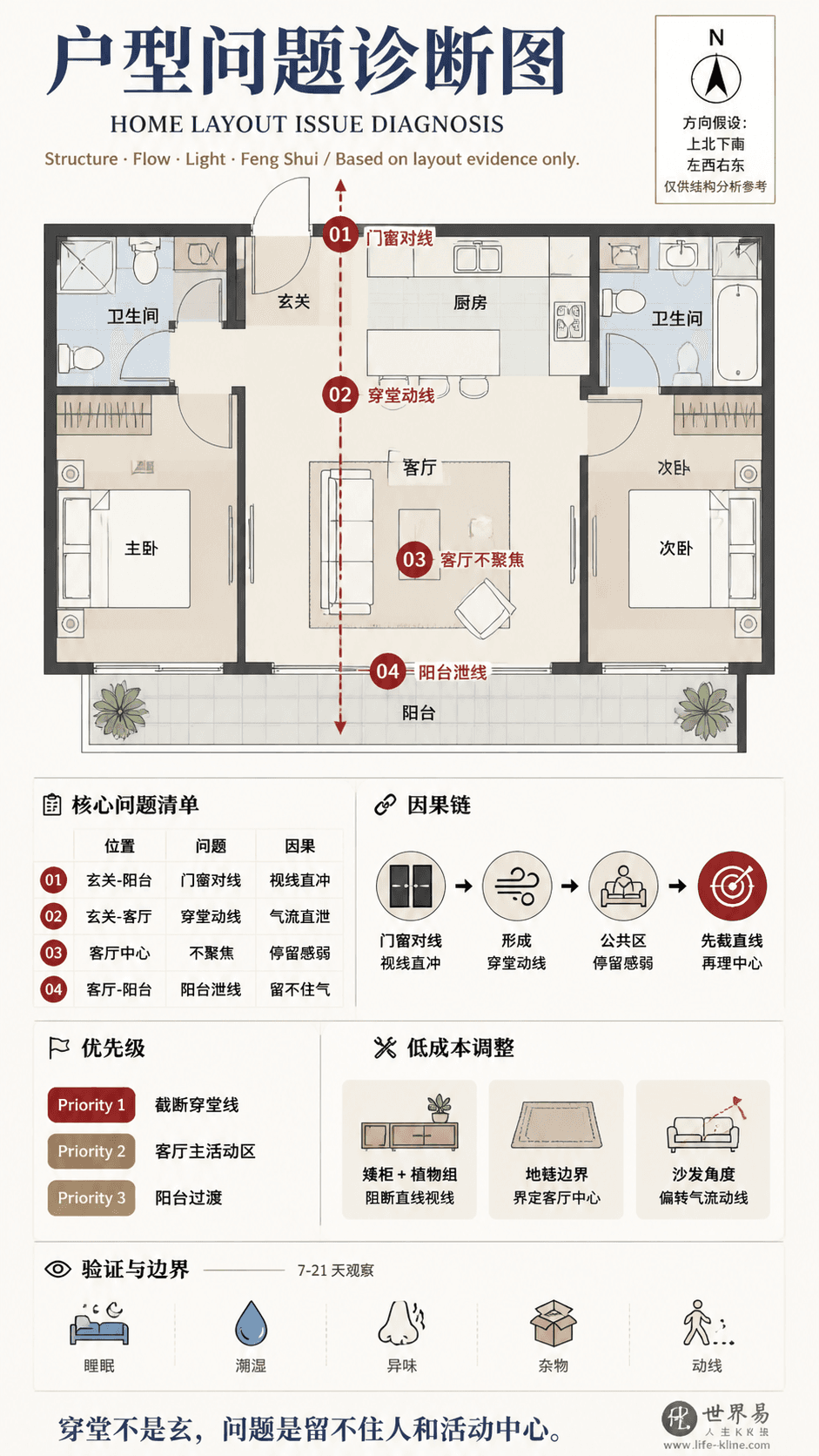
两房分卧式公寓|穿堂动线诊断图
这张图把《Decision-Making for Overseas Care of Parents Among North American Chinese: A Synchronized Analysis of Metaphysics and Reality》里的命理概念转成关系、边界和应用场景,适合先看图建立结构,再回到知识文章正文理解细节。
常见北美两房分卧户型中,入户与阳台形成的直线动线容易削弱空间停留感。本文聚焦结构位置与低成本调整路径,帮助优化日常使用体验。
查看图片解读