BaZi Analysis and Practical Guidance for Cross-Cultural Career Role Matching of Chinese in North America
把这篇文章落到自己身上验证:先看结构,再进入个人分析,不做泛泛阅读。
Why This Scenario Is Especially Difficult for Overseas Chinese
Chinese in North America face complex practical constraints when matching cross-cultural career roles, including identity verification, tax policies, and pressures from cross-border communication. The workplace cultures in the US and Canada emphasize autonomy and innovation, whereas traditional Chinese culture values collective collaboration and stability. This cultural difference causes significant variation in role expectations and responsibility density for the same individual across the two environments.
Secondly, fluctuations in exchange rates and psychological burdens from family distance mean Chinese must consider not only personal development but also balance economic benefits and family responsibilities when choosing career paths. These multidimensional pressures affect the speed and manner of career decision-making, making role matching in the workplace more complicated.
From a BaZi perspective, the cultural environment and life rhythm in North America can amplify or suppress the strength of the individual’s Day Master and the effectiveness of the Yong Shen. If the pattern (geju) in the BaZi chart aligns with the local culture, career advancement proceeds smoothly; otherwise, obstacles arise, reflected in adjustments to role density and advancement methods.
Therefore, cross-cultural career role matching is not only a matter of skills and experience but also a comprehensive reflection of the interaction between BaZi structure and environment. Only by understanding this interaction can one achieve precise role positioning and effective advancement in the North American workplace.
Three Core Dimensions of BaZi Judgment
First is the Day Master and pattern (geju). The Day Master represents the individual’s core energy and personality traits. A Day Master that is either slightly strong or balanced will manifest differently in various cultural environments. The pattern reflects the fundamental BaZi configuration type, such as Shi Shen (食神, Eating God) pattern, Yang Ren (羊刃, Yang Blade) pattern, or Bi Jian (比肩, Peer) pattern, determining the dominant workplace style and suitable role density.
Second are the Yong Shen (favorable element) and Ji Shen (unfavorable element). Yong Shen is the Five Elements element that harmonizes or supplements the individual, corresponding to beneficial resources and environments in career development; Ji Shen represents obstructive factors. The Five Elements attributes of Yong Shen and Ji Shen, combined with North American workplace cultural values and industry characteristics, influence the suitability of role matching and advancement strategies.
Lastly, Da Yun (decade luck cycle) and Liu Nian (annual fortune). Da Yun reflects the overall luck trend over ten-year periods, while Liu Nian is the single-year fortune. Their auspicious or inauspicious interactions determine the timing of career development. Chinese in North America must closely integrate Da Yun and Liu Nian to adapt or seize opportunities, thereby improving decision success rates.
Three Real BaZi Chart Cases
Case 1: This chart’s Day Master is Ren (壬, Water), slightly strong, with a Shi Shen (Eating God) pattern. The Yong Shen are Earth and Fire, and the Ji Shen is Metal. Currently in the Wu Zi (戊子) Da Yun (ages 35-44), which is a favorable luck cycle, with career and wealth progress; the Liu Nian is Bing Wu (丙午), supporting advancement. In the North American cross-cultural workplace context, the Ren Water Day Master exhibits flexibility and adaptability; the Shi Shen pattern reflects creativity and expressive ability. However, the slightly strong Water needs Earth and Fire Yong Shen to stabilize it. The open and competitive North American workplace environment amplifies this creativity but requires steady and rhythmical career advancement. The Ji Shen Metal here represents management pressure and institutional constraints, which may pose challenges. It is recommended to avoid taking on excessive management duties and prioritize roles requiring creativity with controllable pace. The judgment sequence suggests first confirming whether the current Da Yun and Liu Nian support trying new roles, then assessing the adequacy of the Yong Shen environment, and finally considering cultural adaptability to decide the advancement speed.
Case 2: This chart’s Day Master is Xin (辛, Metal), slightly strong, with a Yang Ren (Yang Blade) pattern. The Yong Shen are Fire and Wood, and the Ji Shen is Earth. Currently in the Gui Si (癸巳) Da Yun (ages 41-50), also a favorable luck cycle, with career and wealth progress; the Liu Nian is Bing Wu (丙午), supporting advancement. The Xin Metal Day Master is slightly strong; the Yang Ren pattern indicates bravery and decisiveness, suitable for high-intensity responsibilities and leadership roles. Fire and Wood Yong Shen correspond to innovation and interpersonal resources in the North American workplace, enabling advantages. However, the Ji Shen Earth represents stability and conservatism that may suppress development. In the cross-cultural environment, individuals with this BaZi are better suited to actively embrace change and expand diverse roles but should be mindful of their need for stability. It is advised to prioritize evaluating whether the current Da Yun supports role expansion, consider Liu Nian energy for breakthrough suitability, and finally assess the Yong Shen environment and cultural fit to determine action pacing.
Case 3: This chart’s Day Master is Bing (丙, Fire), balanced, with a Bi Jian (Peer) pattern. The Yong Shen is Metal, and the Ji Shen is Water. Currently in the Xin Hai (辛亥) Da Yun (ages 41-50), a stable luck cycle suitable for consolidation; the Liu Nian is Bing Wu (丙午), requiring adaptability. The balanced Bing Fire Day Master manifests moderate enthusiasm and self-expression; the Bi Jian pattern emphasizes competition and self-leadership. The Metal Yong Shen symbolizes rules and execution power in the North American environment, aiding career stability. The Ji Shen Water represents interference and emotional fluctuations. In cross-cultural career matching, this Day Master is suited to relatively stable roles with sustained contribution, avoiding frequent changes. The recommended judgment sequence is to first assess whether the Da Yun supports consolidation, observe external changes through Liu Nian, then evaluate the stability of the Yong Shen environment to decide whether to maintain the current role or make moderate adjustments.
Common Misconceptions of Overseas Chinese in This Scenario
First, many Chinese in North America overemphasize adaptation to a single culture during cross-cultural career matching, neglecting the environmental adaptability of the Day Master and Yong Shen in BaZi, resulting in role positioning that deviates from their inherent BaZi advantages. Cultural differences affect not only language and habits but also deeply influence role density and advancement rhythm.
Second, some Chinese excessively pursue rapid promotion and multiple overlapping roles, ignoring the impact of Da Yun and Liu Nian on career rhythm. This leads to blind expansion during unfavorable years, causing career bottlenecks. BaZi judgment requires integrating the auspiciousness of Da Yun and Liu Nian to reasonably plan role advancement timing.
Additionally, ignoring the existence and influence of Ji Shen causes individuals to take on excessive pressures and responsibilities related to Ji Shen, such as management and administrative duties, resulting in energy depletion and affecting long-term development. Correctly identifying and avoiding Ji Shen is an important strategy in cross-cultural career matching.
Finally, Chinese in the North American workplace often underestimate the real impact of family distance and cross-border taxation on career choices, neglecting the match between the resources environment represented by Yong Shen in BaZi and the real environment, which affects the overall rationality of decisions.
Practical Judgment Sequence
In cross-cultural career role matching, the first step is to clarify the auspiciousness or inauspiciousness of the current Da Yun and Liu Nian, judging whether the overall luck supports role adjustment or expansion. Favorable periods are suitable for proactive advancement, stable periods for consolidation, and unfavorable periods require caution.
The second step is to evaluate the strength of the Day Master and the pattern type, combining Yong Shen and Ji Shen to understand core energy and potential obstacles, determining the suitable role density and workplace style to ensure high compatibility between role and BaZi characteristics.
The third step is to integrate the cultural characteristics of the North American real environment, tax and identity status, family distance, and industry features, assessing whether the environment resources represented by Yong Shen are sufficient and whether Ji Shen pressure is excessive, deciding whether to advance rapidly or accumulate steadily.
By logically checking these three steps, one can scientifically determine the best timing and method for career role matching in a cross-cultural environment, avoiding blind actions and resource waste.
FAQ
Question 1: Does the Day Master change in BaZi when the same person is in different cultural environments? Answer: The Day Master symbolizes the individual’s core energy and is fixed. However, different cultural environments affect the expression of this energy and the effectiveness of the Yong Shen, thereby influencing role matching performance.
Question 2: How to judge if the current Da Yun and Liu Nian are suitable for adjusting career roles in the North American workplace? Answer: One must consider the interaction of Da Yun and Liu Nian in the BaZi chart. When both are favorable and Liu Nian is supportive, proactive adjustments are suitable; stable luck suggests consolidation; unfavorable luck recommends waiting or making minor adjustments.
Question 3: How to balance Ji Shen pressure in cross-cultural career advancement? Answer: First, identify the types of workplace pressure corresponding to Ji Shen and try to avoid taking on excessive related responsibilities; second, choose environments and roles aligned with the Yong Shen to mitigate Ji Shen’s impact and ensure sustainable career advancement.
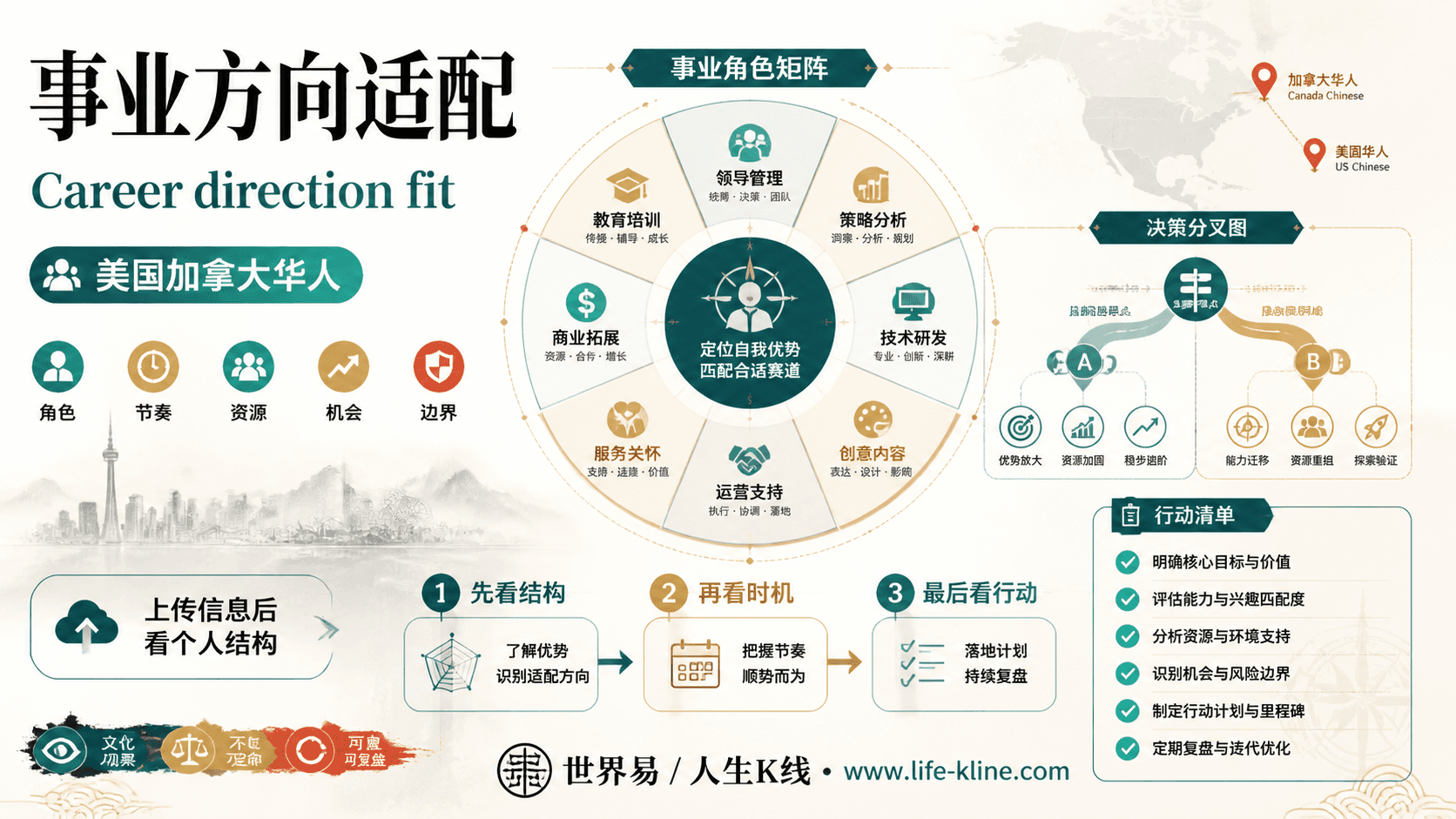
事业方向适配|美国加拿大华人
这张图把《BaZi Analysis and Practical Guidance for Cross-Cultural Career Role Matching of Chinese in North America》里的命理概念转成关系、边界和应用场景,适合先看图建立结构,再回到知识文章正文理解细节。
事业方向适配不应被写成固定结论。更适合美国加拿大华人的读法,是把传统术语翻译成结构、时机、环境、行动和复盘。
查看图片解读