Chinese in the UK and Europe: Return Home or Stay? A Comprehensive Analysis of Migration Palace and Da Yun Decision-Making
把这篇文章落到自己身上验证:先看结构,再进入个人分析,不做泛泛阅读。
你现在搜索的,
其实是一个要落到自己身上的判断。
当前页面主要回答「Overseas Chinese」这类搜索问题;真正有价值的下一步是把这套结构带进自己的报告、工具与案例验证。
Why This Scenario Is Especially Difficult for Overseas Chinese
Chinese in the UK and Europe face intertwined pressures from career development, family responsibilities, and legal identity when deciding whether to return home or stay. Regarding career, the economic environment and industry structures in Europe differ significantly; Chinese often seek breakthroughs amid high competition, while returning home may involve challenges in market adaptation and cultural repositioning. On the family front, transnational distance causes emotional estrangement and caregiving difficulties, especially regarding elderly parents, which is a major concern for many overseas Chinese.
Identity issues are even more critical. Residency status, tax compliance, and social welfare policies in the UK and European countries are complex and ever-changing. Returning home might result in losing current residency status, affecting asset security and children’s education planning, whereas staying requires ongoing pressures of visa renewals and tax burdens. These practical constraints make migration decisions not merely personal wishes but difficult trade-offs of pros and cons.
From a metaphysical perspective, changes in the Migration Palace and Da Yun reflect an individual’s fortune shifts across geography and life stages. The multicultural overseas environment and policy differences can amplify or suppress the manifestation of metaphysical energies. For example, an overly strong Day Master’s efficiency in resource utilization varies across environments; the steadiness or hazards in Da Yun directly impact the risks and benefits of migration behavior.
In summary, Chinese overseas in the UK and Europe must consider both the complexity of real-world environments and the intrinsic guidance of their metaphysical structures when facing the return-or-stay question, to make rational decisions aligned with their personal destiny rhythms.
Three Core Dimensions of Metaphysical Judgment
First is the Day Master and its pattern. The strength of the Day Master determines an individual’s vitality and adaptability, while the pattern reflects personality traits and career development directions. For example, a relatively strong Ji Earth (己, Ji) Day Master with a Pian Yin (偏印) pattern implies active thinking but reliance on external resources, suitable for steady progress; a relatively strong Geng Metal (庚, Geng) Day Master with a Pian Cai (偏财) pattern indicates strong wealth awareness and high adaptability to change.
Second is the configuration of Yong Shen (用神, favorable element) and Ji Shen (忌神, unfavorable element). Yong Shen represents the Five Elements in the chart that harmonize the Day Master and help resolve difficulties; Ji Shen are elements to be avoided or controlled. The effectiveness of Yong Shen directly affects whether the individual can smoothly pass critical periods, especially during migration and identity transitions, making the power of Yong Shen particularly crucial.
Third is the interaction between Da Yun (大运, decade luck cycle) and Liu Nian (流年, annual fortune). Da Yun reflects the overall fortune phase, while Liu Nian shows the specific annual fluctuations. The steadiness or hazards of Da Yun combined with Liu Nian changes determine whether migration is timely and whether environmental support or obstacles will be encountered. The Migration Palace, symbolizing space and environment, works with Da Yun and Liu Nian to decide the auspiciousness and success of migration.
Therefore, comprehensive judgment should place the Day Master pattern and Yong Shen as the foundational layer, combined with the spatiotemporal rhythm of Da Yun and Liu Nian to assess migration timing and risks. Particular attention should be paid to the geographical and social environment factors indicated by the Migration Palace to ensure metaphysical insights complement real-world conditions.
Three Real BaZi Cases
Case 1: The male Day Master is Ji Earth (己, Ji), relatively strong, with a Pian Yin (偏印) pattern. Yong Shen are Wood and Water; Ji Shen is Fire. Currently in the 6th year of Xin Wei (辛未, Xin Wei) Da Yun, which is a stable luck phase. The Liu Nian is Bing Wu (丙午, Bing Wu), requiring adaptability. Placed in the UK and European environment, the age 55-60 corresponds to career maturity while facing identity and family caregiving pressures. The Pian Yin pattern indicates reliance on external resources and good thinking ability; the stability of Xin Wei Da Yun emphasizes preservation, suitable for steady development in the current environment and avoiding rash migration. Although the Liu Nian Bing Wu Fire is Ji Shen, its flexible nature advises flexible decision-making. The recommendation is to first assess current career and identity stability; if the Migration Palace (representing spatial changes) shows no clear advantage, it is better to maintain the status quo and wait for a more favorable timing.
Case 2: The female Day Master is Geng Metal (庚, Geng), relatively strong, with a Pian Cai (偏财) pattern. Yong Shen is Water; Ji Shen is Earth. Currently in the 6th year of Ji Chou (己丑, Ji Chou) Da Yun, which is relatively weak and requires caution against major upheavals. The Liu Nian is Bing Wu (丙午, Bing Wu), indicating the need for prudence. Age 50-55 is a period of concentrated career and family pressures. The Pian Cai pattern shows sensitivity to wealth and opportunities, but the Ji Shen Earth influence may exacerbate stress under the complex tax and identity policies in the UK and Europe. Especially with the weak Da Yun, migration should be approached cautiously. The Liu Nian Bing Wu Fire as Ji Shen suggests higher risks in that year. When deciding whether to return or stay, this chart should prioritize securing existing resources and avoid major migration during unfavorable Da Yun periods. It is advisable to stabilize identity and career foundations before considering migration possibilities.
Case 3: The male Day Master is Yi Wood (乙, Yi), relatively strong, with a Yang Ren (羊刃) pattern. Yong Shen are Metal and Earth; Ji Shen is Water. Currently in the 6th year of Yi You (乙酉, Yi You) Da Yun, which is stable. The Liu Nian is Bing Wu (丙午, Bing Wu), requiring adaptability. The relatively strong Yi Wood Day Master with Yang Ren pattern shows strong self-drive and adaptability, suitable for proactive action. Yong Shen Metal and Earth help moderate the impulsiveness of Wood, but Ji Shen Water requires avoiding emotional and environmental fluctuations. In the complex cross-border UK and European context, strong self-drive may motivate considering migration for better development, but the stable Da Yun advises against reckless moves. The suggestion is to analyze in detail the policies and living environment of the Migration Palace’s location, combined with the individual’s Yong Shen harmonization, to act at the right time.
All three cases illustrate that the stability of Da Yun has a key impact on migration decisions. Although a relatively strong Day Master has strong adaptability, the influence of Ji Shen must be evaluated together with real policies and family situations to make a more scientific judgment on whether to return or stay.
Common Misconceptions Among Overseas Chinese in This Scenario
Many overseas Chinese overly rely on immediate economic benefits when deciding to return or stay, neglecting the long-term impacts on identity and family. For example, blindly pursuing high-paying jobs back home without considering tax compliance and continuity in children’s education can lead to a decline in quality of life after migration.
Another common misconception is ignoring the cyclical nature of Da Yun and Liu Nian in metaphysics, thinking migration decisions depend solely on external environments or personal will, thereby overlooking the guidance from the Migration Palace and the harmonizing effects of Yong Shen and Ji Shen. This leads to poor timing choices and increased risks.
Some also have a narrow understanding of the Migration Palace, focusing only on geographic spatial changes without integrating the interaction of Da Yun, Liu Nian, and real-world environments. They underestimate the complexity of cultural adaptation and social resources, resulting in difficulties and discomfort post-migration.
Therefore, rational migration decisions must avoid these pitfalls by validating both metaphysical insights and practical realities, balancing short-term gains with long-term stability, and scientifically planning migration paths based on the dynamic interplay of the Migration Palace and Da Yun.
Practical Judgment Sequence
First, clarify the strength and pattern of your Day Master in the BaZi chart, identify Yong Shen and Ji Shen, and understand the nature of the current Da Yun (whether stable or hazardous). This is the foundation for judging whether migration can proceed smoothly, with special attention to whether the geographical and social environment indicated by the Migration Palace supports the manifestation of metaphysical energies.
Second, combine the current Liu Nian to determine if the timing is suitable for action. If Liu Nian supports the Yong Shen and Da Yun is stable, migration timing is favorable; if Liu Nian is Ji Shen and Da Yun is hazardous, caution and waiting are advised to avoid unforeseen risks from rash actions.
Finally, integrate metaphysical judgment with real-world factors such as career development, legal identity, tax burdens, and family distance. If metaphysics suggests preservation but real pressures are severe, prioritize stabilizing identity and career; if metaphysics supports migration and real conditions permit, actively plan for returning home or relocating.
By following this sequence, overseas Chinese can scientifically use metaphysical information to assist decisions, avoiding missed optimal migration opportunities due to impulsiveness or excessive conservatism.
FAQ
Question 1: What exactly does the Migration Palace refer to, and how is it identified in the BaZi chart? Answer: The Migration Palace in metaphysics represents an individual’s spatial movement and environmental changes, usually related to geographical location and social environment. Identifying the Migration Palace requires analyzing the interactions of Five Elements and Ten Gods related to space and migration within the Four Pillars (Heavenly Stems and Earthly Branches) and Da Yun/Liu Nian, combined with real migration intentions for comprehensive analysis.
Question 2: How do a stable Da Yun and an adaptable Liu Nian affect migration decisions? Answer: A stable Da Yun indicates overall steady fortune, suitable for preservation and steady progress; an adaptable Liu Nian suggests that the year’s situation is variable and requires flexibility. Migration decisions should prioritize stable Da Yun periods and maintain caution and flexibility during changing Liu Nian to avoid rash actions.
Question 3: How to balance metaphysical judgment with conflicts arising from real identity, taxation, and other factors? Answer: Metaphysics provides guidance on trends and potentials, while real identity and taxation are concrete operational constraints. Ideally, both should complement each other, maximizing metaphysical advantages within practical limits. When conflicts arise, priority should be given to securing real identity safety and family stability, then adjusting action timing according to metaphysical cues.
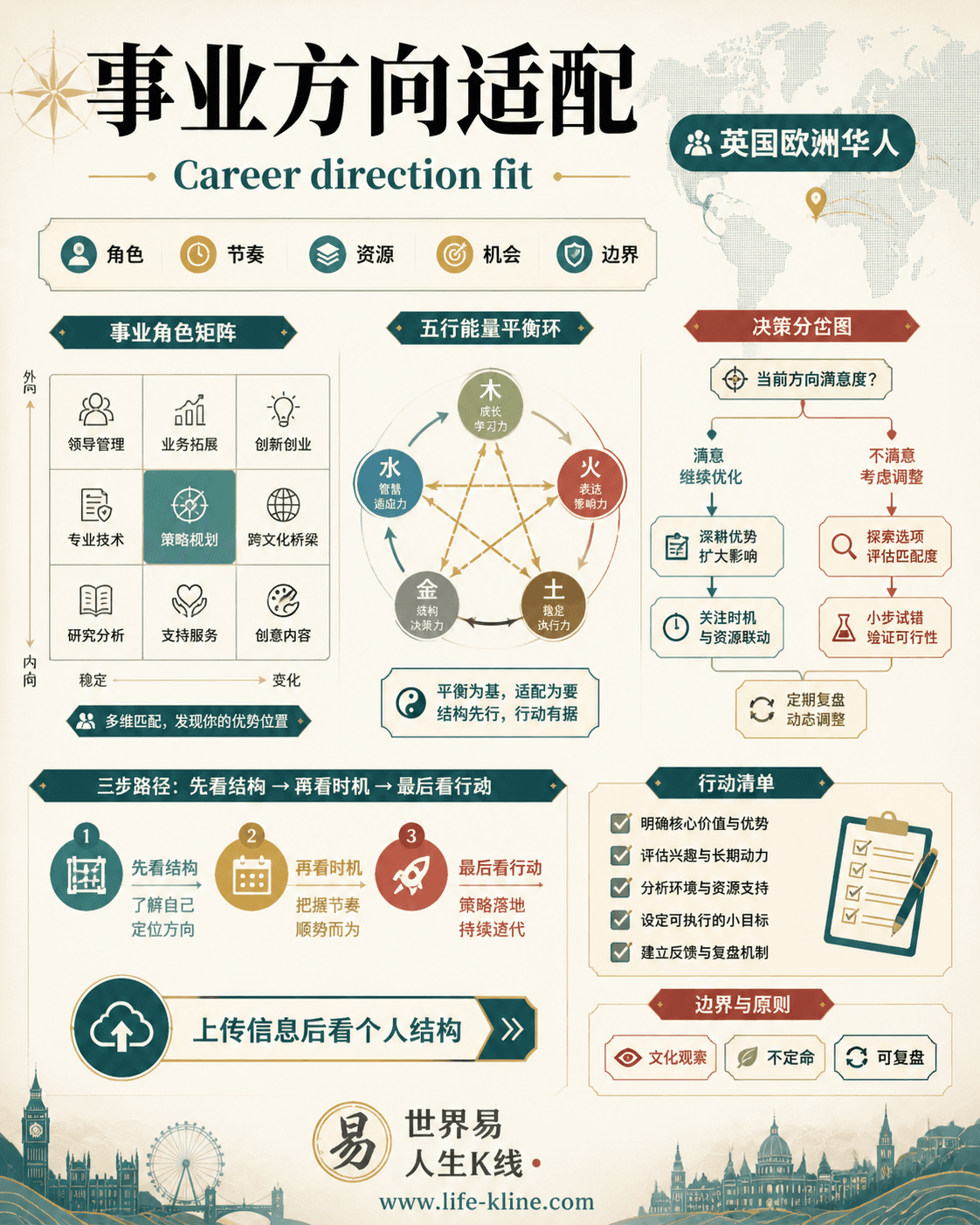
事业方向适配|英国欧洲华人
这张图把《Chinese in the UK and Europe: Return Home or Stay? A Comprehensive Analysis of Migration Palace and Da Yun Decision-Making》里的命理概念转成关系、边界和应用场景,适合先看图建立结构,再回到知识文章正文理解细节。
事业方向适配不应被写成固定结论。更适合英国欧洲华人的读法,是把传统术语翻译成结构、时机、环境、行动和复盘。
查看图片解读