A BaZi Analysis and Practical Guide to Role Reallocation in Overseas Chinese Families in the UK and Europe
把这篇文章落到自己身上验证:先看结构,再进入个人分析,不做泛泛阅读。
Why This Scenario Is Especially Challenging for Overseas Chinese
Chinese families living overseas in the UK and Europe face multiple practical constraints such as cultural differences, legal and tax systems, cross-border remittances, and geographic separation among family members. Particularly in family role reallocation decisions, the original division of labor and responsibility is often disrupted. Determining who takes on more or less responsibility becomes key to family stability and harmony. Cultural differences mean traditional perceptions of main and subordinate roles no longer fully apply, requiring family members to renegotiate their role positioning.
From a BaZi perspective, the strength of the Day Master, the pattern (geju), and the balance of Yong Shen (favorable elements) influence a person's dominant or subordinate status within the family. However, this BaZi structure can be amplified or suppressed by the realities of the overseas environment. For example, cross-border work pressures, tax burdens, and geographic separation among family members may affect whether the person who should bear more responsibility according to BaZi can actually shoulder that burden.
Additionally, European societal views on gender roles differ from traditional Chinese culture. Women often bear greater professional pressure outside the home, while men may need to participate more in household chores. This environmental change poses new challenges to the BaZi main-subordinate relationship. BaZi judgments combined with real-world context can provide more precise guidance for overseas Chinese families during role reallocation.
Therefore, when overseas Chinese families face role reallocation, they must comprehensively consider both BaZi structures and the complexities of overseas life to effectively identify who is dominant and who is auxiliary in the family, enabling scientifically informed decisions that benefit the family.
Three Core Dimensions of BaZi Judgment
In the BaZi analysis of overseas family role reallocation, the primary focus is on the strength of the Day Master. The Day Master represents an individual's core energy, and its strength directly indicates their capacity to bear family responsibilities. A relatively weak Day Master often needs external support, while a strong or balanced Day Master is more capable of proactively taking on responsibilities.
Secondly, the pattern (geju) reveals the overall temperament and structure of the chart, such as Bi Jian (Peer) pattern, Zheng Cai (Direct Wealth) pattern, Pian Cai (Indirect Wealth) pattern, etc., reflecting whether the person tends toward independence or relies on collaborators within the family. The Yong Shen is the key element that harmonizes the chart and strengthens the Day Master. Whether the Yong Shen functions effectively determines the person's adaptability under real-world pressures.
Lastly, Da Yun (decade luck cycle) and Liu Nian (annual fortune) as temporal dimensions reveal the current fortune status of the individual. When in a stable and conservative luck phase, family role reallocation is more suitable for steady progress; whereas in years requiring flexible response, sudden changes may occur, necessitating adaptable role adjustments. Especially in overseas environments, cross-cultural and cross-border factors make Da Yun and Liu Nian impacts on family roles more sensitive.
Moreover, although environmental factors like geographic location, occupation, and family member interactions are not detailed within the provided BaZi facts, they can overlay or suppress BaZi structures, influencing the practical outcomes of role distribution. Integrating these three dimensions provides accurate BaZi foundations for overseas Chinese family role reallocation.
Three Real BaZi Chart Case Studies
Case 1: This chart belongs to a female with a 丁火 (Ding Fire) Day Master, which is relatively weak. The pattern is Bi Jian (Peer) pattern, with Yong Shen being Wood and Ji Shen (unfavorable elements) being Earth and Metal. She is currently in the 壬午 (Ren Wu) Da Yun (ages 44-53), a stable and conservative phase, with the Liu Nian (annual fortune) being 丙午 (Bing Wu). The weak 丁火 Day Master relies on the Wood Yong Shen for harmony, indicating that this woman needs external support to take on more family responsibilities. Within the real constraints of UK and European Chinese life, cultural and tax pressures mean she requires more assistance from family members, especially support from her spouse or elders to balance the pressure. The Bi Jian pattern shows independent awareness, but the weak Day Master limits her ability to dominate the family. It is recommended to first assess whether the family support system is sound before deciding if she should proactively shoulder more family responsibility, to avoid excessive unilateral pressure.
Case 2: This chart is of a female with a 丙火 (Bing Fire) Day Master, which is balanced. The pattern is Zheng Cai (Direct Wealth) pattern, with Yong Shen being Wood and Ji Shen being Water. She is currently in the 丙子 (Bing Zi) Da Yun (ages 43-52), a stable and conservative phase, with the Liu Nian also being 丙午 (Bing Wu). The balanced 丙火 Day Master indicates relative stability and some dominant ability within the family. The Zheng Cai pattern suggests she has advantages in managing family resources and external economic connections. In the cross-border family environment of the UK and Europe, she may take on the role of a bridge and financial manager, coordinating economic distribution and resource utilization among family members. The Wood Yong Shen supports the Day Master well, indicating she can effectively cope with overseas life pressures. It is advised to prioritize her as the core of family economic management and coordination while paying attention to the Ji Shen Water, which may indicate emotional or health issues, to avoid negative effects from overburdening responsibility.
Case 3: This chart belongs to a male with a 戊土 (Wu Earth) Day Master, which is relatively strong. The pattern is Pian Cai (Indirect Wealth) pattern, with Yong Shen being Wood and Water, and Ji Shen being Fire. He is currently in the 丁亥 (Ding Hai) Da Yun (ages 47-56), a stable and conservative phase, with the Liu Nian being 丙午 (Bing Wu). The strong 戊土 Day Master possesses considerable capacity and stability to bear responsibility. The Pian Cai pattern reflects strong influence in wealth and resource distribution, suitable for taking leadership and decision-making roles within the family. The balanced Wood and Water Yong Shen help moderate the Day Master's strength, enabling flexible responses to challenges in the complex overseas UK and Europe environment. The Ji Shen Fire warns to avoid overwork and emotional fluctuations. In family role reallocation, he is suitable to assume the main responsibility but must consider actual family circumstances to prevent imbalance caused by excessive dominance. It is recommended to first confirm his health and emotional management before assessing the sustainability of his leading role.
Common Misconceptions Among Overseas Chinese in This Scenario
Many overseas Chinese overly rely on traditional main-subordinate concepts during family role reallocation, neglecting the profound impact of the overseas environment on family responsibility distribution. For example, cultural differences leading to changes in gender roles may force members who were dominant in their home country to adjust roles overseas, a transition often insufficiently acknowledged.
Another misconception is ignoring the importance of Day Master strength and Yong Shen in the chart. Some family members with weak Day Masters are still expected to bear excessive responsibility, resulting in internal family conflicts and accumulated pressure. The BaZi main-subordinate relationship should be combined with actual capacity in real life, not rigidly applied.
Additionally, some families fail to consider Da Yun and Liu Nian changes when judging the timing of actions, blindly making major family role adjustments during unfavorable luck phases or years requiring flexible response, leading to failed adjustments or intensified family friction. The temporal dimension of BaZi must be incorporated into decision-making to avoid impulsive actions.
Finally, insufficient understanding of Yong Shen and Ji Shen neglects their roles in mitigating or exacerbating family role conflicts. Without targeted regulation of energy balance among family members, role misalignment and emotional imbalance easily occur.
Practical Judgment Sequence
First, clarify the strength status of family members' Day Masters and whether their Yong Shen is supported, identifying who has the BaZi foundation to assume dominant responsibility. Those with weak Day Masters should be observed for sufficient external support; otherwise, they should not overburden core family responsibilities.
Second, combine the current Da Yun and Liu Nian states to judge whether the family is in a suitable phase for role adjustment. Stable and conservative Da Yun phases favor steady responsibility distribution, while years requiring flexible response call for adaptable measures and avoidance of major changes.
Finally, based on BaZi indications combined with real environmental factors, evaluate family members' capacity and external support systems to gradually adjust family roles. It is recommended to start with resource management and emotional support, progressively transitioning to greater responsibility to avoid sudden changes that trigger family conflicts.
FAQ
Question 1: How can someone with a weak Day Master take on more responsibility in an overseas family? Answer: Those with weak Day Masters should rely on Yong Shen support and assistance from other family members. Combining resource allocation in the real environment, they should gradually assume responsibility to avoid excessive unilateral pressure causing negative effects.
Question 2: How do Da Yun and Liu Nian guide the timing of family role adjustments? Answer: Stable and conservative Da Yun phases are suitable for steady role adjustments, while Liu Nian requiring flexible response remind to adapt to sudden changes. One should not act rashly but observe the situation before making decisions.
Question 3: What impact do overseas cultural differences have on the BaZi main-subordinate relationship? Answer: Cultural differences may alter traditional gender and age role positioning within the family, causing the BaZi dominant role to be suppressed or amplified by the real environment. It is necessary to reinterpret BaZi indications in the context of cultural background.
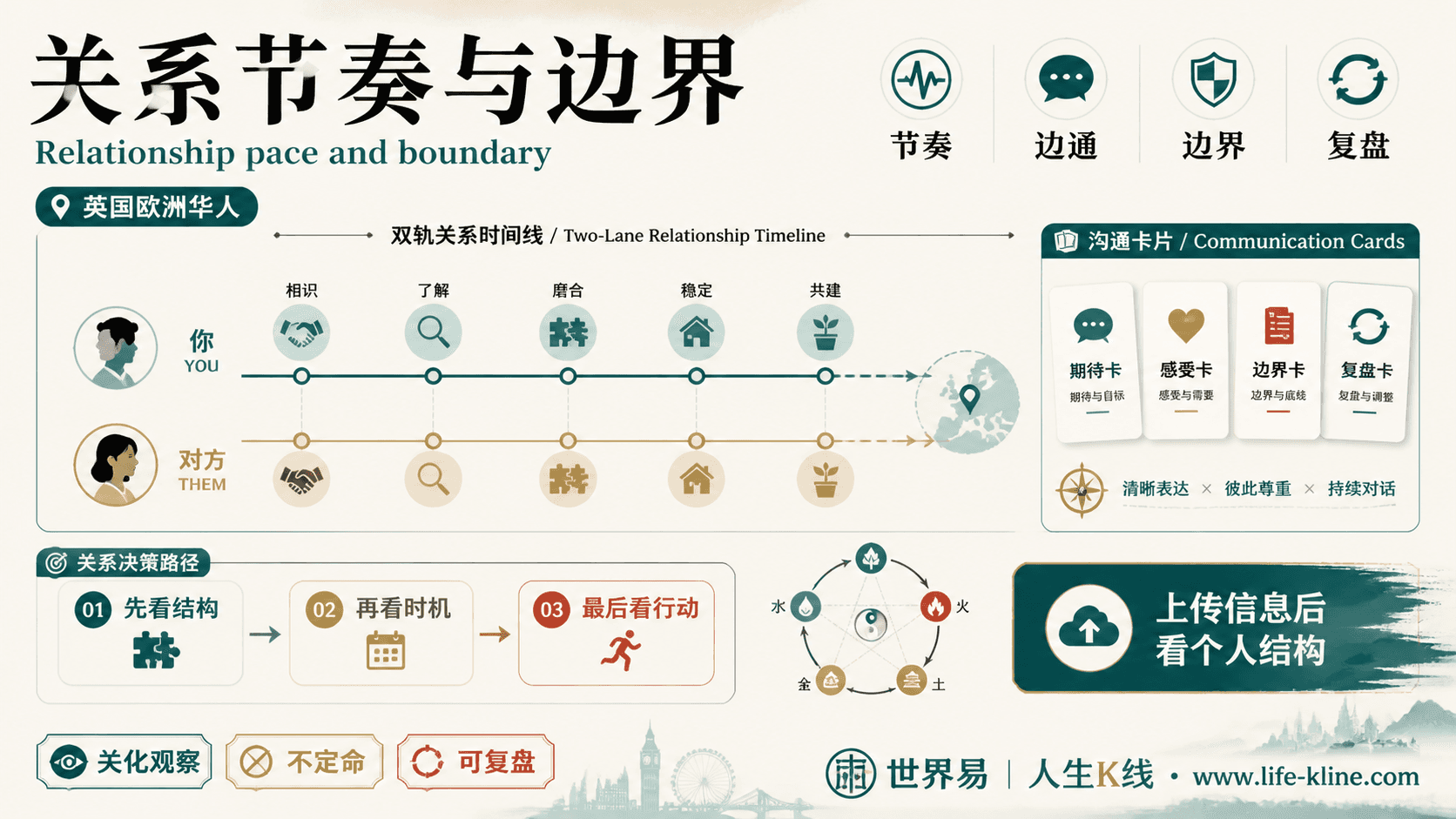
关系节奏与边界|英国欧洲华人
这张图把《A BaZi Analysis and Practical Guide to Role Reallocation in Overseas Chinese Families in the UK and Europe》里的命理概念转成关系、边界和应用场景,适合先看图建立结构,再回到知识文章正文理解细节。
关系节奏与边界不应被写成固定结论。更适合英国欧洲华人的读法,是把传统术语翻译成结构、时机、环境、行动和复盘。
查看图片解读