An Analysis of BaZi and Practical Realities in Overseas Chinese Decision-Making for Elderly Parental Care in the UK and Europe
把这篇文章落到自己身上验证:先看结构,再进入个人分析,不做泛泛阅读。
你现在搜索的,
其实是一个要落到自己身上的判断。
当前页面主要回答「Overseas Chinese」这类搜索问题;真正有价值的下一步是把这套结构带进自己的报告、工具与案例验证。
Why This Scenario Is Especially Difficult for Overseas Chinese
Overseas Chinese in the UK and Europe often find themselves in a dilemma when facing the care of elderly parents, torn between returning home to provide care and offering remote support. Practical constraints such as high cross-border travel costs, visa policy restrictions, tax burdens, and time zone differences make personal accompaniment complicated and costly. Additionally, cultural differences and varying social security systems further increase the difficulty and uncertainty of caregiving arrangements.
BaZi (Four Pillars) metaphysics plays a unique role in this scenario by helping individuals gain insight into their intrinsic energy and compatibility with external environments through analysis of their Day Master strength, pattern, Yong Shen (favorable elements), and Da Yun (decade luck cycles) and Liu Nian (annual fortune) trends. When the BaZi structure aligns with the practical environment, it can provide more targeted guidance for decision-making, thereby avoiding resource waste and psychological burdens caused by blind actions.
At the same time, overseas Chinese families often have complex relationships, with strong emotional ties but significant physical distance. The palace environments and the influence of the Ten Gods (Shi Shen) in BaZi are amplified or suppressed by the realities of geography and social environment. For example, the resource support ability represented by the Yong Shen in the chart may be practically limited by taxation and exchange rate factors, affecting the feasibility and effectiveness of decisions.
Therefore, decisions about overseas parental care are not only expressions of emotion and responsibility but also a multidimensional interplay between real-world conditions and metaphysical energies. Only by deeply understanding the interaction of these two aspects can one make optimal choices that are both consistent with BaZi trends and practically feasible.
Three Core Dimensions of BaZi Analysis
First, the Day Master and pattern determine an individual’s fundamental energy and personality tendencies. For example, a relatively strong Earth Day Master usually represents stability and a strong sense of responsibility, whereas a weaker Day Master may require external resource support. Patterns such as Bi Jian (Peer), Zheng Cai (Direct Wealth), and Pian Yin (Indirect Resource) respectively reflect competitiveness, wealth management, and supportive resources, directly influencing initiative and risk tolerance in decision-making.
Second, the Yong Shen (favorable element) and Ji Shen (unfavorable element) indicate which Five Elements are beneficial or detrimental during specific Da Yun (decade luck cycles) and Liu Nian (annual fortunes). The smooth functioning of the Yong Shen means the individual can effectively mobilize needed resources; conversely, the Ji Shen represents obstacles and risks. The interaction of Da Yun and Liu Nian reveals the current phase’s fortune trend, where auspicious Da Yun favor proactive actions, and stable or fluctuating periods suggest cautious weighing of options.
Third, the palace environments reflect the concrete domains of BaZi in reality, representing energy distribution in family, career, health, and other areas. In overseas parental care decisions, the Family Palace and Wealth Palace are especially important, symbolizing family responsibilities and economic support capacity. Combined with unique overseas factors such as taxation, exchange rates, and cross-border restrictions, the energy expression of these palaces can be correspondingly amplified or suppressed by the real environment.
Integrating these three dimensions, BaZi not only reveals personal potential and challenges but also provides a structured analytical framework for complex overseas family care decisions. This enables decision-makers to identify when BaZi and reality align for active return-home care and when remote support is more appropriate, thereby reducing decision risks.
Three Real BaZi Chart Case Studies
Case 1: This gentleman’s Day Master is Ji (己, Earth), relatively strong, forming a Bi Jian (Peer) pattern. His Yong Shen are Wood and Water, with Fire as Ji Shen (unfavorable element). Currently, he is in the Jia Zi (甲子, 46-55 years old, auspicious) Da Yun, with Bing Wu (丙午) Liu Nian favoring action. In the UK and European reality, although he has stable fortune support and his relatively strong Day Master grants him a strong sense of responsibility and self-drive, the Ji Shen Fire representing obstacles may be intensified by cross-border travel and cultural differences. It is recommended that he first assess the feasibility of remote support, optimize resource allocation during this auspicious Da Yun, and consider returning home to accompany only when the Liu Nian is more favorable, avoiding unnecessary pressure from impulsive actions.
Case 2: This lady’s Day Master is Wu (戊, Earth), relatively weak, with a Zheng Cai (Direct Wealth) pattern. Her Yong Shen is Fire, while Ji Shen are Metal and Water. She is currently in the Ding You (丁酉, 54-63 years old, conservative) Da Yun, with Bing Wu (丙午) Liu Nian requiring adaptability. Her BaZi indicates economic and emotional reliance on external support, and the weak Day Master suggests caution in action. In the UK and Europe, taxation and family burdens may reflect the Ji Shen Metal and Water constraints, limiting her financial liquidity. It is advised that she prioritize stability under the current Da Yun and Liu Nian, favor remote support measures, and plan finances prudently to avoid destabilizing her overall life by blindly returning home to provide care.
Case 3: A young lady with a Wu (戊, Earth) Day Master, relatively strong, forming a Pian Yin (Indirect Resource) pattern. Her Yong Shen are Wood and Water, with Fire as Ji Shen. She is currently in the Ji Wei (己未, 21-30 years old, stable) Da Yun, with Bing Wu (丙午) Liu Nian requiring adaptability. Being young and with a relatively strong Day Master, she has strong adaptability and learning ability, but the Ji Shen Fire may correspond to emotional fluctuations and family conflicts in reality. Living in the UK and Europe, she faces dual pressures from work and family, and the complexity of cross-border care is a challenge. It is recommended that she take steady steps during this stable Da Yun, prioritize remote support, accumulate resources and experience, and plan for returning home or short-term accompaniment when future Da Yun are more favorable.
All three cases illustrate the deep connection between Day Master strength, patterns, Yong Shen, and the overseas environment, emphasizing time- and place-sensitive decision strategies that avoid one-size-fits-all blind choices.
Common Misconceptions Among Overseas Chinese in This Scenario
Many overseas Chinese often overlook the internal rhythm of their BaZi and blindly pursue returning home to provide care, neglecting practical constraints such as visas, taxation, and cross-border travel. This leads to increased financial and psychological pressure on families. Especially when Da Yun and Liu Nian are unfavorable, rash actions tend to result in adverse outcomes.
Another common misconception is overreliance on remote support, ignoring the need for direct emotional communication and physical presence within the family. When the Yong Shen in BaZi is not fully activated, remote modes may fail to meet the critical caregiving needs of parents, causing emotional estrangement.
Additionally, many neglect the real-world reflections of Ji Shen in their charts, treating BaZi patterns and reality as separate, resulting in a lack of holistic perspective during decision-making and missing optimal timing to adjust strategies.
Therefore, rationally identifying one’s BaZi strengths and limitations, combined with real cross-border constraints, and avoiding extreme decisions are key for overseas Chinese to achieve effective parental care.
Practical Decision-Making Sequence
Step one: Clarify your BaZi structure, especially the Day Master strength, pattern type, Yong Shen, and Ji Shen, combined with the current Da Yun and Liu Nian, to assess your current energy state and potential risks. For example, auspicious Da Yun favor proactive actions, whereas unfavorable periods call for cautious waiting.
Step two: Outline key practical constraints such as visa policies, cross-border travel costs, tax burdens, and family support capabilities, to evaluate the feasibility and cost-effectiveness of returning home versus remote support.
Step three: Cross-match internal BaZi energy with external practical constraints to identify when BaZi energy and real conditions align for active action, and when conflicts exist, adopt conservative or adjusted strategies.
This sequence helps overseas Chinese clarify decision logic, avoid unfavorable choices driven by blind emotions, and achieve rational, BaZi-consistent family care arrangements.
FAQ
Question 1: How do I determine whether I should return home to provide care or support remotely? Answer: First, consider your Day Master strength and Yong Shen. If your Day Master is relatively strong and your current Da Yun is auspicious, you have sufficient energy to actively return home. If your Day Master is weak or the Da Yun is stable, remote support is preferable. Also, factor in practical visa and financial conditions for a comprehensive judgment.
Question 2: How does the Ji Shen (unfavorable element) affect caregiving decisions? Answer: Ji Shen represents obstacles or risks in action. If Ji Shen is active in the current Liu Nian or Da Yun, it often corresponds to legal, financial, or emotional barriers in reality. Decisions should be cautious, avoiding impulsive moves, and prioritize alternative solutions.
Question 3: What is the specific role of Da Yun and Liu Nian in overseas caregiving? Answer: Da Yun determines the overall fortune trend for a period, while Liu Nian affects the specific conditions of the year. When Da Yun is auspicious and Liu Nian is favorable, proactive action is suitable. When Da Yun is stable or Liu Nian fluctuates, it is better to maintain the status quo or adapt flexibly, adjusting plans based on real circumstances.
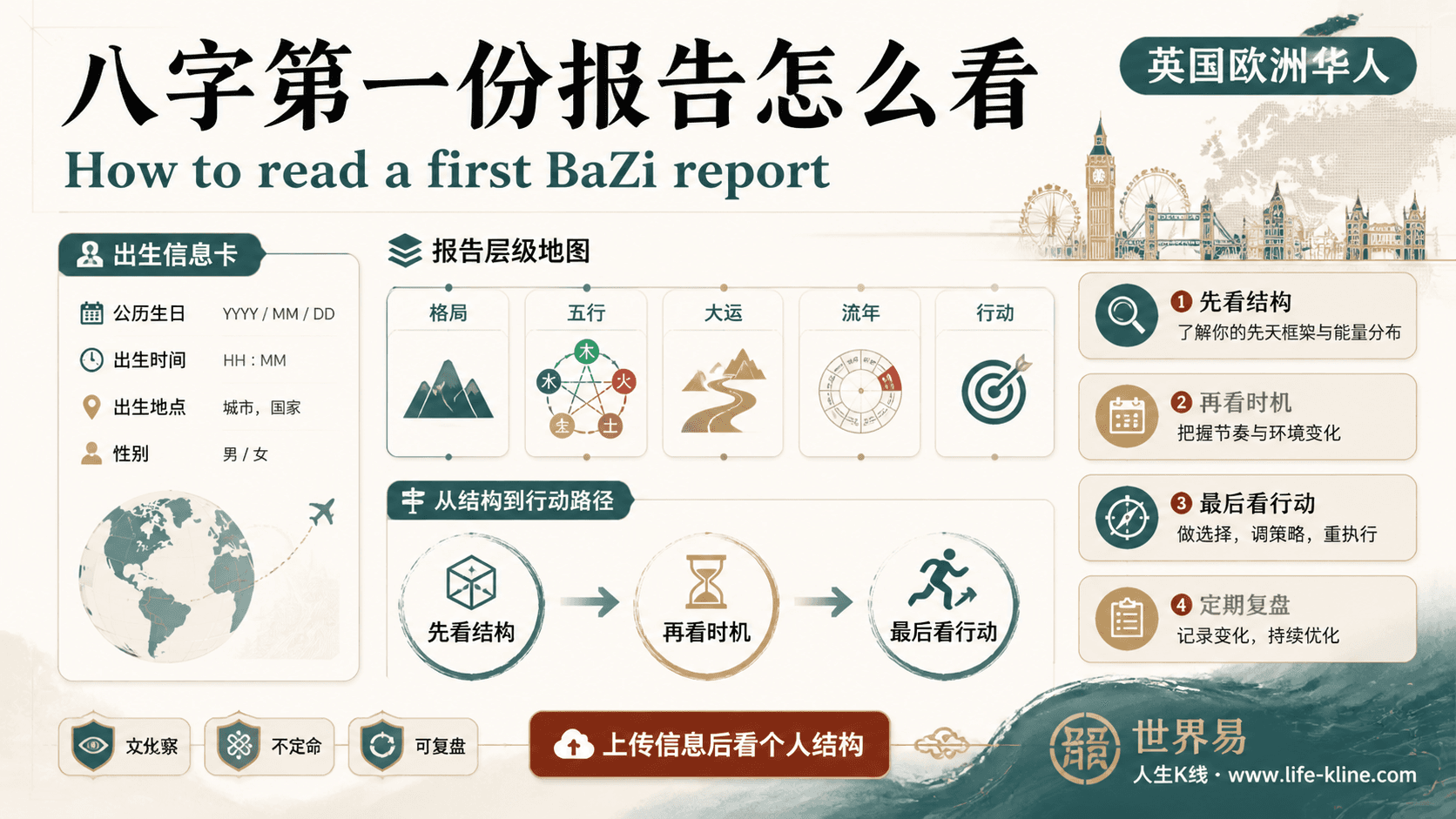
八字第一份报告怎么看|英国欧洲华人
这张图把《An Analysis of BaZi and Practical Realities in Overseas Chinese Decision-Making for Elderly Parental Care in the UK and Europe》里的命理概念转成关系、边界和应用场景,适合先看图建立结构,再回到知识文章正文理解细节。
八字第一份报告怎么看不应被写成固定结论。更适合英国欧洲华人的读法,是把传统术语翻译成结构、时机、环境、行动和复盘。
查看图片解读