A Metaphysical Analysis and Practical Guide to Cross-Cultural Career Role Matching for Chinese in the UK and Europe
把这篇文章落到自己身上验证:先看结构,再进入个人分析,不做泛泛阅读。
Why This Scenario Is Especially Challenging for Overseas Chinese
Chinese individuals in the UK and Europe face numerous practical constraints when matching career roles across cultures. Firstly, cultural differences lead to significant variations in workplace communication, role expectations, and promotion pathways. The clash between Eastern and Western values means the same role demands different skill densities and advancement rhythms in different cultural environments. Secondly, tax systems, social security, and fluctuations in cross-border financial exchange rates impose additional challenges on career choice and income stability, affecting personal career planning and risk tolerance.
Moreover, geographical distance from family and the pressures of transnational living increase the complexity of role adaptation. Chinese immigrants often need to balance family relationships both domestically and abroad. Psychological stress and identity issues in cross-cultural environments also influence career performance and role positioning. The metaphysical structure does not exist in isolation here; it deeply intertwines with external environments. The Day Master’s strength, structure, and Yong Shen’s alignment with the real workplace culture directly affect role density and advancement methods.
The influence of Da Yun (decade luck cycles) and Liu Nian (annual fortune) is particularly critical in overseas contexts. Auspicious Da Yun and favorable Liu Nian can amplify opportunities for smooth career development, whereas unfavorable Da Yun may be exacerbated by cultural adaptation difficulties and external constraints, causing career bottlenecks. Overall, the key challenge for overseas Chinese in cross-cultural career matching lies in integrating their metaphysical strengths with external environmental limitations to find the optimal role positioning and advancement strategy.
Three Core Dimensions of Metaphysical Judgment
The Day Master, as the core of BaZi, reflects an individual’s fundamental energy and personality traits. In cross-cultural career scenarios, the Day Master’s strength determines one’s adaptability and initiative in facing cultural differences. For example, a relatively weak Day Master may require external support from the Yong Shen to enhance decisiveness and action, whereas a relatively strong Day Master needs to be mindful of Ji Shen (unfavorable elements) restrictions to avoid impulsiveness or stubbornness.
The structure reveals the core energy pattern and workplace positioning of the individual. For instance, a Bi Jian (Peer) structure emphasizes peer competition and self-realization; a Yang Ren (Yang Blade) structure manifests strong initiative and decisiveness; a Zheng Cai (Proper Wealth) structure focuses on steady financial management and resource integration. Identifying the structure helps determine the suitable role density—whether to handle multiple roles simultaneously or focus deeply on a single role.
The relationship between Yong Shen and Ji Shen indicates the supportive elements needed and potential risks. Combined with Da Yun and Liu Nian, one can assess the current environment’s benefits and drawbacks for career development. When Da Yun is favorable and aligns with Liu Nian, role advancement can be more proactive; if Da Yun is stable or constrained, it is advisable to maintain current achievements or flexibly adjust role density. Although the palace environments are not detailed, considering the chart facts, the overall energy flow synchronized with external cultural environments will greatly impact the effectiveness of career decisions.
Three Real BaZi Chart Cases
Case 1: This subject is a male aged 20-25, with Day Master Ren (壬, Water), relatively weak, Bi Jian (Peer) structure. Yong Shen is Metal, Ji Shen are Wood and Fire. Currently in the Geng Chen (庚辰) Da Yun (14-23 years old). The Geng Chen Da Yun is auspicious, and the Liu Nian Bing Wu (丙午) is favorable. In the multicultural workplace of the UK and Europe, the relatively weak Ren Water Day Master limits adaptability, requiring reliance on the Yong Shen Metal to enhance decision-making and action. The Bi Jian structure emphasizes peer competition, which in the UK’s cultural context of individual independence and teamwork is both a challenge and an opportunity. Ji Shen Wood and Fire represent potential competitive pressures and cultural conflicts in the workplace. It is recommended that this individual prioritize roles that leverage team resources and institutional support, avoid excessive self-driven role density, and adapt gradually.
Case 2: This subject is aged 30-35, with Day Master Ding (丁, Fire), relatively strong, Yang Ren (Yang Blade) structure. Yong Shen are Water and Metal; Ji Shen is Wood. Currently in the Xin Hai (辛亥) Da Yun (24-33 years old), a very auspicious luck cycle. The Yang Ren structure reflects strong initiative and a desire for breakthroughs. The relatively strong Day Master indicates proactivity, suitable for leadership or change-driving roles in the UK and European workplaces. Yong Shen Water and Metal support energy harmonization and resource management, while Ji Shen Wood indicates potential cultural friction or risks of overexpansion. The Xin Hai Da Yun aligns well with the Bing Wu Liu Nian, favoring career success. This individual can increase role density, managing multiple projects or teams, but must carefully control pace to avoid conflicts escalating due to cultural differences. It is advised to first assess key cultural nodes and team acceptance, then advance steadily.
Case 3: This subject is aged 25-30, with Day Master Ding (丁, Fire), relatively weak, Zheng Cai (Proper Wealth) structure. Yong Shen is Water; Ji Shen are Earth and Metal. Currently in the Ren Xu (壬戌) Da Yun (20-29 years old), a stable luck cycle. The Zheng Cai structure emphasizes steady financial management and resource integration. The relatively weak Day Master indicates insufficient initiative, requiring reliance on Yong Shen Water for flexibility and adaptability. In the UK and European workplace, this individual suits steady roles, especially in finance, compliance, or cross-border fund management. Ji Shen Earth and Metal may correspond to pressures from UK tax regulations and cross-border financial restrictions. With a stable Da Yun and Liu Nian Bing Wu for flexibility, it is recommended to avoid excessive role stacking, focus on deepening expertise in a single field, and flexibly adjust strategies to accommodate cultural and policy changes.
Common Misconceptions Among Overseas Chinese in This Scenario
Many overseas Chinese overlook the interaction between their metaphysical structure and the external environment when matching cross-cultural careers. They blindly apply domestic success experiences, causing role positioning to disconnect from the actual cultural environment. Role advancement methods may become overly aggressive or conservative, negatively impacting career development. Additionally, some overly rely on their strong Day Master while neglecting the potential constraints and support from Ji Shen and Yong Shen, failing to flexibly adjust career strategies.
Other common misconceptions include ignoring the guidance of Da Yun and Liu Nian on career rhythm, leading to blind expansion or high-risk decisions during unfavorable luck cycles, increasing failure risks. Some overseas Chinese fail to effectively utilize their metaphysical structure advantages such as Bi Jian or Zheng Cai in cross-cultural teams, missing opportunities to leverage collaboration or resource management capabilities and losing promotion chances. Lastly, insufficient understanding of tax, exchange rates, and cross-border policies results in failure to incorporate these practical constraints into overall career role matching, causing imbalanced planning.
Practical Judgment Sequence
First, clarify the individual’s Day Master strength and structure type to assess basic adaptability and role positioning tendencies in cross-cultural environments. Second, combine Yong Shen and Ji Shen to identify the most needed support elements and risks in the current environment, optimizing role density and advancement rhythm. Third, focus on the interaction between current Da Yun and Liu Nian to judge whether it is suitable to expand role coverage or adopt a conservative approach.
Next, integrate the UK and European workplace culture, tax policies, and cross-border financial environment to evaluate the subject’s resource integration ability and risk tolerance, adjusting career path and role depth accordingly. Finally, it is recommended to conduct small-scale trials and collect feedback first, dynamically adjusting advancement methods based on cultural adaptation and metaphysical indications to ensure scientifically sound decisions that maximize the alignment between metaphysical advantages and the environment.
FAQ
Question 1: Will the same BaZi chart have different career role matching outcomes in the UK versus other European countries? Answer: Yes, differences exist. Although the UK and some European countries share cultural similarities, variations in tax policies, workplace culture details, and language environments affect the expression of Yong Shen and suppression of Ji Shen. Flexible adjustments based on specific country contexts are necessary.
Question 2: How to determine when it is appropriate to increase career role density? Answer: This should be judged by combining the current Da Yun and Liu Nian fortunes. When luck is favorable and aligned, increasing role density is suitable. At the same time, cultural adaptation level and team support should be assessed. Avoid rushing and expand gradually.
Question 3: In cross-cultural environments, how does Ji Shen manifest as real-world obstacles? Answer: Ji Shen corresponds to real obstacles such as cultural friction, policy restrictions, or interpersonal conflicts. The individual needs to adjust Yong Shen or strategies to mitigate Ji Shen’s impact and avoid career advancement blockages.
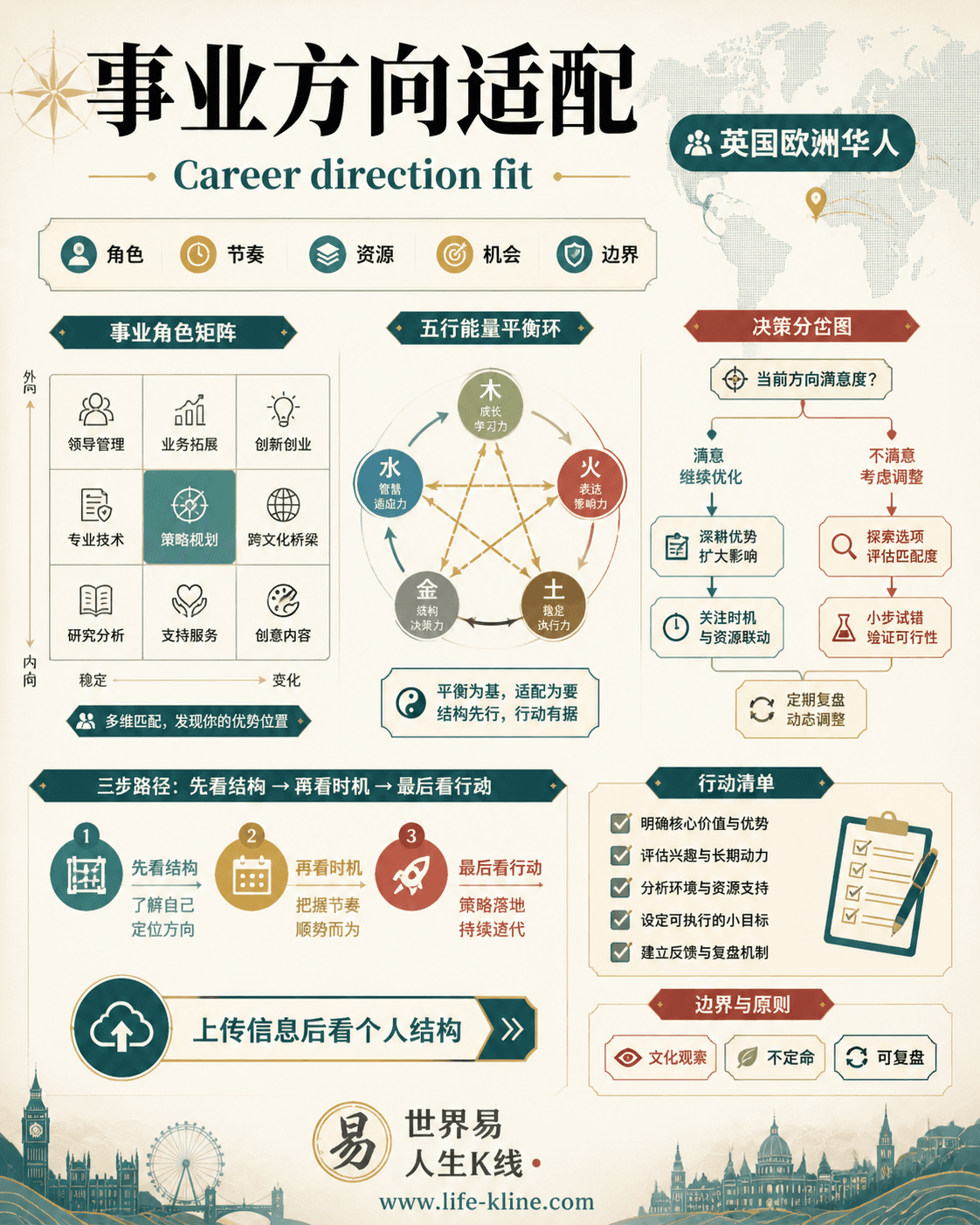
事业方向适配|英国欧洲华人
这张图把《A Metaphysical Analysis and Practical Guide to Cross-Cultural Career Role Matching for Chinese in the UK and Europe》里的命理概念转成关系、边界和应用场景,适合先看图建立结构,再回到知识文章正文理解细节。
事业方向适配不应被写成固定结论。更适合英国欧洲华人的读法,是把传统术语翻译成结构、时机、环境、行动和复盘。
查看图片解读