Annual Fortune Rhythm Analysis and Guide to Using the Annual Window Tool
把这篇文章落到自己身上验证:先看结构,再进入个人分析,不做泛泛阅读。
What This Scenario Is Judging
The core of the annual fortune rhythm lies in accurately identifying the impact of each year's Liu Nian on an individual's BaZi chart, avoiding fear caused by the superficial label of an 'inauspicious year,' or missing the beneficial energy contained in a 'Yong Shen year.' The Five Elements characteristics and Ten Gods manifestations inherent in the Liu Nian must be comprehensively judged in combination with the Day Master's strength, the chart pattern, and the current Da Yun status.
The Liu Nian does not exist in isolation but interacts with the Da Yun. This interaction determines whether the Liu Nian can exert a positive effect or bring obstacles. Correct interpretation of the annual fortune requires first understanding the Day Master's attributes and strength in the personal BaZi chart, then combining the overall trend of the Da Yun, and finally closely examining the relationship between the Liu Nian and Da Yun.
To avoid being frightened by an 'inauspicious year,' the primary analysis is whether the Liu Nian truly triggers the Ji Shen (unfavorable element) or clashes with important palaces, and whether it weakens the Yong Shen's power; similarly, to identify a 'Yong Shen year,' observe whether the Liu Nian enhances the Yong Shen, bringing smooth energy. Overall, judging the annual fortune rhythm is a systematic framework relying on the synergistic analysis of the three major metaphysical dimensions.
Three Core Dimensions Seen in the BaZi Chart
The first is the Day Master and its strength. The Day Master represents the Day Master's own Five Elements attribute, and its strength determines the individual's adaptability to the external environment and energy needs. For example, a relatively strong Day Master usually requires some restraint or drainage to balance, while a relatively weak Day Master needs supplementation.
The second is the pattern and Yong Shen. The pattern reflects the overall momentum and Five Elements distribution of the BaZi chart, while the Yong Shen is the key element that harmonizes the Five Elements and improves fortune. Accurately identifying the Yong Shen helps judge the benefits or harms of the Liu Nian to the individual.
The third is the interaction between Da Yun and Liu Nian. Da Yun represents the medium-to-long-term trend, while Liu Nian is the specific annual manifestation. When the Five Elements of Liu Nian and Da Yun generate nurturing or controlling relationships, it will have a significant impact on fortune. Mastering this interaction is key to precise prediction.
Three Real BaZi Chart Cases
Case 1: This female's Day Master is Yi Wood (乙, Yi) and relatively strong, with a Jian Lu pattern. Her Yong Shen is Fire, and Ji Shen is Water. She is currently in the 4th year of the Jia Wu (甲午, Jia Wu) Da Yun, with the Liu Nian being Bing Wu (丙午, Bing Wu). The Jia Wu Da Yun is a stable period, suitable for maintaining achievements. The Bing Wu Liu Nian has strong Wood and Fire, which precisely enhances the Yong Shen Fire energy. In the annual rhythm, the focus is on whether the Fire energy in the Liu Nian is effectively utilized and whether Water interference is avoided. The judgment sequence suggests first confirming the Day Master's strength, then examining the Liu Nian's Five Elements support for the Yong Shen Fire.
Case 2: This male's Day Master is Bing Fire (丙, Bing) and relatively strong, with a specialized strong pattern. His Yong Shen is Metal, and Ji Shen is Fire. He is in the 3rd year of the Bing Xu (丙戌, Bing Xu) Da Yun, with the Liu Nian being Bing Wu (丙午, Bing Wu). The Da Yun is overall stable, but the Liu Nian has strong Fire, which is both the Ji Shen and prominent in the Liu Nian. It is necessary to guard against excessive Fire overpowering the Yong Shen Metal, avoiding Fire damaging Metal. The judgment sequence is to first confirm the Day Master's Fire strength, then analyze the Liu Nian Fire's influence on the Yong Shen Metal, ensuring that the strength of the Ji Shen in the Liu Nian is properly mitigated.
Case 3: This male's Day Master is Gui Water (癸, Gui) and relatively strong, with a specialized strong pattern. His Yong Shen is Metal, and Ji Shen is Fire. He is currently in the 3rd year of the Wu Shen (戊申, Wu Shen) Da Yun, with the Liu Nian being Bing Wu (丙午, Bing Wu). The Da Yun is auspicious, with progress in career and wealth. Although the Liu Nian Fire is strong and the Ji Shen, the Da Yun support and the effective Yong Shen Metal allow the Liu Nian to proceed smoothly. The judgment sequence suggests first analyzing the overall support brought by the auspicious Da Yun, then focusing on the impact of the Liu Nian Fire Ji Shen, and finally making a comprehensive judgment combined with the Yong Shen's harmonizing condition.
Common Misconceptions
First, simply judging good or bad fortune based solely on whether the Liu Nian Five Elements correspond to Ji Shen or Yong Shen, while ignoring the interaction between Da Yun and Liu Nian. The appearance of Ji Shen in Liu Nian does not necessarily mean an inauspicious year; the support from Da Yun may alleviate or transform its negative effects.
Second, neglecting the strength state of the Day Master, leading to misjudgment of Liu Nian energy. A relatively strong or weak Day Master reacts very differently to the Liu Nian Five Elements; without distinguishing strength, it is difficult to accurately judge the annual fortune.
Third, focusing narrowly on the Liu Nian without analyzing the specific Ten Gods and palace clashes or combinations within the Liu Nian, which easily leads to biased conclusions. Annual fortune interpretation should involve multi-dimensional detailed analysis rather than single-dimensional judgments.
Judgment Sequence and Tool Anchors
The first step in judging the annual fortune rhythm is to understand the Day Master's Five Elements attribute and its strength, which is the foundation of the entire analysis. The second step is to confirm the individual's pattern and identify the Yong Shen and Ji Shen, clarifying the potential assistance or obstruction of the Liu Nian to the individual. The third step is to analyze the Five Elements relationship between the current Da Yun and Liu Nian, judging whether they nurture or control each other; this step determines the extent of Liu Nian energy exertion.
After completing the above three basic judgments, the next step is to enter detailed calibration of the Liu Nian energy rhythm. At this point, using the 'Annual Window' tool can help the individual more accurately grasp the specific timing of the Yong Shen's effect within the Liu Nian, avoiding blind fear of 'inauspicious years' and not missing the good opportunities of 'Yong Shen years.' The Annual Window tool subdivides time nodes to assist in adjusting the overall fortune rhythm and is a key supplement in the judgment sequence.
Therefore, the complete judgment sequence for annual fortune is: first observe the Day Master's strength, then examine the pattern and Yong Shen, next analyze the Da Yun and Liu Nian interaction, and finally use the 'Annual Window' tool to finely calibrate the specific timing within the Liu Nian. Only in this way can the annual Liu Nian be interpreted scientifically and comprehensively.
FAQ
Q: Why can't we judge an 'inauspicious year' or 'auspicious year' solely based on the Liu Nian Five Elements? A: The Liu Nian Five Elements are only one influencing factor. It must be combined with the Day Master's strength and Da Yun trend to judge its true effect; otherwise, it is easy to be one-sided or overreact.
Q: What is the difference between a Yong Shen year and a Ji Shen year? A: A Yong Shen year is when the Liu Nian strengthens the individual's Yong Shen Five Elements, bringing opportunities and smoothness; a Ji Shen year may activate restrictions and conflicts within the chart, requiring resolution and cautious handling.
Q: What specifically does the 'Annual Window' tool help with? A: It helps users refine key time points within the Liu Nian, accurately capturing the peaks of Yong Shen power and the valleys of Ji Shen, thereby more scientifically mastering the rhythm of the annual fortune.
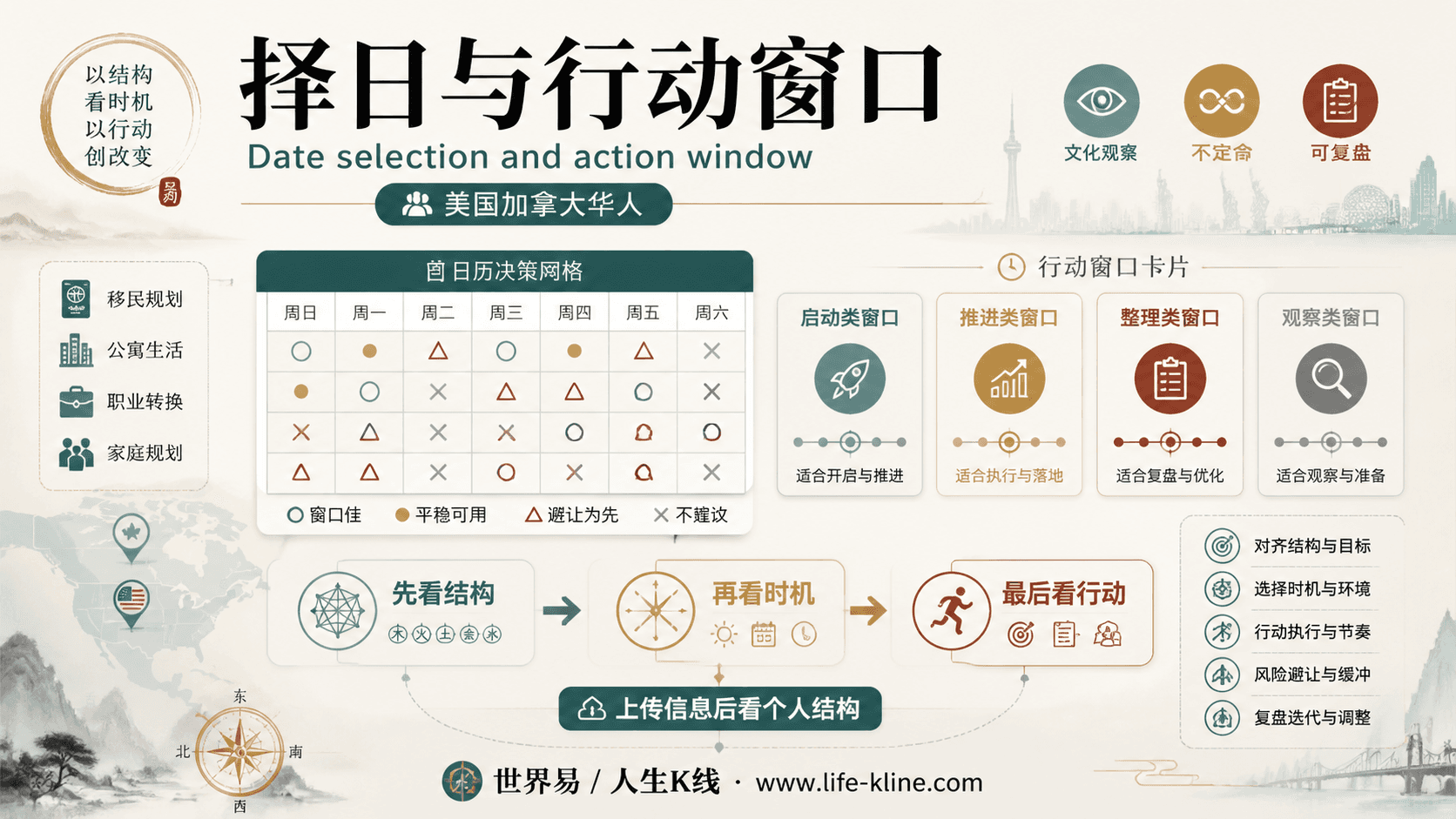
择日与行动窗口|美国加拿大华人
这张图把《Annual Fortune Rhythm Analysis and Guide to Using the Annual Window Tool》里的命理概念转成关系、边界和应用场景,适合先看图建立结构,再回到知识文章正文理解细节。
择日与行动窗口不应被写成固定结论。更适合美国加拿大华人的读法,是把传统术语翻译成结构、时机、环境、行动和复盘。
查看图片解读