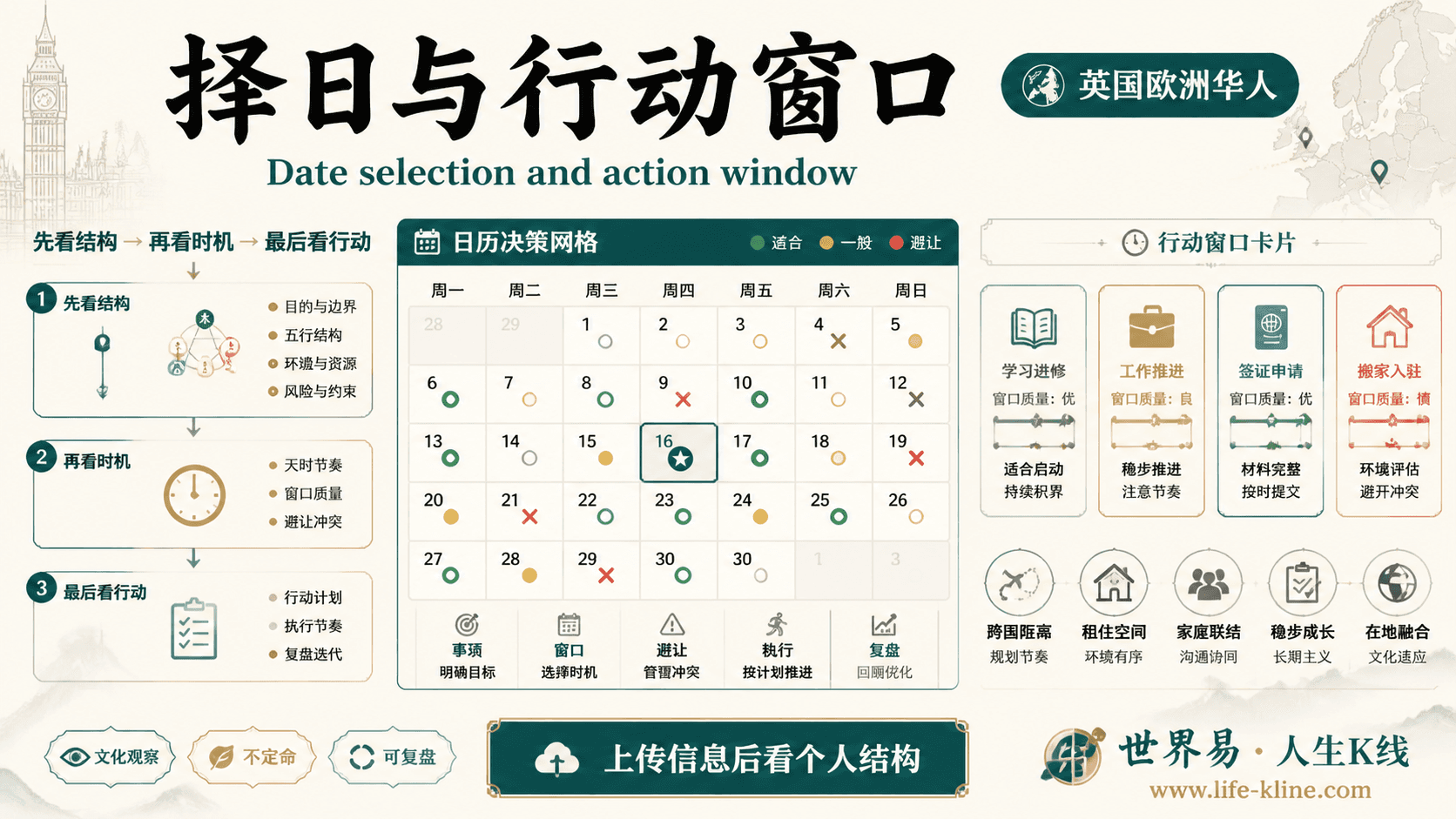
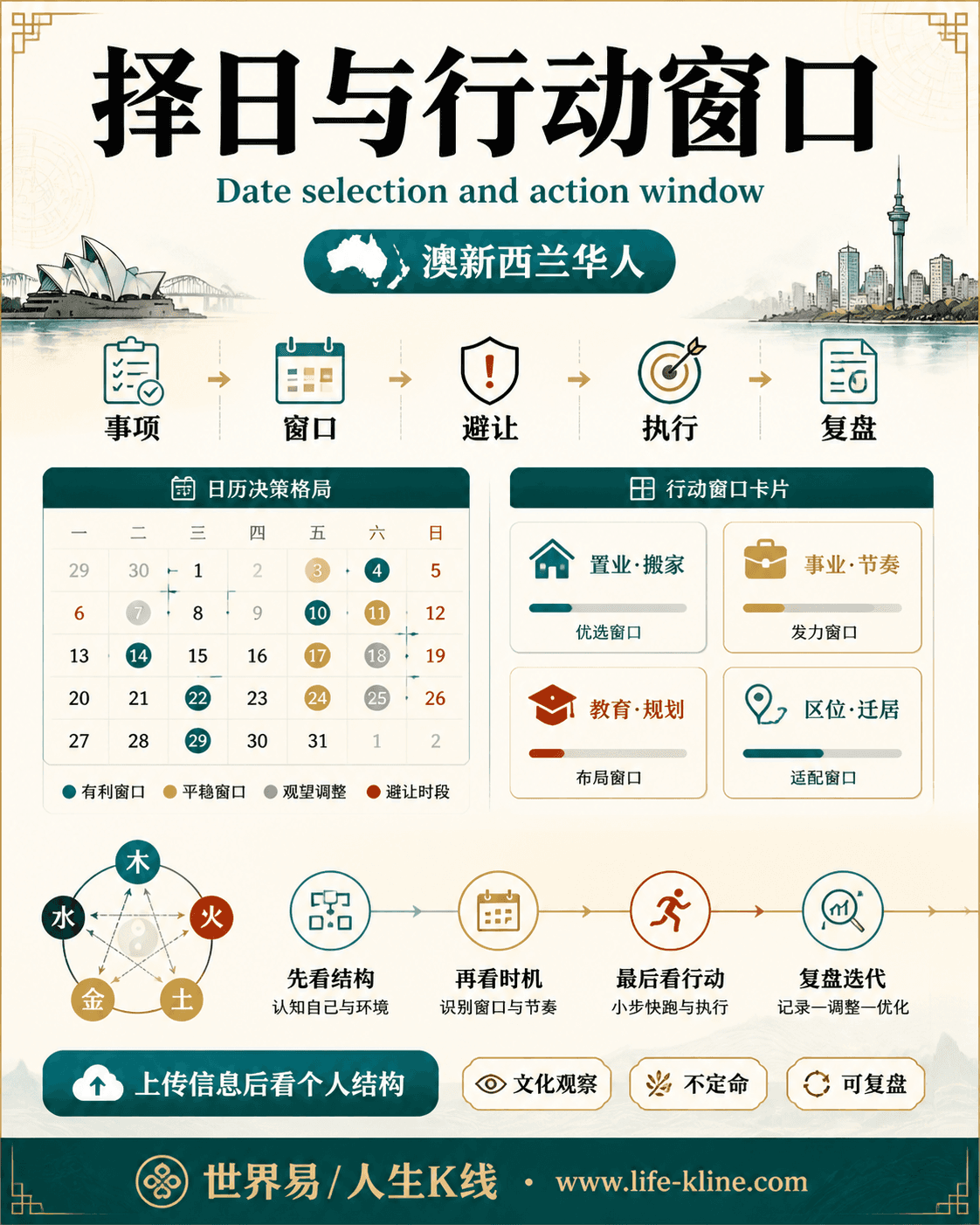
Key Techniques for Identifying the Main Push and Contraction Windows in Monthly Action Rhythms
把这篇文章落到自己身上验证:先看结构,再进入个人分析,不做泛泛阅读。
What This Scenario Is Judging
The core of monthly action rhythms is to identify the time windows each month that are suitable for exerting effort (main push) and those suitable for contraction or defense. This judgment helps individuals reasonably allocate resources and actions during different periods, avoiding blind impulsiveness or excessive conservatism.
To judge the main push and contraction windows, one must first clarify the strength or weakness of the Day Master in the natal chart and its Yong Shen (favorable element) and Ji Shen (unfavorable element), as these determine the driving force and resistance for action. Secondly, by combining the changes in Da Yun and Liu Nian, observe how time nodes support or consume the Day Master's energy, thereby judging the rhythm's speed and adjustments.
Monthly rhythm is not simply about looking at the monthly pillar alone but requires overlaying the monthly pillar with the overall energy field of Liu Nian and Da Yun. Only then can one accurately grasp the transitions between main push and contraction, forming a dynamic time management strategy.
Moreover, monthly rhythms also involve the flow of the five elements according to the solar terms and the coordination with the natal chart's pattern. Especially when the Yong Shen is in season, it often represents a golden window for action, whereas when the Ji Shen is in season, caution and contraction are required.
Three Core Dimensions to Look at in the Natal Chart
The first is the Day Master and its strength or weakness. The strength of the Day Master determines its energy foundation and adaptability to external changes. A relatively strong Day Master often has stronger initiative, while a weaker one needs to rely on the Yong Shen for adjustment.
The second is the status of the Yong Shen and Ji Shen. The Yong Shen provides support to the chart and is the powerful direction for action; the Ji Shen represents obstacles and factors to avoid. Judging monthly rhythms requires focusing on the relationship between the month's five elements and the Yong Shen and Ji Shen.
The third is the interaction between Da Yun and Liu Nian. Da Yun represents longer-term trends, while Liu Nian reflects the energy changes of the year. Combining these two can reveal the energy directions of the year and month, guiding the timing choices for main push and contraction.
These three dimensions intertwine to form a dynamic framework for judging monthly rhythms. Only by comprehensive consideration can one accurately identify each month's key action focus and adjustment nodes.
Three Real BaZi Chart Cases
Case 1: This female's BaZi chart has a relatively strong Day Master of Geng Metal (庚, Geng), belonging to the Yang Ren (羊刃) pattern, requiring Fire and Wood as Yong Shen, with Earth as Ji Shen. Currently in the 7th year of the Bing Chen (丙辰) Da Yun, with the Liu Nian being Bing Wu (丙午), both are Fire elements, clearly supporting the Yong Shen Fire. Combining monthly rhythm judgment, attention should be paid to months where Fire and Wood are strong as main push windows, while months heavy in Earth are suitable for contraction and adjustment. The judgment sequence is to first look at months when the Yong Shen is in season, then combine the strength of the annual Fire energy, and finally refer to the Da Yun's stability for fine-tuning.
Case 2: This male's BaZi chart has a relatively strong Day Master of Geng Metal (庚, Geng), with the Shi Shen (食神) pattern, and uses Fire and Wood as Yong Shen, Earth as Ji Shen. The current Da Yun is Geng Yin (庚寅) in its 8th year, with Liu Nian Bing Wu (丙午) having strong Fire energy. The periods within the month when Fire and Wood are in season serve as main push windows, while Earth in season requires contraction. The judgment starts by confirming the compatibility between the monthly pillar's five elements and the Yong Shen, then combining the strength of the Liu Nian Fire energy, and finally referencing the overall trend of the Da Yun to decide the rhythm's pace.
Case 3: This female's BaZi chart has a relatively strong Day Master of Ren Water (壬, Ren), with the Qi Sha (七杀) pattern, using Earth and Fire as Yong Shen, and Metal as Ji Shen. The current Da Yun is Gui Mao (癸卯) in its 8th year, with the Liu Nian Bing Wu (丙午) having abundant Fire. In the monthly action rhythm, months when Fire and Earth are in season are main push windows, while months when Metal is in season require contraction. The judgment steps are to first lock in months when the Yong Shen five elements are in season, assess the support level of the Liu Nian Fire, and then combine the Da Yun's stability for a comprehensive judgment on rhythm adjustment.
Common Misconceptions
Treating monthly rhythms independently and ignoring the overlay effects of Liu Nian and Da Yun leads to one-sided judgments and an incomplete action strategy.
Over-relying on the strength or weakness of the Day Master while neglecting the Yong Shen and Ji Shen often results in inaccurate identification of main push windows, missing optimal action timing.
Mistakenly believing that the main push window is only related to the month's monthly pillar five elements, ignoring the regulatory role of the annual Liu Nian and Da Yun on the overall rhythm.
Ignoring the natal chart's pattern characteristics and simply applying generic five-element flow rules to judge monthly rhythms causes imprecise rhythm control.
Judgment Sequence and Tool Anchors
To judge the main push and contraction windows in monthly action rhythms, first clarify the Day Master's strength and pattern in the natal chart, and confirm the specific five-element attributes of the Yong Shen and Ji Shen.
Next, combine the current Da Yun and Liu Nian, observing their specific manifestations in supporting the Yong Shen or suppressing the Ji Shen, forming the annual energy baseline.
Then, based on the five-element changes of the monthly pillar, judge the periods within each month when the Yong Shen or Ji Shen are in season, determining potential main push or contraction windows.
After completing these steps, use the 'monthly rhythm' tool to further calibrate the specific action timing each month, ensuring integration with the natal chart's overall dynamics to accurately grasp the monthly action rhythm and focus.
FAQ
Q: Is the main push window in the monthly rhythm always the month when the Yong Shen is in season? A: Usually, months when the Yong Shen is in season are more suitable for the main push, but it is also necessary to consider the overall support from Liu Nian and Da Yun; it cannot be judged in isolation.
Q: What effect does a fire-strong Liu Nian have on the monthly rhythm? A: A fire-strong Liu Nian generally enhances the energy of the Yong Shen fire, favoring action exertion, but if the Yong Shen is insufficient or the Ji Shen interferes, the effect will be weakened.
Q: How to avoid misconceptions in judging monthly rhythms? A: One should comprehensively consider the Day Master, Yong Shen and Ji Shen, Da Yun, Liu Nian, and monthly pillars, avoiding isolated consideration of any single factor, achieving multidimensional overlay analysis.
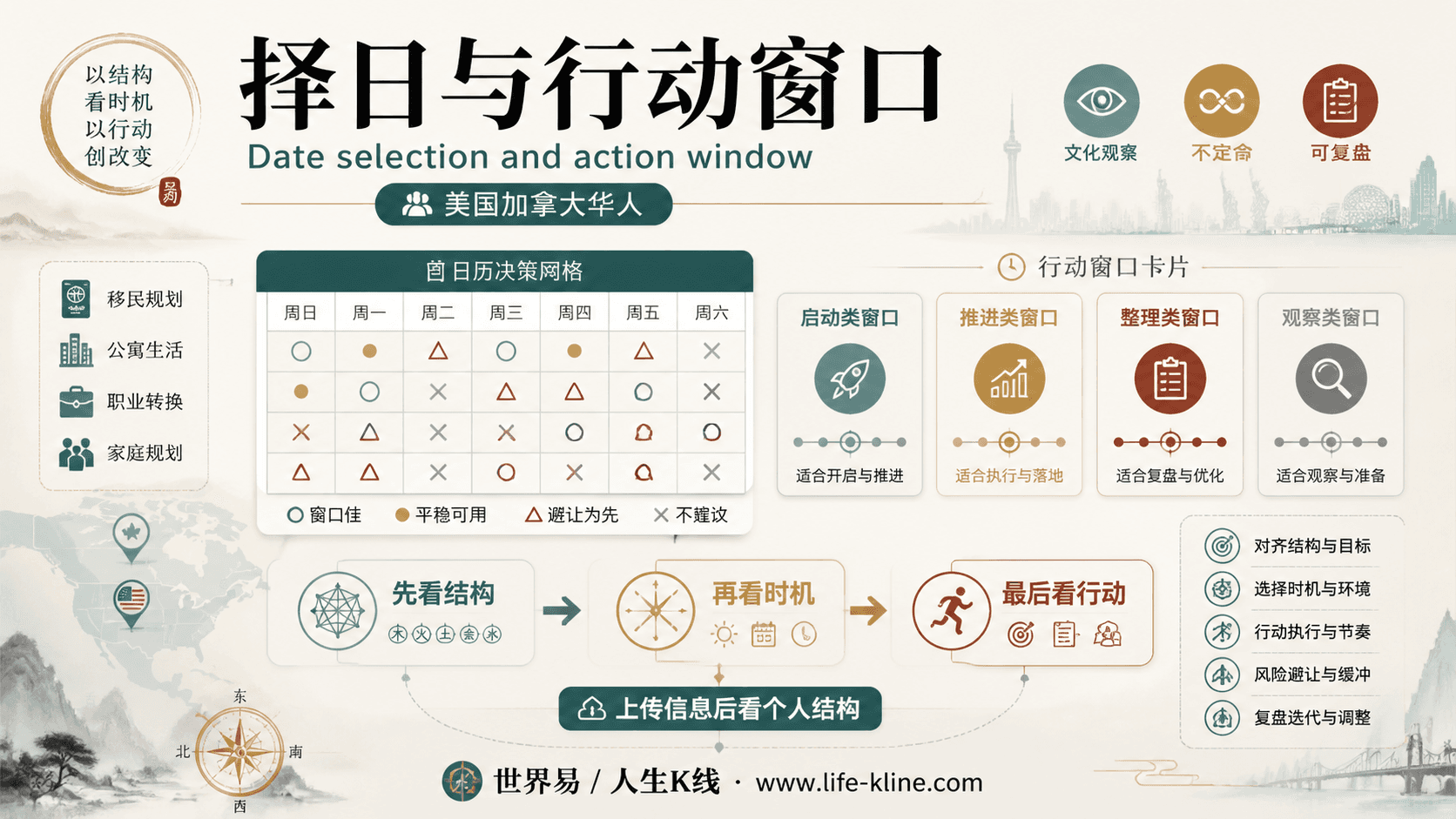
择日与行动窗口|美国加拿大华人
这张图把《Key Techniques for Identifying the Main Push and Contraction Windows in Monthly Action Rhythms》里的命理概念转成关系、边界和应用场景,适合先看图建立结构,再回到知识文章正文理解细节。
择日与行动窗口不应被写成固定结论。更适合美国加拿大华人的读法,是把传统术语翻译成结构、时机、环境、行动和复盘。
查看图片解读