How to Select a Conflict-Free Day Avoiding Ji Shen on Major Decision Days? Practical Guide to Decision Day Selection Tools
把这篇文章落到自己身上验证:先看结构,再进入个人分析,不做泛泛阅读。
你现在搜索的,
其实是一个要落到自己身上的判断。
当前页面主要回答「Major Decisions」这类搜索问题;真正有价值的下一步是把这套结构带进自己的报告、工具与案例验证。
What This Scenario Is Judging
The core of selecting a date for major decisions lies in avoiding days that conflict with or restrain the Ji Shen (unfavorable elements) in the individual's BaZi chart. For matters such as signing contracts, resigning, or negotiating cooperation, encountering conflict with the Ji Shen can easily cause obstacles and unexpected changes, affecting the effectiveness of the decision.
Therefore, date selection must consider not only the general auspiciousness of the day but also integrate the individual's BaZi information, especially the strength of the Day Master, the pattern type, and the Yong Shen and Ji Shen, to avoid making key decisions on days when the Ji Shen is dominant or in conflict.
Additionally, combining the current Da Yun and Liu Nian situation to assess the strength and stability of the present luck cycle helps select a more favorable timing for the decision, reducing risks.
In summary, date selection judgment depends on matching the core elements of the BaZi chart with the dynamic consideration of Da Yun and Liu Nian, providing a solid temporal foundation for major decisions.
Three Core Dimensions to Examine in the BaZi Chart
First is the Day Master and its strength. The Day Master represents the individual's own Five Elements strength, and its strength determines the choice of Yong Shen and Ji Shen, also influencing which day pillars and Heavenly Stems and Earthly Branches should be avoided during date selection.
Second is the pattern type. The pattern reflects the overall Five Elements combination and generating/controlling relationships in the BaZi chart, such as Cong Sha (從殺) pattern, Cong Er (從兒) pattern, or Zhuan Wang (專旺) pattern. Different patterns rely on Yong Shen and Ji Shen differently, so date selection must be adjusted according to the pattern characteristics.
Third is the Yong Shen and Ji Shen. Yong Shen is the element that harmonizes the Five Elements and supports the individual, while Ji Shen is the element that restrains the individual or causes unfavorable outcomes. Date selection should avoid days when Ji Shen is strong or conflicts with Yong Shen.
Moreover, combining the current Da Yun and Liu Nian to judge the individual's luck phase helps evaluate the overall auspicious or inauspicious trend of the day, enabling dynamic adjustment in date selection.
Three Real BaZi Chart Case Studies
Case 1: Male, 45–50 years old, Day Master 癸水 (Gui Water), balanced strength, pattern is Cong Sha (從殺) pattern, Yong Shen are Earth and Fire, Ji Shen are Metal and Water. Currently in the unfavorable Da Yun of 辛酉 (Xin You Metal Rooster), Liu Nian is 丙午 (Bing Wu Fire Horse). On the major decision day, first determine whether the day contains Metal or Water Ji Shen to avoid conflict with Yong Shen Earth and Fire, thereby excluding days that clash with the Day Pillar 癸丑 (Gui Chou Water Ox). The judgment sequence is to first confirm the Day Master's strength, then verify Yong Shen and Ji Shen, and finally integrate Da Yun and Liu Nian trends for comprehensive evaluation.
Case 2: Male, 45–50 years old, Day Master 丙火 (Bing Fire), balanced strength, pattern is Cong Er (從兒) pattern, Yong Shen are Earth and Metal, Ji Shen is Wood. Currently in a stable Da Yun of 丙寅 (Bing Yin Fire Tiger), Liu Nian is 丙午 (Bing Wu Fire Horse). The focus in date selection is to avoid days with strong Wood, especially those containing Wood in the Earthly Branches or Heavenly Stems, to prevent Wood from restraining the Yong Shen Earth and Metal, which would affect the individual's stability. The judgment steps are to first determine the Yong Shen and Ji Shen corresponding to the Day Master and pattern, then exclude days conflicting with Ji Shen, and finally combine Da Yun and Liu Nian to judge whether the day is suitable for major decisions.
Case 3: Female, 55–60 years old, Day Master 癸水 (Gui Water), slightly strong, Zhuan Wang (專旺) pattern, Yong Shen is Metal, Ji Shen is Fire. Currently in a stable Da Yun of 丁酉 (Ding You Fire Rooster), Liu Nian is 丙午 (Bing Wu Fire Horse). On the decision day, it is important to avoid days with strong Fire, especially those containing 丙午 (Bing Wu Fire Horse) in the Heavenly Stems or Earthly Branches, because Fire is the Ji Shen and restrains the Yong Shen Metal, thereby harming the smoothness of the decision. The judgment sequence is similarly to first confirm the Day Master and Yong/Ji Shen, then match the day's Five Elements attributes, and finally combine Da Yun and Liu Nian to assess auspiciousness.
Common Misconceptions
Many people only look at superficially auspicious days or traditional solar terms when selecting dates, neglecting the Day Master's strength and Yong/Ji Shen, resulting in choosing days that are traditionally auspicious but conflict with the individual's Ji Shen, bringing obstacles instead.
Another misconception is ignoring the influence of Da Yun and Liu Nian, relying solely on fixed Yong Shen and Ji Shen without dynamically adjusting according to the current luck phase, which easily leads to selecting days unfavorable to the current luck cycle.
Some mistakenly think that simply avoiding days that clash with the Day Pillar is enough, but in fact, one must also avoid Heavenly Stems and Earthly Branches that restrain or clash with the Yong Shen to truly prevent the negative effects of Ji Shen.
Lastly, many date selections overlook the influence of the Hour Pillar, especially for major decisions where the chosen hour is equally important. Neglecting this may cause uncertainty in the auspiciousness of the decision timing.
Judgment Sequence and Tool Anchors
Date selection judgment should start by identifying the strength of the Day Master, determining the pattern type, and clarifying the Yong Shen and Ji Shen. This is the foundational and critical first step.
Next, combine the current Da Yun and Liu Nian to understand the strength and trend of the present luck, judging whether it is suitable to make major decisions now.
The third step is to check the Heavenly Stems and Earthly Branches of candidate days, excluding those that conflict with or intensify the Ji Shen, ensuring the Yong Shen is supported.
After completing these steps, one can use the 'Decision Day Selection' tool by inputting the core BaZi information and candidate dates. Leveraging the tool’s systematic calibration enables precise identification of the most suitable auspicious days for major decisions, avoiding human judgment oversights.
FAQ
Q: How does the strength of the Day Master affect date selection? A: The strength of the Day Master determines the type and strength of Yong Shen needed. Different strengths mean different Ji Shen and Yong Shen. Date selection must adjust accordingly to choose days truly beneficial to the individual.
Q: Why combine Da Yun and Liu Nian? A: Da Yun and Liu Nian represent the individual's current luck environment. Only by combining these can one judge the day's auspiciousness and strength, selecting days that both meet the ideal Yong Shen and fit the current luck phase.
Q: What effects do days conflicting with Ji Shen bring? A: Conflict with Ji Shen can cause obstacles, changes, unsuccessful cooperation, or contract disputes, affecting decision outcomes and subsequent development. Therefore, date selection must avoid days that conflict with Ji Shen.
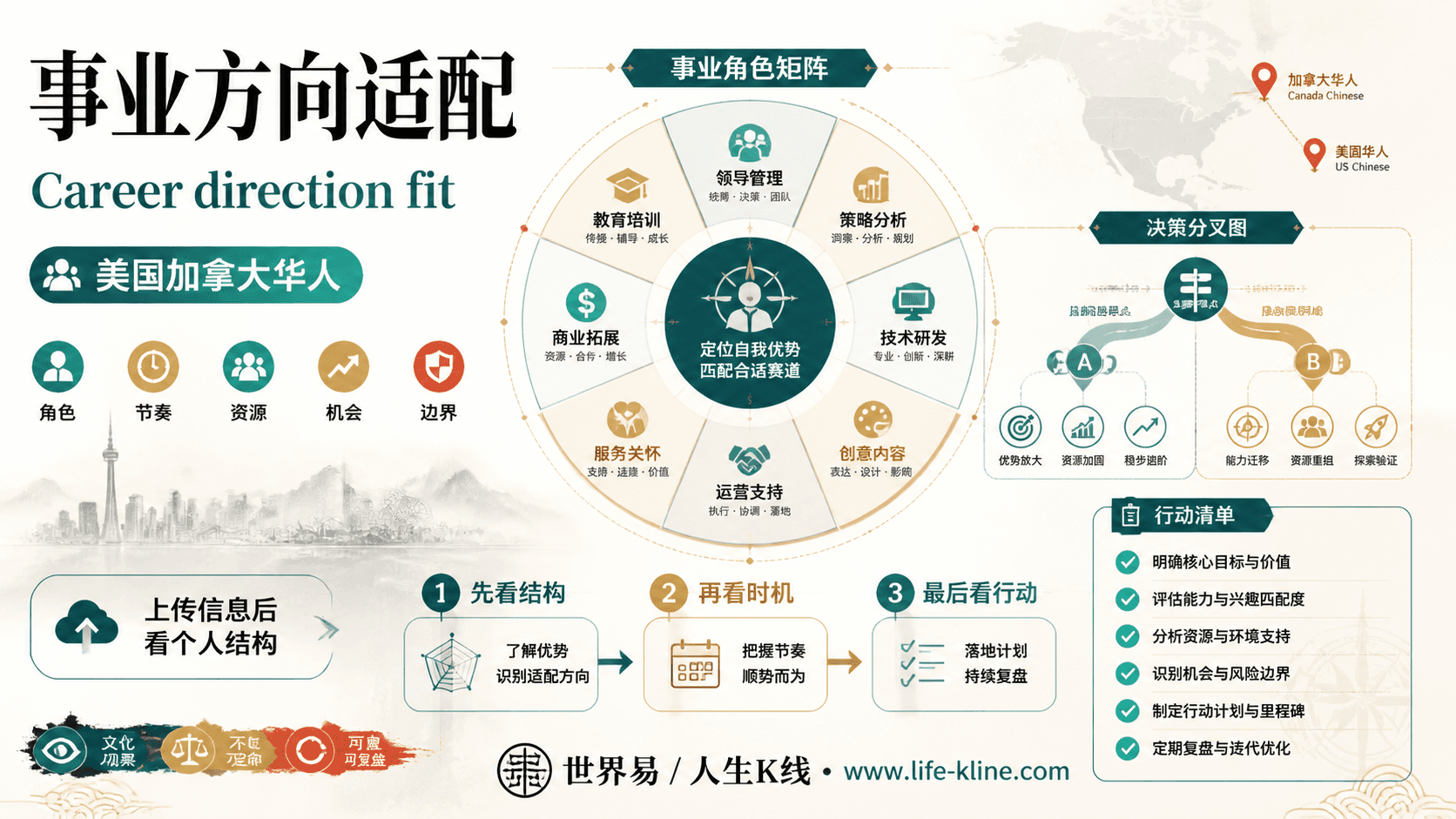
事业方向适配|美国加拿大华人
这张图把《How to Select a Conflict-Free Day Avoiding Ji Shen on Major Decision Days? Practical Guide to Decision Day Selection Tools》里的命理概念转成关系、边界和应用场景,适合先看图建立结构,再回到知识文章正文理解细节。
事业方向适配不应被写成固定结论。更适合美国加拿大华人的读法,是把传统术语翻译成结构、时机、环境、行动和复盘。
查看图片解读