How BaZi Reveals Different City Conditions in Relocation Decisions: Exploring the City Compatibility Tool
把这篇文章落到自己身上验证:先看结构,再进入个人分析,不做泛泛阅读。
What This Scenario Is Judging
In relocation decisions, it is common to encounter the phenomenon where the same person experiences vastly different living conditions in different cities. The core issue in BaZi is how to use an individual's BaZi chart to judge their adaptability and energy flow in different environments, thereby explaining why their state changes significantly after relocation.
The main focus is on the strength of the Day Master, the pattern type, the configuration of Yong Shen (favorable element) and Ji Shen (unfavorable element), as well as the interaction between Da Yun (decade luck) and Liu Nian (annual fortune). These factors collectively determine how a person resonates with the external environment, affecting various aspects such as life, career, and health.
By deeply analyzing these BaZi dimensions, one can help determine in which type of city environment the person's energy flows smoothly and their state is better. In other words, the success of relocation depends not only on external conditions but is closely related to whether the Yong Shen in the BaZi chart is fulfilled.
Therefore, the core of this scenario is to interpret key indicators in the BaZi chart, combine them with city environmental characteristics, and scientifically guide relocation decisions to maximize positive effects and reduce adaptation risks.
Three Core Dimensions Seen in the BaZi Chart
The first is the Day Master and its strength. The Day Master represents the individual's intrinsic energy; if it is relatively strong or weak, it directly affects whether the person can effectively manage their environment. A strong Day Master usually has a strong self-awareness and requires an environment with corresponding Yong Shen to harmonize; a weak Day Master relies more on external support.
The second is the pattern type. The pattern determines the overall energy structure of the BaZi chart. For example, the Yang Ren (Yang Blade) pattern often shows strength and aggressiveness, suitable for highly competitive environments; the Bi Jian (Peer) pattern tends toward independence but requires a reasonable Yong Shen configuration to avoid energy imbalance.
The third is Yong Shen and Ji Shen. Yong Shen is the key element in the BaZi chart that harmonizes the Five Elements and balances energy, while Ji Shen may bring adverse effects. Whether the city environment’s climate, industry structure, and cultural atmosphere meet the needs of the Yong Shen directly affects the state after relocation.
Additionally, the interaction between Da Yun and Liu Nian should not be overlooked. Da Yun represents long-term trends, while Liu Nian reflects short-term changes. Their auspicious or inauspicious influences determine the timing of relocation and the fluctuations in state afterward. Analyzing these three major dimensions is fundamental to judging relocation adaptability.
Three Real BaZi Case Studies
Case 1: This female’s BaZi chart has a Day Master of Ji Earth (己, Ji) that is relatively strong, with a Yang Ren (Yang Blade) pattern. Her Yong Shen are Wood and Water, and Ji Shen is Fire. She is currently in the Geng Chen (庚辰, Geng Chen) Da Yun, which is a stable luck period suitable for maintaining achievements. When relocating, she should focus on whether the new city favors Wood and Water elements, such as humid environments and abundant greenery, which can activate her Yong Shen. Avoiding places with excessive Fire is crucial, as it strengthens the Ji Shen and leads to poor condition. The judgment sequence should first confirm the Day Master’s strength, then verify the Yong Shen’s environmental compatibility, and finally combine the dynamics of Da Yun and Liu Nian to determine the timing of relocation.
Case 2: Another female’s BaZi chart has a Ren Water (壬, Ren) Day Master that is relatively strong, with a Yang Ren pattern. Her Yong Shen are Earth and Fire, and Ji Shen is Metal. She is currently in the first year of the Yi Chou (乙丑, Yi Chou) Da Yun, which is auspicious with progress in career and wealth. She should choose cities where Earth and Fire elements are strong, such as warm climates, fertile soils, or culturally passionate regions. Cities with excessive Metal may cause energy conflicts and hinder development. The judgment order is to first confirm Yong Shen and Ji Shen as well as Day Master strength, then evaluate the auspiciousness of Da Yun and Liu Nian, and finally match the city’s Five Elements attributes.
Case 3: A male’s BaZi chart has a Yi Wood (乙, Yi) Day Master that is relatively weak, with a Bi Jian (Peer) pattern. His Yong Shen is Water, and Ji Shen are Fire and Earth. He is currently in the first year of the Xin Mao (辛卯, Xin Mao) Da Yun, which is a stable period suitable for maintaining status quo. Due to his weak Day Master, he relies more on environmental Water element support. Cities near water or with humid climates can replenish his energy. Excessive Fire and Earth will suppress his Day Master and cause a decline in condition. The judgment steps are to first identify the weak Day Master characteristic, check the presence of Yong Shen Water element in the city, and combine Da Yun and Liu Nian analysis to assess relocation timing and adaptability.
Common Misconceptions
Misconception 1: Ignoring the strength of the Day Master and blindly assuming everyone suits the same environment. People with a strong Day Master need environments that weaken the Ji Shen, while those with a weak Day Master need environments that strengthen the Yong Shen; otherwise, significant fluctuations in condition occur after relocation.
Misconception 2: Only considering the auspiciousness of Da Yun and Liu Nian while neglecting the match between Yong Shen, Ji Shen, and the city environment. Even if the Da Yun is favorable, if the city’s Five Elements do not align with the Yong Shen, potential cannot be fully realized.
Misconception 3: Treating city-level factors such as climate, culture, and humanities as secondary. In fact, these external conditions are key to whether the Yong Shen can be activated. Neglecting them leads to unsatisfactory relocation results.
Therefore, a scientific relocation decision must comprehensively consider both internal BaZi factors and external conditions, avoiding one-sided interpretations and mechanical application of metaphysical rules.
Judgment Sequence and Tool Anchors
Relocation decisions should start by assessing the strength of the Day Master to clarify the core energy intensity; the second step is to identify the pattern type to understand the overall energy structure of the BaZi chart; the third step is to thoroughly analyze Yong Shen and Ji Shen to identify the Five Elements that the chart most needs support from or must avoid.
Next, combine the current Da Yun and Liu Nian to judge whether the timing of relocation is favorable, avoiding state fluctuations caused by inappropriate timing. These steps form the basic framework of BaZi analysis.
At this stage, the “city compatibility” tool can be used for further calibration, combining the specific city’s Five Elements attributes, climate environment, and cultural characteristics to precisely match the individual’s Yong Shen needs. In this way, relocation decisions are supported not only by theory but also by data, improving the success rate and adaptability of relocation.
FAQ
Q: What are the manifestations if the Yong Shen does not match during relocation? A: A mismatch of Yong Shen may cause difficulties in life and career, physical fatigue, emotional fluctuations, and overall poor condition.
Q: Which has a greater impact in the BaZi chart, Da Yun or Liu Nian? A: Da Yun represents long-term trends, while Liu Nian reflects short-term changes. Both act together, and the best relocation timing considers both, ideally when Da Yun is favorable and Liu Nian is in alignment.
Q: How does the city compatibility tool assist relocation? A: This tool combines the BaZi Yong Shen with the city’s Five Elements attributes to evaluate the degree of compatibility, helping to judge whether the new city can activate the individual’s Yong Shen and avoid blind relocation.
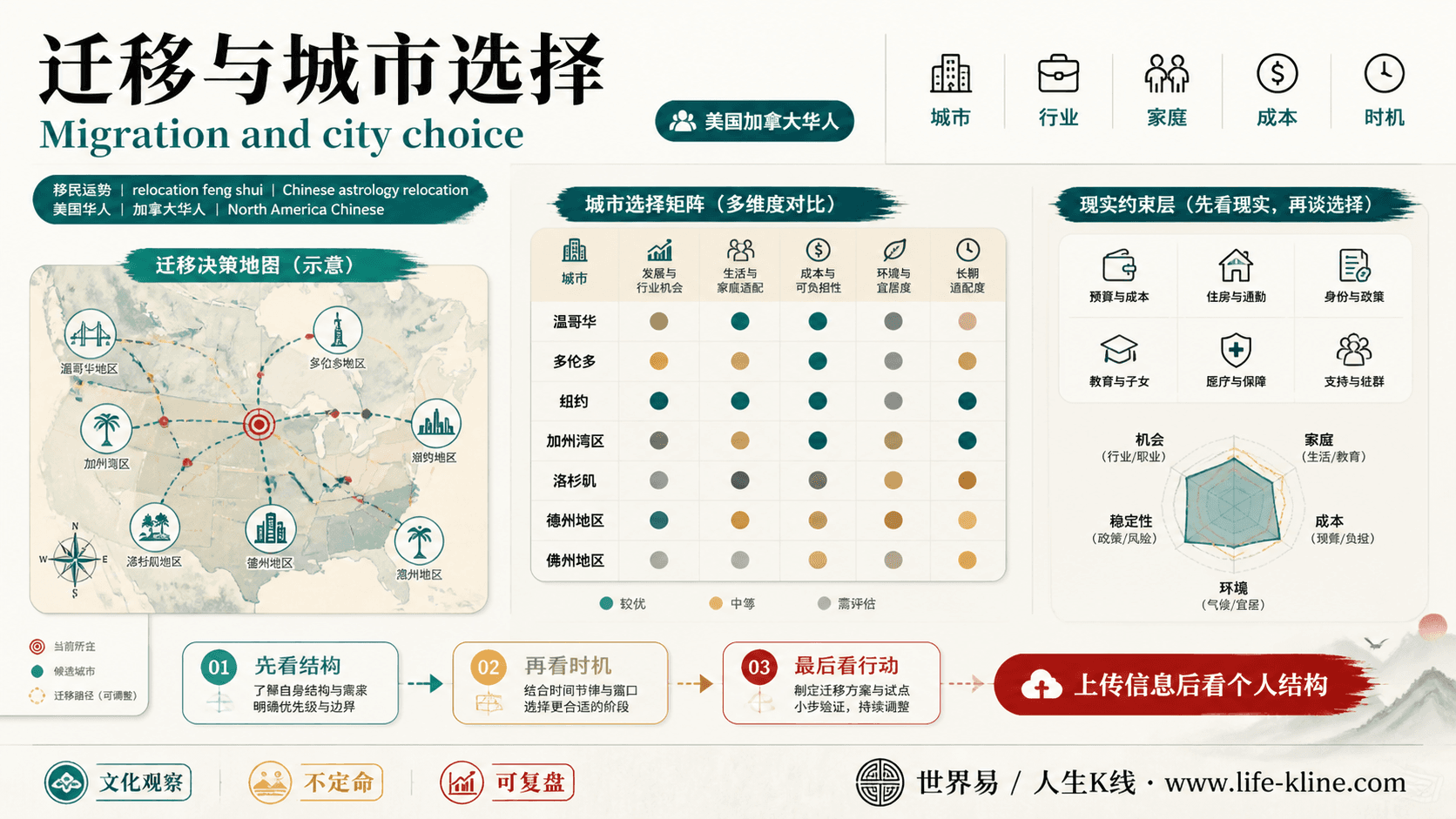
迁移与城市选择|美国加拿大华人
这张图把《How BaZi Reveals Different City Conditions in Relocation Decisions: Exploring the City Compatibility Tool》里的命理概念转成关系、边界和应用场景,适合先看图建立结构,再回到知识文章正文理解细节。
迁移与城市选择不应被写成固定结论。更适合美国加拿大华人的读法,是把传统术语翻译成结构、时机、环境、行动和复盘。
查看图片解读