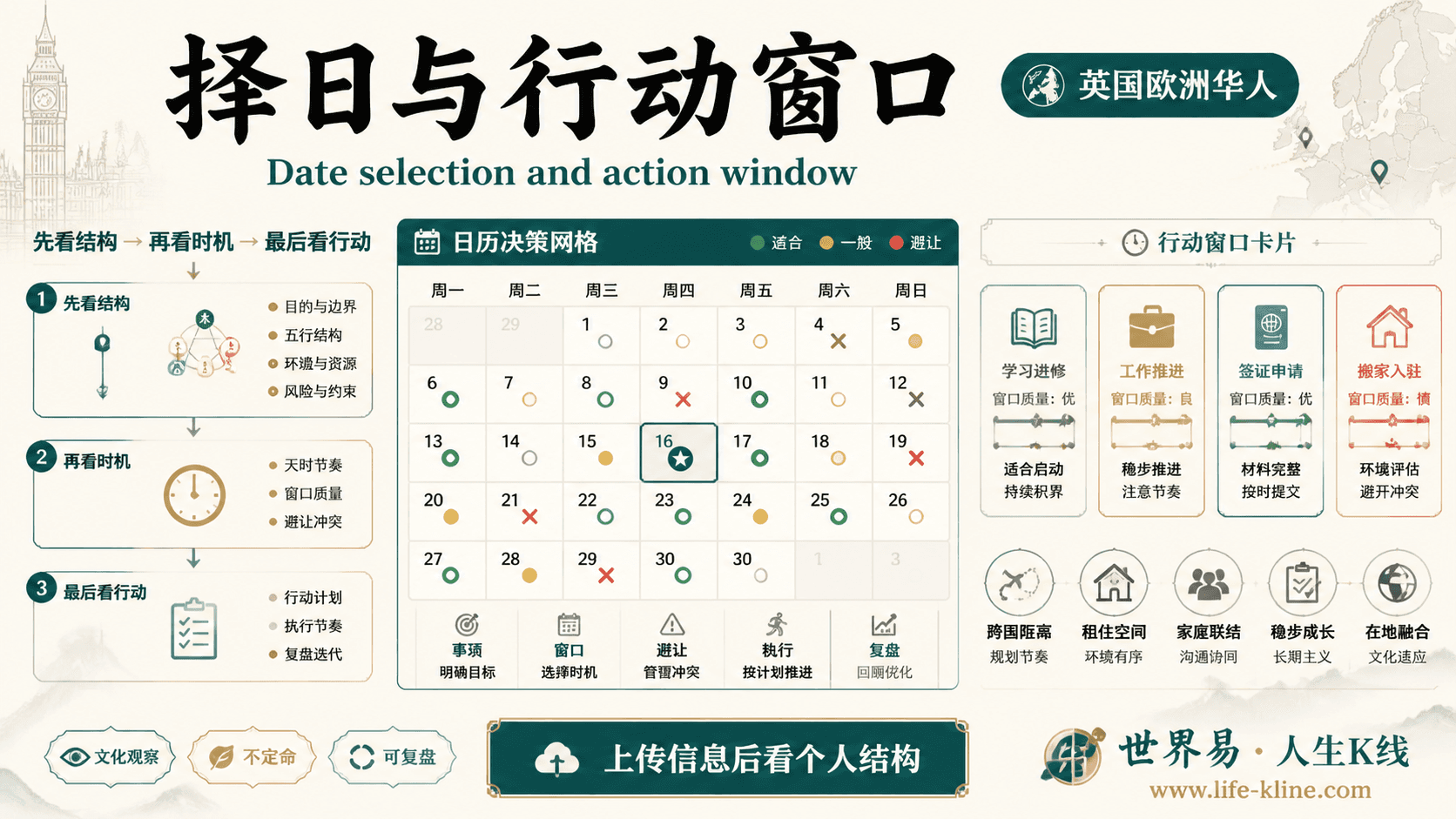
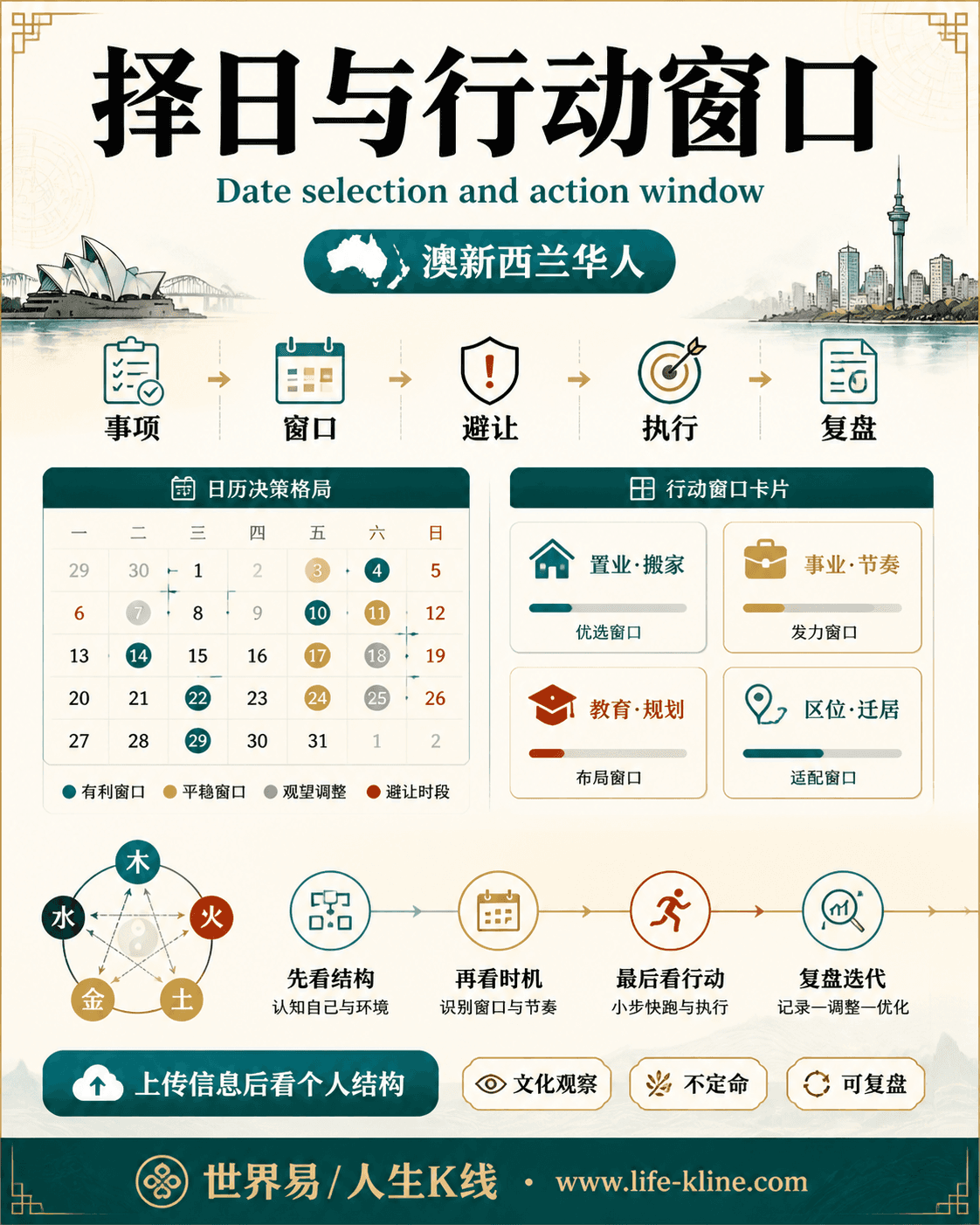
Choosing Key Dates: Analyzing True Date Selection and General Almanac from a Metaphysical Perspective
把这篇文章落到自己身上验证:先看结构,再进入个人分析,不做泛泛阅读。
What This Scenario Is Judging
The core of choosing key dates lies in selecting a time point most suitable to an individual's metaphysical chart, aiming for smoothness or auspiciousness of events. Here, True Date Selection and the general almanac are two common methods with essential differences. True Date Selection emphasizes precise timing based on the individual's specific BaZi chart; whereas the general almanac is based on broadly applicable auspicious and inauspicious time records without considering individual differences.
In practical metaphysical application, date selection is not only about the auspicious or inauspicious markings on the calendar but more importantly about integrating the individual's Four Pillars chart—specifically the Day Master, pattern, and Yong Shen—to judge whether the Heavenly Stems and Earthly Branches (天干地支) of the chosen day harmonize with the person's metaphysical structure, thereby enhancing the scientific validity and effectiveness of the timing.
Therefore, the core issue in selecting key dates is: how to distinguish and reasonably apply True Date Selection versus the general almanac, and which metaphysical dimensions need focus to ensure timing accuracy and suitability?
By deeply analyzing these three core dimensions and their interaction with Da Yun and Liu Nian, one can better understand and grasp the internal logic of date selection, thus making choices that more closely align with one’s own metaphysical constitution in real life.
Three Core Dimensions Seen in the BaZi Chart
The first is the strength of the Day Master (日主). The Day Master represents the individual's own Five Elements attribute and its strength, determining how the person responds to the external environment. When selecting dates, it is necessary to judge whether the day's Five Elements can assist or restrain the Day Master. Especially if the Day Master is relatively weak, more careful selection of time periods with strong Yong Shen elements is required.
The second is the pattern (格局). The pattern reflects the overall structure and energy field of the BaZi chart, determining the nature of the Yong Shen and the key focus during date selection. For example, different patterns such as Qi Sha (Seven Kill) pattern, Pian Cai (Indirect Wealth) pattern, or Shi Shen (Eating God) pattern require consideration of the corresponding Five Elements for support or control during timing.
The third is the Yong Shen (用神). Yong Shen is the important factor in balancing and harmonizing the Five Elements within the chart. When selecting dates, priority should be given to time periods that enhance or at least do not harm the Yong Shen, while avoiding interference from Ji Shen (忌神, unfavorable elements), to ensure the chosen time brings the best vitality and auspicious effect to the individual.
These three dimensions are interrelated and must be considered comprehensively during date selection to improve precision and personalization, avoiding the generality and limitations of relying solely on the general almanac.
Three Real BaZi Chart Cases
Case 1: The Day Master is 甲 (Jia) Wood and relatively weak, the pattern is Qi Sha (Seven Kill) pattern, and the Yong Shen is Wood. The person is currently in the 7th year of the 甲戌 (Jia Xu) Da Yun, with the Liu Nian being 丙午 (Bing Wu). In the context of choosing key dates, focus should be on whether the selected time can strengthen Wood and avoid excessive influence from Fire and Earth. The judgment sequence is to first confirm if the day's Five Elements favor Wood, then check for interference from Ji Shen Fire and Earth, and finally adjust the timing strategy according to the interaction between Da Yun and Liu Nian.
Case 2: The Day Master is 己 (Ji) Earth and relatively weak, the pattern is Pian Cai (Indirect Wealth) pattern, with Fire as Yong Shen and Metal and Water as Ji Shen. The current Da Yun is 丙午 (Bing Wu) and it is the first year, with Liu Nian also being 丙午 (Bing Wu). Under this situation, date selection should focus on choosing time periods that enhance Fire and avoid interference from Metal and Water. The judgment sequence is to first determine if the day's Heavenly Stems and Earthly Branches support Fire, then confirm whether the Ji Shen are suppressed, and finally verify the auspiciousness of Da Yun and Liu Nian before confirming the timing.
Case 3: The Day Master is 辛 (Xin) Metal and relatively weak, the pattern is Shi Shen (Eating God) pattern, with Wood as Yong Shen and Water as Ji Shen. The person is in the 6th year of the 戊午 (Wu Wu) Da Yun, with Liu Nian being 丙午 (Bing Wu). When selecting dates, it is necessary to choose days and hours that support Wood and avoid periods with strong Water. The judgment sequence starts by confirming if the day's Five Elements can generate or assist Wood, then excludes Water influence, and finally decides the best timing based on the stability of Da Yun and Liu Nian.
Common Misconceptions
Misconception one is treating the general almanac as an all-purpose tool, ignoring individual chart differences. Although the general almanac’s auspicious and inauspicious indications are convenient for reference, it cannot provide personalized adjustments based on the individual's Day Master and Yong Shen, often leading to suboptimal date selection results.
Misconception two is overlooking the importance of Day Master strength in timing decisions. Many people simply look for auspicious days without considering the Five Elements’ generating or controlling relationship with the Day Master on that day, resulting in chosen dates that are not truly suitable for the individual's metaphysical constitution.
Misconception three is focusing on only one dimension during date selection, such as only considering Yong Shen while neglecting the pattern and the interaction with Da Yun and Liu Nian, leading to one-sided judgments that fail to comprehensively reflect the individual's fortune changes.
To correct these misconceptions, it is necessary to adhere to core metaphysical principles, integrating the Day Master, pattern, Yong Shen, and Da Yun/Liu Nian, combined with True Date Selection methods, to achieve scientific and personalized timing choices.
Judgment Sequence and Tool Anchors
The first step in date selection judgment is to clarify the individual's Day Master and its strength, determining the basic Five Elements needs. The second step is to analyze the chart’s pattern, identify Yong Shen and Ji Shen, and understand the overall energy structure of the BaZi chart. The third step is to combine the current Da Yun and Liu Nian to assess fortune trends and external environmental influences.
Based on this foundation, date selection requires comparing the day’s Heavenly Stems and Earthly Branches to judge whether their Five Elements generate or assist the Yong Shen and avoid Ji Shen clashes or controls. Only after completing these steps can specific hours be matched and chosen.
When reaching the stage of identifying and matching the day’s Five Elements with the Yong Shen, using the 'Date and Time Selection' tool can help calibrate the accuracy of timing. By integrating BaZi charts and Da Yun/Liu Nian data, it provides more detailed auspicious and inauspicious hour indications, assisting in making more scientific date selection decisions.
FAQ
What is 'True Date Selection'? True Date Selection is based on the individual's Four Pillars (BaZi) chart, comprehensively considering the Day Master strength, pattern, and Yong Shen, combined with Da Yun and Liu Nian, to precisely select the most suitable auspicious days and times for the individual. This differs from the general almanac’s universal auspicious and inauspicious indications.
Can the general almanac meet everyone’s date selection needs? The general almanac provides generally applicable auspicious and inauspicious indications for the public but cannot adjust for individual metaphysical differences. It is suitable for general reference but not for precise personal date selection.
Why is Yong Shen so important in metaphysical date selection? Yong Shen is the key element balancing and harmonizing the Five Elements in the chart. Selecting days and times that enhance the Yong Shen helps improve the individual’s fortune and the smoothness of events, while avoiding interference from Ji Shen.
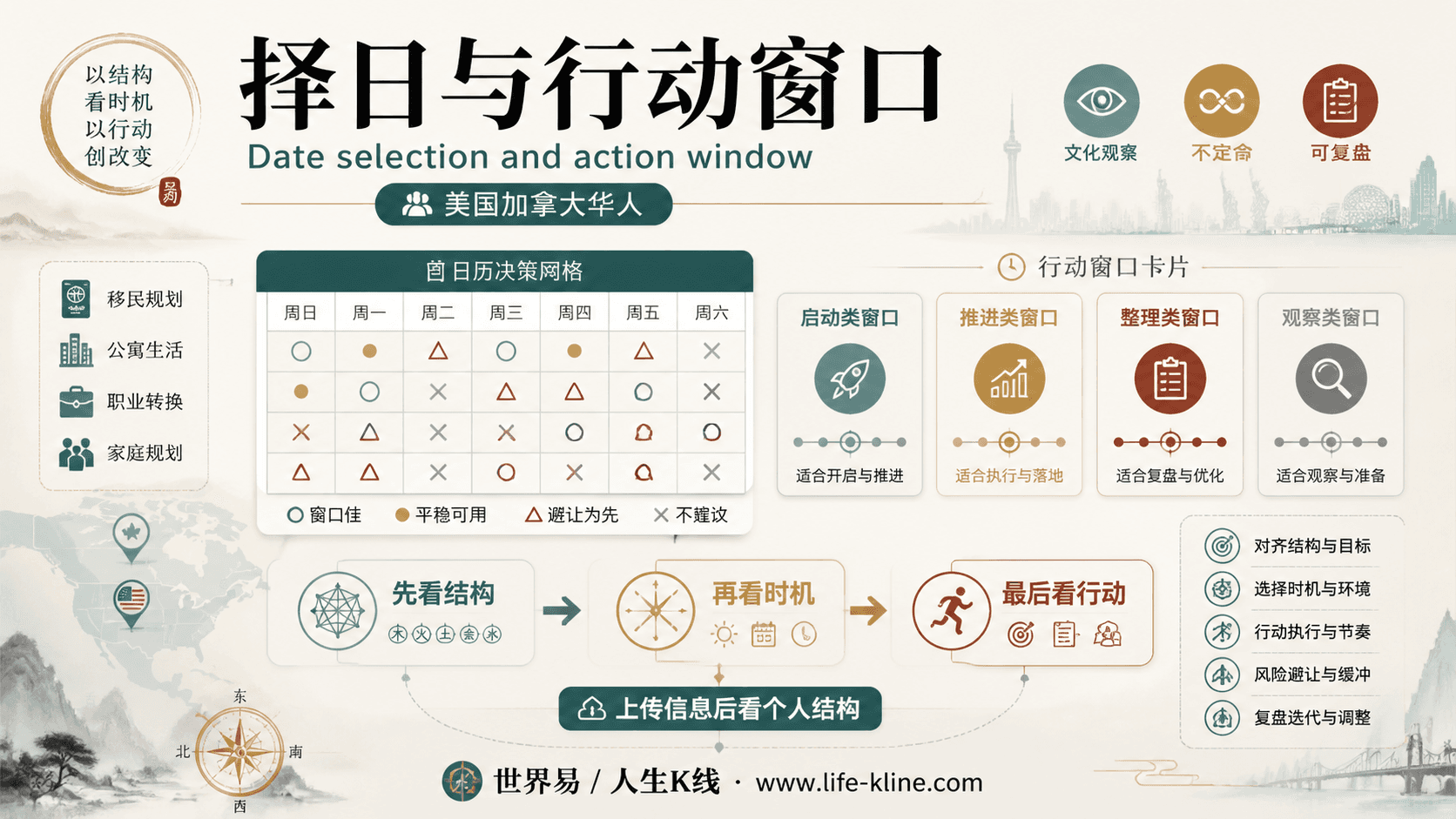
择日与行动窗口|美国加拿大华人
这张图把《Choosing Key Dates: Analyzing True Date Selection and General Almanac from a Metaphysical Perspective》里的命理概念转成关系、边界和应用场景,适合先看图建立结构,再回到知识文章正文理解细节。
择日与行动窗口不应被写成固定结论。更适合美国加拿大华人的读法,是把传统术语翻译成结构、时机、环境、行动和复盘。
查看图片解读