Jia (甲): Yang Wood Heavenly Stem and Its Metaphysical Characteristics Explained
把这篇文章落到自己身上验证:先看结构,再进入个人分析,不做泛泛阅读。
Concept Definition
Jia (甲) is the first of the Heavenly Stems (天干), classified as a Yang Stem (阳干). Its Five Elements attribute is Wood, oriented towards the East, representing colors such as green, cyan, and emerald. As the Yang Wood Stem, Jia symbolizes the force of growth and upward development.
In metaphysics, Jia (甲) combines with Ji (己) to form Jia-Ji He (甲己合), an important combination relationship representing mutual coordination and energy transformation. Jia also clashes with Geng (庚), reflecting the Wood-Metal conflict in the Five Elements, indicating opposition and confrontation between the two.
Regarding seasonal strength ratings, Jia scores highest at Yin (寅) and Mao (卯), both rated 3, indicating spring as Jia's peak season, consistent with Wood's natural growth in spring. Other months like Si (巳), Hai (亥), and Zi (子) provide some support, Wu (午) scores zero, and Shen (申) and You (酉) have negative scores, showing Jia Wood's weakness in summer and autumn.
Metaphysical Characteristics and Symbolic Meaning
As Yang Wood, Jia symbolizes a tall, upright tree, representing vitality and the power of growth. Its Eastern orientation and correspondence with spring further emphasize Jia Wood's growth characteristic, reflecting the flourishing Wood energy in nature.
Jia's green, cyan, and emerald colors represent life force and renewal, symbolizing vitality and hope. In metaphysical applications, Jia is often regarded as a symbol of beginnings and vitality, carrying meanings of pioneering and creativity.
The Jia-Ji He (甲己合) relationship reflects the interaction between Wood and Earth, where Wood draws nourishment from Earth. This combination manifests as mutual complementarity and cooperation. The clash between Jia and Geng (庚) illustrates the traditional Wood overcoming Metal conflict in the Five Elements, indicating possible contradictions and challenges within the natal chart.
Practical Configuration and Interpretation
In practical metaphysical analysis, Jia Wood is strong in spring. When appearing at Yin (寅) or Mao (卯) times, it usually indicates a vigorous and thriving situation, suitable for starting careers or new projects. At this time, Jia Wood is like a springtime tree, full of vitality and development potential.
When Jia combines with Ji (己), representing Wood-Earth mutual generation, it generally favors stability and growth. For example, encountering Jia-Ji He (甲己合) in a chart often means internal and external coordination, resource complementarity, and benefits for career and life progress.
If Jia Wood clashes with Geng Metal (庚), obstacles or conflicts may arise. Geng Metal is rigid Metal that restrains Jia Wood, representing challenges in environment or interpersonal relationships. Attention to harmonization and prevention is necessary to avoid intensified conflicts affecting overall fortune.
Common Misconceptions
Some interpreters mistakenly believe Jia Wood is always strong regardless of time, overlooking the seasonal strength ratings that show spring as strong and summer-autumn as weak. In fact, Jia Wood's strength varies significantly with seasons, strongest in spring, requiring specific chart context for analysis in other seasons.
Another misunderstanding is assuming Jia-Ji He (甲己合) always indicates complete harmony without conflict, ignoring the complexity of combination transformations. Although Jia-Ji He is a combination, it must be assessed together with other stems and branches; it should not be simplistically viewed as entirely auspicious, as potential yin-yang imbalances may exist.
FAQ
Question: Why does Jia Wood represent the East? Answer: Jia belongs to the Wood element in the Five Elements, whose directional attribute is East. It symbolizes spring and the direction of growth. Therefore, Jia Wood is commonly associated with the East in metaphysics, representing vitality and renewal.
Question: What does the clash between Jia and Geng imply? Answer: Jia is Wood and Geng is Metal. Metal overcomes Wood, so their clash represents conflict and opposition. In metaphysics, Jia-Geng clash often indicates contradictions in environment or interpersonal relationships, requiring attention to resolution.
Question: How should the combination effect of Jia-Ji He be understood? Answer: Jia-Ji He is a Wood-Earth combination, showing mutual coordination and transformation. It generally implies resource complementarity and cooperation, favorable for stability and development of situations.
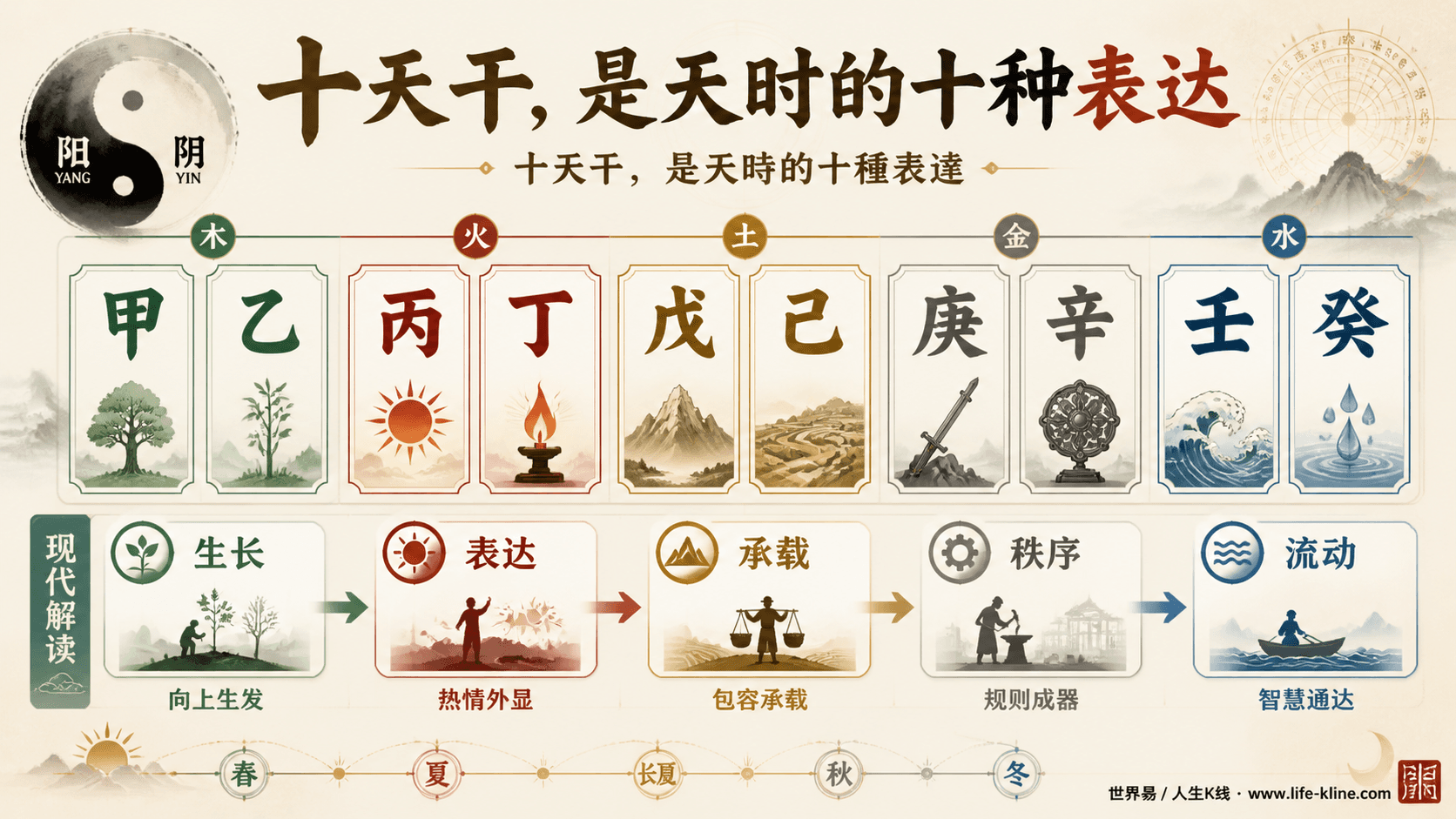
十天干总览图
这张图把《Jia (甲): Yang Wood Heavenly Stem and Its Metaphysical Characteristics Explained》里的命理概念转成关系、边界和应用场景,适合先看图建立结构,再回到知识文章正文理解细节。
十天干是时间与环境变化的十种基础模式。理解其阴阳、五行属性,能帮助我们在不同时位中找到清晰的结构入口,而非预测结果。
查看图片解读