Comprehensive Analysis of the Heavenly Stem Wu: Yang Earth Symbolism and Metaphysical Applications
把这篇文章落到自己身上验证:先看结构,再进入个人分析,不做泛泛阅读。
Concept Definition
Wu (戊) is the fifth of the ten Heavenly Stems (天干), classified as a Yang Stem with the Five Element of Earth. In terms of direction, Wu represents the central direction, symbolizing the heaviness of soil and the stability of the center. Its representative colors are yellow, brown, and beige, all corresponding to earth tones that reflect Wu Earth’s steadiness and inclusive nature.
In metaphysics, Wu combines with Gui (癸) to form the Wu-Gui combination (戊癸合), a special harmonizing relationship between Wu Earth and Gui Water, embodying the balance and transformation between Earth and Water. Wu has no directly clashing Heavenly Stem, indicating that Wu Earth maintains a relatively stable state within the system of Heavenly Stem clashes.
The seasonal strength rating of Wu shows it is strongest in spring, with specific scores as follows: Yin (寅) and Mao (卯) at 0, Si (巳), Wu (午), and Shen (申) at 2, Hai (亥) and Zi (子) at -1, and Chen (辰), Wei (未), Xu (戌), and Chou (丑) all at 3. This indicates Wu Earth is very strong in the four Earthly Branches (地支) of Chen, Wei, Xu, and Chou during spring, reflecting the natural fertility and vitality of soil in that season.
Metaphysical Characteristics and Symbolic Meaning
As a Yang Earth Heavenly Stem, Wu Earth symbolizes heaviness, solidity, and inclusiveness. It represents the central direction, implying the center, stability, and bearing capacity, much like the vast earth that supports all things. In the Five Elements, Earth nurtures all life; Wu Earth, being Yang Earth, manifests as a strong and stable earth element with a firm and steady nature.
The representative colors of Wu Earth—yellow, brown, and beige—belong to the earth tone palette, reflecting its close connection to soil. In traditional culture, these colors often symbolize abundance, stability, and safety, embodying the core symbolic meaning of Wu Earth in metaphysics.
The Wu-Gui combination (戊癸合), formed by Wu Earth and Gui Water, symbolizes the union of Earth and Water. This harmonizing relationship plays a role in balancing Yin and Yang and facilitating transformation in metaphysics. Wu Earth has no clashing Heavenly Stem, highlighting its stability and resistance to disturbance within the Heavenly Stem system.
Practical Configurations and Interpretations
In BaZi metaphysics, the strength of Wu Earth mainly concentrates in the four Earthly Branches of Chen, Wei, Xu, and Chou during spring, all of which are Earth storage branches that enhance Wu Earth’s power. For example, when the Wu Earth Day Master encounters Chen Earth or Chou Earth, it often signifies a solid foundation with good bearing capacity and stability.
The Wu-Gui combination is an important harmonizing relationship in Wu Earth configurations. The combination of Wu Earth and Gui Water not only demonstrates the harmony between Earth and Water but also symbolizes the balance of Yin and Yang and energy transformation. In practical interpretation, the Wu-Gui combination can manifest as Earth nurturing Water and Water nourishing Earth, representing a potential for harmony within the natal chart.
Because Wu Earth has no direct clashes, its stability in the natal chart is relatively strong and less susceptible to external disturbances. This often causes the Wu Earth Day Master to exhibit traits of steadiness and reliability, making it suitable for careers requiring patience and endurance, such as agriculture, real estate, and construction, consistent with its heavy Earth attribute.
Common Misconceptions
Firstly, it is mistaken to believe that Wu Earth has no conflict or restriction relationships. Although Wu Earth has no direct Heavenly Stem clashes, it can still be restrained or controlled through Earthly Branch interactions or other Five Element combinations, so it should not be simplistically regarded as absolutely stable.
Secondly, the seasonal strength influence on Wu Earth is often overlooked. Wu Earth is strongest in spring; if Wu Earth appears in a weak seasonal period within the natal chart, other Five Element forces must be considered comprehensively. Its nature and strength cannot be generalized without context.
FAQ
Question: What direction and colors does Wu Earth represent? Answer: Wu Earth represents the central direction and is mainly associated with yellow, brown, and beige colors, symbolizing the heaviness and stability of earth.
Question: What is the significance of the Wu-Gui combination? Answer: The Wu-Gui combination reflects the harmonizing relationship between Earth and Water, symbolizing Yin-Yang transformation and coordination. In metaphysics, it represents energy balance and complementarity.
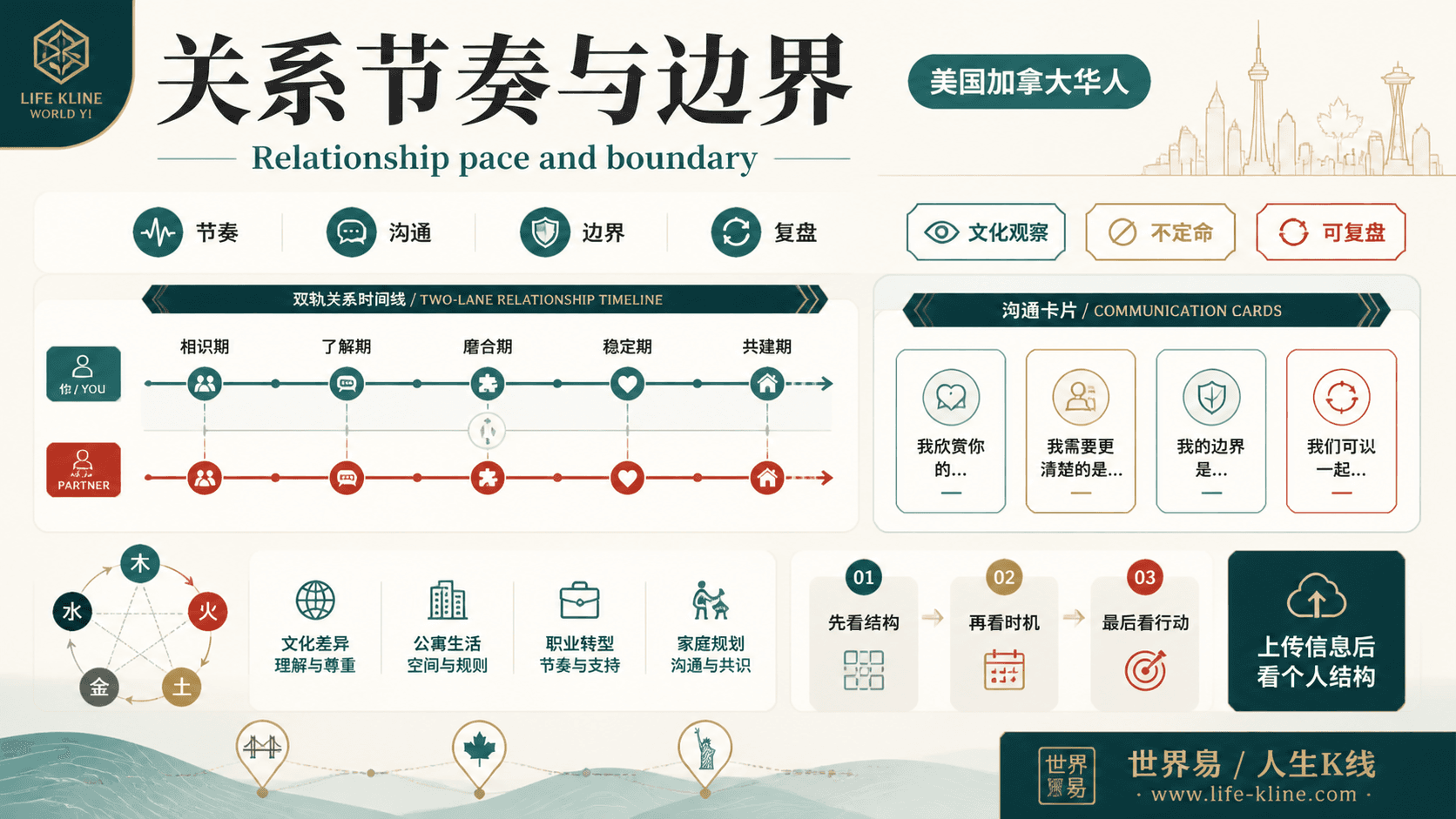
关系节奏与边界|美国加拿大华人
这张图把《Comprehensive Analysis of the Heavenly Stem Wu: Yang Earth Symbolism and Metaphysical Applications》里的命理概念转成关系、边界和应用场景,适合先看图建立结构,再回到知识文章正文理解细节。
关系节奏与边界不应被写成固定结论。更适合美国加拿大华人的读法,是把传统术语翻译成结构、时机、环境、行动和复盘。
查看图片解读