Analysis and Practical Guide to Ji (己) Yin Earth Heavenly Stem in Fate Studies
把这篇文章落到自己身上验证:先看结构,再进入个人分析,不做泛泛阅读。
Concept Definition
Ji (己) is the sixth of the Heavenly Stems (天干), classified as a Yin Stem, with the Five Elements attribute of Earth. Its directional position is central, and its representative colors include yellow, brown, and beige. As Yin Earth, Ji Earth’s nature is gentler and more inclusive compared to Yang Earth, symbolizing introversion and steadiness.
In the Heavenly Stem combination relationships, Ji Earth forms a 'Ji-Jia Combination' (己甲合) with Jia Wood (甲木), reflecting the mutual generating interaction between Earth and Wood. Notably, Ji Earth has no corresponding conflicting Heavenly Stem in the clash (相冲) relationships, meaning Ji Earth experiences fewer direct clashes in fate applications, thus exhibiting relative stability.
Seasonal strength ratings indicate Ji Earth is strongest in spring, especially in the spring months of Yin (寅) and Mao (卯), where Ji Earth’s energy reaches its peak, significantly influencing the fate chart. Other seasons such as summer, autumn, and winter show comparatively moderate or weaker performance.
Fate Characteristics and Symbolic Meaning
As Yin Earth, Ji Earth symbolizes fertile soil in the land—gentle and nurturing, capable of nourishing all things without sharpness. Its yin-yang attribute emphasizes internal accumulation and steadiness, embodying a delicate yet enduring strength.
Ji Earth’s Five Elements attribute is Earth, representing stability, reliability, and the doctrine of the mean. In fate studies, Earth signifies bearing and support; Ji Earth focuses more on details and latent harmonizing functions, often representing residence, foundation, and wealth accumulation.
The representative colors of Ji Earth—yellow, brown, and beige—correspond to the colors of soil, further reinforcing its earth symbolism. Its central directional position reflects Ji Earth’s balancing and harmonizing role within the Five Elements, serving as a crucial hub connecting elemental transformations.
Practical Configuration and Interpretation
In practical fate interpretation, Ji Earth, due to its Yin Earth attribute, is suitable for forming the 'Ji-Jia Combination' (己甲合) with Yang Wood Jia (甲). This combination manifests the mutual generation between Earth and Wood, where Earth nourishes Wood, and Wood grows by borrowing Earth’s strength, illustrating a mutually beneficial energy configuration.
Seasonal ratings show Ji Earth is strongest in spring, especially scoring 3 in Earthly Branches (地支) such as Chen (辰), Wei (未), Xu (戌), and Chou (丑), indicating Ji Earth’s energy is very robust. If a fate chart contains Ji Earth combined with these Earthly Branches, it usually signifies the individual has a solid foundation with favorable growth environment and development potential.
Because Ji Earth has no conflicting Heavenly Stem, its stability in the fate chart is relatively high and less prone to external disruptions. This assists in analyzing the individual’s resilience and endurance. By integrating Ji Earth’s directional position, combination relationships, and seasonal strength, fate practitioners can more accurately grasp its role in the chart.
Common Misconceptions
A common misconception is equating Ji Earth simply with Yang Earth, overlooking Ji’s Yin Earth gentleness and introversion. The yin-yang difference directly affects its manifestation and function in fate studies; confusing these qualities can lead to interpretative errors.
Another misconception is neglecting Ji Earth’s positive role in combinations, especially the 'Ji-Jia Combination' with Jia Wood. Sometimes fate analysis focuses excessively on clash relationships and ignores the generating energy brought by combinations, thereby missing critical interpretive information.
FAQ
Question: Why is Ji Earth called a Yin Stem? Answer: Ji (己) is a Yin Stem among the Heavenly Stems, representing the yin attribute characterized by gentleness and introversion, contrasting with the strength and extroversion of Yang Stems.
Question: What does the Ji-Jia Combination specifically mean? Answer: The Ji-Jia Combination (己甲合) indicates the mutual interaction and mutual support between Earth and Wood; Earth nourishes Wood, and Wood grows by borrowing Earth’s strength, reflecting favorable energy exchange in the fate chart.
Question: Why does Ji Earth have no conflicting Heavenly Stem? Answer: According to fate rules, Ji Earth has no corresponding conflicting Heavenly Stem in clash relationships, making it relatively stable and less prone to direct clashes in the chart.
Question: Why is Ji Earth strongest in spring? Answer: Seasonal strength ratings show Ji Earth scores highest in spring Earthly Branches such as Chen (辰), Wei (未), Xu (戌), and Chou (丑), reflecting the spring environment’s energy support that enhances Ji Earth’s strength.
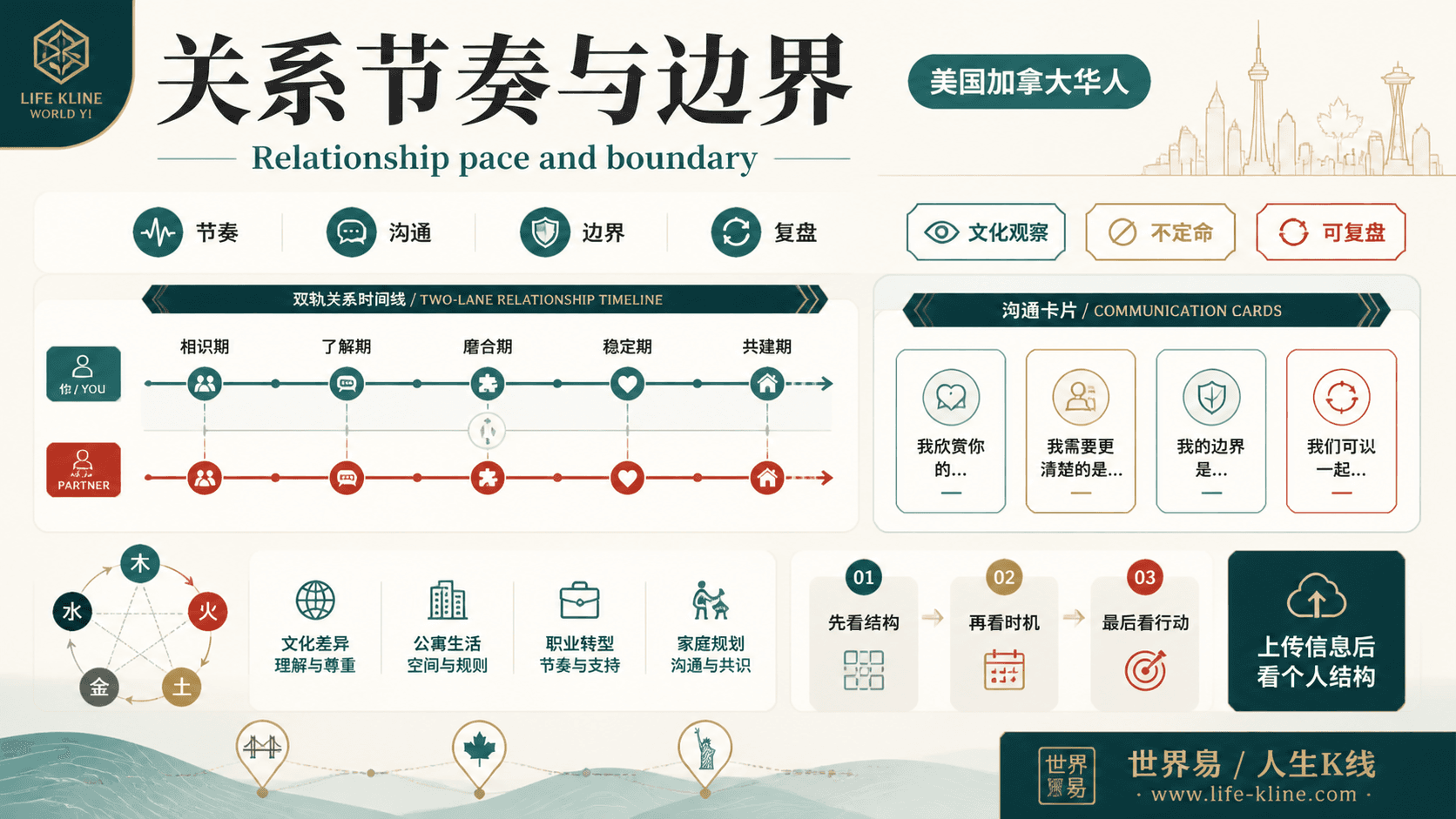
关系节奏与边界|美国加拿大华人
这张图把《Analysis and Practical Guide to Ji (己) Yin Earth Heavenly Stem in Fate Studies》里的命理概念转成关系、边界和应用场景,适合先看图建立结构,再回到知识文章正文理解细节。
关系节奏与边界不应被写成固定结论。更适合美国加拿大华人的读法,是把传统术语翻译成结构、时机、环境、行动和复盘。
查看图片解读