Comprehensive Analysis and Application of the Heavenly Stem Yi (乙) in Destiny Studies
把这篇文章落到自己身上验证:先看结构,再进入个人分析,不做泛泛阅读。
Concept Definition
Yi (乙) is one of the ten Heavenly Stems (天干), classified as a Yin stem and belonging to the Wood element in the Five Elements (Wu Xing). Its directional correspondence is the East. As Yin Wood, Yi symbolizes softness, delicacy, and growth, representing the colors green, cyan, and emerald green, reflecting the vitality and energy of spring. Yi's attributes give it a unique status in destiny studies, especially evident in its combination and clash relationships with other Heavenly Stems.
Yi combines with the Geng (庚) Heavenly Stem, known as the Yi-Geng combination (乙庚合). This combination relationship is often used in destiny analysis to harmonize the Five Elements, balance Yin and Yang, and enhance auspicious energy. Conversely, Yi clashes with Xin (辛), and this clash relationship often implies conflict and instability, which should be given careful attention during chart analysis. Yi's seasonal strength rating shows that it is strongest in spring (the months of Yin 寅 and Mao 卯), with a strength score of 3, reflecting Yi Wood's peak growth period.
The seasonal strength rating of Yi not only reflects its energy changes across different months but also provides an important reference for destiny practitioners analyzing charts. Yi is strong in spring (Yin 寅 and Mao 卯), weakens during some months of summer and autumn, and partially recovers in winter. This pattern aligns with the natural growth cycle of Wood in nature, demonstrating the close connection between the Heavenly Stems and natural seasons.
Destiny Characteristics and Symbolic Meaning
Yi belongs to Yin Wood, symbolizing a life force that is delicate yet resilient, representing vines or branches in plants, embodying meticulousness, flexibility, and environmental adaptability. Yi's Yin nature allows it to play a harmonizing and gentle role within the Five Elements, often symbolizing a mild, introverted, and refined personality.
Yi, oriented towards the East, is closely linked to the vitality of spring. The representative colors are green, cyan, and emerald green, which symbolize renewal and hope, reflecting the vigorous life force of Yi Wood in nature. Yi's Wood attribute and its color symbolism are often used to represent new beginnings, growth, and vitality, fitting naturally with the rhythm of the spring season.
Yi combines with Geng (庚), reflecting the harmony of Yin and Yang. Geng is Yang Metal, and together with Yi Yin Wood, they form a Metal-Wood combination that can transform the softness of Wood and strengthen its vitality. Conversely, Yi clashes with Xin (辛), which is Yin Metal. This clash indicates that Yi Wood tends to encounter obstacles and conflicts when facing Xin, reflecting the Five Elements' mutual overcoming principle in destiny studies.
Practical Configurations and Interpretations
In destiny configurations, Yi Wood often represents gentle and delicate energy and is suitable for pairing with Geng Metal to form the Yi-Geng combination (乙庚合), achieving Yin-Yang complementarity and Five Elements balance. For example, if Yi Wood is weak in a chart, encountering Geng Metal in combination can often stimulate Yi Wood's potential, enhancing career or health outcomes.
The Yi Wood and Xin Metal clash combination requires cautious handling, as the conflict may bring changes or instability, commonly seen in career or interpersonal relationship fluctuations. Destiny practitioners will consider other hidden stems and Earthly Branches (地支) to comprehensively assess the impact of the clash and possible resolution methods.
The seasonal strength rating is an important basis for practical interpretation. Yi Wood is strongest in the months of Yin (寅) and Mao (卯), making these times ideal for Yi Wood to exert its maximum influence in a chart. Conversely, Yi Wood is weakest in the Wu (午) month and requires combination or support from other Five Elements to avoid Wood's weakness affecting the overall chart balance.
Common Misconceptions
First, it is mistaken that Yi Wood only represents weakness and lack of strength. In fact, although Yi belongs to Yin Wood, it possesses strong resilience and adaptability, able to grow flexibly in complex environments. It symbolizes delicacy with vitality rather than mere fragility.
Second, the importance of the Yi-Geng combination is often overlooked. The Yi-Geng combination is not merely a simple Five Elements combination but embodies a deep meaning of Yin-Yang harmony. Neglecting this can lead to one-sided chart analysis and an inability to accurately grasp Yi Wood's actual role and latent energy.
FAQ
Question: Why is Yi Wood strongest in the spring season within a chart? Answer: Yi Wood belongs to the Wood element, whose growth is closely related to spring in the Five Elements. Spring's warm climate and the revival of all things cause Yi Wood's seasonal strength rating to reach 3 in the months of Yin (寅) and Mao (卯), indicating its vigorous growth and vitality, consistent with natural seasonal rhythms.
Question: What exactly does the Yi-Geng combination mean? Answer: Yi is Yin Wood, and Geng is Yang Metal. Their combination reflects Yin-Yang complementarity and the balanced interaction of the Five Elements' generating and overcoming cycles. The Yi-Geng combination can enhance Yi Wood's vitality, harmonize the chart's energies, and promote smooth personal fortune and development.
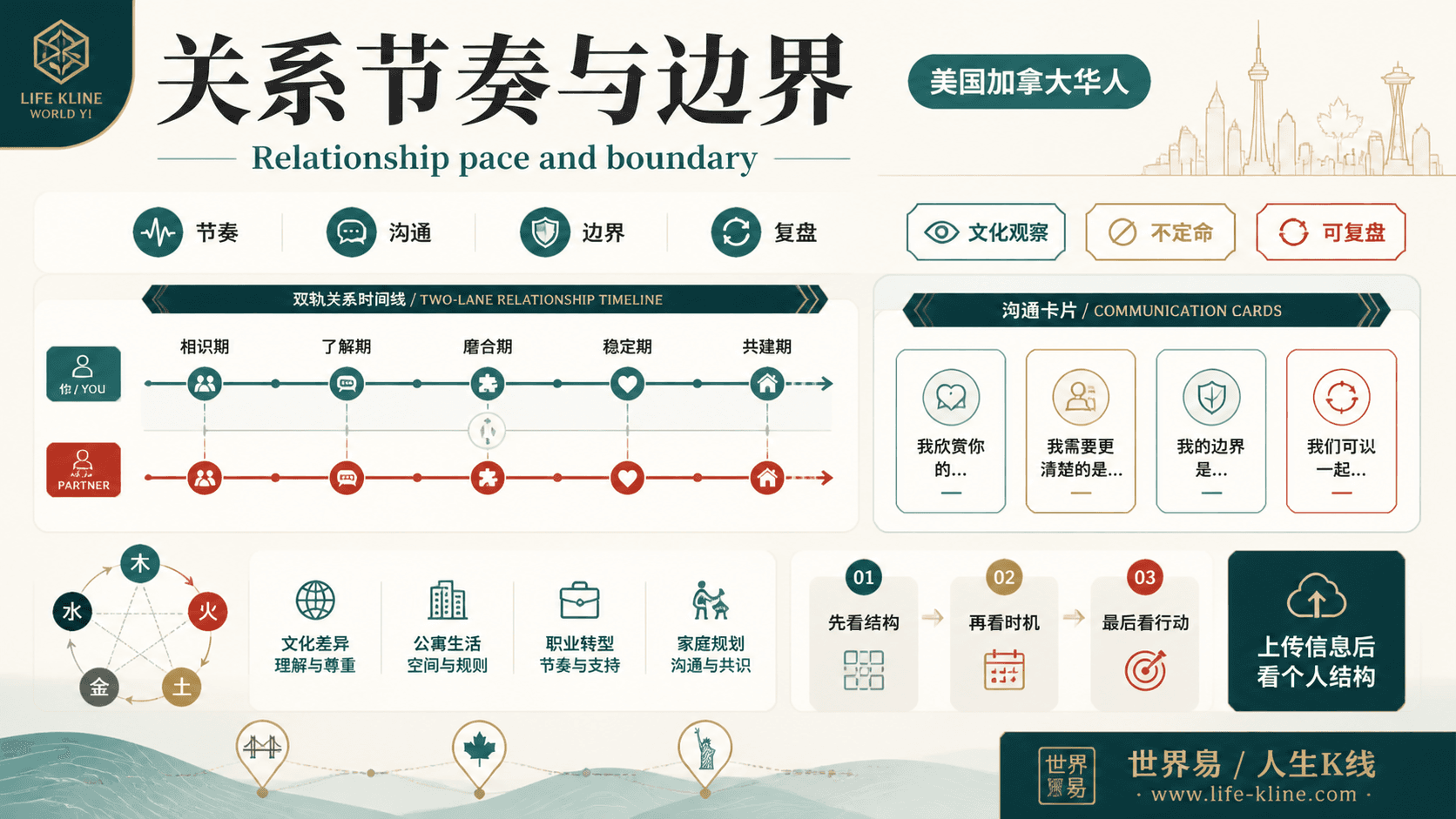
关系节奏与边界|美国加拿大华人
这张图把《Comprehensive Analysis and Application of the Heavenly Stem Yi (乙) in Destiny Studies》里的命理概念转成关系、边界和应用场景,适合先看图建立结构,再回到知识文章正文理解细节。
关系节奏与边界不应被写成固定结论。更适合美国加拿大华人的读法,是把传统术语翻译成结构、时机、环境、行动和复盘。
查看图片解读