Industry Suitability Analysis for Teachers: Career Choices Between Zheng Yin and Shang Guan Patterns
把这篇文章落到自己身上验证:先看结构,再进入个人分析,不做泛泛阅读。
Why This Decision Is Especially Difficult in This Profession
The teaching profession features a stable work rhythm and clear summer and winter vacation cycles, requiring practitioners to have strong emotional management and group coordination abilities, as well as efficient expression and knowledge output. This nature of work means that when facing industry suitability decisions, one must consider whether the individual’s BaZi structure supports sustained emotional labor and expressive demands. The heavy responsibilities and emotional pressures can easily lead to career burnout or development bottlenecks if the BaZi lacks stable supporting elements.
Regarding income structure, teaching typically involves fixed salaries, with limited promotion and bonuses. While job security is relatively high, growth potential is limited. If the BaZi structure has strong Pian Cai (Indirect Wealth) or Zheng Cai (Direct Wealth), it may indicate additional income and external opportunities. However, for teachers purely seeking career stability, overly strong Pian Cai might cause instability in career direction. Therefore, a reasonable combination of Zheng Yin (Direct Resource) and Shang Guan (Hurting Officer) in the BaZi determines whether the practitioner can achieve good expressive output and emotional regulation while maintaining stability.
From a BaZi perspective, Zheng Yin often represents support and assistance, suitable for the knowledge accumulation and emotional support needed in teaching, while Shang Guan emphasizes expression and creativity, fitting for innovation and expression in teaching. How these two balance directly affects the success of industry suitability decisions. Additionally, the directions of Da Yun and Liu Nian will amplify or suppress this balance, determining the timing and risks of entering or leaving the teaching profession.
Therefore, when making decisions about suitability for teaching, one must consider not only the BaZi pattern itself but also how Da Yun and Liu Nian influence the individual’s career lifecycle. Evaluating the match between stable rhythms and expressive output is essential for making scientific and reasonable judgments.
Three Core Dimensions of BaZi Judgments
The first dimension is the Day Master and the overall pattern. Common Day Masters in teaching are often Water or Metal, with patterns mainly of Zheng Yin (Direct Resource) or Shang Guan (Hurting Officer). Zheng Yin patterns symbolize knowledge and support, suitable for a stable teaching environment; Shang Guan patterns emphasize expression and innovation, fitting for diversified teaching content and lively classrooms. The strength of the Day Master determines personal energy and endurance; a weak Day Master requires external Yong Shen support, while an overly strong Day Master needs to control Ji Shen to avoid excessive depletion.
The second dimension is the configuration of Yong Shen (favorable elements) and Ji Shen (unfavorable elements). In the teaching profession, Yong Shen is usually Metal or Earth, representing stability and support, whereas Ji Shen like Wood and Fire may cause emotional fluctuations and depletion. Proper application of Yong Shen helps teachers maintain balance in emotional labor and expressive output, while excessive Ji Shen may trigger occupational anxiety or restricted expression.
The third dimension is the interaction between Da Yun (decade luck cycle) and Liu Nian (annual fortune). Da Yun represents the long-term trend of personal fortune, while Liu Nian reflects changes in the current year. Teaching requires stable Da Yun and effective Yong Shen. If Da Yun is weak or Liu Nian conflicts with Ji Shen, caution is advised to avoid career risks. Conversely, favorable Da Yun and supportive Liu Nian are suitable for actively expanding and innovating teaching methods.
These three dimensions collectively form the BaZi framework for industry suitability in teaching. Only through comprehensive consideration can one accurately judge whether an individual is fit for teaching and when to adjust their career path.
Three Real BaZi Chart Cases
Case 1: Female, aged 25-30, Day Master 癸 (Gui, Water), relatively weak, Zheng Yin pattern, Yong Shen Metal, Ji Shen Wood and Fire, currently in Da Yun 丁丑 (Ding Chou, relatively weak), Liu Nian 丙午 (Bing Wu). This chart’s Zheng Yin pattern reflects a need for knowledge accumulation and emotional support, matching the stable rhythm and emotional labor demands of teaching. However, the weak Day Master and current weak Da Yun suggest caution in industry suitability, especially as the Liu Nian 丙午 year has strong Fire, which may increase emotional depletion. This chart suits teachers who emphasize emotional regulation and colleague support, avoiding over-expression that leads to fatigue. It is recommended to prioritize confirming the strength of Yong Shen and the harmony of current Da Yun and Liu Nian for steady development rather than aggressive changes.
Case 2: Male, aged 20-25, Day Master 辛 (Xin, Metal), relatively strong, Zheng Guan (Direct Officer) pattern, Yong Shen Fire and Wood, Ji Shen Earth, currently in Da Yun 甲申 (Jia Shen, auspicious), Liu Nian 丙午 (Bing Wu). The Zheng Guan pattern symbolizes rules and responsibility; the relatively strong Metal Day Master benefits authority and order management in teaching. Yong Shen Fire and Wood support expression and innovation, enhancing classroom vitality and diverse teaching methods. The auspicious Da Yun and favorable Liu Nian indicate good career development opportunities. This chart suits those undertaking teaching management roles, leveraging organizational and expressive strengths. In suitability decisions, focus should be on whether Ji Shen Earth pressure affects stability, and whether Da Yun and Liu Nian continue to support Yong Shen, favoring proactive advancement.
Case 3: Female, aged 25-30, Day Master 庚 (Geng, Metal), balanced, Shang Guan pattern, Yong Shen Earth, Ji Shen Fire, currently in Da Yun 乙未 (Yi Wei, stable), Liu Nian 丙午 (Bing Wu). The Shang Guan pattern emphasizes expression and creativity, suitable for innovation and lively teaching atmospheres. Yong Shen Earth helps stabilize the teaching foundation, while Ji Shen Fire requires attention to emotional management. The stable Da Yun and adaptive Liu Nian suggest suitability for steady progress. This chart can meet expressive output demands while maintaining some stability, fitting moderate innovation in teaching content and methods. In suitability judgment, first confirm the bearing capacity of Yong Shen Earth and the impact of Ji Shen Fire to assess if emotional labor balance can be maintained.
These three cases illustrate how different BaZi structures affect industry suitability in teaching, from stable support to expressive innovation. Each chart’s Yong Shen, Ji Shen, and Da Yun-Liu Nian combinations determine appropriate career strategies and development rhythms.
Common Misjudgments and Blind Spots in This Profession
The teaching profession is often mistakenly judged as requiring only stability and knowledge accumulation, neglecting the dual pressures of expression and emotional labor. In BaZi analysis, focusing solely on Zheng Yin support while ignoring the need for Shang Guan expression can lead to insufficient teaching innovation and limited career development. Conversely, overemphasizing Shang Guan expression while neglecting Zheng Yin’s emotional support may cause emotional exhaustion and burnout.
Another blind spot is ignoring the interaction between Da Yun and Liu Nian. Many people judge industry suitability only by fixed BaZi structures without considering current and future luck cycles, leading to decision errors. Teaching requires adjusting work rhythm and roles according to Da Yun and Liu Nian; neglecting this may miss optimal development timing or overlook potential risks.
Additionally, the role of Ji Shen is often underestimated. In teaching, Ji Shen such as Fire and Wood, if overly strong, increases emotional labor burdens, causing expression blockages or emotional instability. Many BaZi judgments insufficiently consider Ji Shen’s depletion effects on career adaptation, creating blind spots.
Therefore, a comprehensive and integrated approach considering Day Master, pattern, Yong Shen, Ji Shen, and Da Yun-Liu Nian is key to making accurate industry suitability decisions in teaching.
Practical Judgment Sequence
Step one: Confirm the Day Master’s strength and pattern type. Determine whether it is a Zheng Yin or Shang Guan pattern, understanding its innate tendencies toward stable rhythm and expressive output, laying the foundation for further analysis. Special attention is needed for weak Day Masters regarding Yong Shen support, and for strong Day Masters regarding Ji Shen control.
Step two: Evaluate the configuration of Yong Shen and Ji Shen and the current Da Yun and Liu Nian status. Strong Yong Shen and auspicious Da Yun indicate suitability for active teaching and expanding content; weak Da Yun or Liu Nian conflicting with Ji Shen suggest caution, favoring maintaining status quo or adjusting direction. Focus on Ji Shen changes related to emotional labor to avoid excessive depletion.
Step three: Combine the profession’s work rhythm and responsibility characteristics to judge whether the individual can sustain long-term emotional labor and expressive demands. According to BaZi indications, choose appropriate work intensity and role positioning to determine suitability for teaching or the need to seek a better-matched position. Timing of action should align with Da Yun and Liu Nian trends to avoid impulsive decisions.
Following these steps enables scientific determination of individual suitability for the teaching profession and guides career planning and decision-making rhythms, enhancing job satisfaction and stability.
FAQ
Question 1: Why does the strength of the Day Master greatly affect suitability for the teaching profession? Answer: The Day Master’s strength represents personal energy and endurance. Teaching requires stable and sustained emotional labor and expressive output. A weak Day Master may struggle to support high-intensity work, while an overly strong Day Master may cause excessive depletion or emotional fluctuations, affecting career stability.
Question 2: What roles do Zheng Yin and Shang Guan play in the teaching profession? Answer: Zheng Yin represents knowledge support and emotional stability, aiding continuity and steadiness in teaching; Shang Guan emphasizes expression and creativity, suitable for enhancing classroom vitality and teaching innovation. Balancing these two is key to success in teaching careers.
Question 3: How do Da Yun and Liu Nian affect industry suitability decisions for teachers? Answer: Da Yun determines mid- to long-term fortune trends, while Liu Nian reflects annual changes. Auspicious Da Yun and Liu Nian supporting the individual’s Yong Shen favor active development; weak or conflicting periods require caution to avoid career risks. Proper use of Da Yun and Liu Nian information improves decision-making scientificity and timeliness.
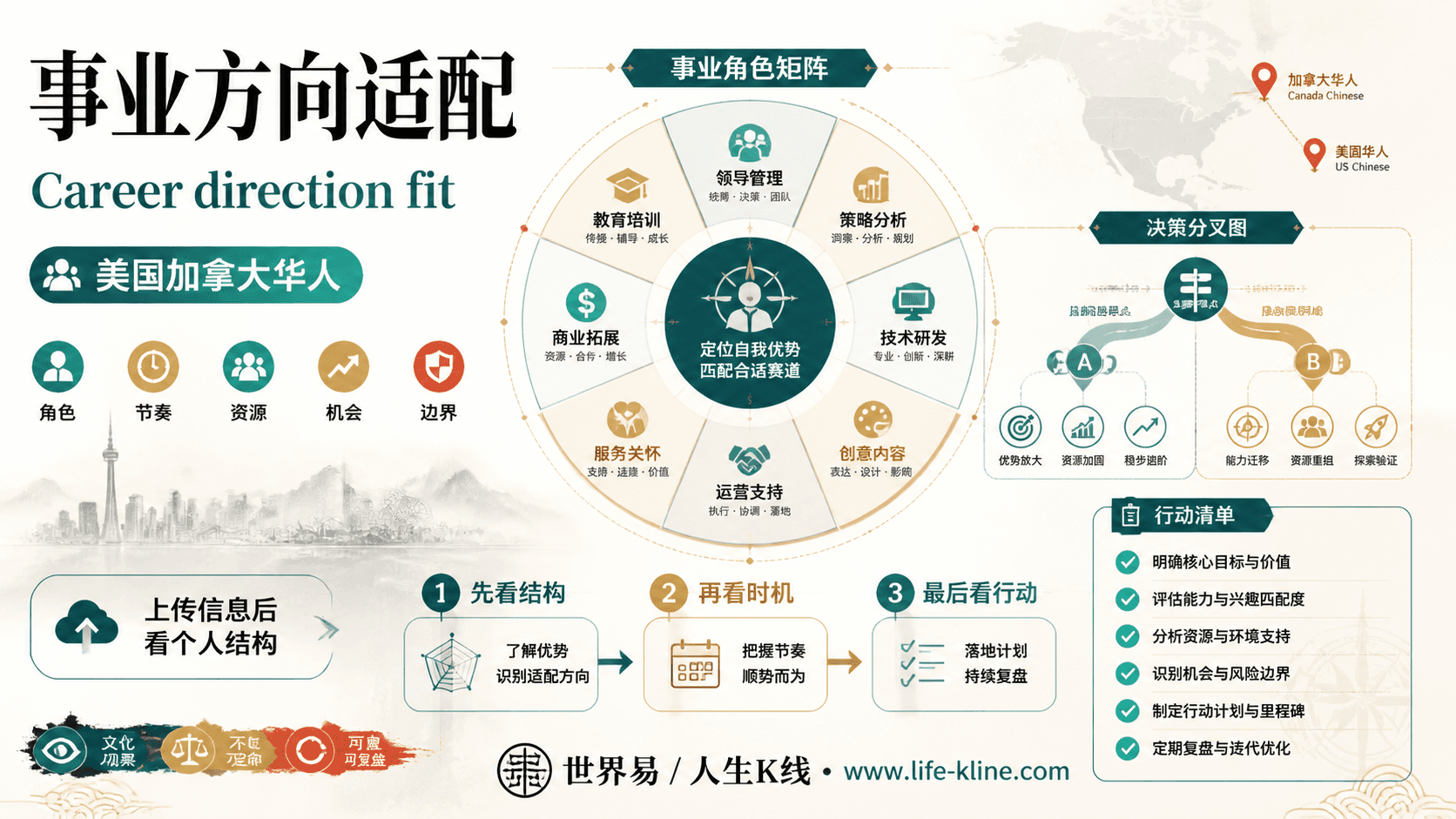
事业方向适配|美国加拿大华人
这张图把《Industry Suitability Analysis for Teachers: Career Choices Between Zheng Yin and Shang Guan Patterns》里的命理概念转成关系、边界和应用场景,适合先看图建立结构,再回到知识文章正文理解细节。
事业方向适配不应被写成固定结论。更适合美国加拿大华人的读法,是把传统术语翻译成结构、时机、环境、行动和复盘。
查看图片解读