A Metaphysical Perspective and Practical Guide to Identifying Danger Signals in Stock Market Investment
把这篇文章落到自己身上验证:先看结构,再进入个人分析,不做泛泛阅读。
Why This Decision Is Particularly Difficult in This Wealth Scenario
Stock and fund investment is essentially a high-volatility wealth appreciation activity, where investors face multiple decision challenges such as adjusting risk appetite, timing entry, and setting stop-losses. In reality, high housing prices, inflationary pressures, and interest rate fluctuations require more cautious capital allocation, while pressures from lending among relatives and family savings generally lower risk tolerance. Psychologically, investors tend to fall into cycles of panic selling or greedy chasing of gains, leading to frequent decision errors.
On this basis, BaZi structure offers an internal energy and trend perspective, helping to understand investors’ risk tolerance and operational habits. Different Day Master strengths and combinations of Yong Shen and Ji Shen amplify or suppress investors’ reactions to market fluctuations. Especially during interactions between Da Yun and Liu Nian, risk signals are more likely to manifest or be concealed.
Therefore, identifying danger signals in stock market investment is not only a judgment of market conditions but also an insight into one’s own metaphysical energy state. Misidentifying signals often leads to capital chain breaks or decision imbalances. Conducting multidimensional risk assessments based on BaZi structure can help investors rationally pause or adjust strategies in complex market environments.
Three Core Dimensions of Metaphysical Judgment
First, the strength of the Day Master determines the investor’s core energy foundation. A relatively weak Day Master often indicates insufficient internal resources, leading to greater emotional fluctuations and limited risk tolerance in the face of market volatility; a relatively strong Day Master may be overconfident and overlook potential risks. In the stock market, the Wealth Star represents wealth inflow, and its activity level directly affects investment return expectations.
Second, the presence of Bi Jian (Peer) and Jie Cai (Rob Wealth) stars reflects cooperative and competitive relationships. In investment, an abundance of Bi Jian/Jie Cai may manifest as capital splitting, interference from loans among relatives, or tight capital chains, increasing operational risks. The Yin stars (Pian Yin/Zheng Yin) symbolize protection and support forces, which can buffer market shocks and suppress impulsive decisions.
Finally, the interaction between Da Yun (decade luck cycle) and Liu Nian (annual fortune) is especially critical. Da Yun represents long-term trends, while Liu Nian reflects phase-specific fluctuations. When Da Yun is stable and auspicious, investors are better suited for preservation and steady allocation; when Liu Nian involves clashes or Ji Shen activation, market risk signals are amplified, requiring heightened vigilance and timely stop-loss or exit. Particularly, changes in the relationship between the Wealth Star and Yong Shen often indicate the strength of capital flow and risk points.
Three Real BaZi Chart Cases
Case 1: This female investor has a relatively weak Day Master Geng (庚, Metal), belonging to the Shang Guan (Hurting Officer) pattern, with Yong Shen being Earth and Ji Shen being Water and Wood. Currently, the Yi Wei (乙未) Da Yun is stable, and the Bing Wu (丙午) Liu Nian requires adaptability. In her chart, Earth as Yong Shen represents stability and accumulation, while the Shang Guan pattern reflects strong expressiveness and extroversion. In stock investment, this may manifest as a pursuit of short-term swing operations, prone to emotional influence mid-course. During the Yi Wei Da Yun, preservation is advised, but the liquidity changes in Bing Wu Liu Nian signal that when Water and Wood (Ji Shen) appear, she should immediately stop operations to avoid losses caused by information asymmetry or excessive chasing of gains.
Case 2: This male investor has a relatively weak Day Master Ji (己, Earth), with a Pian Cai (Indirect Wealth) pattern, Yong Shen being Fire, and Ji Shen being Metal and Water. Currently, the Yi Hai (乙亥) Da Yun is stable, and the Bing Wu (丙午) Liu Nian requires adaptability. The Pian Cai pattern indicates strong proactive wealth acquisition ability, but the weak Day Master shows insufficient steadiness. Yong Shen Fire symbolizes motivation and enthusiasm, but Ji Shen Metal and Water correspond to real market risks such as interest rate changes and capital tightness. When facing intense Metal and Water fluctuations in the market, the investor should beware of excessive speculation and leverage use. Upon signals of capital chain tightening triggered by Liu Nian or Da Yun, decisive stop-loss is necessary to avoid amplified losses.
Case 3: This female investor has a relatively strong Day Master Ji (己, Earth), with a Jie Cai (Rob Wealth) pattern, Yong Shen being Wood and Water, and Ji Shen being Fire. Currently, the Yi Wei (乙未) Da Yun is auspicious, and the Bing Wu (丙午) Liu Nian aligns with the trend. A strong Day Master means a solid financial foundation; the Jie Cai pattern indicates a tendency toward resource sharing and teamwork in investment. Yong Shen Wood and Water help regulate internal pressures and improve capital liquidity. The auspicious Da Yun combined with a favorable Liu Nian suggests suitability for active market participation, but Ji Shen Fire represents potential risks of market overheating and emotional volatility. When Fire signals strengthen (e.g., excessive optimism), timely position adjustment is advised to avoid blind accumulation.
The above three cases integrate real market fluctuations, interest rate changes, inflation pressures, and personal capital situations, demonstrating how to identify different investors’ risk boundaries through BaZi structure, providing multidimensional references for investment decisions.
Common Misjudgments and Blind Spots in This Scenario
One common misjudgment in stock investment risk identification is overreliance on technical market indicators while neglecting one’s own metaphysical energy state. Even if technical analysis signals adjustment, if the investor’s BaZi shows stable Da Yun and Liu Nian, blind stop-loss may cause missed rebound opportunities; conversely, ignoring market risks when Ji Shen is activated in BaZi structure may exacerbate losses.
Another blind spot is treating Day Master strength as the sole decision criterion, overlooking the regulatory roles of Yong Shen and Ji Shen. For example, a weak Day Master investor with strong Yin star protection may have relatively enhanced risk tolerance, and blind panic would be detrimental to long-term positioning.
Additionally, the complexity of Da Yun and Liu Nian interactions is often oversimplified, leading to mistimed judgments. Even if Da Yun is auspicious, when Liu Nian’s strong Ji Shen erupts, risk signals cannot be ignored. Integrated judgment often neglects phase-specific risks, causing capital chain breaks. Especially in today’s volatile market environment, single-dimensional interpretation is usually insufficient for effective risk control.
Practical Judgment Sequence
Step one: Confirm the Day Master’s strength and pattern type to clarify one’s risk tolerance foundation and capital flow characteristics. For a weak Day Master, priority should be given to the activity level of protective Yong Shen; for a strong Day Master, focus on whether Ji Shen is erupting.
Step two: Focus on examining the interactions among the Wealth Star, Yong Shen, and Ji Shen within the current Da Yun and Liu Nian. If Da Yun is stable but Liu Nian activates Ji Shen, vigilance should be raised, preparing for timely stop-loss or operation pause; if Da Yun is auspicious and Liu Nian aligns with the trend, moderate position adjustments can be made to follow the momentum.
Step three: Combine the real financial environment, such as interest rates, inflation, family capital status, and market heat, for comprehensive evaluation. When signs like capital chain tightness, market overheating, or increased pressure from loans among relatives resonate with Ji Shen in BaZi, decisively stopping operations is wise. Otherwise, moderate diversification and avoiding blind chasing of highs and lows is advisable.
By following this judgment sequence, investors can scientifically identify danger signals in stock market investment, reasonably adjust strategies, reduce risks, and increase the probability of steady wealth growth.
FAQ
Question 1: How to monitor danger signals in BaZi during daily investment? Answer: It is recommended to regularly combine changes in Da Yun and Liu Nian, paying attention to the activity levels of Yong Shen and Ji Shen, especially during periods of intense market volatility. Combine this with the Day Master’s strength to judge one’s risk boundaries and adjust positions in a timely manner.
Question 2: If Ji Shen is activated in Liu Nian but the market trend is bullish, should one continue holding? Answer: In such cases, priority should be given to assessing capital chain safety and risk tolerance. Even if the market is bullish, Ji Shen activation usually indicates increased potential risks. It is advisable to reduce positions appropriately or set stop-loss orders to avoid major losses from sudden risks.
Question 3: How does BaZi view the choice between long-term investment and short-term swing trading? Answer: BaZi structures with weak Day Masters and patterns like Shang Guan that are prone to emotional influence are better suited for steady long-term investment, avoiding frequent operations. When the Day Master is strong and supported by Yong Shen, moderate participation in swing trading is possible, but one must be wary of emotional volatility triggered by Ji Shen activation and reasonably control position sizes.
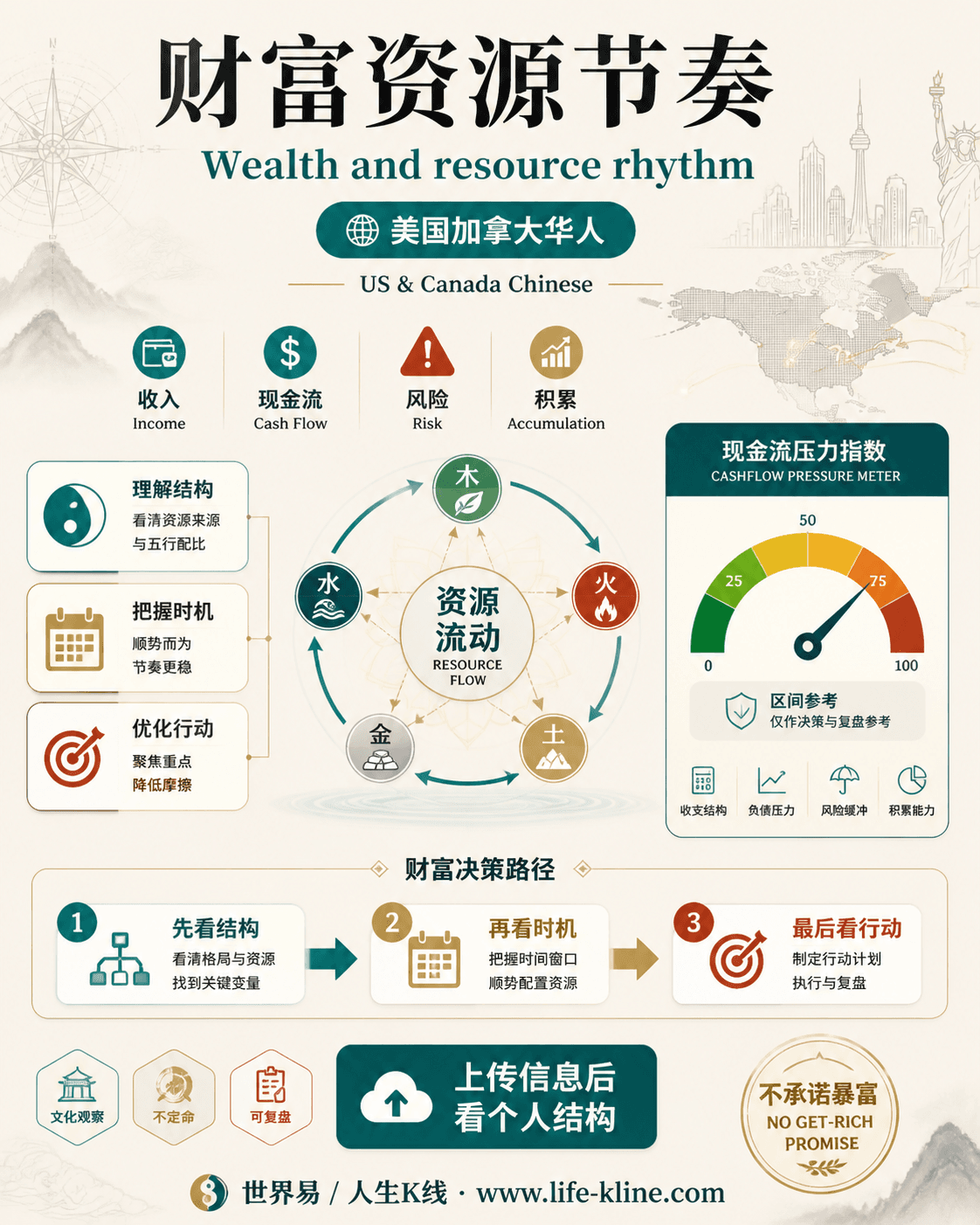
财富资源节奏|美国加拿大华人
这张图把《A Metaphysical Perspective and Practical Guide to Identifying Danger Signals in Stock Market Investment》里的命理概念转成关系、边界和应用场景,适合先看图建立结构,再回到知识文章正文理解细节。
财富资源节奏不应被写成固定结论。更适合美国加拿大华人的读法,是把传统术语翻译成结构、时机、环境、行动和复盘。
查看图片解读