Post-Loss Review and Restart in Stock Market Investment: Risk and Opportunity Analysis from a Metaphysical Perspective
把这篇文章落到自己身上验证:先看结构,再进入个人分析,不做泛泛阅读。
Why This Decision Is Especially Difficult in This Wealth Scenario
Post-loss review and restart in stock and fund investment face multiple practical constraints. Firstly, investors are often influenced by emotions such as panic or wishful thinking, making it difficult to rationally decide whether to continue holding positions or cut losses in time. Secondly, the current Chinese market experiences intense volatility, with high housing prices and inflationary pressures tightening capital allocation, increasing household savings and liquidity demands, thereby reducing investment tolerance for errors. Additionally, timing entry and stop-loss strategies in the stock market are inherently uncertain, and choosing the correct action timing after losses is critical.
On the psychological level, investment losses often lead to cognitive biases; investors easily fall into the sunk cost fallacy, finding it hard to cut losses or adjust strategies, increasing the risk of further losses. The metaphysical structure plays a role here by objectively indicating the investor’s current energy state and potential risks. For example, the Day Master’s strength and its relationship with the Yong Shen reveal personal endurance and action capability; the combination of Bi Jian (Peer) / Jie Cai (Rob Wealth) and Cai Xing (Wealth Stars) reflects cooperation and wealth relations; Yin Xing (Seal Stars) indicate information reception and adjustment ability.
In this decision-making, metaphysics not only reflects individual risk tolerance but also signals when it is appropriate to preserve gains or pursue advancement. The interaction of Da Yun and Liu Nian corresponds to external environmental changes, such as market trends and policy impacts, helping investors judge when to adapt flexibly and when to preserve capital. Therefore, the difficulty lies in integrating real economic conditions, psychological state, and metaphysical energy to formulate a scientific and reasonable review and restart plan.
Three Core Dimensions of Metaphysical Judgment
First, the relationship between the Day Master and Cai Xing (Wealth Stars) determines the investor’s wealth attraction and risk tolerance. The Day Master’s strength influences initiative and decision confidence; a relatively weak Day Master is more prone to emotional fluctuations after losses and requires Yong Shen support to stabilize; a relatively strong Day Master has stronger self-regulation but may also be overconfident, increasing the risk of blindly chasing rises or panicking sell-offs.
Second, Bi Jian (Peer) and Jie Cai (Rob Wealth) reflect the investor’s performance in interpersonal relations and resource sharing. A strong Bi Jian indicates competition and self-enhancement, suitable for diversified cooperation, but excessive strength may lead to blind expansion. The strength or weakness of Cai Xing reflects wealth inflows and outflows, while the restraint from Ji Shen (unfavorable elements) points to potential risk points. Properly balancing these elements is an important reference during review.
Third, the interaction between Da Yun and Liu Nian reveals external trends and timing. Da Yun represents long-term trends, while Liu Nian corresponds to short-term market environments; their clashes and harmonies influence the timing of review decisions. When luck is favorable and trends align, active strategy adjustments are advisable; when luck is conservative or adverse, preservation or cautious observation is preferred. Combined with changes in Yong Shen for seasonal adjustment, investors can judge when to stop loss and exit, and when to add positions or adjust allocations to achieve recovery.
Three Real Natal Chart Cases
Case 1: The Day Master is 丁火 (Ding Fire) and relatively weak, belonging to the Qi Sha (Seven Killings) pattern; Wood is the Yong Shen, Earth and Metal are Ji Shen. Currently in the 戊午 (Wu Wu) Da Yun (favoring preservation) and 丙午 (Bing Wu) Liu Nian (favoring flexible adaptation). In stock investment, a weak Ding Fire Day Master means the investor’s own energy is limited and prone to emotional fluctuations when facing losses. The Wood Yong Shen suggests stabilizing the mindset by introducing new information and resources (such as research reports and expert advice). Although the Wu Earth Da Yun is stable, Earth is a Ji Shen, indicating potential market resistance. Post-loss review should lean conservative, avoiding blind chasing of rallies. It is recommended that the investor first confirm the stability of the Da Yun stage and focus on Liu Nian changes; if the Bing Wu Liu Nian brings positive signals, small position additions can be considered; otherwise, accepting losses and exiting is advisable to prevent emotional decisions causing greater losses.
Case 2: The Day Master is 癸水 (Gui Water) and relatively strong, Qi Sha pattern; Yong Shen are Earth and Fire, Ji Shen is Metal. Currently in the 乙巳 (Yi Si) Da Yun, a favorable luck cycle, and 丙午 (Bing Wu) Liu Nian aligned with the trend. A strong Gui Water Day Master shows the investor has strong information processing and adaptability; the Earth and Fire Yong Shen support stable strategy execution. The Yi Si Da Yun brings positive energy for career and wealth growth, and the Liu Nian aligns with the trend, indicating a relatively favorable market environment. After losses, the investor can rely on the strong Day Master advantage, combine Yong Shen to stabilize mindset and capital allocation, actively adjust the portfolio, and strive for rebound opportunities. It is suggested to first confirm the overall auspiciousness of the Da Yun, combine Liu Nian to judge short-term trends, make appropriate remedies, and set reasonable stop-losses to avoid excessive optimism expanding risks.
Case 3: The Day Master is 乙木 (Yi Wood) and relatively strong, Qi Sha pattern; Yong Shen is Fire, Ji Shen is Water. Currently in 丁亥 (Ding Hai) Da Yun, a stable cycle, and 丙午 (Bing Wu) Liu Nian favoring flexible adaptation. A strong Yi Wood Day Master indicates the investor has strong growth and innovation drive; the Fire Yong Shen supports initiative and execution, but the Ji Shen Water may bring volatility and uncertainty. The Ding Hai Da Yun favors preservation, suggesting that aggressive operations are not suitable currently, while the Bing Wu Liu Nian requires flexible market response. After losses, the investor should leverage the strong Day Master advantage and the energy of Fire Yong Shen, cautiously choose timing for adding positions, but remain alert to market volatility risks brought by the Ji Shen Water. It is recommended to first assess the preservation trend of the current Da Yun, focus on Liu Nian dynamics, avoid chasing rises or panicking sell-offs, and adjust positions steadily.
Common Misjudgments and Blind Spots in This Scenario
Investors often fall into the sunk cost trap after losses, mistakenly believing that the more money invested, the more they should hold on, ignoring metaphysical indications of current energy states and external trends, resulting in continuous position additions that worsen risks. The psychological mix of wishful thinking and panic causes reviews to lose objectivity, making rational asset allocation adjustments impossible.
Another blind spot is neglecting the risk signals of Ji Shen in the natal chart, especially when Da Yun or Liu Nian indicate preservation or adverse luck. Blindly pursuing quick turnarounds while ignoring dual warnings from the market and metaphysics can cause greater losses. Additionally, some investors lack sufficient understanding of Yong Shen and fail to effectively use metaphysical hints to adjust mindset and strategy, leading to impulsive or overly passive actions.
Finally, over-reliance on short-term Liu Nian while ignoring the long-term trend of Da Yun causes unstable decision-making. Stock market volatility is inherently random; metaphysical judgment must be combined with real economic conditions and personal risk tolerance. Blind operation based on a single dimension often results in inefficiency and difficulty achieving steady wealth accumulation.
Practical Judgment Sequence
Step one: Confirm the strength of the Day Master and the state of the Yong Shen, assess one’s current psychological and action capacity, and judge whether one has the ability for rational review and adjustment. When the Day Master is weak, stabilize emotions first and avoid impulsive operations; when strong, beware of overconfidence that may expand risks.
Step two: Combine Da Yun and Liu Nian relationships to judge external environmental trends. When Da Yun is auspicious and Liu Nian aligns with the trend, moderately adjust positions and attempt remediation; when Da Yun favors preservation or is adverse, be more cautious and prioritize accepting losses to control risk.
Step three: Identify the combination of Cai Xing (Wealth Stars), Bi Jian (Peer), and Yin Xing (Seal Stars) to balance wealth acquisition and cooperative support. If Cai Xing is damaged and Bi Jian is strong, it may indicate dispersed resources and capital pressure; a concentrated allocation and reasonable stop-loss are recommended. A strong Yin Xing suggests good information reception, allowing the use of multiple data channels to assist decisions.
In summary, investors should first clarify the metaphysical structure and real capital situation, combine market trends, and scientifically formulate review strategies. The timing of accepting losses depends on risk amplification periods indicated by Da Yun and Liu Nian, while remediation relies on Yong Shen support and favorable Liu Nian. Rational judgment and gradual adjustments are essential to achieve steady wealth restart.
FAQ
Question 1: How do Yong Shen and Ji Shen affect stock market investment decisions in metaphysics? Answer: Yong Shen represents the Five Elements favorable to the Day Master, stabilizing mindset and enhancing action capability, helping investors rationally judge and adjust strategies. Ji Shen are unfavorable elements to the Day Master, indicating potential risks and obstacles. After losses, special attention should be paid to the activation of Ji Shen to avoid blind operations.
Question 2: What role do Da Yun and Liu Nian play in investment review? Answer: Da Yun reflects long-term trends, influencing overall fortune and wealth accumulation ability; Liu Nian reflects the external environment and market fluctuations of the current year. Their interaction determines the timing for review and restart; when trends align, active adjustments are advisable; when trends oppose, preservation and caution are preferred.
Question 3: What insights does Day Master strength provide for emotional management after losses? Answer: Investors with a weak Day Master are prone to emotional fluctuations and are advised to stabilize their mindset first to avoid impulsive actions; those with a strong Day Master tend to be confident but should guard against excessive optimism and set reasonable stop-loss points to prevent risk expansion.
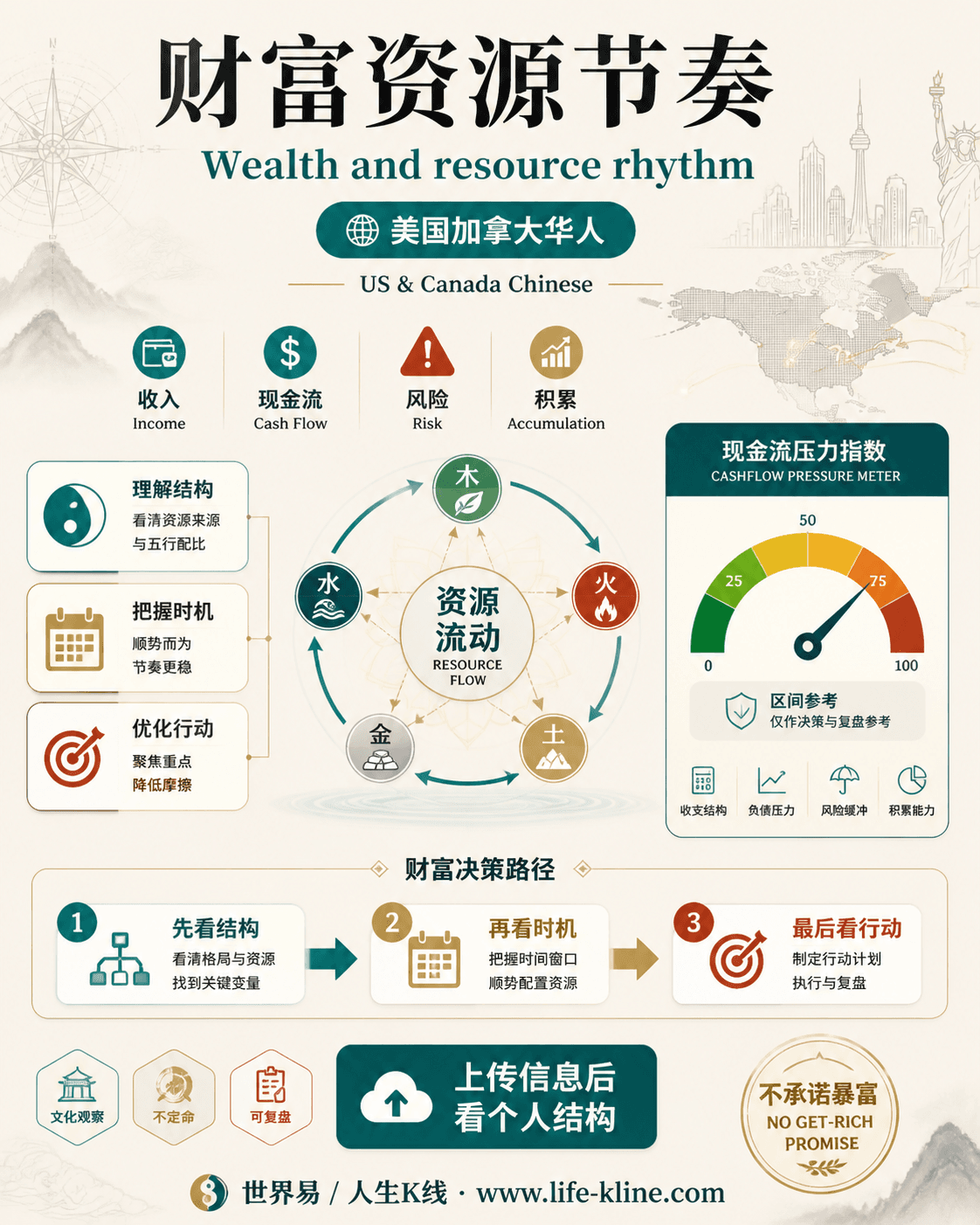
财富资源节奏|美国加拿大华人
这张图把《Post-Loss Review and Restart in Stock Market Investment: Risk and Opportunity Analysis from a Metaphysical Perspective》里的命理概念转成关系、边界和应用场景,适合先看图建立结构,再回到知识文章正文理解细节。
财富资源节奏不应被写成固定结论。更适合美国加拿大华人的读法,是把传统术语翻译成结构、时机、环境、行动和复盘。
查看图片解读