Metaphysical Judgments and Practical Guide on Action vs. Waiting in Stock Market Investment
把这篇文章落到自己身上验证:先看结构,再进入个人分析,不做泛泛阅读。
Why This Decision Is Especially Difficult in This Wealth Scenario
Stock and fund investments are essentially wealth management activities facing high uncertainty. Investors need to balance risk preference, timing entry, stop-loss settings, asset allocation ratios, and long-term versus swing operations. In the current Chinese economic environment, high housing prices, fluctuating interest rates, and increasing inflation pressure make liquidity and risk management core challenges. Investors often find it difficult to determine when to act decisively and when to pause to avoid potential risks.
On the psychological level, investors easily fall into overconfidence or panic emotions, leading to frequent chasing of rising stocks and selling at lows or premature stop-losses, thereby affecting the long-term capital growth potential. Additionally, real constraints such as borrowing from relatives and family savings limit liquidity flexibility, making losses from decision errors more severe.
Metaphysical structures play a role in amplifying or suppressing risks in this scenario. The strength of different Day Masters, the Yong Shen and Ji Shen (unfavorable element) of the pattern, and the clash and combination relationships between the current Da Yun and Liu Nian reflect the investor’s inherent risk tolerance and market sensitivity. Correctly identifying these metaphysical signals helps investors accurately judge the timing to act amid stock market fluctuations, avoiding blind chasing or excessive conservatism.
Therefore, the 'action or waiting' decision in stock market investment is not only a response to external economic environments but also a comprehensive test of internal metaphysical structure and psychological state. Understanding the interaction mechanisms of these multidimensional factors is key to achieving stable wealth growth.
Three Core Dimensions of Metaphysical Judgment
First, the relationship between the Day Master and the Wealth Star is key to measuring the investor’s risk preference and capital flow. The Day Master’s strength determines personal energy status; a relatively strong Day Master usually means the investor has strong self-drive and execution ability, while a weak Day Master tends to be cautious or dependent on external support. The appearance of the Wealth Star represents opportunities and temptations for wealth; when the Wealth Star is strong, active action is suitable, and when it is restrained, a conservative waiting approach is advisable.
Second, the role of Bi Jian (Peer) and Jie Cai (Rob Wealth) stars reflects cooperation and competition relationships. A high number of Bi Jian indicates rich social resources, suitable for joint investments or diversified allocation, but excessive strength may cause fund dispersion or conflicts. The Yin Star (Pian Yin or Zheng Yin) represents information and wisdom support; when the Yin Star is strong, it helps investors analyze the market rationally and avoid blindly following trends.
Third, the interaction between Da Yun and Liu Nian reflects how external timing influences internal metaphysics. Favorable Da Yun combined with supportive Liu Nian means the market environment and personal state are synchronized, conducive to decisive action; otherwise, caution and observation are preferred. Particular attention should be paid to the clash and combination between the Wealth Star and the Yong Shen; once the Yong Shen is restrained, investment risk increases and position size should be controlled accordingly.
In summary, the strength of the Day Master and Wealth Star, the cooperation of Bi Jian and Yin Stars, and the harmony or conflict of Da Yun and Liu Nian are the three core metaphysical dimensions determining 'action or waiting' in stock market investment. Only by combining the real economic environment and personal metaphysical structure can scientifically reasonable investment decisions be made.
Three Real BaZi Chart Cases
Case 1: This female’s Day Master is Xin (辛, Metal) and relatively strong, belonging to the Jie Cai pattern. Her Yong Shen are Fire and Wood, and Ji Shen is Earth. Her current Da Yun is Jia Yin (甲寅, Wood Tiger) Da Yun, which is auspicious and smooth in all affairs, and the Liu Nian is Bing Wu (丙午, Fire Horse), forming a favorable combination with the Da Yun. The relatively strong Xin Metal Day Master indicates abundant self-energy, and the Jie Cai pattern shows her advantage in capital flow and resource competition. Fire and Wood as Yong Shen represent that she should leverage proactive energy and growth-oriented allocation. In reality, facing current high inflation and interest rate volatility, she is more suitable to time entry opportunistically when Da Yun and Liu Nian align well, actively allocating growth stocks or funds and using market fluctuations for swing operations. Attention should be paid to the Ji Shen Earth’s restraint, avoiding heavy positions in real estate or heavy asset classes. The judgment sequence should prioritize confirming the coordination of Da Yun and Liu Nian; once Yong Shen is effective, decisive action can be taken; otherwise, it is better to wait and observe.
Case 2: This female’s Day Master is Gui (癸, Water) and relatively weak, with a Shang Guan (Hurting Officer) pattern. Her Yong Shen is Metal, and Ji Shen are Wood and Fire. Her current Da Yun is Geng Xu (庚戌, Metal Dog) Da Yun, which is auspicious, and the Liu Nian is Bing Wu (丙午, Fire Horse), forming a supportive trend. The relatively weak Gui Water Day Master indicates limited action power and market adaptability; the Shang Guan pattern suggests sensitivity to information but susceptibility to emotional influence. Metal as Yong Shen means she should rely on rationality and rules to guide investment; Ji Shen Wood and Fire imply avoiding excessive aggressiveness and blind chasing. In practice, it is recommended that she make low-proportion allocations during market hotspots when Metal is supported, focusing on stable blue-chip stocks and defensive funds. When Da Yun and Liu Nian are auspicious but market sentiment is volatile, waiting should be prioritized to avoid high-risk operations driven by emotions. The judgment sequence is to confirm the strength of Yong Shen Metal and market rationality, verify information transparency and risk controllability before acting.
Case 3: This male’s Day Master is Wu (戊, Earth) and relatively weak, with a Pian Yin (Indirect Resource) pattern. His Yong Shen is Fire, and Ji Shen are Metal and Water. His current Da Yun is Geng Wu (庚午, Metal Horse) Da Yun, which is stable and suitable for holding, and the Liu Nian is Bing Wu (丙午, Fire Horse), requiring flexible response. The weak Wu Earth Day Master indicates limited basic strength; the Pian Yin pattern shows dependence on knowledge and strategic support. Fire as Yong Shen means he should seek hotspots and opportunities in the market, but Ji Shen Metal and Water restrict investment in metal and highly liquid assets. The current Da Yun is stable and Liu Nian calls for flexible adjustment, implying his investment strategy should focus on steady holding and avoid impulsive operations. In practice, it is recommended to maintain stable positions, focus on medium- to long-term layouts of growth assets, and avoid frequent trading. The judgment sequence is to first confirm that the overall market trend aligns with Da Yun and Liu Nian, then assess the strength of Yong Shen Fire, and after confirming risk control, adjust positions timely; in non-urgent situations, waiting is preferable.
These three cases respectively reflect the specific application of different Day Master strengths and pattern Yong Shen combinations in stock market investment decisions. Combined with real economic pressures and market fluctuations, they help investors scientifically judge when to act and when to pause.
Common Misjudgments and Blind Spots in This Scenario
One common misjudgment by investors is ignoring the warnings of Ji Shen in the BaZi chart and blindly chasing market hotspots, resulting in funds being trapped. For example, a Xin Metal Day Master investor with Ji Shen Earth heavily investing in real estate or cyclical stocks often suffers significant losses due to market fluctuations. Additionally, investors with weak Day Masters who do not emphasize Yong Shen support tend to frequently stop loss due to insufficient information or emotional impulses, missing long-term gains.
Another blind spot is insufficient consideration of the interaction between Da Yun and Liu Nian. When Da Yun is auspicious, investors often become overconfident and overlook short-term risks caused by Liu Nian clashes, leading to overly aggressive operations. Conversely, when Da Yun is unfavorable, they mistakenly believe all investment opportunities should be abandoned, ignoring local quality assets and swing opportunities still present in the market.
On the psychological level, investors easily oscillate between 'fear of loss' and 'greed for gains,' lacking a stable judgment framework. If metaphysical judgment is not scientifically combined with real economic conditions and psychological states, it is easily disturbed by market noise, causing decision errors.
Therefore, ignoring Ji Shen risks, improper coordination of Da Yun and Liu Nian, and emotional volatility are the most common misjudgments and blind spots in the 'action or waiting' decision in stock market investment.
Practical Judgment Sequence
First, confirm the strength of the Day Master and the status of the Yong Shen in the personal BaZi chart to judge whether there is an energy foundation for proactive action. When the Day Master is relatively strong and the Yong Shen is effective, active allocation and timing entry can be considered; otherwise, risk control should be strengthened and better opportunities awaited.
Second, combine the interaction between Da Yun and Liu Nian to evaluate whether the current market timing aligns with personal metaphysics. When Da Yun is auspicious and Liu Nian is supportive, investment proportion can be appropriately increased to realize swing profits from market fluctuations. If Da Yun is restrained or Liu Nian clashes are obvious, positions should be kept stable to avoid impulsive operations.
Finally, adjust investment strategies based on the real economic environment (such as interest rate trends, inflation pressure, and market hotspot changes). Even if metaphysical signals are good, macro risks and asset allocation diversification must be considered to prevent excessive exposure to a single investment type. In practice, it is recommended to set clear stop-loss points and position limits, balancing rational decision-making and flexible response.
FAQ
Question 1: How do Yong Shen and Ji Shen in metaphysics affect stock market investment decisions? Answer: Yong Shen represents the forces and resources the investor should rely on, such as information, strategy, or emotional support, helping rational judgment and action; Ji Shen represents potential risk factors. If Ji Shen is strong or restrained, investment risk increases, and cautious operation or delayed action is advised.
Question 2: How to combine Da Yun and Liu Nian to judge whether it is suitable to act? Answer: Da Yun represents long-term trends, and Liu Nian reflects the fortune of the current year. When Da Yun is auspicious and Liu Nian is supportive, personal fortune and market environment synchronize, favoring active investment; if Da Yun or Liu Nian are clashed, market risk increases, and a stable or waiting approach should be maintained.
Question 3: How to avoid misjudgments caused by discrepancies between metaphysics and reality during investment? Answer: Metaphysical judgment should be used as an auxiliary tool combined with macroeconomic data, market trends, and personal financial status to formulate scientific investment plans. The key is rational analysis and risk control, avoiding impulsive decisions based solely on metaphysics.
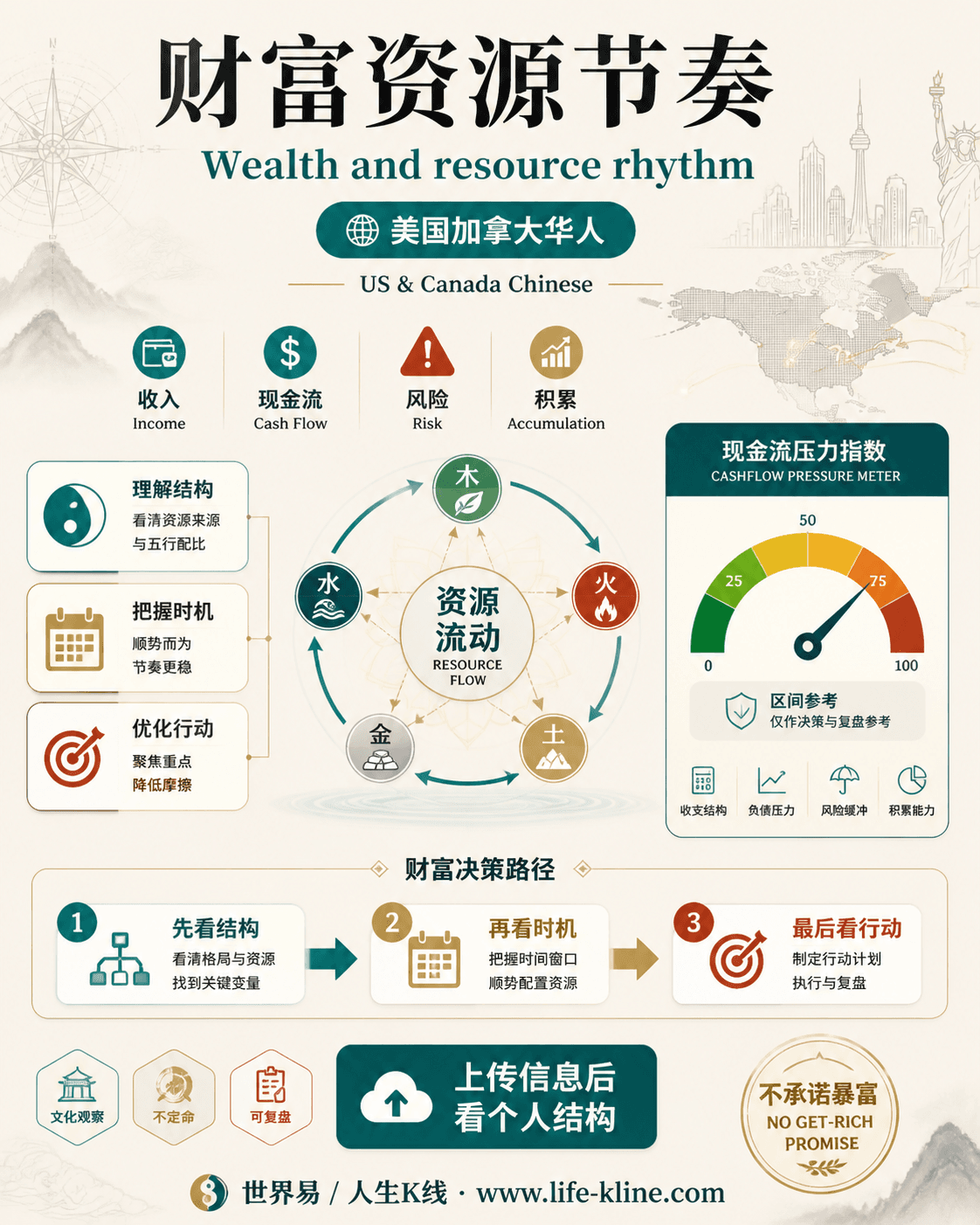
财富资源节奏|美国加拿大华人
这张图把《Metaphysical Judgments and Practical Guide on Action vs. Waiting in Stock Market Investment》里的命理概念转成关系、边界和应用场景,适合先看图建立结构,再回到知识文章正文理解细节。
财富资源节奏不应被写成固定结论。更适合美国加拿大华人的读法,是把传统术语翻译成结构、时机、环境、行动和复盘。
查看图片解读