Metaphysical Analysis and Practical Strategies for Optimal Timing in Stock Market Investment
把这篇文章落到自己身上验证:先看结构,再进入个人分析,不做泛泛阅读。
Why This Decision Is Particularly Difficult in This Wealth Scenario
The core difficulty in stock and fund investment lies in frequent market fluctuations, requiring dynamic adjustments of risk preference and allocation ratios based on personal financial status and psychological tolerance. In reality, factors such as high housing prices, interest rate volatility, inflation pressure, and lending among relatives and friends compound, making liquidity and capital safety key considerations for investors. Investors often face the dilemma of timing entry and stop-loss, with challenges balancing short-term trading and long-term holding.
Psychologically, investors are prone to emotional swings, blindly chasing rises and selling at falls, neglecting how their own metaphysical structure affects risk tolerance. In BaZi, combinations of Cai Xing (Wealth Stars), Bi Jian (Peer Stars), and Yin Xing (Seal Stars) reflect an individual’s sensitivity to wealth opportunities and risk control ability. Ignoring these factors easily leads to capital misallocation or even significant financial losses.
Da Yun (decade luck cycles) and Liu Nian (annual fortunes), as important carriers of personal fate rhythm, determine the timing quality of financial decisions. Especially the strength or weakness of Cai Xing and the gain or loss of Yong Shen (favorable element) directly influence the success rate of investors during critical time windows. If one can combine metaphysical structure to scientifically judge the clash and harmony between Liu Nian and Da Yun, avoiding misfortune and seeking auspiciousness, it will greatly improve the precision and effectiveness of investment operations.
Therefore, making decisions about the optimal timing window in stock and fund investments requires not only keen market insight but also integration with personal metaphysical structure to achieve a dynamic balance of risk and opportunity, avoiding blind aggression or excessive conservatism, and truly realizing steady wealth growth.
Three Core Dimensions of Metaphysical Judgment
First, the strength of the Day Master and the overall pattern determine the investor’s fundamental financial endurance. A strong Day Master usually indicates a proactive spirit and financial initiative but may be overly impulsive if too strong; a weak Day Master tends to be conservative and needs Yong Shen (favorable element) to regulate and enhance execution power. Patterns such as Yang Ren (Goat Blade) indicate a strong-willed personality, making investment decisions more aggressive or decisive, while Jie Cai (Rob Wealth) pattern suggests cooperation or shared capital risks.
Second, the interaction between Cai Xing (Wealth Stars) and Bi Jian (Peer Stars) reflects the relationship between wealth acquisition and competition or cooperation. When Cai Xing is strong and supported by Yong Shen, there are more investment opportunities, suitable for active allocation and timing entry. When Bi Jian is strong, it may indicate competition for funds with others or self-capital dispersion, requiring attention to capital management and strict stop-loss discipline. The presence of Yin Xing (Seal Stars) represents backing support and risk buffering, favoring steady operations.
Finally, the clash and harmony between Da Yun and Liu Nian form the temporal dimension’s opportunity window. Years with stable Da Yun are suitable for maintaining capital and steady investment; if Liu Nian supports Yong Shen, it is a favorable time for action. Conversely, if Liu Nian clashes with Yong Shen or Cai Xing, caution is needed to avoid blind accumulation or frequent trading. Especially the combination of Liu Nian and Da Yun amplifies or suppresses personal risk preference and market response capability.
In summary, judging the optimal timing window for stock investment requires integrating Day Master strength, Cai Xing and Bi Jian combinations, and Da Yun-Liu Nian interactions, acting according to time and circumstances to maximize metaphysical advantages and avoid potential risks.
Three Real BaZi Chart Case Studies
Case 1: This male’s Day Master is Yi Wood (乙木, Yi), relatively strong, with a Yang Ren (Goat Blade) pattern. His Yong Shen are Metal and Earth, and Ji Shen (unfavorable element) is Water. He is currently in the 10th year of the Ding Si (丁巳, Ding Si) Da Yun, which is a stable luck phase, with the Liu Nian being Bing Wu (丙午, Bing Wu), allowing flexible adaptation. The strong Yi Wood Day Master reflects a strong enterprising spirit and adaptability; the Yang Ren pattern increases decisiveness and action. The Metal and Earth Yong Shen regulate his investments, requiring attention to market factors related to Metal and Earth, such as interest rate trends and real estate policies. The Ding Si Da Yun is stable, suitable for capital preservation, while the Bing Wu Liu Nian, though random, offers opportunities for flexible adjustment. Considering real-world inflation and stock market volatility, this BaZi is suitable for timing entry when Da Yun is stable and Liu Nian supports Yong Shen, avoiding blind chasing when Ji Shen Water is strong or during extreme market fluctuations. Recommended judgment sequence: first confirm if Da Yun and Liu Nian are stable; observe if Metal and Earth Yong Shen are supported; then combine market trends for wave trading, strictly enforcing stop-loss rules.
Case 2: This female’s Day Master is Ji Earth (己土, Ji), relatively weak, with a Jie Cai (Rob Wealth) pattern. Her Yong Shen is Fire, and Ji Shen are Metal and Water. She is in the 3rd year of the Ren Zi (壬子, Ren Zi) Da Yun, which is relatively weak, with the Liu Nian being Bing Wu (丙午, Bing Wu), requiring caution. The weak Ji Earth Day Master means the Cai Xing is constrained; the Jie Cai pattern indicates more shared capital and external competition, making investments susceptible to others’ influence. Fire as Yong Shen is the key regulator of her wealth luck, but the Ren Zi Da Yun is weak and carries risks. Although the Bing Wu Liu Nian is Fire and provides some support, the overall Da Yun-Liu Nian combination indicates higher risk. In reality, this investor should control risk and avoid heavy positions chasing rises, especially during volatile markets, favoring conservative allocation. Judgment sequence: first check for clashes in Da Yun and Liu Nian; confirm if Fire Yong Shen’s strength is sufficient; then adjust positions according to market risk, adopting diversified investments and strict stop-loss strategies to avoid major financial losses.
Case 3: This male’s Day Master is Geng Metal (庚金, Geng), relatively strong, with a Zheng Cai (Proper Wealth) pattern. His Yong Shen are Fire and Wood, and Ji Shen is Earth. He is currently in the 9th year of the Wu Zi (戊子, Wu Zi) Da Yun, a stable phase, with the Liu Nian being Bing Wu (丙午, Bing Wu), allowing flexible adaptation. The strong Geng Metal Day Master and Zheng Cai pattern indicate wealth acquired legitimately; the Fire and Wood Yong Shen properly regulate and support the Day Master, enhancing wealth creation ability. The Wu Zi Da Yun is stable, providing an environment for steady capital preservation; the Bing Wu Liu Nian, though random, benefits the Fire and Wood Yong Shen, offering opportunities to capitalize on market hotspots for wave profits. Considering real-world stock market volatility, this BaZi suits timely position increases when Da Yun and Liu Nian support Yong Shen and market hotspots emerge, leveraging the trend of Yong Shen support for wealth growth. Judgment sequence: first confirm the support strength of Da Yun and Liu Nian for Yong Shen; then combine market hotspots and capital conditions to time entry; strict stop-loss mechanisms are necessary to prevent risks when Earth is strong.
These three cases demonstrate that the strength of the Day Master and pattern determine initiative and risk preference; the gain or loss of Cai Xing and Yong Shen determine capital liquidity and wealth opportunities; and the stability and clash of Da Yun and Liu Nian determine the actual timing window for operations. Investors should scientifically judge the optimal timing window based on their own metaphysical structure combined with market conditions, reasonably allocate positions, and flexibly apply stop-loss to improve success rates in stock market investment.
Common Misjudgments and Blind Spots in This Scenario
Many investors ignore the influence of their personal metaphysical structure and blindly follow market hotspots, resulting in capital misallocation and significant losses. Especially during unfavorable Da Yun and Liu Nian phases, excessive aggressiveness easily triggers financial risks, missing opportunities for steady appreciation. Another common misjudgment is mistaking short-term fluctuations as long-term trends, neglecting metaphysical signals for capital preservation and timing, leading to frequent trading and increased costs.
Additionally, some investors over-rely on the strength or weakness of Cai Xing to judge wealth opportunities, ignoring the regulating role of Yong Shen, resulting in insufficient capital liquidity or weak risk control. Others have a one-sided understanding of Da Yun and Liu Nian clash and harmony, focusing only on annual fortune auspiciousness while neglecting the stabilizing effect of Da Yun, causing a lack of systematic investment decisions.
Psychologically, investors often stop losses prematurely out of fear during market downturns or blindly increase positions when the market improves, failing to rationally assess risk tolerance and optimal timing based on their metaphysical structure. These blind spots collectively severely impact the scientific nature and execution of decisions.
Therefore, avoiding these misjudgments requires strengthening the dual integration of metaphysics and market cognition, neither blindly chasing rises nor panicking easily, scientifically judging Da Yun and Liu Nian in relation to personal Yong Shen status, rationally allocating capital, and enhancing the stability and success rate of investment decisions.
Practical Judgment Sequence
Step one: Check the current impact of Da Yun and Liu Nian on the Day Master and Yong Shen, confirming whether they are in a stable or supportive phase. If the Da Yun-Liu Nian combination supports Yong Shen, risks are generally controllable, suitable for timing entry; otherwise, exercise caution and avoid blind position increases.
Step two: Combine personal pattern and Yong Shen to assess risk tolerance and capital liquidity. Those with a strong Day Master and effective Yong Shen may moderately increase positions and flexibly seize wave opportunities; those with a weak Day Master or unfavorable Da Yun-Liu Nian should prioritize capital safety, adopting conservative allocation and strict stop-loss.
Step three: Pay attention to the overall market environment and capital flow changes, especially the impact of interest rates, inflation, and policy guidance on the stock market. Within metaphysically supported time windows, execute operations based on market signals, avoiding impulsive trades driven by single factors. Maintain dynamic position adjustments and stop-loss discipline to achieve steady growth.
By following this judgment sequence, investors can scientifically select the best timing window, reasonably balance risk and opportunity, avoid blind following and emotional operations, and improve success rates in stock and fund investments.
FAQ
Question 1: Why is the influence of Da Yun and Liu Nian so important for timing stock market investments? Answer: Da Yun and Liu Nian represent the temporal rhythm of personal fate, affecting the strength or weakness of Cai Xing and Yong Shen. Stable or supportive Da Yun-Liu Nian phases correspond to better personal risk tolerance and wealth opportunities, suitable for active investment; phases with clashes or strong Ji Shen increase risks, requiring cautious operations to avoid major losses.
Question 2: How to combine Yong Shen regulation to achieve risk control in stock market investment? Answer: Yong Shen represents the regulating Five Element forces balancing the Day Master and Cai Xing in the metaphysical structure. If Yong Shen is supported during investment, it indicates stronger risk control ability and suitability for flexible operations; if Yong Shen is clashed or weakened, investors should reduce position sizes and strictly enforce stop-loss to prevent capital loss.
Question 3: What guidance does the combination of Cai Xing and Bi Jian offer for investment decisions? Answer: Strong Cai Xing indicates abundant wealth opportunities, while strong Bi Jian suggests complex capital competition and cooperation relationships. Reasonable balance of Cai Xing and Bi Jian facilitates smooth capital flow and risk diversification. Investment decisions should consider this combination to judge whether to increase or reduce positions, avoiding excessive concentration or dispersion of funds.
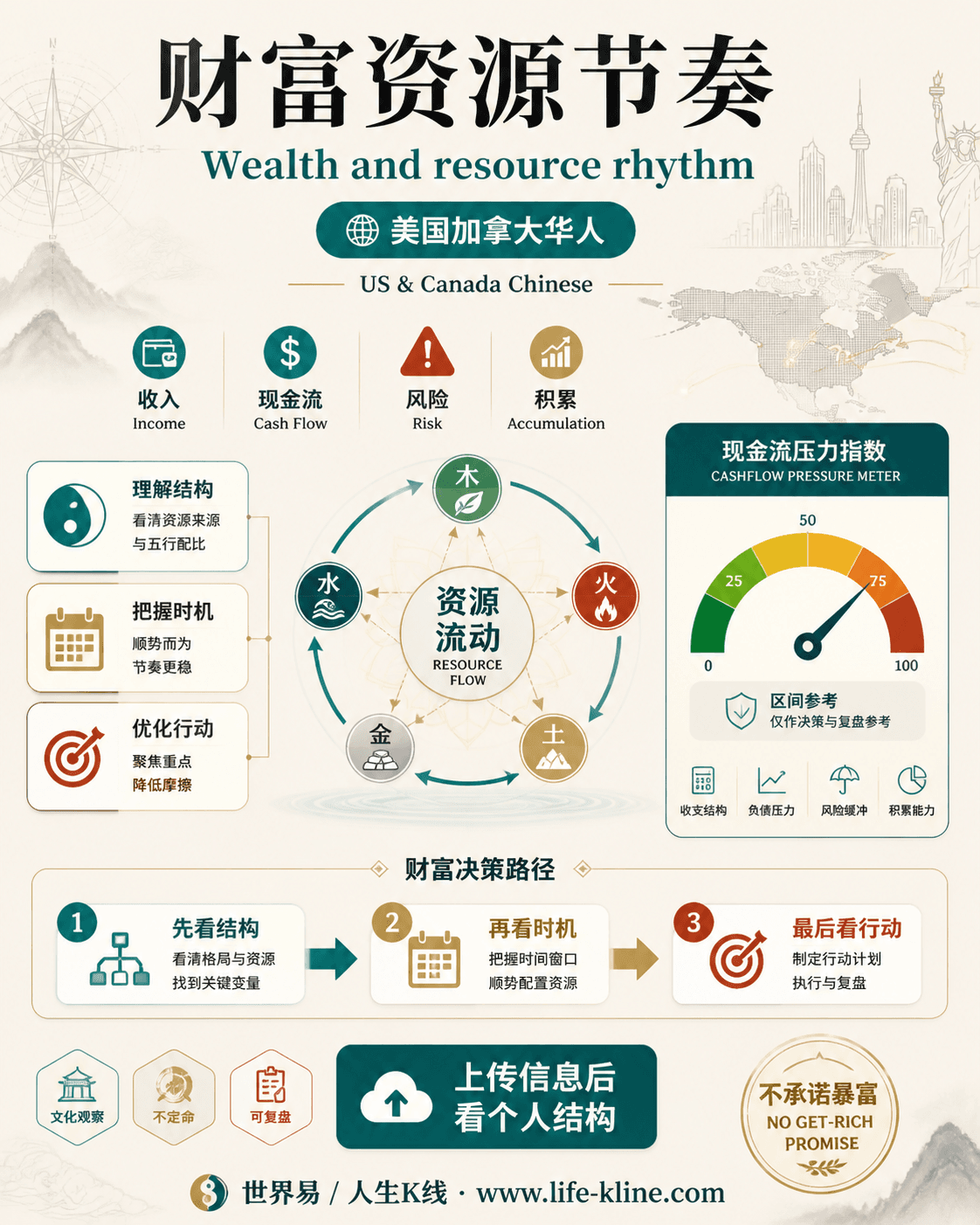
财富资源节奏|美国加拿大华人
这张图把《Metaphysical Analysis and Practical Strategies for Optimal Timing in Stock Market Investment》里的命理概念转成关系、边界和应用场景,适合先看图建立结构,再回到知识文章正文理解细节。
财富资源节奏不应被写成固定结论。更适合美国加拿大华人的读法,是把传统术语翻译成结构、时机、环境、行动和复盘。
查看图片解读