Astrological Analysis of Entrepreneurial Capital Risk Tolerance: Practical Guidance on Wealth Stars and Bi Jie Structures
把这篇文章落到自己身上验证:先看结构,再进入个人分析,不做泛泛阅读。
你现在搜索的,
其实是一个要落到自己身上的判断。
当前页面主要回答「Wealth Scenarios」这类搜索问题;真正有价值的下一步是把这套结构带进自己的报告、工具与案例验证。
Why This Decision Is Especially Difficult in This Wealth Scenario
Entrepreneurial capital raising involves multiple financial constraints, including limited own funds, high borrowing costs, and angel investment uncertainties. Under the current Chinese economic environment, with persistent housing prices and inflation pressure, family savings tend to be conservative, making entrepreneurial capital investment a high-risk exposure of family assets. Psychologically, entrepreneurs often have risk perception biases, possibly overestimating their tolerance and underestimating external market volatility impacts.
In this context, BaZi structures play a role in amplifying or suppressing risk perception. The Wealth Star (Cai Xing) represents the attraction and flow of wealth, Bi Jian/Jie Cai reflect competition and sharing of nearby resources, while Yin Stars symbolize support and wisdom accumulation. The combination of these elements in the natal chart directly influences an individual's true risk appetite when facing entrepreneurial capital, which sometimes may not align with their expressed intentions.
Additionally, the interaction of the current Da Yun (decade luck cycle) and Liu Nian (annual fortune) brings timing uncertainties. For example, those in a stable Da Yun may have a steady financial foundation, but Liu Nian clashes might trigger excessive risk-taking. Conversely, those in unfavorable or weak luck cycles should adopt more cautious strategies regarding capital risk. The complexity of real-world constraints combined with metaphysical signals amplifies the difficulty of this decision.
Therefore, relying solely on subjective will to formulate entrepreneurial capital plans often leaves blind spots. Integrating the dynamics of Wealth Star, Bi Jian/Jie Cai, and Yin Stars in BaZi can provide entrepreneurs with more practical bases for judging their risk tolerance.
Three Core Dimensions of Astrological Judgment
First, the relationship between the Day Master (Ri Zhu) and the Wealth Star determines the pattern of wealth inflow and consumption. A weak Day Master often sees the Wealth Star as a symbol of wealth opportunities but also potential pressure and dissipation, requiring precise assessment of the Wealth Star’s strength. A strong Day Master bears less pressure from the Wealth Star, but an excessively strong Wealth Star may cause intense resource competition.
Second, the strength and distribution of Bi Jian/Jie Cai influence cooperation and resource sharing. In entrepreneurial capital raising, Bi Jian/Jie Cai represent social resources such as loans from relatives and friends or partnership equity. When Bi Jian/Jie Cai are strong, there are more cooperation opportunities and shared risk capacity, but competition may cause fund dispersion or internal conflicts; when weak, cooperation resources are limited and risks are borne individually.
Third, Yin Stars, as symbols of wisdom support and backup, can alleviate pressures from the Wealth Star and Bi Jian/Jie Cai. Reasonable configuration of the Yong Shen (favorable element) can enhance risk coping ability, especially during Da Yun and Liu Nian clashes or combinations. The stability of Yin Stars determines whether the entrepreneur can maintain clarity and rationality under capital pressure.
By combining Da Yun and Liu Nian interactions, one can assess the timeliness and strength of current capital risk tolerance. Stable Da Yun calls for prudent strategies, while unfavorable or weak luck cycles require vigilance against capital chain breaks. Liu Nian clashes and combinations indicate critical windows for capital input or withdrawal.
Three Real BaZi Chart Cases
Case 1: The female Day Master is Yi Wood (乙, Yi), relatively weak, belonging to the Shang Guan (Hurting Officer) pattern, with Yong Shen being Water and Ji Shen (unfavorable elements) being Fire and Earth. She is in the Xin Chou (辛丑, Xin Chou) stable Da Yun, currently experiencing the Bing Wu (丙午, Bing Wu) Liu Nian. The Wealth Star is Fire, which is restrained by the Ji Shen, indicating that while there are opportunities for entrepreneurial capital, the pressure is significant. Bi Jian/Jie Cai are not strong, limiting cooperation resources. For this chart, it is recommended to emphasize prudent use of own funds, avoid excessive borrowing and aggressive financing. Risk tolerance is relatively low; risk-controllable financing methods should be chosen, especially during the volatile Bing Wu Liu Nian. A conservative strategy focusing on capital and network accumulation is advisable.
Case 2: The female Day Master is Xin Metal (辛, Xin), relatively strong, with the Shi Shen (Eating God) pattern, Yong Shen is Water, and Ji Shen is Earth. She is currently in the Wu Chen (戊辰, Wu Chen) unfavorable Da Yun, with the Bing Wu (丙午, Bing Wu) Liu Nian overlapping a relatively weak Da Yun. The Wealth Star is Wood, representing capital inflow, but the unfavorable Da Yun suggests risks of major setbacks. Bi Jian/Jie Cai are moderate, so cooperation opportunities exist but internal capital chain breaks must be guarded against. This chart shows relatively high risk tolerance but accompanied by significant fluctuations, prone to capital return difficulties or partnership conflicts. Decision-making should strictly control borrowing scale, prioritize short-term return financing projects, and avoid long-term capital lockup causing cash flow tightness. The overlapping Liu Nian and Da Yun warn against blind expansion; steady strategic adjustments are more suitable.
Case 3: The male Day Master is Jia Wood (甲, Jia), balanced, with a Cong Cai (From Wealth) pattern, Yong Shen are Earth and Fire, Ji Shen are Water and Wood. He is currently at the beginning of a stable Ren Chen (壬辰, Ren Chen) Da Yun, with the Bing Wu (丙午, Bing Wu) Liu Nian. The Wealth Star is strong and aligns well with the Yong Shen, indicating strong capital raising potential. Bi Jian/Jie Cai are moderate, favoring cooperation and resource sharing. The chart structure supports a relatively high risk tolerance, suitable for actively seeking angel investment and equity cooperation, leveraging the stable Da Yun to expand capital sources. However, attention should be paid to the Ji Shen Water and Wood elements that may bring liquidity risks; dynamic capital chain management is necessary. It is recommended to carefully evaluate partners and capital structure before action, reasonably allocating equity and risks to ensure capital security.
In summary, these three cases respectively reflect how different Day Master strengths and patterns influence entrepreneurial capital risk tolerance through the Wealth Star, Bi Jian/Jie Cai, and Yin Stars. Weak structures in stable Da Yun favor prudent capital raising; relatively strong structures in unfavorable luck require caution against setbacks; balanced structures allow moderate aggressiveness but require attention to capital flow management.
Common Misjudgments and Blind Spots in This Scenario
Misjudgment of entrepreneurial capital risk tolerance often stems from neglect or misunderstanding of BaZi structures. Some entrepreneurs overly rely on subjective will, ignoring risks from Wealth Star being restrained by Ji Shen or insufficient Bi Jian/Jie Cai, leading to capital chain breaks or partnership failures. Especially during unfavorable Da Yun periods, blind expansion more easily triggers financial crises.
Another common blind spot is overlooking the importance of Yin Stars. As symbols of wisdom and support, Yin Stars provide rational decision-making and resource integration under capital pressure. Missing or restrained Yin Stars often expose management deficiencies during capital raising, causing rapid capital depletion.
Simultaneously, psychological biases in entrepreneurial capital raising, such as over-optimism and excessive reliance on external funds, amplify risk signals in BaZi. Without integrating Da Yun and Liu Nian dynamics, blindly pursuing high-return financing easily overlooks latent capital risks and partnership hazards.
Therefore, comprehensive judgment of Wealth Star, Bi Jian/Jie Cai, Yin Stars, and Da Yun/Liu Nian is key to avoiding blind spots in capital decisions. Ignoring these factors often results in underestimating capital risks and passive entrepreneurial capital raising.
Practical Judgment Sequence
Step one: Examine the strength of the Wealth Star in the natal chart and the degree to which it is restrained by Ji Shen, clarifying the Wealth Star’s activity and risk tolerance. A strong Wealth Star supported by Yong Shen indicates greater capital inflow potential; if restrained by Ji Shen, cautious evaluation of capital sources and capital chain stability is necessary.
Step two: Analyze the strength and distribution of Bi Jian/Jie Cai to assess cooperation and external resource reliability. Strong Bi Jian/Jie Cai indicate robust cooperation and resource sharing ability, suitable for leveraging partnerships and family/friend funds; weak Bi Jian/Jie Cai require strengthening self-fund management and avoiding over-dependence on external sources.
Step three: Combine the support level of Yin Stars to evaluate capital management and risk response capacity. Adequate Yin Stars with effective Yong Shen enhance financial wisdom and capital turnover efficiency, helping reduce risks; missing Yin Stars call for strengthened capital monitoring and risk contingency planning.
Finally, it is essential to integrate the current Da Yun and Liu Nian to judge the timing of capital input. Stable Da Yun favor steady layout; unfavorable luck cycles require guarding against capital fluctuations. Liu Nian clashes and combinations signal critical decision windows. Reasonable capital pacing, avoiding blind aggressiveness or excessive conservatism, is key to improving risk tolerance.
FAQ
Question 1: Does the Wealth Star being restrained by Ji Shen mean one cannot boldly finance? Answer: The Wealth Star restrained by Ji Shen indicates obstacles and risks in capital flow but does not mean financing is impossible. Decisions should be based on Yong Shen conditions and the comprehensive assessment of Da Yun and Liu Nian, choosing risk-controllable financing methods to avoid blind expansion and capital chain breaks.
Question 2: Is a person with weak Bi Jian/Jie Cai unsuitable for partnership entrepreneurship? Answer: Weak Bi Jian/Jie Cai means limited external cooperation resources, posing challenges in partnership capital raising. However, by strengthening self-fund management and selecting highly trusted partners, cooperation risks can be reduced to achieve steady development.
Question 3: How to adjust entrepreneurial capital strategies during unfavorable Da Yun periods? Answer: During unfavorable Da Yun, priority should be given to preventing major capital setbacks, reducing long-term capital input, prioritizing short-term return projects, and enhancing capital liquidity. Adjusting equity structure and reasonably allocating risks ensure capital chain stability.
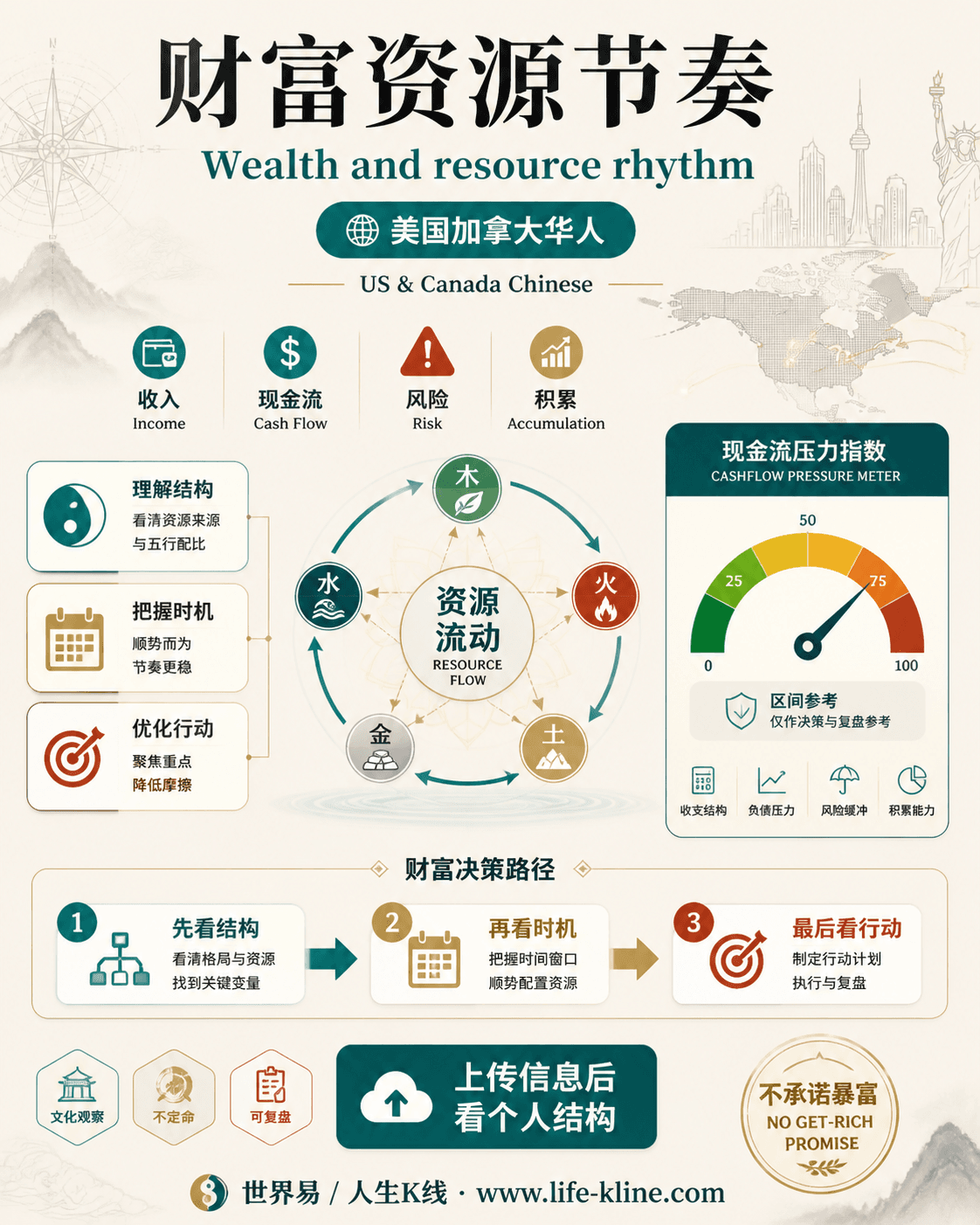
财富资源节奏|美国加拿大华人
这张图把《Astrological Analysis of Entrepreneurial Capital Risk Tolerance: Practical Guidance on Wealth Stars and Bi Jie Structures》里的命理概念转成关系、边界和应用场景,适合先看图建立结构,再回到知识文章正文理解细节。
财富资源节奏不应被写成固定结论。更适合美国加拿大华人的读法,是把传统术语翻译成结构、时机、环境、行动和复盘。
查看图片解读