Retirement Adjustments Under Spouse Disability Care: BaZi Perspective on Persisting or Withdrawing Decisions
把这篇文章落到自己身上验证:先看结构,再进入个人分析,不做泛泛阅读。
Why This Decision Is Especially Difficult in This Scenario
After a spouse or partner becomes disabled or seriously ill, retirement adjustment becomes one of the core challenges in eldercare structure. The primary caregiver often faces multiple pressures including health depletion, decreased income, and psychological burden. Although traditional social security and medical insurance provide basic support, they often cannot cover all risks associated with long-term care needs, leading to a sharp increase in internal family resource allocation pressure.
Psychologically, the primary caregiver tends to be caught in a struggle, wanting to persist in caregiving on one hand, while feeling physical and mental limits on the other. Decisions at this time are often driven by emotions, neglecting risks to their own health and economic sustainability. Eldercare decisions not only involve the individual but also inheritance and legal arrangements among family members, greatly increasing complexity.
BaZi structure provides rhythmic assistance in this context, especially by observing the Day Master strength, pattern, and changes in Yong Shen, which can indicate the individual's current energy state and carrying capacity. Meanwhile, the combination of Wealth Stars, Shi Shen (Eating God) and Yin Stars (Resource Stars) reflects the reserves or consumption of economic and psychological resources, and Guan Sha (Officer and Seven Killings) relates to family responsibilities and legal obligations. The interplay of Da Yun and Liu Nian helps assess whether phase risks are intensifying.
Therefore, in retirement adjustments under spouse disability care, how to scientifically judge 'whether to retire or persist a while longer' by combining BaZi signals with practical eldercare becomes a multidimensional challenge involving medical, financial, psychological, and legal aspects. BaZi cannot replace professional advice but can provide important rhythmic reference for decision-making.
Three Core Dimensions of BaZi Judgment
First, the strength of the Day Master and the late-life Da Yun relate to the individual's vitality and stress resistance. A relatively weak Day Master is prone to health depletion signals under spouse disability pressure. The stability or danger of the late-life Da Yun directly affects the primary caregiver's physical condition and sustained carrying capacity, thereby indicating whether early retirement adjustment is necessary.
Second, the condition of the Wealth Star corresponds to the availability of economic resources. A strong Wealth Star with an appropriate Yong Shen indicates relatively sufficient economic support, allowing the primary caregiver to persist for a while. Conversely, if the Wealth Star is restrained or the Ji Shen (unfavorable elements) are too heavy, it implies a significant risk of income cliff, requiring prompt adjustment of eldercare strategy to prevent family financial crises.
Third, Shi Shen (Eating God) and Yin Stars (Resource Stars) reflect the primary caregiver's psychological state and medical dependency. Shi Shen represents creativity and expression, while Yin Stars symbolize support and protection. A strong Shi Shen with moderate Yin Stars helps alleviate psychological burden and actively cope with stress; whereas weak Yin Stars or excessive Guan Sha may indicate increased medical needs and insufficient support from children, signaling the need for early medical and legal planning.
Overall, the Guan Sha combination in BaZi not only involves legal responsibilities and family power structure but also relates to the degree of socialized support for caregiving pressure. Changes in BaZi rhythms and interactions with Liu Nian can indicate risk fluctuations, assisting in judging whether one has entered the 'time to retire' phase or the 'persist a while longer' window.
Three Real BaZi Chart Cases
Case 1: The Day Master is relatively weak Bing Fire (丙, Bing), with a Jie Cai (Rob Wealth) pattern. The Yong Shen is Earth, and the Ji Shen is Metal. Currently in the 10th year of Ren Chen Da Yun (壬辰, Ren Chen), with Bing Wu Liu Nian (丙午, Bing Wu). This Da Yun is stable and suitable for maintaining status quo, with Liu Nian requiring flexible adaptation. Under this structure, the weak Day Master with stable Earth Yong Shen suggests the primary caregiver's vitality is somewhat insufficient but economic support is adequate, and the Da Yun environment is stable, helping to sustain the current situation. Although caregiving pressure is high, the Ji Shen Metal is not intensified, limiting destructive power. It is suitable to rely on existing resources and persist a while longer, while paying attention to health and emotional management. Recommended judgment sequence: prioritize evaluating medical and insurance coverage, strengthen financial planning, and respond steadily during stable rhythm periods to avoid rash retirement.
Case 2: The Day Master is relatively weak Ding Fire (丁, Ding), with a Jie Cai pattern. The Yong Shen is Wood, and the Ji Shen are Earth and Metal. Currently in the 3rd year of Xin Chou Da Yun (辛丑, Xin Chou), with Bing Wu Liu Nian. The Da Yun is weak and requires caution against major changes; although Liu Nian provides some support, the overall environment is unfavorable. This structure reflects that the primary caregiver's vitality and resources are both under pressure. The Wealth Star is heavily restrained by Ji Shen, indicating a significant risk of income cliff, and the dangerous Da Yun warns potential upheavals. Under caregiving pressure, physical and psychological depletion may worsen, and BaZi signals lean toward 'time to retire.' Recommended judgment sequence: urgently organize legal and medical support systems, assess financial cliff risks, prioritize early retirement adjustment and family division of labor, coordinate with professional financial and legal consultation to avoid greater risks caused by delay.
Case 3: The Day Master is relatively weak Geng Metal (庚, Geng), with a Zheng Yin (Proper Resource) pattern. The Yong Shen is Fire, and the Ji Shen are Water and Wood. Currently in the 4th year of Jia Xu Da Yun (甲戌, Jia Xu), with Bing Wu Liu Nian. The Da Yun is stable and suitable for maintaining status quo, with Liu Nian requiring flexible adaptation. The Zheng Yin pattern indicates the primary caregiver has certain spiritual shelter and medical support. Although the Day Master is weak, the Fire Yong Shen helps stimulate vitality. The overall environment is stable, with relatively balanced financial and psychological resources, favorable for temporarily maintaining caregiving status. Recommended judgment sequence: combined with BaZi rhythm, continue monitoring health and psychological state, arrange rest and medical care reasonably, carry out financial and legal planning timely, and choose to steadily advance eldercare adjustment during stable Da Yun periods to avoid hasty decisions.
Common Misjudgments and Blind Spots in This Scenario
A common misjudgment in eldercare decisions is over-reliance on emotional factors while neglecting the caregiver's own health condition, leading to physical and mental exhaustion and delaying necessary adjustments. In BaZi, a weak Day Master often corresponds to this risk, but without combining Da Yun and Liu Nian rhythms, it is easy to misjudge whether to retire immediately or continue to persist.
Another blind spot is ignoring the interaction between the Wealth Star and economic conditions. Some families, despite strong sense of responsibility, have Wealth Stars restricted by Ji Shen, causing income cliff risks to be underestimated, which traps them in financial difficulties and affects overall eldercare quality. Misinterpretation of Shi Shen and Yin Star combinations can also overlook psychological and medical burdens.
Legal and medical factors are often marginalized, exacerbating family disputes and insufficient medical resources, thereby increasing eldercare risks. The Guan Sha combination in BaZi indicates legal and social responsibilities, but actual decisions often neglect this, causing breaks in the caregiving chain. Proper integration of BaZi with professional planning and avoiding one-sided judgments based solely on BaZi rhythms is key to preventing misjudgments.
Practical Judgment Sequence
First, clarify the Day Master strength and current Da Yun and Liu Nian rhythms to assess the primary caregiver's vitality and carrying capacity. Those with weak Day Masters and dangerous Da Yun should prioritize adjustment, while stable Da Yun may allow continued support as appropriate. Second, focus on the Wealth Star status and Yong Shen performance to confirm the sustainability of economic resources and prevent family risks caused by income cliffs.
Next, pay attention to the support role of Shi Shen and Yin Stars to judge psychological endurance and medical dependency. If Yin Stars are weak or Guan Sha is excessive, early medical and legal planning is needed to prevent sudden incidents. Finally, combine professional financial planning, legal consultation, and medical evaluation to formulate phased adjustment plans. BaZi rhythms serve as auxiliary references to help grasp the best timing and intensity for adjustment, avoiding blind actions or delays.
Overall judgment should adopt dynamic observation, adjusting according to changes in Liu Nian and real environment. When encountering Da Yun and Liu Nian transitions or Ji Shen intensification, vigilance should be heightened and emergency plans activated timely. BaZi references are not conclusions; they must be combined with multiple professional judgments to form a stable and flexible eldercare adjustment strategy.
FAQ
Question 1: Does a weak Day Master in BaZi necessarily mean early retirement is required? Answer: Not necessarily. A weak Day Master indicates greater physical and mental burden but requires comprehensive judgment combined with overall rhythms of Da Yun and Liu Nian and economic conditions. A weak Day Master with stable Da Yun and favorable Wealth Star and Yong Shen can persist for some time; otherwise, cautious early adjustment is advised.
Question 2: When spouse disability causes an income cliff, how does BaZi assist in judging adjustment timing? Answer: The status of the Wealth Star is key. If the Wealth Star is significantly restrained by Ji Shen and Da Yun and Liu Nian are unfavorable, BaZi signals increased economic risk, suggesting priority in initiating financial restructuring and retirement plans. At the same time, Shi Shen and Yin Stars should be combined to assess psychological and medical support to prevent excessive burden.
Question 3: How to avoid relying solely on BaZi for eldercare decisions? Answer: BaZi can only serve as a rhythmic auxiliary tool and cannot replace professional financial planning, legal consultation, and medical evaluation. BaZi signals should be integrated with multidisciplinary professional information to form comprehensive judgments and dynamically adjust eldercare strategies, ensuring decisions are scientific and reasonable.
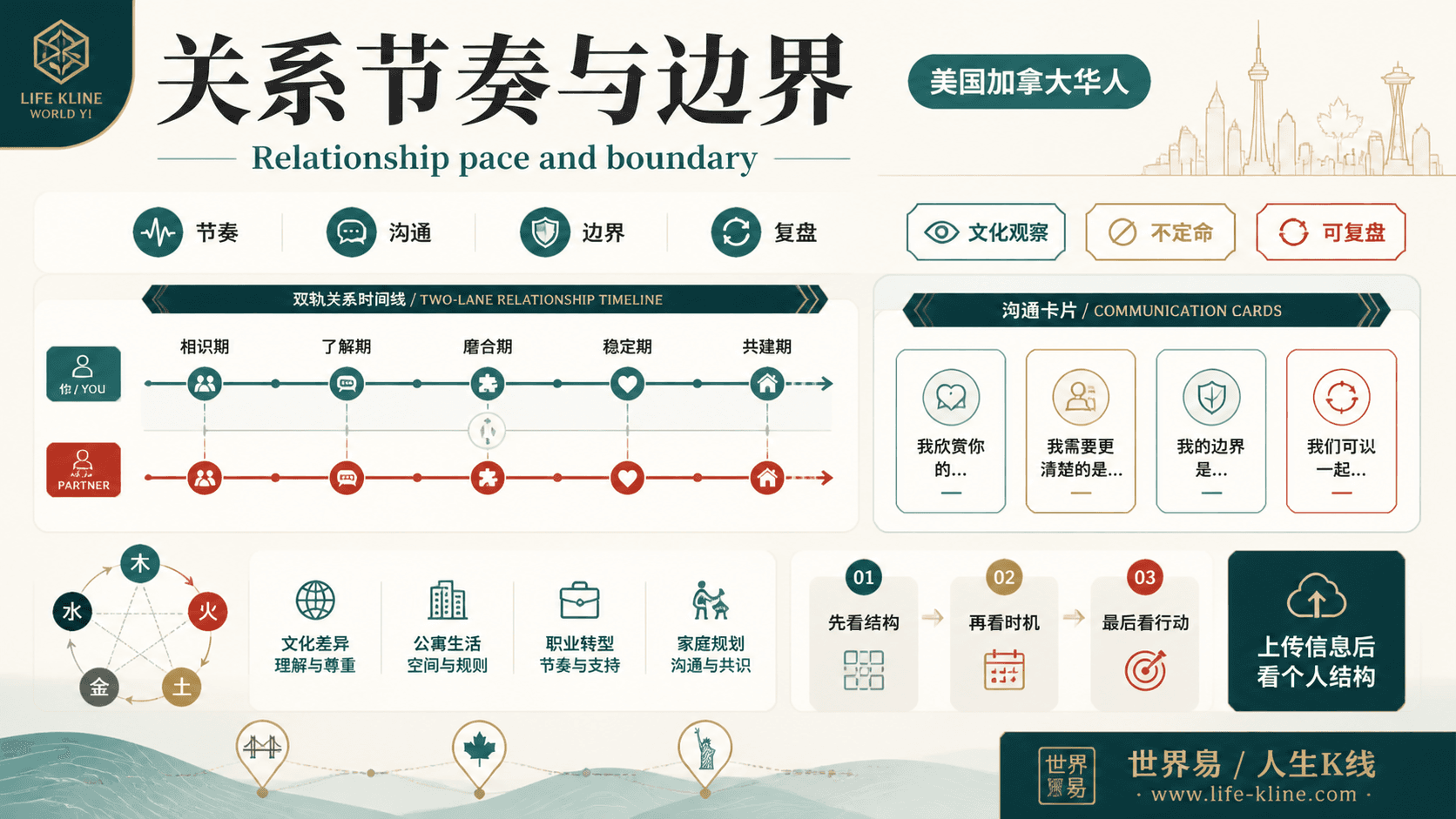
关系节奏与边界|美国加拿大华人
这张图把《Retirement Adjustments Under Spouse Disability Care: BaZi Perspective on Persisting or Withdrawing Decisions》里的命理概念转成关系、边界和应用场景,适合先看图建立结构,再回到知识文章正文理解细节。
关系节奏与边界不应被写成固定结论。更适合美国加拿大华人的读法,是把传统术语翻译成结构、时机、环境、行动和复盘。
查看图片解读