Migration of Southeast Asia Digital Nomads’ Second Residences: Fate-Based Decisions on Staying or Returning
把这篇文章落到自己身上验证:先看结构,再进入个人分析,不做泛泛阅读。
Why This Decision Is Especially Difficult at This Destination
Southeast Asian countries such as Thailand, Malaysia, Indonesia, and Vietnam attract a large number of digital nomads and second residence investors due to low living costs, superior natural environments, and cultural diversity. However, visa policies often exist in gray zones, with complicated and uncertain procedures for visa extensions and status changes, becoming the primary obstacle in migration decisions. Additionally, medical resources are uneven, especially concerning healthcare coverage for middle-aged and elderly groups and children, increasing health risk considerations.
On the financial front, Southeast Asian currencies fluctuate frequently, and foreign exchange management policies restrict cross-border capital flows, affecting the stability of living and investments. The issue of children’s education continuity cannot be ignored either, with limited international school options and conflicts between teaching quality and cultural adaptation needs, making family migration decisions more complex.
Psychologically, digital nomads and second residence holders often face conflicts of identity and belonging, especially when encountering tightened policies or life obstacles, making the choice to stay or leave a core internal struggle. In BaZi structures, combinations such as the Day Master with Yi Ma (Traveling Horse) stars, and Wealth stars with Officer or Killing stars, reflect an individual’s adaptability and resilience in a foreign land, serving as rhythmic signals to assist judgment.
Therefore, migration decisions in Southeast Asia involve not only legal, tax, and visa risks but also require integrating BaZi rhythms and personal internal states to rationally assess when to persevere through difficulties and when to consider returning to the homeland, achieving a dynamic balance between mind, body, and the real environment.
Three Core Dimensions of Fate-Based Judgement
First, the relationship between the Day Master and Yi Ma star reflects an individual’s initiative and adaptability in migration. A relatively strong Day Master supported by Yi Ma star indicates a strong willingness to move and good environmental adaptability, suggesting consideration to persist in staying. Conversely, a weak Day Master lacking Yi Ma support signals higher migration risks, requiring cautious evaluation.
Second, the relationship between Wealth stars and earning wealth in a foreign land is reflected in the interaction between Wealth stars and Bi Jian/Jie Cai stars. A strong Wealth star with appropriate Yong Shen indicates the ability to obtain stable income and resource support abroad, suitable for maintaining or developing. If the Wealth star is restrained or Ji Shen is strong, it may face risks of capital chain breaks or investment failures, signaling the need to adjust strategies or consider returning.
Third, Officer and Killing stars are closely related to the pressures of foreign identity. Strong Officer/Killing stars represent significant external pressures, including visa, identity verification, and policy restrictions. If Officer/Killing stars are harmonized by Yin stars, the pressure, though great, is buffered, favoring persistence. Without Yin star support, excessive Officer/Killing stars indicate unbearable pressure, possibly triggering major incidents, thus warning of potential return.
Additionally, the interaction between Da Yun (decade luck cycle) and Liu Nian (annual fortune) provides a temporal dimension for judging rhythm. When Da Yun is auspicious and Liu Nian aligns, it is suitable to act and expand; when Da Yun is weak and Liu Nian conflicts, it is advisable to be prudent or delay, avoiding blind persistence. Integrating these dimensions with the realities of Southeast Asian visa, medical, financial, and children’s education issues forms a dynamic decision-making framework.
Three Real BaZi Case Studies
Case 1: This female’s BaZi Day Master is weak Bing Fire (丙, Bing), with a Bi Jian pattern. Her Yong Shen is Wood, and Ji Shen are Earth and Metal. Currently in the Geng Chen (庚辰, Geng Chen) Da Yun (ages 55-64), which is an unfavorable luck cycle requiring caution against major incidents. The Liu Nian is Bing Wu (丙午, Bing Wu) with strong Fire. As a digital nomad in Southeast Asia, she faces unstable visa policies and prominent medical resource disparities. The weak Day Master and hazardous Da Yun indicate difficulty independently bearing significant pressure abroad, especially since Geng Metal and Chen Earth are Ji Shen, bringing obstacles and depletion. This BaZi suggests that when encountering visa or health bottlenecks, risk should be prioritized and returning considered unless strong external support (such as Yin or Wealth stars) exists. Blind persistence may worsen the situation. It is recommended to work with professional lawyers to review visa status, plan medical insurance in advance, and avoid forcing through major obstacles by timely adjusting migration strategies.
Case 2: This female’s BaZi Day Master is relatively strong Yi Wood (乙, Yi), with a Qi Sha (Seven Killing) pattern. Yong Shen are Metal and Earth; Ji Shen is Water. She is in the Yi Si (乙巳, Yi Si) Da Yun (ages 51-60), a stable luck cycle suitable for maintaining achievements, with Liu Nian Bing Wu (丙午, Bing Wu) Fire strong. Living in a Southeast Asian second residence, she faces currency fluctuations and education continuity challenges. The Qi Sha pattern symbolizes significant external pressure, but the Yong Shen Metal and Earth effectively moderate it, and the stable Da Yun shows her ability to earn wealth and build a foundation abroad. This BaZi advises persistence in facing economic and children’s education challenges, overcoming difficulties through financial planning and educational resource integration. The chart highlights the importance of adaptability, combining domestic and overseas tax and financial planning, reasonably diversifying risks, improving asset liquidity, and optimizing children’s education plans to avoid premature return due to short-term fluctuations.
Case 3: This male’s BaZi Day Master is relatively strong Geng Metal (庚, Geng), with a Shang Guan (Hurting Officer) pattern. Yong Shen are Fire and Wood; Ji Shen is Earth. Currently in the Yi Mao (乙卯, Yi Mao) Da Yun (ages 19-28), a very auspicious luck cycle, with Liu Nian Bing Wu (丙午, Bing Wu) Fire strong. Young and with favorable Da Yun, he possesses good adaptability and pioneering spirit. As a digital nomad, he enjoys policy benefits and convenient living in Southeast Asia. The Shang Guan pattern reflects strong creativity and self-expression, beneficial for development in a multicultural environment. This BaZi suggests that when facing policy adjustments or life frictions, he can follow the trend, leverage the auspicious luck to adjust strategies, respond flexibly to challenges, and is suitable to persist and actively expand social resources. It is recommended to combine local legal and tax policies to avoid potential risks, while focusing on health maintenance and foreign exchange compliance for steady progress.
These three cases respectively illustrate differences in Day Master strength, pattern, and Yong Shen combinations in Southeast Asia migration decisions, providing localized fate-based auxiliary references combined with local visa, medical, financial, and educational realities.
Common Misjudgments and Blind Spots at This Destination
First, overreliance on short-term visa policy changes to make decisions. Although Southeast Asian visa policies are variable, gray operational spaces often exist. BaZi’s Da Yun and Liu Nian reflect trend rhythms; excessive focus on short-term policy fluctuations can lead to frequent migrations, increasing costs and risks.
Second, neglecting the long-term impact of medical resource disparities on health. Ji Shen in BaZi often corresponds to obstacles in life, especially for middle-aged and elderly digital nomads who overlook medical environment suitability, potentially worsening physical burdens and causing passive returns driven by non-fate factors.
Third, ignoring the matching between Wealth stars and Yong Shen configurations with currency fluctuations and capital liquidity. Southeast Asia’s currency volatility and foreign exchange restrictions are complex; if Yong Shen and Wealth stars are imbalanced, capital flow is hindered. Blindly persisting under such conditions may exacerbate financial pressure.
Fourth, underestimating children’s education continuity issues. The interaction between Officer/Killing stars and Yin stars in BaZi manifests as identity pressure and resource support in reality. Ignoring this often forces families to return due to education problems, affecting overall migration stability.
Practical Judgement Sequence
Step one: Examine your BaZi Day Master strength and Yong Shen/Ji Shen, combined with current Da Yun and Liu Nian to judge favorable or unfavorable migration rhythms. Those with relatively strong Day Masters and effective Yong Shen may consider persisting; otherwise, evaluate cautiously.
Step two: Combine Southeast Asian visa policies and external pressures, focusing on the relationship between Officer/Killing stars and Yin stars. If Officer/Killing stars are strong but Yin stars weak, be alert to identity risks and promptly consult professional immigration lawyers to prepare response plans.
Step three: Assess Wealth star status and capital liquidity matching. If Wealth stars are restrained and Ji Shen strong, capital chain risks are high. Work with financial advisors to optimize asset allocation, and consider returning if necessary to secure funds.
Step four: Incorporate family children’s education needs, matching the coordination of Officer/Killing and Yin stars in BaZi to ensure sustainable educational resources, avoiding forced return due to education issues.
Overall, fate-based judgement serves as an auxiliary tool and must be combined with legal, tax, visa, and financial professional advice. Avoid blind actions. When Da Yun and Liu Nian conflict, it is advisable to wait prudently and act according to favorable conditions.
FAQ
Question 1: Can fate-based judgement replace professional immigration and financial consulting? Answer: Fate-based judgement is only an auxiliary reference to help grasp timing and mindset adjustments. It cannot replace professional consultation in immigration law, tax compliance, visa policies, and financial planning. All decisions should be based on professional advice.
Question 2: If the BaZi Da Yun is unfavorable, must one return? Answer: An unfavorable Da Yun signals increased risks, but whether to return depends on personal circumstances, external environment, and professional advice. Fate alone should not be the sole basis; migration strategies should be dynamically adjusted.
Question 3: How to use fate-based judgement to adjust life and investment strategies in Southeast Asia? Answer: According to Day Master strength, Yong Shen/Ji Shen, and Liu Nian/Da Yun trends, arrange capital flows, health management, and children’s education planning reasonably. Prepare contingency plans for unfavorable years and actively expand during favorable periods, combining professional advice for steady development.
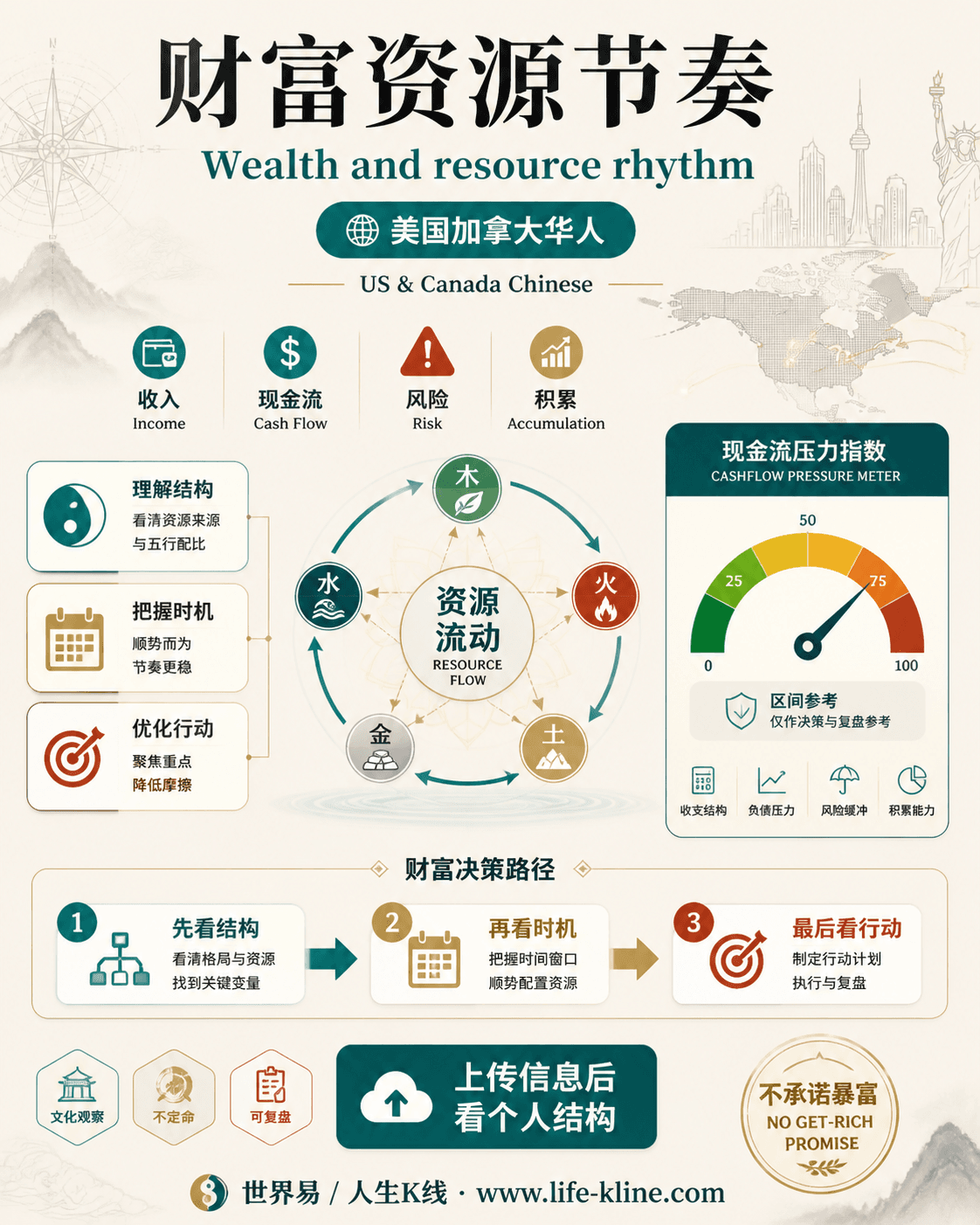
财富资源节奏|美国加拿大华人
这张图把《Migration of Southeast Asia Digital Nomads’ Second Residences: Fate-Based Decisions on Staying or Returning》里的命理概念转成关系、边界和应用场景,适合先看图建立结构,再回到知识文章正文理解细节。
财富资源节奏不应被写成固定结论。更适合美国加拿大华人的读法,是把传统术语翻译成结构、时机、环境、行动和复盘。
查看图片解读