Astrological Reference for Optimal Exit and Visa Submission Timing for Southeast Asian Digital Nomads
把这篇文章落到自己身上验证:先看结构,再进入个人分析,不做泛泛阅读。
Why This Decision Is Especially Difficult in This Destination
Southeast Asia, as a popular choice for digital nomads and second residences, includes countries such as Thailand, Malaysia, Indonesia, and Vietnam. Although these countries are open, their visa policies often contain gray areas. The timing of visa submissions and exits is highly susceptible to policy adjustments, exchange rate fluctuations, and changes in international relations. Especially unstable visa approval cycles make it difficult for applicants to accurately grasp the best timing for submission and entry.
Medical resources vary greatly across different countries and cities in Southeast Asia, which is particularly important for mid- to long-term residents. The uneven medical systems also increase the strictness of visa officers' scrutiny of applicants' ability to support their living, indirectly affecting visa success rates. The need to coordinate children's education also makes family applicants more cautious in choosing submission timing.
From a psychological perspective, applicants often have overly optimistic or pessimistic expectations regarding visa submission success rates, neglecting the importance of timing windows and external environmental changes. The rhythm information in BaZi structures such as Da Yun, Liu Nian, and Yong Shen can serve as auxiliary references to help applicants avoid blind submissions or missed opportunities.
Therefore, combining the complexity of visa policies in Southeast Asian countries with the dynamic changes in BaZi rhythms, finding submission and entry timing supported by Da Yun and Liu Nian becomes key to improving visa success rates and smooth residency.
Three Core Dimensions of BaZi Judgment
First, the strength and pattern of the Day Master determine the fundamental energy for an individual to make a living and adapt in a foreign land. For example, a Pian Yin (偏印) pattern Day Master represents strong learning and adaptability abilities, suitable for the flexible and adaptive lifestyle of digital nomads; a Shang Guan (伤官) pattern reflects innovation and breakthroughs but may encounter external resistance.
Second, the combination of Yong Shen (favorable elements) and Ji Shen (unfavorable elements) is especially important. The Cai star (Wealth stars) represents money-making ability, Bi Jian and Jie Cai (Peer stars) symbolize support from peers, Guan Sha (Officer and Qi Sha) relate to external authority and identity pressure, and Yin stars (印星) reflect learning and protective power. Particularly, the Yi Ma (驿马) combination symbolizes the motivation for migration and sensitivity to change. In the Southeast Asian visa submission process, the interaction of these Ten Gods directly affects the applicant's ability to respond to policy and environmental changes.
Finally, the interaction between Da Yun (decade luck cycles) and Liu Nian (annual fortunes) is a key reference for judging submission timing. Da Yun represents the main tone of a ten-year period, while Liu Nian reflects fluctuations in specific years. When Da Yun is auspicious and Liu Nian is favorable, the success rate and smoothness of visa processing and exit are usually higher; otherwise, caution or postponement is advised.
Overall, the optimal submission rhythm for Southeast Asian digital nomads requires integrating the Day Master’s pattern, Yong Shen and Ji Shen, and the rhythmic changes of Da Yun and Liu Nian to precisely grasp visa submission timing, maximizing avoidance of legal, tax, and visa policy gray zone risks.
Three Real BaZi Case Studies
Case 1: This gentleman has a Ren Water (壬水) Day Master that is relatively strong, with a Pian Yin (偏印) pattern. Water is the Yong Shen (favorable element), Metal is the Ji Shen (unfavorable element). He is currently in the Gui Hai (癸亥) Da Yun (a very auspicious luck cycle), with the Liu Nian being Bing Wu (丙午). The Ren Water Day Master receives nurturing from water in the Gui Hai Da Yun, and the Pian Yin pattern supports learning and adaptability. The Liu Nian Bing Wu year has strong Fire but does not suppress the Yong Shen. Overall, the Da Yun and Liu Nian are in harmony. In the context of Southeast Asian digital nomad visa environments, the water element Yong Shen favors mobility and travel; the Gui Hai Da Yun brings smooth migration momentum, making it suitable to select stable policy periods for submission. This BaZi chart can rely on the Pian Yin pattern to quickly adjust strategies when facing visa gray zones and exchange rate fluctuations. The recommended judgment sequence is to first evaluate whether the Da Yun is still within the auspicious Gui Hai period, confirm no major Liu Nian clashes, and then, combined with professional legal and financial advice, proceed with submission gradually, avoiding impulsive actions during conflicting Liu Nian.
Case 2: This lady has a Ding Fire (丁火) Day Master that is relatively weak, with a Pian Yin (偏印) pattern. Wood is the Yong Shen, Earth and Metal are the Ji Shen. She is in the Ji Si (己巳) Da Yun (stable and conservative), with the Liu Nian being Bing Wu (丙午). The weak Ding Fire Day Master needs support from Wood. The Ji Si Da Yun contains Earth and Metal Ji Shen pressure, while the Liu Nian Bing Wu Fire supports Ding Fire but may also cause worries. In the context of Southeast Asian immigration decisions, Wood as Yong Shen benefits resource integration and relationship maintenance during visa application, while Earth and Metal Ji Shen represent potential obstacles related to taxes and visa policies. This pattern is suitable for steady progress during the Da Yun, avoiding rash actions. The recommended judgment sequence is to closely monitor the Ji Si Da Yun status and the impact of the Fire-strong Liu Nian on the Ji Shen Earth and Metal, combined with professional visa planning, to choose the right time for submission, especially avoiding impulsive actions during policy adjustment windows.
Case 3: This gentleman has a Ren Water (壬水) Day Master that is relatively weak, with a Shang Guan (伤官) pattern. Metal is the Yong Shen, Wood and Fire are the Ji Shen. He is currently in the Wu Shen (戊申) Da Yun (stable and conservative), with the Liu Nian being Bing Wu (丙午). The weak Ren Water Day Master needs Metal support. The Shang Guan pattern shows innovative spirit but the Ji Shen Wood and Fire may cause conflicts. The Wu Shen Da Yun has relatively stable Earth and Metal, but the Liu Nian Bing Wu Fire may intensify Ji Shen influence. In the context of Southeast Asian digital nomad visa submissions, this BaZi chart is suitable to rely on Metal Yong Shen resources, maintain stability, and avoid risky impulsiveness. The recommended judgment sequence is to first confirm the stability of the Wu Shen Da Yun, strengthen risk assessment during Fire-strong Liu Nian, wait for policy clarity or a favorable Liu Nian before submitting, and coordinate with professional immigration and tax planning to ensure the submission rhythm aligns with external conditions.
Common Misjudgments and Blind Spots in This Destination
A major misjudgment is over-relying on the apparent looseness or strictness of visa policies, neglecting the indirect impact of exchange rate fluctuations and subtle changes in international relations on visa approvals. Applicants often submit blindly within visa gray zones, ignoring the rhythmic cues from BaZi, leading to prolonged approval cycles or even rejection.
Another blind spot is ignoring the dynamic changes of Yong Shen and Ji Shen in BaZi, especially during clashes and combinations between Da Yun and Liu Nian, blindly pushing visa applications. For example, submitting when Metal Ji Shen is overly strong may trigger tax audits or identity verification issues, affecting overall success rates.
Many applicants underestimate the importance of medical resources and fail to consider the coordination of children's education, resulting in mistimed submissions that reduce quality of life after landing and indirectly affect subsequent visa renewals and identity stability.
Finally, psychological impatience and fatigue mentality also contribute to imbalanced submission rhythms. BaZi rhythms can serve as auxiliary references to help applicants avoid impulsiveness and loss of timing.
Practical Judgment Sequence
Step one: Confirm whether the current Da Yun is in an auspicious or stable period, paying special attention to whether the Yong Shen is supported and Ji Shen suppressed. For example, in the Gui Hai Da Yun, the water Yong Shen is nurtured, suitable for proactive submission; in Ji Si or Wu Shen Da Yun, it is better to maintain and submit cautiously.
Step two: Evaluate the interaction between Liu Nian and Da Yun, whether the Liu Nian follows or conflicts with the main tone of Da Yun. When the Liu Nian Bing Wu Fire is strong, if Ji Shen is Fire or Wood, caution is needed to avoid rashness; when Liu Nian is favorable, submission and exit can be prioritized.
Step three: Combine visa policies of multiple Southeast Asian countries, exchange rate fluctuations, medical and children's education needs, and cooperate with professional immigration, legal, tax, and financial advisors to formulate a detailed submission and entry schedule, ensuring legal compliance and fund security.
The overall recommendation is to prepare materials and consult services within the auspicious windows indicated by BaZi rhythms, submit and exit when Liu Nian is free of clashes and Da Yun is favorable, and avoid blind actions during periods of strong Ji Shen or policy uncertainty.
FAQ
Question 1: Can BaZi rhythms completely determine visa submission success? Answer: BaZi rhythms can only serve as auxiliary references to help judge submission timing and grasp opportunities; they cannot replace professional legal, tax, and financial advice. Visa success also depends on policies, material preparation, and external environment.
Question 2: If the current Liu Nian has strong Ji Shen, how should the submission plan be adjusted? Answer: When Ji Shen is strong, submission should be cautious; prioritize improving materials and consulting professionals, wait for the Liu Nian to turn favorable or Ji Shen to weaken before acting, to reduce risks.
Question 3: If Da Yun is stable but Liu Nian has clashes, must submission be postponed? Answer: Not necessarily. It requires specific analysis of the intensity of Liu Nian clashes and the overall BaZi chart, combined with policy environment risk assessment. If necessary, waiting or adjusting submission strategy is advisable.
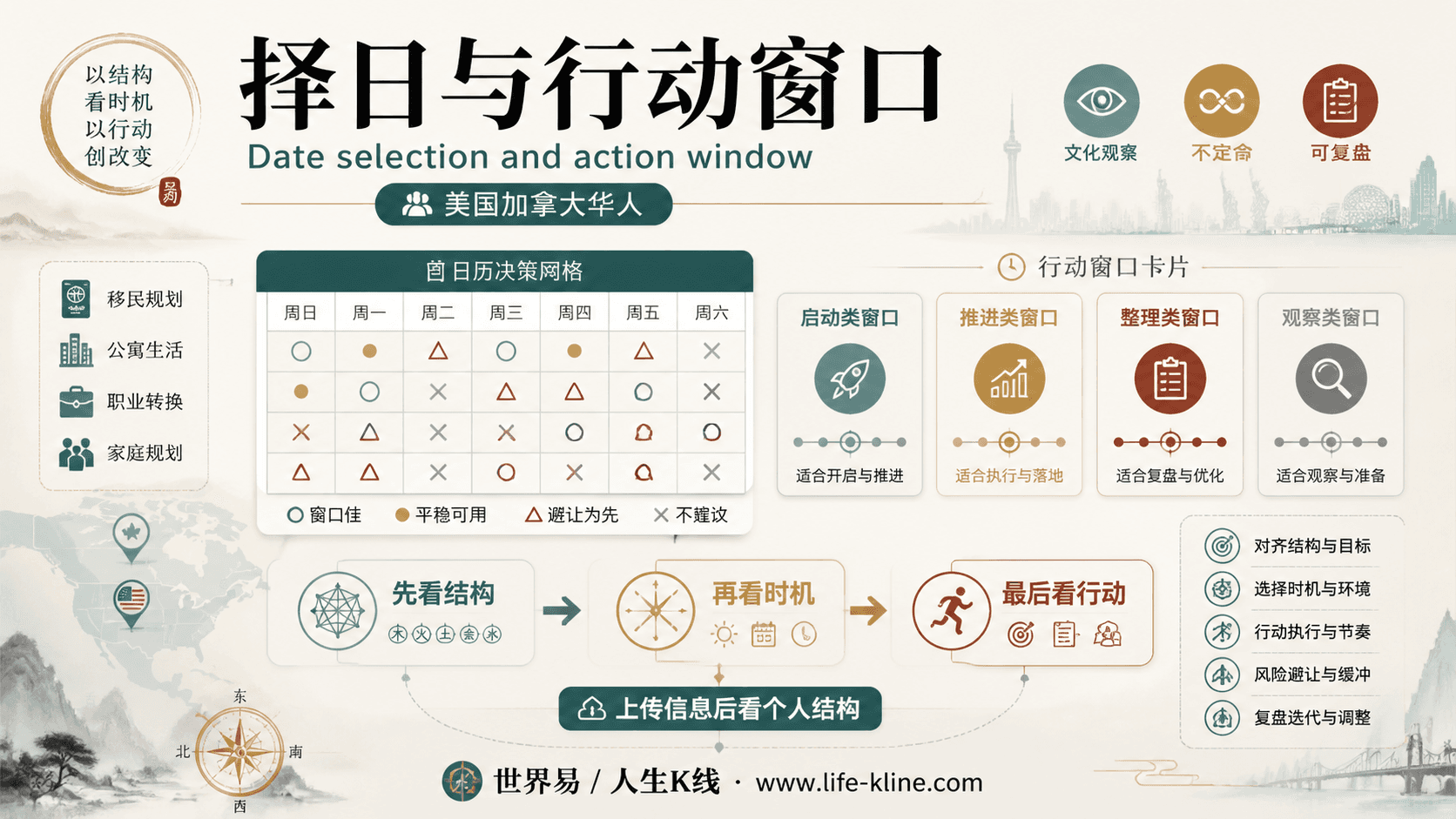
择日与行动窗口|美国加拿大华人
这张图把《Astrological Reference for Optimal Exit and Visa Submission Timing for Southeast Asian Digital Nomads》里的命理概念转成关系、边界和应用场景,适合先看图建立结构,再回到知识文章正文理解细节。
择日与行动窗口不应被写成固定结论。更适合美国加拿大华人的读法,是把传统术语翻译成结构、时机、环境、行动和复盘。
查看图片解读