Self-Regulation and Professional Medical Decision Analysis in Insomnia and Sleep Disorders
把这篇文章落到自己身上验证:先看结构,再进入个人分析,不做泛泛阅读。
Why This Decision Is Especially Difficult in This Health Scenario
Insomnia and sleep disorders manifest as difficulty falling asleep, frequent nighttime awakenings, vivid dreams, and anxiety, severely disrupting an individual’s physiological rhythms and psychological state. These symptoms not only affect daytime mental alertness but also exacerbate internal bodily imbalances, forming a vicious cycle. When an individual’s lifestyle rhythm conflicts with natural seasonal cycles, symptoms often worsen, making the effects of self-regulation unstable.
From the BaZi perspective, insomnia is often related to the excessive strength of Fire and Wood in the Five Elements or the insufficiency of Water and Earth. Imbalances in organ functions such as the Heart, Liver, and Kidneys directly affect sleep quality. If the Day Master is overly strong or the Yong Shen (favorable element) is restrained within the BaZi structure, it can lead to internal heat, anxiety, and nervous tension, further aggravating sleep disturbances. At this point, deciding whether to rely on self-regulated rhythm recovery or to seek professional medical intervention becomes critical.
Meanwhile, individual differences in insomnia symptoms are significant. Some BaZi patterns inherently possess strong rhythm recovery abilities, while others, due to the absence of Yong Shen or the impact of Da Yun (decade luck cycle) and Liu Nian (annual fortune), indicate potential pathological risks. The difficulty in decision-making lies in how to scientifically combine BaZi indications with actual symptoms to judge the boundaries of self-regulation and the timing of medical intervention.
Therefore, the challenge in this scenario is to comprehensively consider the Five Elements’ excesses and deficiencies, corresponding organ systems, and the influences of Da Yun and Liu Nian, accurately grasping the intertwined physiological and psychological characteristics of insomnia symptoms, and reasonably planning the limits between self-regulation and professional medical care to avoid delayed treatment due to misjudgment or over-reliance on medical intervention.
Correspondence Between BaZi and Five Elements Organs
In this topic, the Day Masters are mostly 丁 (Ding) Fire, 辛 (Xin) Metal, and 壬 (Ren) Water, each corresponding to different Five Elements attributes and organ functions. A 丁 (Ding) Fire Day Master with excessive strength represents an overactive heart function, easily leading to heart fire rising manifesting as insomnia and vivid dreams; 辛 (Xin) Metal excess relates to the Lung Metal, with the lungs governing Qi and closely linked to the mind; lung Qi disharmony can also cause sleep problems; 壬 (Ren) Water excess corresponds to Kidney Water, with the kidneys storing essence and governing the spirit, and insufficient or restrained Kidney Water can similarly cause insomnia.
The choice of Yong Shen (favorable element) reflects the need to compensate for the Day Master’s excess or deficiency in the Five Elements. Water and Metal as Yong Shen indicate the need to moisten and cool to balance the excess of Fire and Wood. The presence of Ji Shen (unfavorable element) Wood means that when Wood is excessive, it easily consumes Qi and harms the Liver. The Liver governs the smooth flow and regulation of emotions, and its dysfunction is often seen in anxiety and easy awakening symptoms. When Da Yun and Liu Nian are stable and adaptable, it indicates no severe shocks at the current stage but requires attention to rhythm changes.
Organ rhythms are closely related to natural seasonal cycles: Wood is strong in spring, promoting Liver Qi rising; Fire is strong in summer, activating heart and spirit; Metal is strong in autumn, refining lung Qi; Water is strong in winter, with kidneys storing essence deeply and remaining still. Insomnia is often related to dysfunction in the heart, liver, and kidneys and poor circulation of Qi and blood. The BaZi indications of excess or deficiency correspond to organ states and provide rhythm references for regulation.
Considering the interactions of Liu Nian and Da Yun, if the current luck cycle is stable and the Yong Shen is effective, it suggests balanced internal Five Elements, favorable for relying on self-regulation to improve sleep rhythm; conversely, if Ji Shen causes severe clashes, it indicates potential physical risks and timely professional medical attention should be sought.
Three Real BaZi Case Studies
Case 1: Male, aged 25-30, Day Master 丁 (Ding) Fire with excess strength, Shi Shen (Eating God) pattern, Yong Shen Water and Metal, Ji Shen Wood, currently in the 2nd year of 丙寅 (Bing Yin) Da Yun, and 丙午 (Bing Wu) Liu Nian. The excess 丁 (Ding) Fire corresponds to an overactive heart function, prone to internal heat, palpitations, and anxiety causing difficulty falling asleep. The Shi Shen pattern indicates relatively smooth emotional expression, but the presence of Ji Shen Wood suggests possible excessive Liver Wood, leading to Qi stagnation, manifested as vivid dreams and easy awakening. The current Da Yun and Liu Nian are stable, and overall rhythm can be maintained. In this case, if symptoms are mild insomnia and occasional anxiety, focus on self-regulation methods such as adjusting daily routines and emotional management to restore rhythm; however, if persistent palpitations, nighttime awakenings, and significant anxiety occur, immediate medical consultation is advised to exclude cardiac and neurological diseases. Recommended decision sequence: first assess mental state and physical symptoms, observe the effect of self-regulation, and seek medical help promptly if symptoms do not improve or worsen.
Case 2: Female, aged 55-60, Day Master 辛 (Xin) Metal with excess strength, Zhuan Wang (Specially Strong) pattern, Yong Shen Earth, Ji Shen Wood, currently in the 3rd year of 癸未 (Gui Wei) Da Yun, and 丙午 (Bing Wu) Liu Nian. The excess 辛 (Xin) Metal corresponds to strong lung function; the lungs govern Qi and are closely related to the heart and mind. Lung Qi disharmony easily causes shallow breathing and light, dream-filled sleep. The Zhuan Wang pattern shows strong internal strength, but Ji Shen Wood indicates that Liver Wood may consume Qi and harm Earth, leading to Qi and blood deficiency and depressive emotions, manifested as nighttime anxiety and easy awakening. The current Da Yun and Liu Nian are stable, suitable for nourishing the Earth organ (spleen and stomach) to improve Qi and blood production and promote sleep rhythm. Self-regulation methods such as dietary conditioning, moderate exercise, and breathing training can be sustained if effective; if accompanied by breathing difficulties, significant anxiety, or severe sleep disturbances, immediate medical care is necessary. Recommended decision sequence: monitor breathing and emotional status, and seek professional help promptly if symptoms worsen during regulation.
Case 3: Female, aged 45-50, Day Master 壬 (Ren) Water with excess strength, Pian Yin (Partial Resource) pattern, Yong Shen Earth and Fire, Ji Shen Metal, currently in the 2nd year of 乙亥 (Yi Hai) Da Yun, and 丙午 (Bing Wu) Liu Nian. The excess 壬 (Ren) Water corresponds to abundant Kidney Water; the kidneys store essence and govern the spirit, closely related to sleep. The Pian Yin pattern indicates reliance on external resources and spiritual strength, while the presence of Ji Shen Metal suggests Lung Metal is restrained, possibly causing lung Qi deficiency, leading to poor circulation of Qi and blood, resulting in vivid dreams and insomnia. The current luck cycle is stable, suitable for supplementing Earth and Fire to assist spleen and stomach function, warm Yang, enhance Kidney Qi and balance Heart Fire, promoting sleep rhythm recovery. Self-regulation includes traditional Chinese medicine conditioning, regular routines, and emotional counseling, which can be sustained if effective; if accompanied by severe fatigue, night sweating, or physical weakness, immediate medical attention is required. Recommended decision sequence: first exclude physical weakness and mental status issues, observe regulation response, and seek medical care promptly if symptoms persist or worsen.
Common Misjudgments and Blind Spots in This Scenario
Patients with insomnia and sleep disorders often mistakenly rely solely on BaZi analysis, neglecting the necessity of clinical symptoms and medical diagnosis. Especially when severe symptoms such as persistent palpitations, breathing difficulties, or altered consciousness appear as red flags, delayed medical treatment may worsen the condition. BaZi should only serve as a reference for rhythm regulation and must never replace professional medical judgment.
Another blind spot is over-reliance on self-regulation while ignoring pathological factors. Some BaZi charts show the Yong Shen severely restrained and obvious Five Elements imbalance, indicating potential physical risks. In such cases, relying only on daily adjustments is often ineffective, requiring timely professional intervention; otherwise, symptoms may worsen or even threaten life.
Additionally, ignoring individual differences and rhythm fluctuations caused by changes in Liu Nian and Da Yun can lead to misjudgments. Insomnia symptoms fluctuate with seasons, age, emotions, and other factors. BaZi indications need to be combined with dynamic real-world observation to avoid mechanical application of conclusions.
Finally, blindly attributing sleep problems to a single Ji Shen element while neglecting overall Five Elements and organ coordination can lead to one-sided regulation plans with poor results. Overall balance and dynamic adjustment are the core of health management.
Practical Judgment Sequence
First, a detailed assessment of the severity of insomnia symptoms and accompanying manifestations should be conducted, such as whether red flag signs like palpitations, chest tightness, abnormal breathing, or consciousness disturbances exist. If so, immediate medical attention is required to exclude life-threatening diseases. Second, combine the BaZi Day Master’s excess or deficiency and the status of Yong Shen to preliminarily judge the energy state and potential imbalance of the Five Elements and organs, serving as a reference for rhythm regulation.
Next, consider whether the Da Yun and Liu Nian are stable to infer the stability of the body’s physiological and psychological rhythms at the current stage. If the luck cycle is stable and Yong Shen effective, and clinical symptoms are mild, focus on self-regulation methods such as adjusting routines, diet, emotional management, and moderate exercise, observing the regulation effect. If symptoms do not improve or worsen, timely professional medical consultation should be sought to avoid delayed diagnosis and treatment.
Finally, it is recommended to establish a dynamic observation mechanism, regularly assessing symptom changes and BaZi rhythm indications, flexibly adjusting self-regulation plans, and maintaining communication with doctors to ensure rapid transition to medical care when symptoms become severe. BaZi provides rhythm references, while medical diagnosis and treatment must rely on professional clinical judgment.
FAQ
Question 1: How does BaZi view vivid dreams and easy awakening in insomnia? Answer: Vivid dreams and easy awakening are often related to excessive Heart Fire, Liver Qi stagnation, and insufficient Kidney Water. When the Day Master is excessively strong in Fire and the Ji Shen Wood is strong, it is especially evident, indicating organ dysfunction. It is necessary to regulate the Five Elements balance of the Heart, Liver, and Kidneys to improve sleep.
Question 2: How do Liu Nian and Da Yun affect insomnia regulation strategies? Answer: Liu Nian and Da Yun reflect dynamic changes in the body and environment. Stable luck cycles favor self-regulated rhythm recovery, while sudden changes or severe clashes indicate increased risks, suggesting timely medical intervention. Regulation strategies need to be flexibly adjusted according to their influence.
Question 3: Can severe insomnia be managed solely by BaZi self-regulation? Answer: No. BaZi can only serve as an auxiliary reference. If insomnia is accompanied by persistent palpitations, breathing difficulties, or consciousness abnormalities, immediate medical attention is necessary to avoid delaying treatment. Self-regulation is suitable for mild or temporary symptoms.
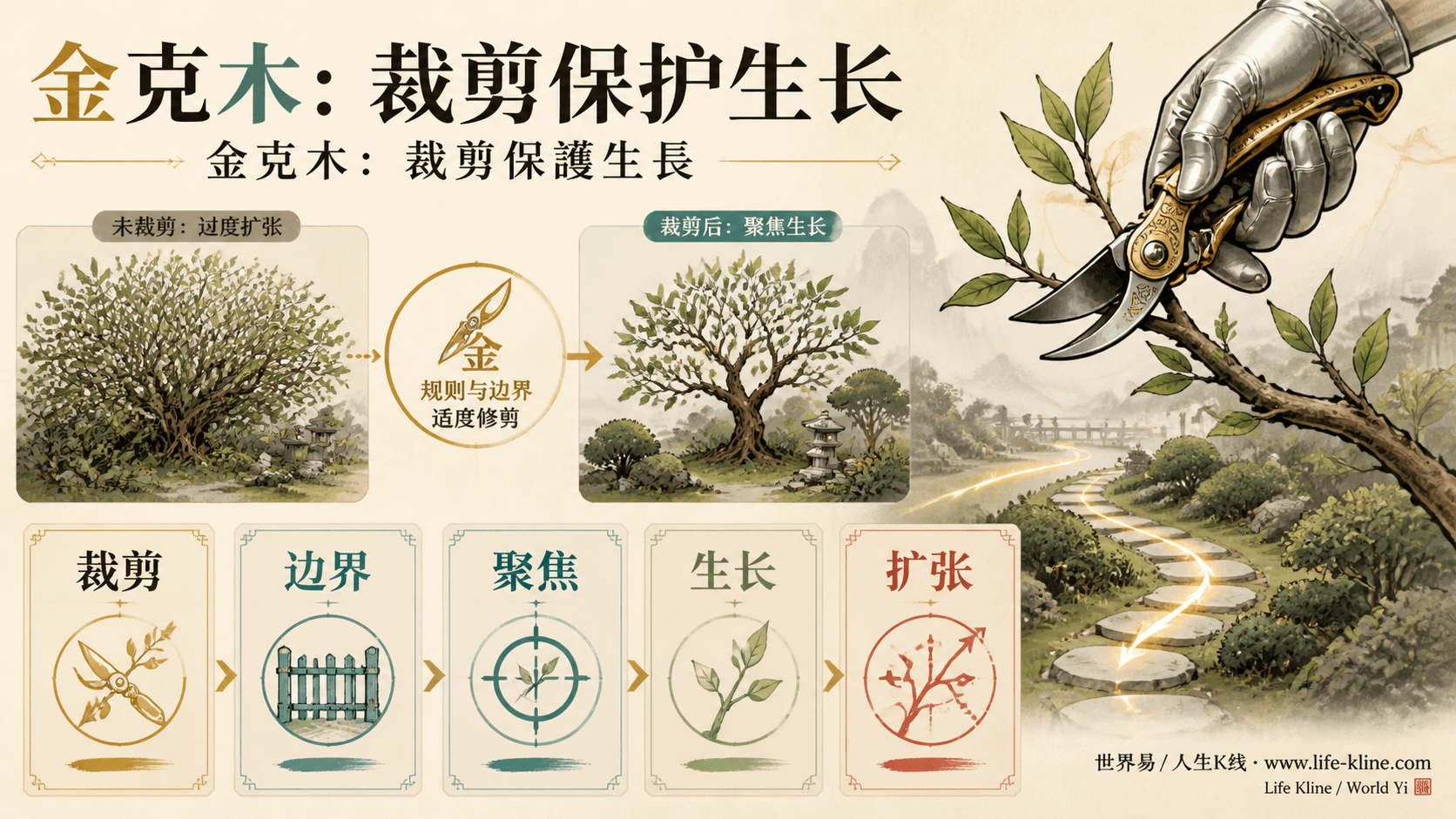
金克木调节图
这张图把《Self-Regulation and Professional Medical Decision Analysis in Insomnia and Sleep Disorders》里的命理概念转成关系、边界和应用场景,适合先看图建立结构,再回到知识文章正文理解细节。
在人生K线与世界易的框架中,金克木并非限制,而是通过规则与边界实现聚焦,让生长保持结构与效率。理解这一调节机制,能帮助我们在不同时位中主动优化路径。
查看图片解读