Metaphysical Rhythm Guidance for Long-Term Insomnia and Sleep Disorder Care Strategies
把这篇文章落到自己身上验证:先看结构,再进入个人分析,不做泛泛阅读。
Why This Decision Is Especially Difficult in This Health Scenario
Long-term care strategies for insomnia and sleep disorders face multiple challenges. Firstly, the symptoms are diverse, including difficulty falling asleep, frequent awakenings, vivid dreams, and nighttime anxiety, often resulting in disrupted circadian rhythms. These symptoms not only impair physical recovery but also negatively affect mental states, requiring care plans to address both physical and psychological regulation.
Secondly, the fast pace and environmental changes of modern life make individual routines unstable, further exacerbating sleep problems due to disrupted biological clocks. At the same time, the individual’s Five Elements imbalances and organ function status critically influence rhythm adaptability, making single care measures insufficient to meet individual differences.
Finally, long-term care strategies must focus not only on symptom relief but also integrate metaphysical patterns and Yong Shen, understanding the effects of Da Yun and Liu Nian (annual fortune) on the Five Elements and organs. This enables scientific adjustment of lifestyle rhythms to avoid symptom recurrence or worsening caused by rhythm mismatches. The complexity of this decision lies in the interplay of multidimensional factors, requiring precise metaphysical assistance combined with health management.
Correspondence Between Metaphysics and Five Elements Organs
In metaphysics, the Day Master’s Five Elements excess or deficiency directly relates to corresponding organ functions. For example, a Metal Day Master (such as 庚 (Geng)) with excess Metal often corresponds to strong lung function, but if Wood and Fire are the Yong Shen (favorable elements), balancing heart and liver regulation is necessary. When the Earth Day Master is weak, spleen and stomach functions may be compromised, requiring strengthening of spleen-stomach rhythms to aid recovery.
Patterns like Yang Ren (羊刃格) often indicate a strong Day Master Five Elements force, prone to Qi overactivity causing insomnia symptoms. Such cases rely on Yong Shen like Wood and Fire to harmonize the Five Elements, promote smooth Qi and blood flow, and improve sleep rhythms. Qi Sha (Seven Killings) patterns emphasize strong external impact and emotional volatility; Fire as Yong Shen can help regulate the mind and relieve anxiety.
The combination of Da Yun and Liu Nian affects overall health rhythms. Da Yun such as 辛丑 (Xin Chou), 丁亥 (Ding Hai), and 己卯 (Ji Mao) are relatively stable luck cycles, suitable for maintaining status quo and minimizing drastic changes. The 丙午 (Bing Wu) Liu Nian increases Fire element activity, potentially causing mental fluctuations but also offering opportunities to adjust heart Fire. Understanding these interactions helps grasp organ rhythms and optimize care plans.
Three Real BaZi Case Studies
Case 1: This female has a Day Master of 庚 (Geng) Metal, which is excessive, with a Yang Ren pattern. Wood and Fire are the Yong Shen, Earth is the Ji Shen (unfavorable element). She is currently in the second year of the 辛丑 (Xin Chou) Da Yun, during the 丙午 (Bing Wu) Liu Nian. Excessive Geng Metal corresponds to strong lung function, but the Fire Yong Shen indicates the need to adjust Qi balance via heart Fire. The Yang Ren pattern intensifies mental pressure, causing difficulty falling asleep and nighttime anxiety. Long-term care should strengthen heart Fire regulation and avoid excessive Earth element affecting spleen and stomach. It is recommended to prioritize monitoring sleep rhythm changes, coordinate lifestyle adjustments and emotional management, and seek immediate medical attention if severe insomnia with palpitations occurs.
Case 2: This female has a Day Master of 己 (Ji) Earth, which is weak, with a Qi Sha (Seven Killings) pattern. Fire is the Yong Shen, Metal and Water are the Ji Shen. She is currently in the third year of the 丁亥 (Ding Hai) Da Yun, during the 丙午 (Bing Wu) Liu Nian. Weak Earth corresponds to weaker spleen and stomach function; the Qi Sha pattern triggers emotional fluctuations, with Fire Yong Shen helping stabilize the mind. Sleep disorders mainly manifest as frequent awakenings and vivid dreams; spleen-stomach deficiency may cause digestive issues affecting sleep quality. Long-term care should focus on spleen-stomach regulation and nourishing heart Fire, combined with moderate exercise and dietary rhythm. It is advised to first rule out digestive system conditions, monitor emotional changes, and seek professional medical guidance if necessary.
Case 3: This female has a Day Master of 戊 (Wu) Earth, which is excessive, with a Yang Ren pattern. Wood and Water are the Yong Shen, Fire is the Ji Shen. She is currently in the first year of the 己卯 (Ji Mao) Da Yun, during the 丙午 (Bing Wu) Liu Nian. Excessive Earth corresponds to strong spleen and stomach, with the Yang Ren pattern indicating rapid Qi movement. Fire as Ji Shen suggests excessive heart Fire disrupting sleep rhythms. Wood and Water Yong Shen benefit liver, gallbladder, and kidney function regulation, assisting in calming the mind. Long-term care should control heart Fire elevation, promote liver and kidney detoxification and regulation, and prevent nighttime anxiety and vivid dreams. It is recommended to monitor emotional fluctuations and sleep quality, adjust lifestyle rhythms, and seek timely medical care if severe palpitations or worsening insomnia occur.
Common Misjudgments and Blind Spots in This Scenario
A common misjudgment in insomnia and sleep disorder care is treating metaphysical analysis as a medical diagnosis or a substitute for professional medical advice. Metaphysics provides references for rhythm and Five Elements adjustment but cannot replace clinical symptom evaluation and medical examinations. Especially when severe insomnia is accompanied by palpitations, breathing difficulties, or persistent anxiety—red flag symptoms—immediate medical attention is essential to avoid treatment delays.
Another blind spot is neglecting the dynamic impact of Five Elements excess or deficiency on organ functions, oversimplifying or applying a one-size-fits-all care strategy. Individual rhythms must be flexibly adjusted according to changes in Da Yun and Liu Nian; ignoring this leads to poor or adverse care outcomes.
Finally, overlooking the interaction between psychological state and living environment is a frequent error. Insomnia is often closely related to stress and anxiety; relying solely on metaphysical rhythm adjustments without psychological counseling and environmental improvements limits the effectiveness of long-term care.
Practical Judgment Sequence
For long-term insomnia care, the first step is to meticulously record sleep patterns and related symptoms, identifying difficulties in falling asleep, frequent awakenings, vivid dreams, or anxiety states. Combine this with the Day Master’s Five Elements excess or deficiency to preliminarily assess corresponding organ functions, focusing on organ regulation related to the Yong Shen.
The second step is to observe the current Da Yun and Liu Nian influences on the Five Elements, evaluating potential rhythm risk points. Based on the Yong Shen Five Elements, formulate lifestyle rhythm adjustment plans, such as modifying sleep schedules, diet structure, and emotional management to promote Five Elements balance.
The third step, during long-term observation, is that if severe insomnia is accompanied by palpitations, breathing difficulties, extreme anxiety, or other physical abnormalities, immediately cease self-regulation and seek medical care. Coordinate with professional medical diagnosis and treatment. Metaphysical adjustments serve only as auxiliary references and must not replace medical diagnosis.
FAQ
Question 1: What specific guidance does the Yong Shen in metaphysics provide for insomnia care? Answer: Yong Shen represents the Five Elements that need supplementation or adjustment in the BaZi chart. In insomnia care, it guides targeted adjustments of lifestyle rhythms and organ functions. For example, Fire as Yong Shen indicates focusing on heart Fire regulation, while Wood as Yong Shen emphasizes liver function maintenance, helping to improve sleep quality.
Question 2: How to determine when timely medical attention is necessary during long-term care? Answer: If insomnia is accompanied by palpitations, breathing difficulties, extreme anxiety, mental abnormalities, or other serious physical discomforts, immediate medical attention is required. Metaphysical rhythm adjustments cannot replace medical diagnosis; red flag symptoms must prioritize life safety.
Question 3: What impact do Da Yun and Liu Nian changes have on insomnia care? Answer: Da Yun and Liu Nian affect the strength and weakness of the BaZi Five Elements, potentially causing fluctuations in organ functions that influence sleep rhythms. Stable Da Yun favor maintaining the status quo, while Liu Nian with strong Fire requires enhanced heart Fire regulation and appropriate care strategy adjustments to prevent rhythm disruption.
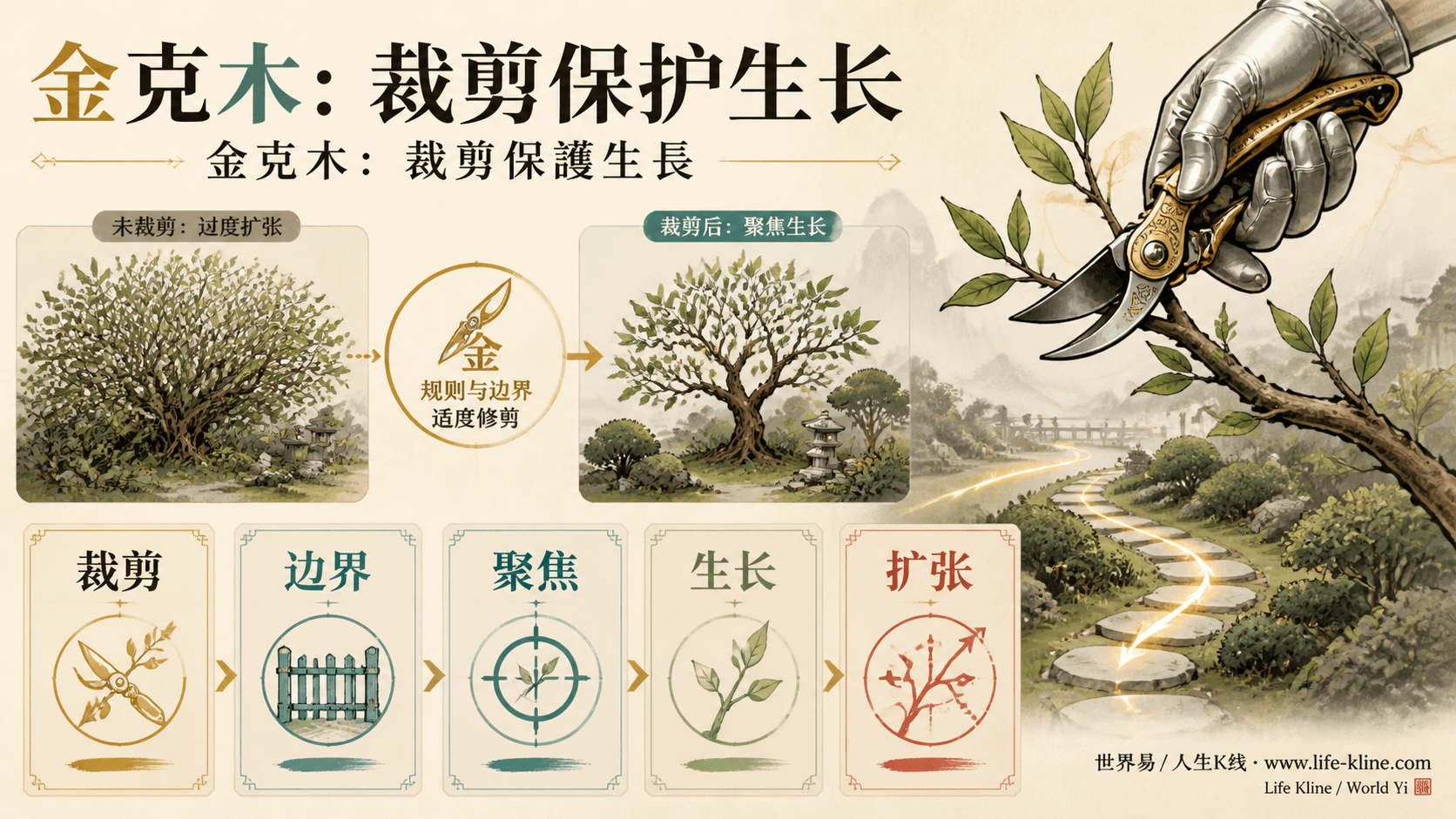
金克木调节图
这张图把《Metaphysical Rhythm Guidance for Long-Term Insomnia and Sleep Disorder Care Strategies》里的命理概念转成关系、边界和应用场景,适合先看图建立结构,再回到知识文章正文理解细节。
在人生K线与世界易的框架中,金克木并非限制,而是通过规则与边界实现聚焦,让生长保持结构与效率。理解这一调节机制,能帮助我们在不同时位中主动优化路径。
查看图片解读