The Second Migration Decision of Chinese in Singapore and Malaysia: Timing and Risk Analysis from a Metaphysical Perspective
把这篇文章落到自己身上验证:先看结构,再进入个人分析,不做泛泛阅读。
你现在搜索的,
其实是一个要落到自己身上的判断。
当前页面主要回答「Overseas Chinese」这类搜索问题;真正有价值的下一步是把这套结构带进自己的报告、工具与案例验证。
Why This Scenario Is Especially Difficult for Overseas Chinese
After the first migration, Chinese in Singapore and Malaysia often have already established a stable foundation in life and work locally. Whether to undertake a second migration involves multiple practical factors such as family distance, tax policies, cross-border cultural adaptation, and exchange rate risks, making the decision complex and full of uncertainty.
Although Singapore and Malaysia are geographically close, there are significant differences in social culture, economic environment, and policies and regulations. The second migration is not only a geographic move but also entails identity reshaping, tax planning, and adjustments in family relationships. This impact is especially profound for families with minor children or elderly parents.
The metaphysical structure is amplified or suppressed by the real environment in this scenario. For example, BaZi charts with a relatively weak Day Master have less resilience to environmental changes; if the Da Yun and Liu Nian are unfavorable, migrating too early may exacerbate instability in life. Conversely, a relatively strong Day Master or auspicious luck cycles may bring new opportunities through migration.
Therefore, the second migration decision must consider not only the Day Master strength, pattern, and Yong Shen in the BaZi chart but also the Da Yun and Liu Nian in conjunction with real-world constraints, precisely grasping the timing to avoid negative impacts caused by premature migration and ensuring a stable and long-term decision.
Three Core Dimensions of Metaphysical Judgment
First, the strength of the Day Master determines the individual's internal energy to cope with changes. A relatively weak Day Master shows strong environmental dependence in migration decisions and is advised to maintain the status quo and avoid frequent changes; a relatively strong Day Master has greater adaptability and pioneering spirit, suitable for seizing opportunities proactively.
Second, the pattern and Yong Shen reflect the overall fortune and regulatory mechanisms of the BaZi chart. The Shi Shen (Food God) pattern usually represents creativity and expressive ability, but the individual must harmonize the Five Elements according to the Yong Shen to avoid obstacles caused by the Ji Shen (unfavorable element). For example, if the Yong Shen is Fire and the Ji Shen are Metal and Water, migration should avoid environments where Metal and Water are excessively strong.
Third, the interaction between Da Yun and Liu Nian provides external timing guidance for the individual. Stable Da Yun suggests maintaining the status quo, as premature migration may disrupt financial luck or career development; auspicious Da Yun combined with favorable Liu Nian is suitable for active action. Policy changes, economic cycles, and exchange rate fluctuations in overseas environments all realistically project the influences of Da Yun and Liu Nian.
Combining these three dimensions, metaphysical judgment needs to incorporate the practical needs of Chinese in Singapore and Malaysia regarding tax planning, cross-border employment, and family support systems, scientifically evaluating the risks and opportunities of the second migration to avoid blind following or excessive conservatism.
Three Real BaZi Chart Cases
Case 1: The male Day Master is 戊 (Wu, Earth), relatively weak, with a Shi Shen pattern. The Yong Shen is Fire, and the Ji Shen are Metal and Water. He is currently in the 壬戌 (Ren Xu) Da Yun (age 20-29), which is stable and suitable for maintaining the status quo. The Liu Nian is 丙午 (Bing Wu), indicating adaptability. In reality, this young Chinese male in Singapore/Malaysia has just completed his first migration and faces the decision whether to change cities. His relatively weak Day Master and stable Da Yun suggest consolidating existing resources; premature migration may intensify the Ji Shen influence, causing instability. The recommended judgment sequence is to first evaluate the support system and career stability in the current city, then combine with Liu Nian opportunities to cautiously choose the migration timing.
Case 2: This male Day Master is 庚 (Geng, Metal), relatively weak, with a Shi Shen pattern. The Yong Shen is Earth, and the Ji Shen are Water and Wood. He is currently in the 己亥 (Ji Hai) Da Yun (age 24-33), which is stable, with the Liu Nian also being 丙午 (Bing Wu). As a Chinese in Singapore/Malaysia in the career development phase, facing the temptation of a second migration, the chart suggests maintaining the status quo. Ji Shen Water and Wood, if excessive in the new environment, may increase pressure. In reality, cross-border tax differences and family distance are his main concerns. It is advised that when judging migration, one should first examine the tax policies and living costs of the target city, then combine with the personal Da Yun stability to decide whether it is suitable to act.
Case 3: This female Day Master is 庚 (Geng, Metal), relatively strong, with a Yang Ren pattern. She has dual Yong Shen of Fire and Wood, and the Ji Shen is Earth. She is currently in the 癸巳 (Gui Si) Da Yun (age 43-52), which is auspicious, with the Liu Nian being 丙午 (Bing Wu), indicating going with the flow. She is in a period of career and financial progress, suitable to leverage the Da Yun and Liu Nian for migration. In reality, Chinese over 50 in Singapore/Malaysia face the dual challenges of family care and career transition. Her relatively strong Day Master and auspicious luck support her proactive choice of a city or country better suited for quality of life. The recommended judgment sequence is to first confirm whether the family support system after migration is complete, then arrange the timing reasonably based on career planning and the preferences of Yong Shen and Ji Shen.
Common Misconceptions Among Overseas Chinese in This Scenario
Many Chinese in Singapore and Malaysia mistakenly believe that after a successful first migration, the second migration can simply follow market trends, ignoring the influence of Day Master strength and Da Yun and Liu Nian in metaphysics, resulting in instability in life and career setbacks caused by premature migration.
Some overly rely on external economic indicators while neglecting the regulatory role of Yong Shen and Ji Shen on personal energy, especially in the complex context of cross-border taxation and family support, failing to adjust migration plans, which leads to resource waste and psychological pressure.
Additionally, some Chinese overlook the issues of family member distance and cultural adaptation, blindly pursuing opportunities in big cities or new countries. As a result, unfavorable Liu Nian or Da Yun influences in their BaZi charts cause migration to become an obstacle to career and family happiness.
In summary, neglecting the deep integration of metaphysics and real-world environment and lacking scientific judgment on migration timing are the most common and fatal mistakes overseas Chinese make in the second migration decision.
Practical Judgment Sequence
Step one: Confirm the strength of the Day Master and the Yong Shen and Ji Shen in the personal BaZi chart, evaluating the match between internal energy and external environment. Those with relatively weak Day Masters should prioritize consolidating the existing foundation, while those with relatively strong Day Masters may consider new opportunities but must avoid geographic or policy environments where Ji Shen elements are excessively strong.
Step two: Combine the current Da Yun and Liu Nian to judge whether it is a stage suitable for maintaining the status quo, adapting flexibly, or going with the flow. Stable Da Yun calls for prudence; auspicious Da Yun and favorable Liu Nian allow consideration of action. At this time, cross-border taxation, family care, and living costs should be included in the decision-making framework.
Step three: Integrate real-world constraints with metaphysical guidance to determine the specific time window for migration. It is recommended to first conduct small-scale exploratory migration or project cooperation, observe environmental adaptation, and then make large-scale migration decisions to avoid premature migration leading to loss of resources and opportunities.
FAQ
Question 1: When is the second migration considered too early? Answer: According to metaphysics, if the current Da Yun is in a stable stage suitable for maintaining the status quo and the Day Master is relatively weak, migrating too early may cause life fluctuations and career instability. Therefore, one should ensure sufficient accumulated resources and support before acting.
Question 2: How to use metaphysics to choose the migration city or country? Answer: One needs to consider the Five Elements attributes of the Yong Shen and Ji Shen, selecting an environment with balanced Five Elements favorable to the Yong Shen. For example, if the Yong Shen is Fire, it is advisable to choose regions with warm climates and inclusive cultures, avoiding environments where Ji Shen elements are excessively strong.
Question 3: How do Da Yun and Liu Nian affect migration decisions? Answer: Da Yun represents long-term trends, while Liu Nian reflects the opportunities and challenges of the year. Stable Da Yun combined with favorable Liu Nian is a better timing for migration; if Da Yun is unfavorable or Liu Nian is conflicting, it is advisable to postpone migration to avoid adverse effects.
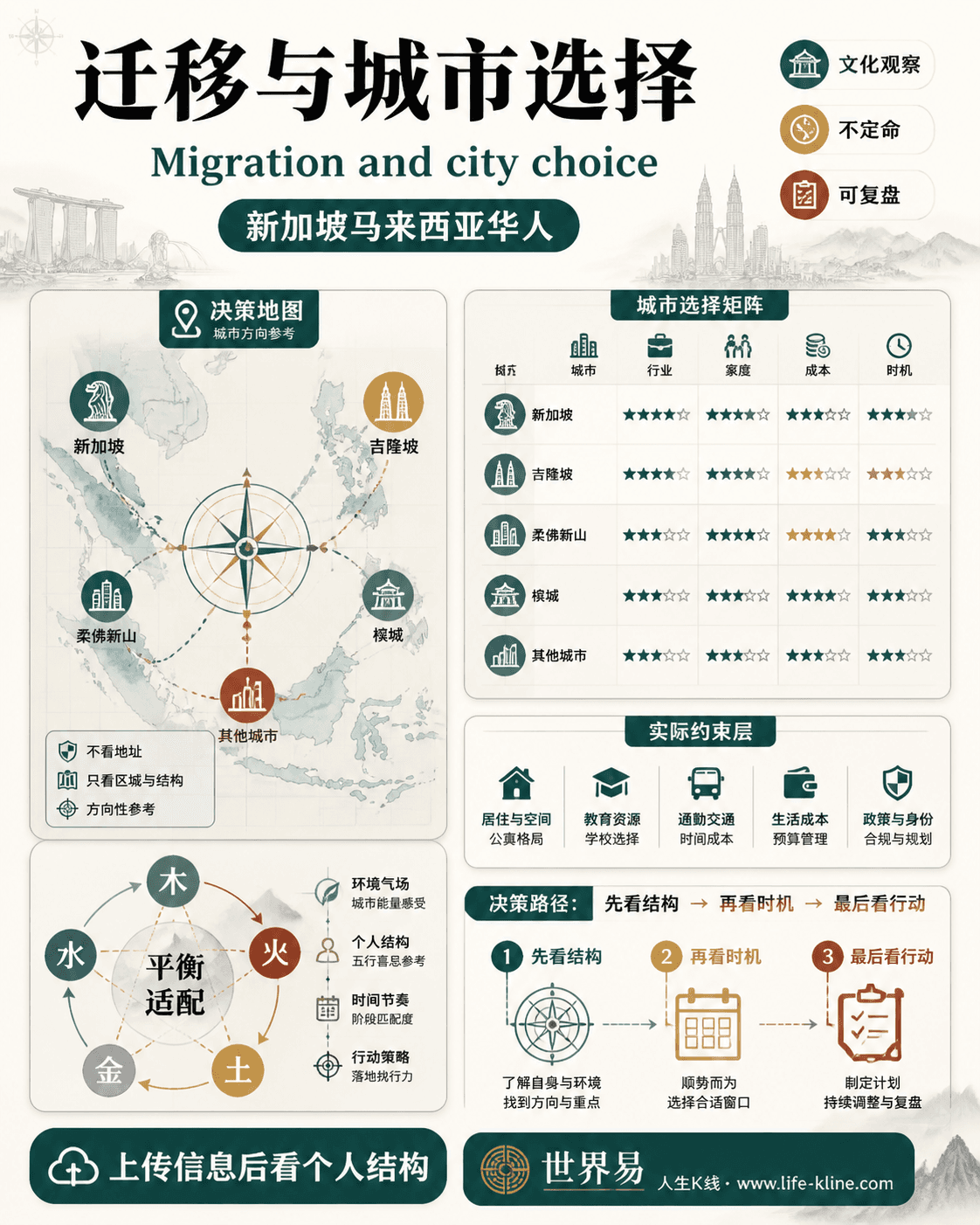
迁移与城市选择|新加坡马来西亚华人
这张图把《The Second Migration Decision of Chinese in Singapore and Malaysia: Timing and Risk Analysis from a Metaphysical Perspective》里的命理概念转成关系、边界和应用场景,适合先看图建立结构,再回到知识文章正文理解细节。
迁移与城市选择不应被写成固定结论。更适合新加坡马来西亚华人的读法,是把传统术语翻译成结构、时机、环境、行动和复盘。
查看图片解读