Key Health Recovery Indicators and BaZi Analysis for Chinese Migrants in Singapore and Malaysia
把这篇文章落到自己身上验证:先看结构,再进入个人分析,不做泛泛阅读。
Why This Scenario Is Especially Difficult for Overseas Chinese
The tropical climate and humid environment of the Singapore-Malaysia region differ significantly from the traditional East Asian climate. After migration, Chinese face enormous physical adaptation pressures. The damp heat often causes spleen and stomach discomfort, respiratory issues, and weakened immunity. For those accustomed to mild seasonal changes, this environmental shift is a major challenge.
Besides the impact of the natural environment, adjustments in dietary structure also affect health recovery. Singapore and Malaysia’s diets are dominated by tropical fruits, seafood, and spicy foods. Chinese accustomed to light diets often experience digestive and energy metabolism problems. This is closely related to the Five Elements balance in traditional BaZi; if the Yong Shen is suppressed, recovery becomes more difficult.
Cross-border migration also involves family distance and psychological stress. Being far from relatives and familiar surroundings, overseas Chinese may experience emotional and mental fluctuations. Such emotional changes often correspond to Ji Shen in BaZi, thereby impacting physical health and creating dual psychological and physiological challenges.
Overall, the difficulties in health recovery after migration arise from the complex overlay of real environmental factors and BaZi structure. It is necessary to pay attention to specific physical signals while integrating BaZi judgments of Yong Shen and Ji Shen interactions to scientifically formulate recovery plans.
Three Core Dimensions of BaZi Judgment
First, the strength of the Day Master determines an individual’s basic vitality and adaptability. A relatively weak Day Master is more prone to health fluctuations in a new environment. The humid heat climate of Singapore and Malaysia particularly challenges Day Masters weak in Water or Earth, requiring special attention to the nourishing effects of the Yong Shen.
Second, the pattern and Yong Shen reveal key regulatory elements of constitution. Pian Cai (Indirect Wealth), Qi Sha (Seven Killings), and Shang Guan (Hurting Officer) patterns correspond to sensitivities in different bodily systems. Whether the Yong Shen (Metal or Water) is strengthened or overcome after migration directly affects the speed and quality of health recovery.
Third, the current Da Yun (decade luck cycle) and Liu Nian (annual fortune) form a dynamic environment. Auspicious luck cycles can aid physical recovery, while weaker Da Yun require caution. The interaction between Da Yun and Liu Nian reveals critical years of health risks and opportunities after migration, guiding overseas Chinese to arrange their lifestyle and medical interventions reasonably.
Finally, although the palace (house) environment is not detailed here, combining the real environment to understand the Five Elements changes in the BaZi chart allows for more accurate judgment of the origins of physical signals and directions for adjustment, achieving an organic integration of BaZi and environment.
Three Real BaZi Case Studies
Case 1: This female’s BaZi Day Master is 癸 (Gui) Water, relatively weak, belonging to the Pian Cai pattern. Her Yong Shen is Metal, and Ji Shen are Wood and Fire. She is currently in the 甲戌 (Jia Xu) Da Yun, which is relatively weak, and the Liu Nian is 丙午 (Bing Wu), requiring caution. After migrating to the tropical humid heat climate of Singapore and Malaysia, the weak Gui Water Day Master is easily affected by the damp heat environment. The Fire and Wood Ji Shen intensify, increasing digestive and respiratory system stress. The Metal Yong Shen is reflected in diet as supplementing cooling and moistening foods to help eliminate damp heat. It is recommended to monitor physical responses to damp heat, such as chest tightness, dry mouth, and tongue coating changes, prioritize dietary adjustments, combine appropriate rest, and avoid overwork and emotional fluctuations.
Case 2: This male’s Day Master is 壬 (Ren) Water, relatively weak, with the Qi Sha pattern. His Yong Shen is Metal, and Ji Shen are Wood and Fire. He is currently in the 癸酉 (Gui You) Da Yun, which is auspicious, and the Liu Nian is 丙午 (Bing Wu), aligning well with the luck cycle. His weak Water Day Master needs to pay attention to the negative effects of humid heat after migration, but benefits from the auspicious Gui You Da Yun supporting stronger recovery ability. According to BaZi, the Metal Yong Shen helps the Metal-to-Water cycle. It is advised to strengthen Metal elements in diet and routine, such as consuming mineral-rich foods and maintaining a cheerful mood. Focus should be on monitoring cardiopulmonary function and immune response to prevent inflammation or allergic reactions caused by the annual Fire peak.
Case 3: This male’s Day Master is 戊 (Wu) Earth, relatively weak, with the Shang Guan pattern. His Yong Shen is Water, and Ji Shen is Metal. He is currently in the 甲子 (Jia Zi) Da Yun, which is stable, with the Liu Nian being 丙午 (Bing Wu), requiring adaptive responses. The Earth Day Master is prone to spleen and stomach function decline in the humid Singapore-Malaysia environment. Especially when the Metal Ji Shen is stimulated by environmental heat, it can increase the burden on the digestive system. The Water Yong Shen emphasizes hydration and moistening to regulate the spleen and stomach. It is recommended to closely observe digestive system reactions such as bloating and appetite changes, promptly adjust diet and lifestyle habits, follow the changes of Da Yun and Liu Nian, and conduct timely health checks and psychological counseling.
Overall, the three cases illustrate the critical influence of Yong Shen and Ji Shen in BaZi on health recovery after migration to Singapore and Malaysia. Combined with the real environment, the focus on specific signals and adjustment plans differ but all emphasize the importance of adapting to the damp heat environment.
Common Misconceptions Among Overseas Chinese in This Scenario
Many Chinese migrants in Singapore and Malaysia overlook the profound impact of climate on the body’s Five Elements, relying solely on original dietary and lifestyle habits. They neglect the dynamic changes of Yong Shen and Ji Shen in BaZi, resulting in persistent physical discomfort that is difficult to resolve.
Another common misconception is attributing health recovery entirely to medical treatment or psychological adjustment, ignoring the influence of Da Yun and Liu Nian on bodily energy. They fail to adjust their action rhythm according to BaZi cycles, causing repeated setbacks or stagnation in recovery.
Some Chinese overly depend on traditional BaZi deductions while neglecting concrete real-life conditions, such as cross-border tax pressures and psychological burdens from family distance. These real factors amplify the negative effects of Ji Shen, affecting the overall effectiveness of physical recovery.
Additionally, the lack of systematic observation and recording of physical signals leads to missing critical health warnings, losing the best timing for adjustments, and negatively impacting post-migration life quality and work efficiency.
Practical Judgment Sequence
First, clarify the strength of the Day Master and identify Yong Shen and Ji Shen. Combine this with the real environment to determine the specific impacts of damp heat, diet, and psychological burden on the body. Prioritize symptoms related to Ji Shen systems, such as digestive and respiratory discomfort corresponding to Fire and Wood Ji Shen.
Second, integrate the current Da Yun and Liu Nian to assess overall health risks. In auspicious luck years, actively adjust lifestyle and diet; in weaker Da Yun years, act cautiously, reduce stress, and increase rest and physical conditioning.
Finally, continuously observe changes in physical signals and gradually adjust lifestyle details related to the Yong Shen according to BaZi judgment order. For example, strengthen hydration for Water Yong Shen, increase mineral intake for Metal Yong Shen, and seek medical attention or make adjustments promptly when Ji Shen warning signs appear, achieving a balance between scientific and BaZi considerations.
FAQ
Question 1: After moving to Singapore or Malaysia, how can I determine if my body has adapted to the local climate? Answer: Combine the strength of your Day Master and your Yong Shen and Ji Shen in BaZi. Observe physical signals related to Ji Shen, such as indigestion, breathing difficulties, or emotional fluctuations. If these symptoms persist or worsen, it is important to pay attention and adjust your lifestyle accordingly.
Question 2: How do Yong Shen and Ji Shen in BaZi guide dietary adjustments? Answer: Yong Shen represents elements the body needs to supplement, while Ji Shen indicates factors to avoid or reduce. For example, those with Metal Yong Shen should consume mineral-rich foods, while those with Fire and Wood Ji Shen should avoid spicy and greasy foods. Combining local ingredients reasonably can help restore health.
Question 3: What impact do Da Yun and Liu Nian have on health recovery? Answer: Da Yun represents long-term trends, and Liu Nian represents annual changes. Auspicious luck cycles favor health recovery and are suitable for active adjustments; weaker Da Yun require caution and steady nurturing. Adjusting your action rhythm according to these cycles enables a more scientific response to health challenges after migration.
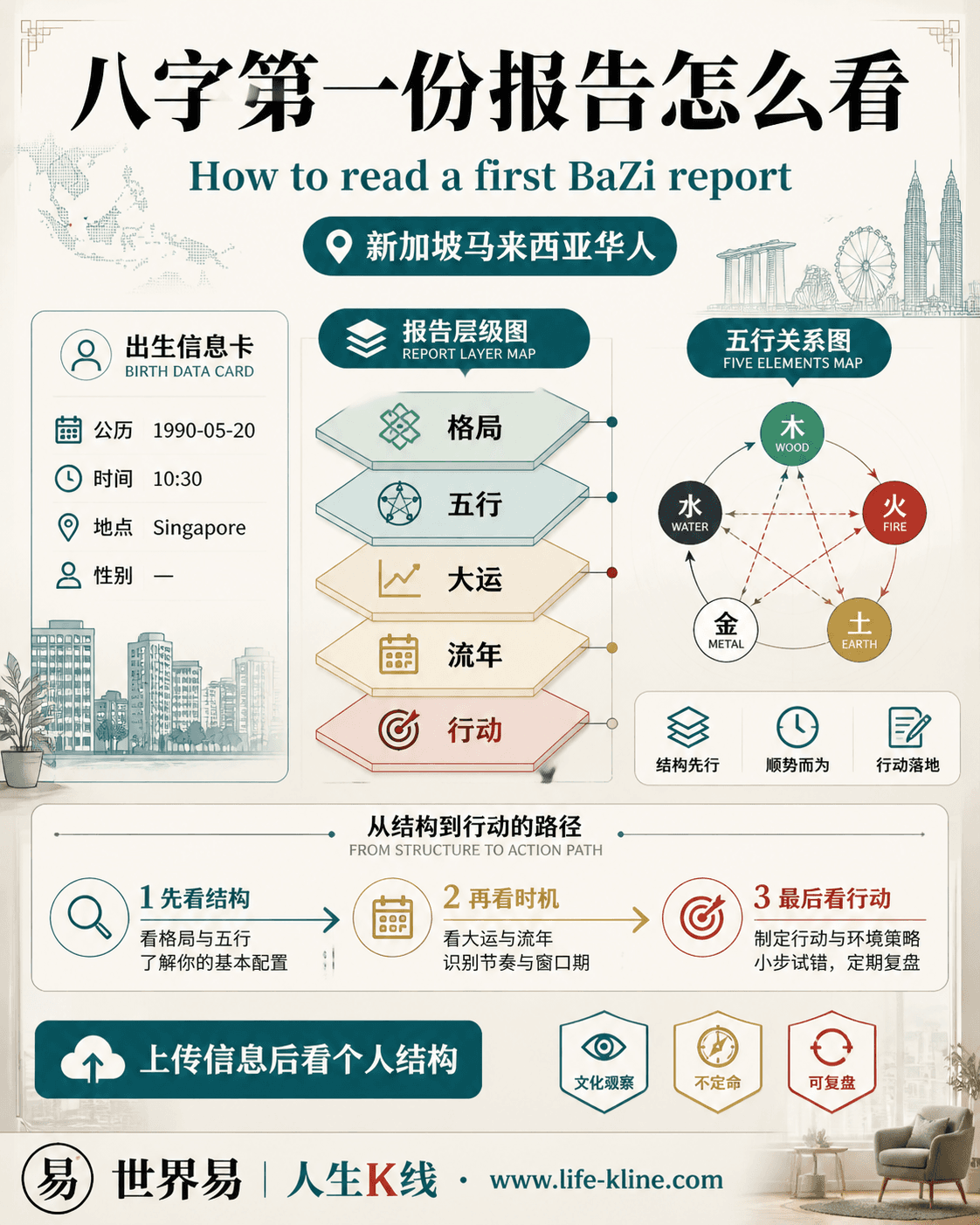
八字第一份报告怎么看|新加坡马来西亚华人
这张图把《Key Health Recovery Indicators and BaZi Analysis for Chinese Migrants in Singapore and Malaysia》里的命理概念转成关系、边界和应用场景,适合先看图建立结构,再回到知识文章正文理解细节。
八字第一份报告怎么看不应被写成固定结论。更适合新加坡马来西亚华人的读法,是把传统术语翻译成结构、时机、环境、行动和复盘。
查看图片解读