Synchronizing Metaphysics and Reality in Overseas Chinese Decisions on Elderly Care in Singapore and Malaysia
把这篇文章落到自己身上验证:先看结构,再进入个人分析,不做泛泛阅读。
Why This Scenario Is Especially Difficult for Overseas Chinese
The overseas Chinese community in Singapore and Malaysia faces particularly complex constraints when addressing elderly care for aging parents. Firstly, geographic distance makes frequent trips home costly, involving transportation expenses, time management, and visa restrictions. Secondly, cross-border taxation and currency fluctuations increase financial burdens, especially as income and living costs are influenced separately by Singapore’s and Malaysia’s economic environments, requiring careful fund allocation. Furthermore, cultural differences and diverse family expectations intensify conflicts between emotional needs and practical arrangements. Overseas children often oscillate between traditional filial piety and modern life pressures. Lastly, the BaZi structure’s Day Master strength and Yong Shen relationships tend to be amplified or suppressed by this complex environment, making it difficult to rely solely on metaphysical judgment for comprehensive decision-making.
Specifically, the Day Master’s strength in BaZi determines an individual’s initiative and endurance in decision-making, while the Yong Shen reveals key elements that regulate the balance of one’s natal chart. In the Singapore-Malaysia region, cultural and policy environments notably impact these metaphysical factors. For example, those with a Zheng Guan (Proper Officer) pattern typically bear responsibility and are suitable for undertaking the duty of returning home for care, but cross-border pressures may disrupt their mental and material balance. Meanwhile, individuals with Qi Sha (Seven Killings) pattern or weaker Day Masters are more vulnerable to external environmental fluctuations and need to weigh resources more cautiously.
Moreover, decisions about overseas elderly care involve not only individual BaZi but also the changes in Da Yun (decade luck cycles) and Liu Nian (annual fortune). Whether the current Da Yun and Liu Nian are favorable directly affects the timing of personal actions. Singapore’s and Malaysia’s policy environments and social support systems can amplify or offset the auspiciousness or inauspiciousness reflected in BaZi, necessitating dynamic adjustments of metaphysical judgments in conjunction with reality. In summary, overseas Chinese in Singapore and Malaysia face the challenge of balancing metaphysics and reality in elderly care decisions, taking into account both spiritual and material needs.
Three Core Dimensions of Metaphysical Judgment
When analyzing overseas Chinese decision-making on elderly care in Singapore and Malaysia, the primary focus is on the Day Master and BaZi pattern. The Day Master’s strength determines one’s dominant energy; a relatively strong Day Master implies strong initiative and capacity to bear responsibility, while a weaker one must rely on external resources. Patterns such as Zheng Guan (Proper Officer) usually represent strong responsibility and adherence to norms, suitable for proactively undertaking family duties; Qi Sha (Seven Killings) patterns are more variable and challenging, indicating possible obstacles during decision-making. The Yong Shen (favorable element) is the key to regulating the chart’s balance; selecting the correct Yong Shen helps stabilize mental state and resource allocation, whereas the Ji Shen (unfavorable element) should be avoided to prevent decision errors.
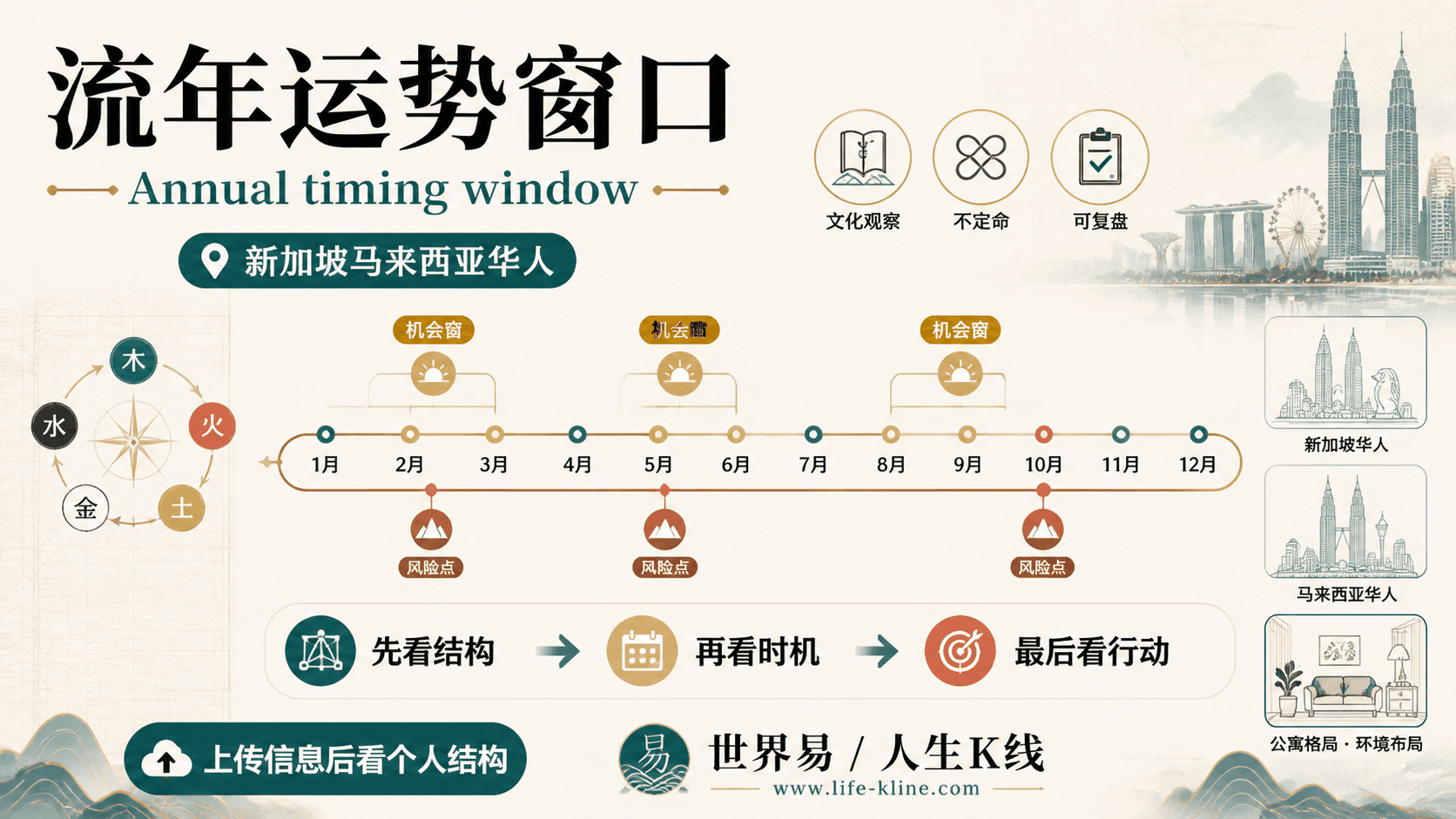
Secondly, Da Yun and Liu Nian provide the temporal context. Da Yun represents longer phases of life fortune; a favorable Da Yun enhances one’s ability to execute decisions, whereas an adverse Da Yun calls for caution. Liu Nian reflects short-term environmental changes. The interaction between Liu Nian and Da Yun determines the auspiciousness of actions in a given year, which is especially important when making critical decisions about cross-border elderly care. For example, a favorable Da Yun combined with a smooth Liu Nian is suitable for actively returning home to care for parents; conversely, a stable or obstructed Da Yun suggests opting for remote support to reduce risks.
Lastly, palace environments (宫位) reflect the concrete intersection of metaphysics and reality. Although this article does not specify palace details, combining the Day Master and pattern allows us to infer that the interaction between the Family Palace and Career Palace is particularly crucial in the Singapore-Malaysia overseas context. The stability of the Family Palace influences the sense of responsibility towards parental care, while the pressure and resources associated with the Career Palace determine actual support capacity. The overlay of metaphysical judgment and real-life environment requires overseas Chinese to comprehensively consider these three dimensions to synchronize metaphysics with daily life.
Three Real BaZi Chart Cases
Case 1: This male’s Day Master is 丁火 (Ding Fire), relatively strong, with a Zheng Guan (Proper Officer) pattern and Yong Shen being Wood. He is currently in the 甲寅 (Jia Yin) Da Yun, which is highly auspicious. In the Singapore-Malaysia environment, he is young and in a rising phase of life. The Zheng Guan pattern gives him a strong sense of responsibility and adherence to rules, making him suitable to undertake parental care duties. The Jia Yin Da Yun brings smooth energy, and the Liu Nian 丙午 (Bing Wu) also supports timely action, indicating favorable conditions for caregiving. However, Wood is both Yong Shen and Ji Shen in his chart, showing a dual dependence and taboo on this element. He needs to balance his actions to avoid overconsumption of the Yong Shen. Considering reality, although cross-border transportation between Singapore and Malaysia is convenient, time costs remain significant. It is recommended that he first assess the feasibility of returning home for care. If remote support can effectively meet his parents’ needs, he should moderate his actions according to the Yong Shen indications to prevent overexertion.
Case 2: This male’s Day Master is 戊土 (Wu Earth), relatively strong, with a Qi Sha (Seven Killings) pattern. His Yong Shen are Wood and Water, and Ji Shen is Fire. He is currently in the 丁卯 (Ding Mao) Da Yun, which is stable. The Qi Sha pattern brings strong variability and challenges, indicating he may face considerable uncertainties during decision-making. The Yong Shen Wood and Water emphasize regulation and nourishment, while the Ji Shen Fire suggests avoiding overly intense actions. Living across Singapore and Malaysia, he must weigh multiple factors such as taxation, family distance, and cultural expectations when caring for parents. The Ding Mao Da Yun advises maintaining the status quo, and combined with the Liu Nian 丙午 (Bing Wu), a prudent strategy is recommended. Prioritizing remote support helps maintain family harmony and economic stability, especially amid uncertain cross-border policies, avoiding frequent trips home that waste resources.
Case 3: This female’s Day Master is 庚金 (Geng Metal), relatively weak, with a Zheng Guan (Proper Officer) pattern. Her Yong Shen is Earth, and Ji Shen are Water and Wood. She is currently in the 甲辰 (Jia Chen) Da Yun, which is stable. The relatively weak Geng Metal Day Master means she has limited energy to bear parental care responsibilities and needs a stable environment and resources. The Zheng Guan pattern endows her with responsibility and moral constraints; Earth as Yong Shen represents steadiness and support, while Water and Wood as Ji Shen warn against emotional volatility and external disturbances. The Jia Chen Da Yun is stable, and the Liu Nian 丙午 (Bing Wu) calls for flexible adjustments in caregiving plans. Considering Singapore-Malaysia’s real constraints, she should choose appropriate remote support based on her parents’ actual needs and arrange short-term home visits when necessary, avoiding a single approach that wastes resources or causes emotional detachment.
Common Misconceptions Among Overseas Chinese in This Scenario
Many overseas Chinese in Singapore and Malaysia overly rely on a single metaphysical factor when deciding on parental care, neglecting the complexity of the real environment. For example, blindly focusing on the Day Master’s strength while ignoring the overall coordination of Yong Shen and Da Yun leads to poor timing choices, increasing financial strain or emotional distance within the family. Another common misconception is underestimating the impact of cross-border policies and taxation, overlooking differences in healthcare resources, social security, and visa regulations between Singapore and Malaysia, resulting in unsustainable plans to return home for care.
Additionally, some overseas children, driven by emotion, rashly decide to return home for caregiving without considering their career development and family stability, which negatively affects their long-term quality of life. Others ignore the influence of Liu Nian changes and fail to timely adjust care plans, missing the best moments to act in harmony with fortune. Misunderstanding the Yong Shen and Ji Shen relationship in BaZi can also lead to overly aggressive or overly conservative actions, undermining the scientific and practical feasibility of decisions.
In summary, overseas Chinese should avoid these misconceptions by integrating metaphysics with reality across multiple dimensions, respecting traditional culture while adapting to modern society, ensuring decisions are stable and sustainable.
Practical Judgment Sequence
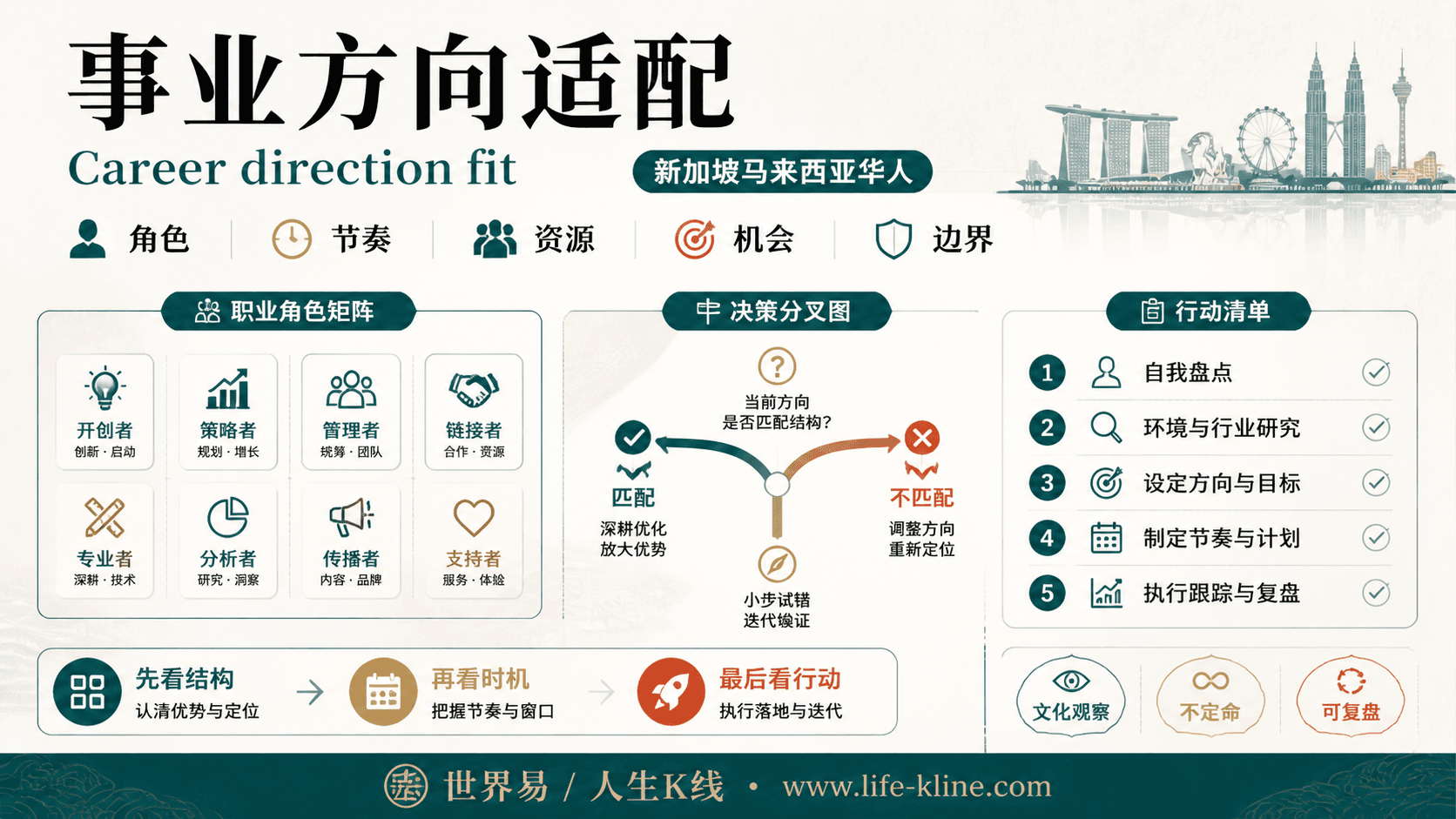
Step one is to comprehensively analyze the BaZi structure, clarifying the Day Master’s strength, pattern type, and Yong Shen/Ji Shen, while considering the current Da Yun and Liu Nian to assess personal energy status and timing for action. Cross-reference with real life by evaluating one’s economic capacity, career development, and family responsibilities to ensure metaphysical insights align with actual resources.
Step two is to incorporate the Singapore-Malaysia cross-border environment by detailing parents’ health conditions, living needs, and social support systems. Analyze the pros and cons of returning home versus remote support, focusing on transportation convenience, taxation impact, and family member roles.
Step three is to grasp the auspiciousness trends from the interaction of Liu Nian and Da Yun, choosing time windows that follow the flow of fortune. Favorable times suit proactive measures such as returning home or arranging long-term care; stable or adverse times call for steady progress and enhanced remote support to reduce risks and stress from frequent cross-border travel. Finally, continuously adjust plans dynamically, responding promptly to changes in metaphysics and reality, avoiding stubbornness, and ensuring parental care decisions are both scientifically sound and practically appropriate.
FAQ
Question 1: How do Yong Shen and Ji Shen affect overseas elderly care decisions? Answer: Yong Shen represents key elements that regulate and support the natal chart, helping stabilize mindset and resource allocation. Ji Shen are energies to avoid as they may cause decision errors. In overseas elderly care scenarios, correctly understanding the Yong Shen and Ji Shen relationship helps identify appropriate timing and intensity of actions, preventing overexertion or indecision.
Question 2: What roles do Da Yun and Liu Nian play in cross-border care decisions? Answer: Da Yun reflects overall fortune over longer periods, while Liu Nian represents environmental changes within a year. Their favorable interaction indicates good timing for actively returning home to care for parents; otherwise, a cautious approach with strengthened remote support is advisable. Considering real cross-border restrictions, timely grasp of these cycles is key to successful decisions.
Question 3: How to balance metaphysical judgment with real cross-border policies? Answer: Metaphysics offers guidance on energy and trends, whereas cross-border policies involve concrete legal and economic factors. It is recommended to integrate policy information within the metaphysical framework and dynamically adjust decisions, respecting traditional culture while adapting to modern societal changes, ensuring scientific and practical balance to maximize family benefits.
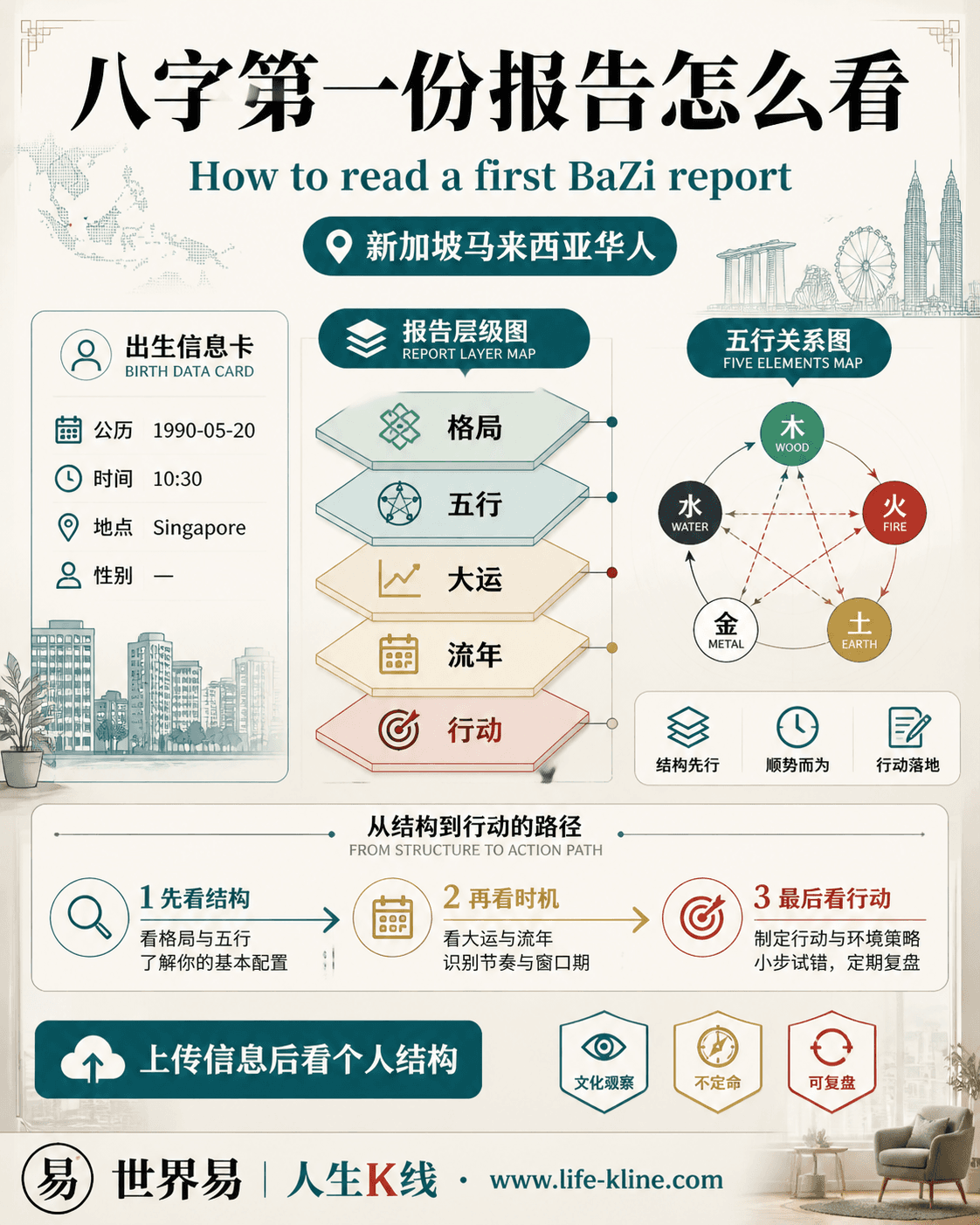
八字第一份报告怎么看|新加坡马来西亚华人
这张图把《Synchronizing Metaphysics and Reality in Overseas Chinese Decisions on Elderly Care in Singapore and Malaysia》里的命理概念转成关系、边界和应用场景,适合先看图建立结构,再回到知识文章正文理解细节。
八字第一份报告怎么看不应被写成固定结论。更适合新加坡马来西亚华人的读法,是把传统术语翻译成结构、时机、环境、行动和复盘。
查看图片解读