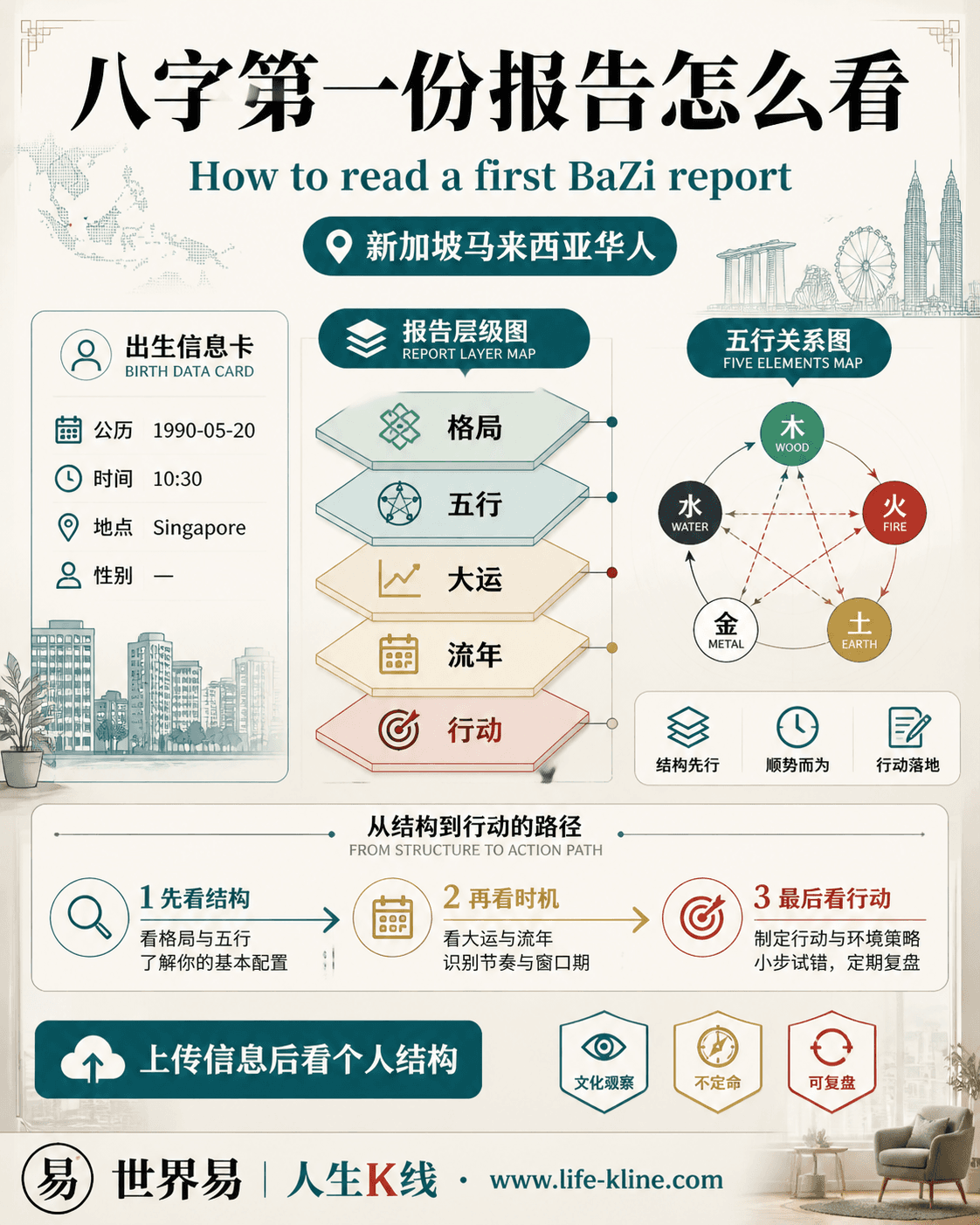
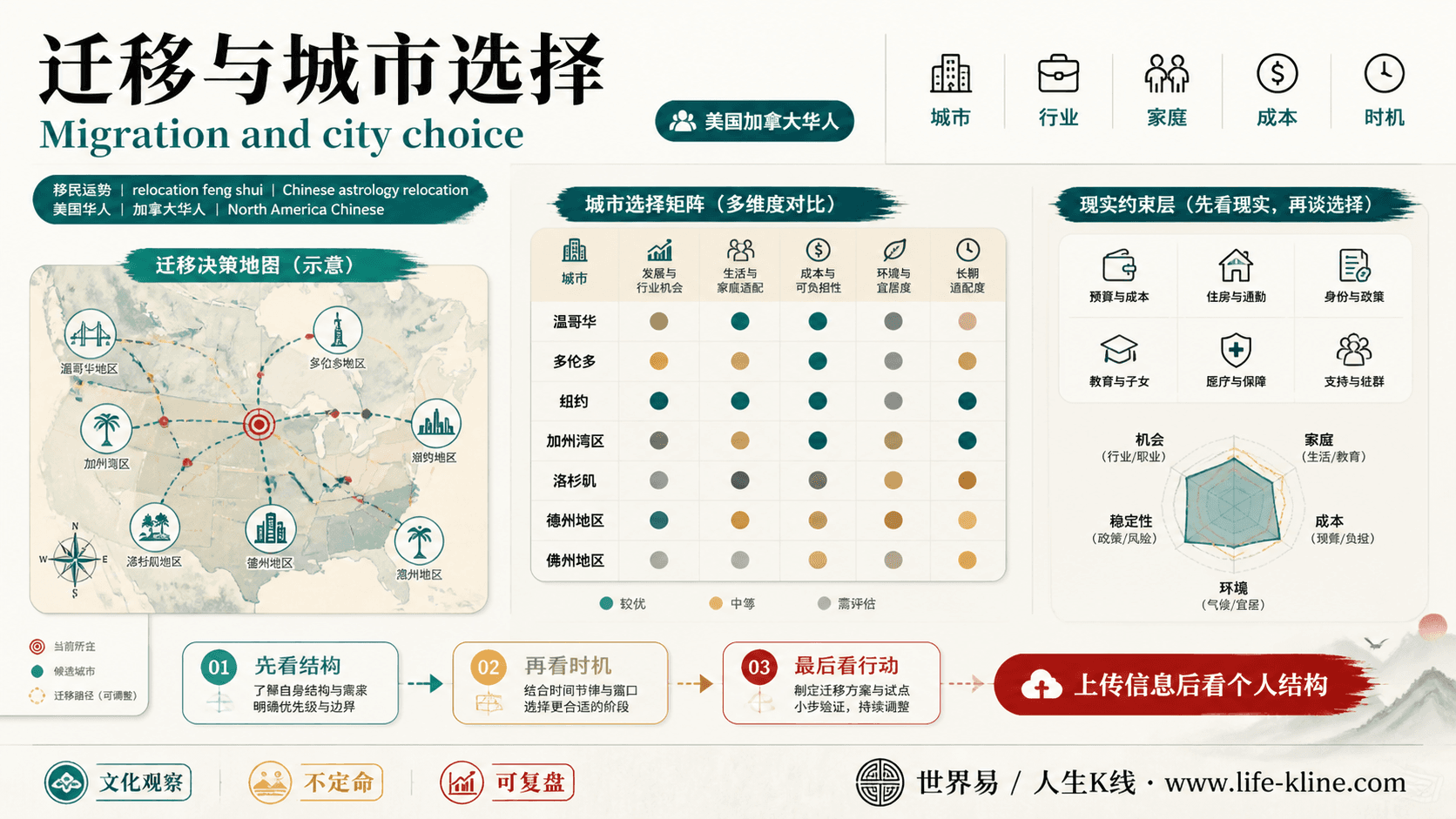
A Decision Guide to Correcting BaZi Errors from Daylight Saving Time and Time Zone Differences for Singaporean and Malaysian Chinese
把这篇文章落到自己身上验证:先看结构,再进入个人分析,不做泛泛阅读。
你现在搜索的,
其实是一个要落到自己身上的判断。
当前页面主要回答「Overseas Chinese」这类搜索问题;真正有价值的下一步是把这套结构带进自己的报告、工具与案例验证。
Why This Scenario Is Especially Difficult for Overseas Chinese
Singapore and Malaysia, as major Chinese communities in Southeast Asia, are geographically close but have different time systems and cultural habits. Especially regarding daylight saving time (DST) switches, their policies are inconsistent: Singapore does not adopt DST, while Malaysia has historically made adjustments. This causes confusion in cross-border birth time records, increasing the difficulty of calibrating BaZi charts.
Moreover, frequent cross-border movement among Chinese families means many members are born under different time zones and time systems. Such large time differences and recording errors easily lead to incorrect hour pillar (Shi Zhu) judgments, directly affecting the Day Master’s strength and the accuracy of the Yong Shen (favorable element). Combined with multiple practical pressures overseas Chinese face—such as taxation, family distance, and cross-border education—the importance of accurate metaphysical judgment for decision-making is further amplified.
From a cultural perspective, Southeast Asian Chinese heavily rely on traditional metaphysics, especially at key life junctures like career selection, marriage, and investment. BaZi deviations caused by time errors not only affect personal fortune analysis but may also trigger trust crises within families, thereby impacting the execution of decisions.
Therefore, the three typical issues of DST switches, large time zone differences, and birth location recording errors constitute unavoidable challenges for BaZi calibration among Singaporean and Malaysian Chinese. The complexity lies in scientifically correcting charts by integrating real-world constraints with metaphysical structures to ensure metaphysical judgments align closely with actual environments.
Three Core Dimensions of Metaphysical Judgment
First, the Day Master and the pattern (Ge Ju) form the foundation of the BaZi chart. The Day Master’s strength determines the chart’s favorable and unfavorable elements and the principles for balancing the Five Elements. The pattern reveals the main life energy flow of the chart owner. For Singaporean and Malaysian Chinese, the Day Master’s Five Elements strength is greatly affected by the precision of birth time; time zone errors can cause misjudgments of whether the Day Master is overly strong or weak.
Second, the choice of Yong Shen (favorable element) is key to harmonizing the BaZi balance. Yong Shen depends on the accurate combination of the Four Pillars (Si Zhu), especially the correct determination of the hour pillar (Shi Zhu). DST adjustments or time zone errors directly affect the hour pillar, thus influencing the positioning of Yong Shen, causing balancing strategies to fail and undermining the scientific basis of metaphysical decision-making.
Third, Da Yun (decade luck cycle) and Liu Nian (annual fortune) as dynamic spatiotemporal variables reflect the chart owner’s fortune changes. The interaction between Da Yun and Liu Nian is complex; correct time input ensures the Da Yun start time corresponds accurately with the Liu Nian. Cross-border movement and time errors among Singaporean and Malaysian Chinese often cause confusion in Da Yun start times, affecting the timing of decisions.
Additionally, the palace environment (Gong Wei) should not be overlooked. Converting the time zone of different birth locations affects palace divisions, especially the hour pillar’s corresponding hour palace, influencing life stage fortunes. Reasonable chart calibration requires comprehensive judgment based on the above three core dimensions combined with real-world contexts.
Three Real BaZi Case Studies
Case 1: This male’s BaZi chart has a Day Master 戊 (Wu, Earth), which is slightly strong. The pattern is Pian Cai (偏财, indirect wealth), with Yong Shen being Wood and Water, and Ji Shen (unfavorable element) being Fire. His current Da Yun is 乙亥 (Yi Hai) Da Yun, a favorable luck cycle, and the Liu Nian is 丙午 (Bing Wu), which aligns well. In the context of Singaporean and Malaysian realities, due to time zone differences at birth, if the birth hour was not promptly adjusted or was misrecorded due to DST changes, the hour pillar might be incorrectly recorded as 己未 (Ji Wei), affecting the accuracy of the Wood and Water Yong Shen. Since Wood and Water Yong Shen are heavily influenced by the hour pillar, any error there will weaken the balancing effect. It is recommended to first confirm the birth location’s time system for that year, verify the hour record, then use the year pillar 甲戌 (Jia Xu) and month pillar 壬申 (Ren Shen) together to recalibrate the hour pillar, ensuring the Yong Shen functions optimally.
Case 2: This male’s BaZi chart has a Day Master 辛 (Xin, Metal), balanced in strength. The pattern is Zheng Guan (正官, direct officer), with Yong Shen being Earth and Ji Shen being Fire. His current Da Yun is 辛亥 (Xin Hai) Da Yun, stable and suitable for maintaining achievements, and the Liu Nian is 丙午 (Bing Wu), requiring flexible adaptation. Since the Zheng Guan pattern relies on the hour pillar 丙申 (Bing Shen) to provide official star strength, DST or time zone errors easily cause hour pillar deviation, weakening the official star’s power and causing the strategy to maintain achievements to fail. Singaporean and Malaysian Chinese living cross-border who do not calibrate the hour pillar may miss timely opportunities to maintain stability. It is advised to compare the Heavenly Stems and Earthly Branches of the birth year and month pillars with the hour pillar, combined with historical time zone information of the birth location, to repeatedly adjust and correct, ensuring the hour pillar matches the Yong Shen Earth, thereby stabilizing the chart.
Case 3: This female’s BaZi chart has a Day Master 庚 (Geng, Metal), slightly strong. The pattern is Bi Jian (比肩, peer), with Yong Shen being Fire and Wood, and Ji Shen being Earth. Her current Da Yun is 甲子 (Jia Zi) Da Yun, a favorable luck cycle, and the Liu Nian is 丙午 (Bing Wu), which aligns well. The Bi Jian pattern emphasizes self-energy, and the accuracy of the hour pillar 癸未 (Gui Wei) relates to the nurturing effect of Yong Shen Fire and Wood. If the birth hour is offset due to DST switching errors, the hour pillar’s misplacement will cause imbalance in the Fire and Wood Yong Shen, affecting career and financial stability. Singaporean and Malaysian Chinese women in cross-border families often neglect precise hour pillar calibration due to time zone differences, impacting personal development. It is recommended to first verify the birth location’s DST policy for that year, then dynamically adjust the hour pillar by analyzing the Five Elements generating and overcoming relationships among the other pillars to ensure the Yong Shen system’s balance.
Common Misconceptions among Overseas Chinese in This Scenario
First, ignoring the impact of DST and time zone differences on birth hour leads to incorrect BaZi chart calculations. Many Singaporean and Malaysian Chinese habitually report birth times according to local standard time without considering DST adjustments, causing hour pillar deviations and reducing metaphysical judgment accuracy.
Second, mistakenly attributing hour errors to metaphysical structure itself while neglecting external environmental factors. Changes in metaphysical structure should be based on factual data rather than blindly adjusting patterns or Yong Shen, which easily causes judgment errors and hinders scientific decision-making.
Third, lacking a systematic calibration process. Most Chinese clients fail to integrate birth location historical time zones, DST policies, and family records, lacking interdisciplinary coordinated calculations, resulting in persistent chart errors that affect timing and direction of major life decisions.
Fourth, over-relying on a single metaphysical dimension while neglecting the dynamic interaction of Da Yun and Liu Nian. Time zone errors not only affect the hour pillar but also the Da Yun start time. Overseas Chinese who do not analyze Da Yun and Liu Nian comprehensively risk one-sided judgments, impacting financial, career, and family decisions.
Practical Judgment Sequence
First, clarify the birth location and the corresponding time zone and DST policy for that year. Cross-check official time systems to confirm if the birth time involved DST adjustments, avoiding basing calculations on incorrect times. Next, verify the hour pillar’s reasonableness by analyzing the Heavenly Stems and Earthly Branches of the year and month pillars, especially ensuring the hour pillar fits the birth hour range; perform time conversion adjustments if necessary.
Then, evaluate the reasonableness of the Yong Shen based on the Day Master’s strength and pattern characteristics. After calibrating the hour pillar, check whether the Yong Shen receives appropriate support or control to ensure BaZi structural balance. Finally, verify the Da Yun start time and Liu Nian changes to confirm alignment with the adjusted hour pillar, preventing time zone errors from causing Da Yun start time deviations that affect fortune judgments.
In practice, it is advised to wait for complete time data confirmation first to avoid premature metaphysical conclusions. After confirming data, perform multiple conversions and cross-checks to ensure chart information accuracy. Only after the chart calibration stabilizes should one plan key life decisions based on Da Yun and Liu Nian to avoid decision errors caused by time zone discrepancies.
FAQ
Question 1: For Singaporean and Malaysian Chinese with misrecorded birth times, which time point should be calibrated first? Answer: First calibrate the birth location’s standard time and whether DST was in effect that year to confirm the birth time’s accuracy relative to standard time. Then verify the hour pillar’s reasonableness by comparing the year and month pillars’ Heavenly Stems and Earthly Branches. This is the first step in calibration.
Question 2: Does DST switching greatly affect the BaZi hour pillar? Answer: Yes, it has a significant impact. The hour pillar determines the Earthly Branch of the birth hour. A DST adjustment causing a time shift of more than one hour can change the hour pillar, thereby affecting the Yong Shen judgment and chart balance.
Question 3: How to avoid BaZi errors with large time zone differences? Answer: It is essential to combine the birth location’s specific time zone standards and historical time zone change records for time conversion. Especially for cross-border births or migrations, accurately record local time and convert it to standard time to ensure Four Pillars calculations are accurate.
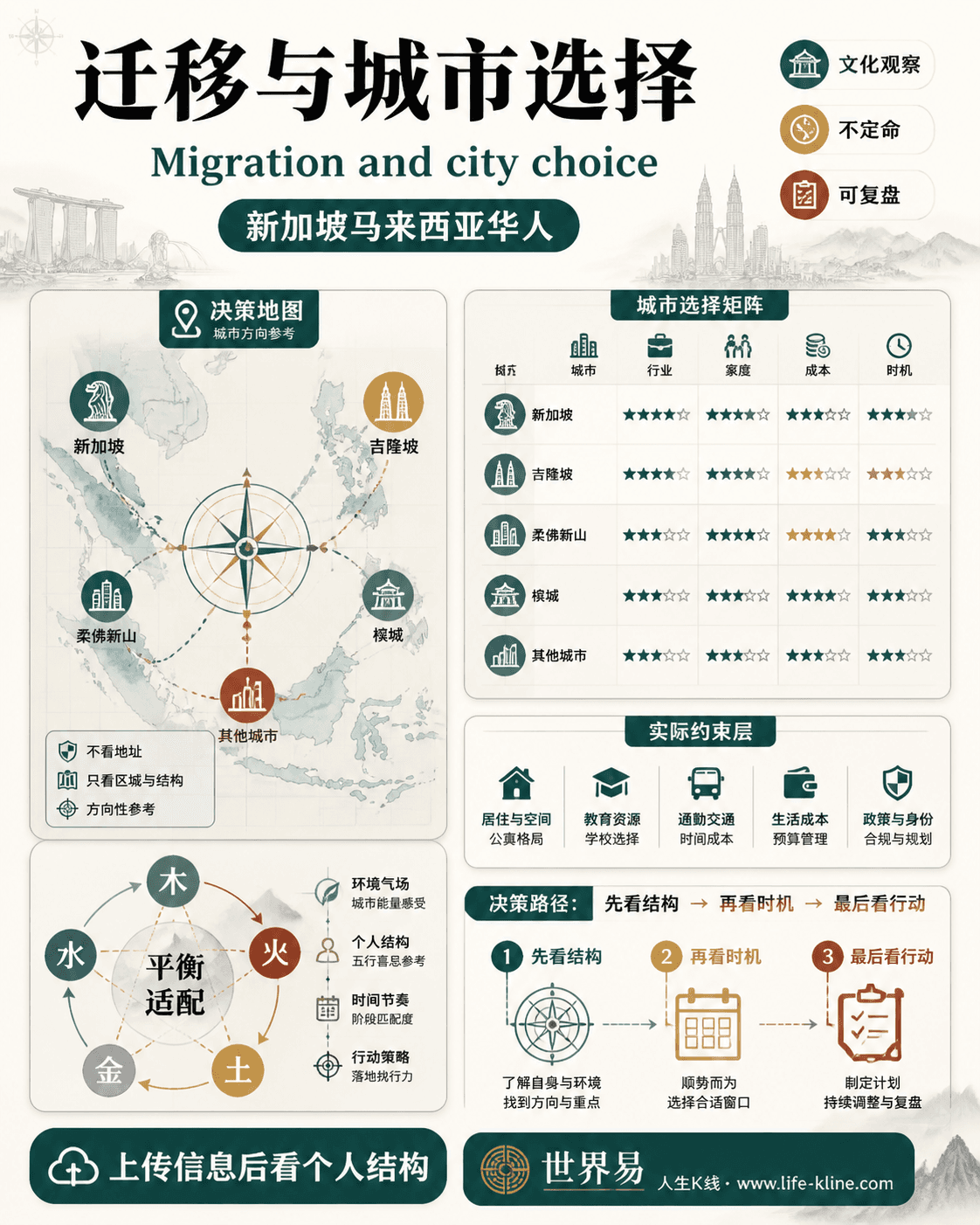
迁移与城市选择|新加坡马来西亚华人
这张图把《A Decision Guide to Correcting BaZi Errors from Daylight Saving Time and Time Zone Differences for Singaporean and Malaysian Chinese》里的命理概念转成关系、边界和应用场景,适合先看图建立结构,再回到知识文章正文理解细节。
迁移与城市选择不应被写成固定结论。更适合新加坡马来西亚华人的读法,是把传统术语翻译成结构、时机、环境、行动和复盘。
查看图片解读