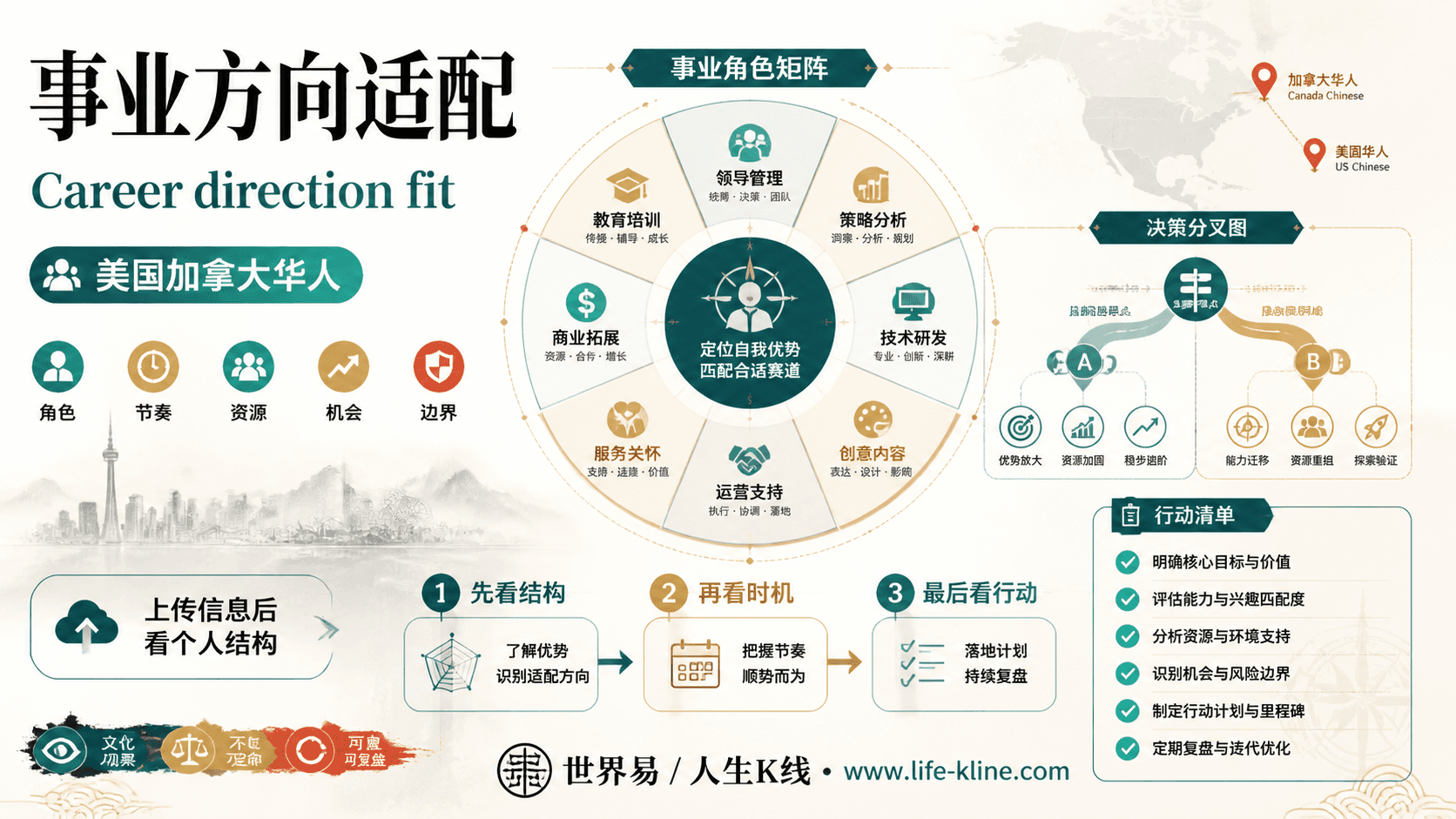
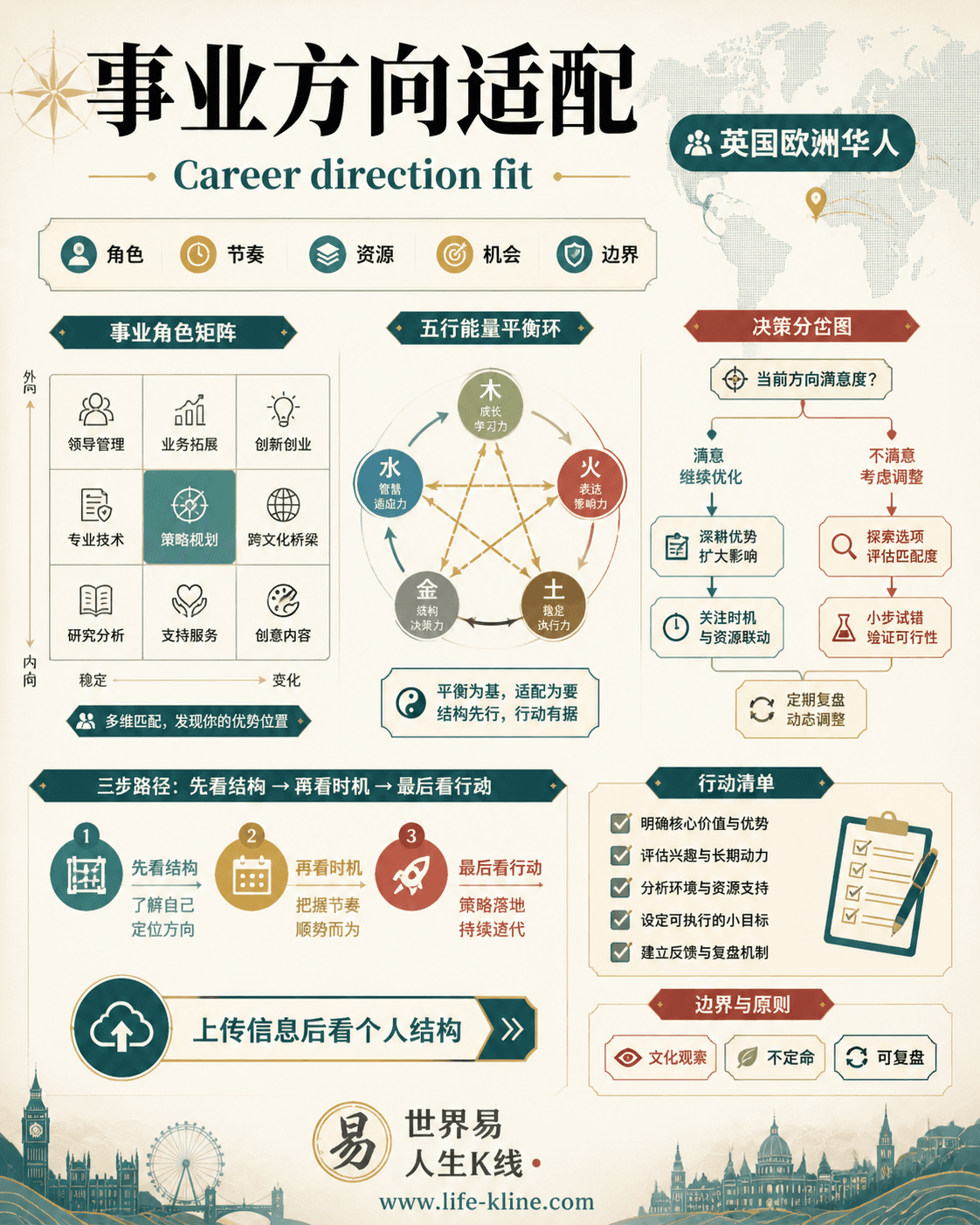
BaZi Rhythms and Key Windows Analysis for Singapore Identity Path Transitions
把这篇文章落到自己身上验证:先看结构,再进入个人分析,不做泛泛阅读。
Why This Decision Is Especially Difficult in This Destination
Singapore, as a major global international financial center and immigration hotspot, faces multiple practical challenges in identity path transitions. Firstly, although its tax-friendly environment attracts high-net-worth individuals and professionals, the high cost of living and limited public housing policies increase pressure on quality of life assurance. Secondly, Singapore’s approval policies for EP (Employment Pass), PR (Permanent Resident), and citizenship are gradually tightening, with higher application thresholds and longer processing times, resulting in increased uncertainty in identity transitions.
In terms of education and healthcare, Singapore offers abundant resources but intense competition. Families must consider their children’s educational planning during the identity transition process, creating dual pressures on applicants' finances and time management. Psychologically, applicants often hope to stabilize their status quickly to gain better benefits, but policy fluctuations can easily trigger anxiety and poor decision-making.
Within this complex environment, BaZi structures provide a rhythmic auxiliary reference. Especially by observing combinations of wealth stars (Cai Xing), resource stars (Yin Xing), and the traveling horse star (Yi Ma), applicants can be alerted to potential critical timing and risk points in their identity transition paths. Combined with Singapore’s policy environment, the dynamic changes in BaZi help applicants judge when it is suitable to proactively apply for PR and when to maintain their current status, avoiding increased costs caused by blind actions.
Therefore, the difficulty in decision-making for Singapore identity paths lies in accurately grasping the transition rhythm amid policy tightening, balancing living costs and educational needs, while being vigilant to risk signals indicated by BaZi, to achieve rational and stable migration planning.
Three Core Dimensions of BaZi Judgment
The relationship between the Day Master (Ri Zhu) and the traveling horse star (Yi Ma) is a key dimension in judging migration willingness and initiative. The Yi Ma star represents mobility and opportunities for change. In Singapore’s identity path, if the Yi Ma star is active in the BaZi chart, it often indicates strong motivation and timing for applicants during the stages of work visa to PR or PR to citizenship. However, this must be assessed in conjunction with the Liu Nian (annual fortune) and Da Yun (decade luck cycle) to evaluate stability.
The wealth star (Cai Xing) is closely related to the ability to earn wealth in a foreign land. Although Singapore is tax-friendly, the high cost of living means those with strong Cai Xing are better suited to proactively expanding their careers and investments, supporting the financial strength required for identity conversion. The presence of Bi Jian (competing peers star) warns of competitive pressure and resource contention among peers, necessitating careful management of workplace and interpersonal relationships to avoid risks in identity applications caused by rivalry.
The official and killing stars (Zheng Guan and Qi Sha) are closely linked to pressures from foreign identity status. These stars represent authority and policy pressure. If the BaZi chart shows strong Zheng Guan and Qi Sha stars and the Liu Nian or Da Yun clash with these stars, it indicates the applicant may face policy restrictions or approval obstacles during identity transitions. The resource stars (Yin Xing) represent assistance and resource support; when strong, they facilitate steady progress in identity conversion and reduce external resistance.
Finally, the clash and harmony relationships in Liu Nian and Da Yun reveal critical windows in the identity path. Harmonious combinations indicate suitable timing for active action, whereas clashes or punishments suggest caution, waiting, or strategy adjustment. By integrating the chart’s Yong Shen (favorable elements) and Ji Shen (unfavorable elements), a dynamic decision-making framework is formed to assist applicants in reasonably scheduling their identity transition rhythm.
Three Real BaZi Chart Cases
Case 1: Female, aged 20-25, Day Master Geng (庚, Metal), relatively strong, with a Yang Ren (Yang Blade) pattern. Yong Shen are Fire and Wood; Ji Shen is Earth. Currently in the 10th year of the Ren Xu (壬戌) Da Yun, with Liu Nian Bing Wu (丙午). The Geng Metal Day Master is relatively strong; the Yang Ren pattern indicates decisiveness and strong initiative. The Ren Xu Da Yun is stable, suitable for maintaining status. The Bing Wu Liu Nian’s Fire element (Yong Shen) generates Earth, harmonizing the Day Master. Considering the Singapore EP to PR path, the Yang Ren pattern and Yong Shen Fire and Wood suggest strong motivation and execution power during the work visa stage. However, the Ji Shen Earth represents risks from policy tightening, especially public housing restrictions and rising approval thresholds, reminding that the transition window must be precisely grasped to avoid increased costs from blind acceleration. It is recommended that this applicant mainly maintain status during the Ren Xu Da Yun and actively push PR applications during years when Yong Shen Fire and Wood are strong, combined with professional immigration advice to ensure funds and compliance before action.
Case 2: Male, aged 50-55, Day Master Ren (壬, Water), relatively weak, with a Zheng Yin (Proper Resource) pattern. Yong Shen is Fire; Ji Shen is Wood. Currently in the 3rd year of Bing Shen (丙申) Da Yun, with Liu Nian Bing Wu (丙午). The Ren Water Day Master is relatively weak; the Zheng Yin pattern reflects strong resource support and learning ability. The Bing Shen Da Yun is auspicious, and the Bing Wu Liu Nian aligns well, with Fire as Yong Shen restraining the Ji Shen Wood, beneficial for dispelling career obstacles. This chart suits leveraging resource advantages in Singapore’s identity path, especially through family office or high-end investor immigration routes, to promote identity transition. The resource stars enhance the possibility of applying for PR or even citizenship, but the Ji Shen Wood warns of hidden competition and complex approvals amid policy tightening. It is advised to seize the transition window during the Bing Shen Da Yun and Bing Wu Liu Nian, coordinating with professional legal and tax planning to arrange funds and identity structures properly, avoiding approval delays or financial strain caused by Ji Shen Wood.
Case 3: Female, aged 25-30, Day Master Ren (壬, Water), relatively strong, with a Yang Ren pattern. Yong Shen and Ji Shen are both Metal. Currently in the 9th year of Xin Hai (辛亥) Da Yun, with Liu Nian Bing Wu (丙午). The Ren Water Day Master is relatively strong; the Yang Ren pattern indicates strong initiative and ambition. The Xin Hai Da Yun is auspicious, and the Bing Wu Liu Nian is favorable. Having both Yong Shen and Ji Shen as Metal means this chart has internal and external contradictions in the identity path, requiring Metal’s assistance but also caution against risks from Metal’s excess. In Singapore’s identity transition, the Yang Ren pattern combined with the Yi Ma star suggests active attempts during the work visa to PR stage. However, the Ji Shen Metal warns of possible policy restrictions or liquidity issues. It is recommended that this applicant steadily advance identity conversion during the peak of the Xin Hai Da Yun with financial planning, pausing or adjusting plans when Ji Shen Metal effects arise, to avoid failures or extra costs caused by excessive aggressiveness.
All three cases emphasize the interaction between BaZi rhythms and Singapore identity paths, reminding applicants to combine policy environments and legal-tax advice to rationally judge the best timing and potential costs of identity transitions.
Common Misjudgments and Blind Spots in This Destination
Many applicants mistakenly believe that as long as they have sufficient funds and stable careers, their Singapore identity path transition will proceed smoothly, neglecting policy dynamics and approval details. In reality, policy tightening leads to stricter approvals, and blindly accelerating applications may cause delays or even rejections, increasing time and financial costs.
From a BaZi perspective, ignoring the interaction between Liu Nian, Da Yun, and Yong Shen/Ji Shen is a major blind spot. Some applicants fail to align their actions with their BaZi rhythms, missing optimal windows or acting rashly under strong Ji Shen influence, resulting in blocked identity transitions or unexpected risks.
Another misjudgment is neglecting the importance of mental and psychological adjustment during identity transitions. The uncertainty and pressure brought by transitions, if not properly managed, can affect the applicant’s overall fortune and family stability, indirectly impacting immigration outcomes.
Finally, BaZi is only an auxiliary tool. Blind reliance on BaZi without considering professional legal, tax, and visa advice can easily lead to difficulties. Cross-border migration involves complex compliance; BaZi insights must be synchronized with professional plans to achieve stable identity path transitions.
Practical Judgment Sequence
Step one: Combine your BaZi Day Master strength, Yong Shen, and Ji Shen to clarify whether the current Da Yun and Liu Nian are harmonious, judging if you are in a suitable rhythm window to advance identity transitions. Actively prepare documents during harmonious periods; cautiously assess risks and consider delaying applications when Ji Shen is strong.
Step two: Thoroughly review Singapore’s policy environment, including EP renewal difficulty, PR application thresholds, citizenship requirements, public housing restrictions, and education and healthcare support. Combine these with BaZi-indicated risk points to formulate phased migration plans, avoiding blind crossing of policy red lines.
Step three: Collaborate with professional immigration, legal, tax, and financial advisors to ensure funds are legal and compliant, optimize taxes, and complete visa procedures. Use BaZi rhythms as auxiliary references to remind applicants to adjust action rhythms during critical Liu Nian and Da Yun, strengthen psychological adjustment, and improve identity transition success rates.
In summary, it is recommended that applicants use BaZi rhythms as an auxiliary tool to identify windows, combined with policy interpretation and professional planning, to seek steady progress, guard against hidden costs in the transition path, and ultimately achieve smooth identity conversion.
FAQ
Question 1: Can BaZi determine exactly when I will obtain Singapore PR? Answer: BaZi mainly provides rhythmic references, indicating potentially favorable or risky timings, but cannot guarantee absolute outcomes. Identity applications still require consideration of policies, funds, and legal factors; BaZi is only an auxiliary decision-making tool.
Question 2: If my chart’s Ji Shen aligns with Singapore’s policy risks, should I abandon the application? Answer: Ji Shen indicates potential risks; it is recommended to adjust application strategies and timing with professional consultation and proceed cautiously rather than giving up. Through reasonable planning and resource integration, identity transitions are still possible.
Question 3: How to use BaZi to judge if it is suitable to apply for citizenship directly from EP? Answer: The identity path generally recommends gradual progression. When the Yi Ma and resource stars are active in BaZi, accelerating steps may be considered, but only after obtaining PR status and with supportive Liu Nian and Da Yun. Otherwise, direct citizenship application carries higher risks and should be advanced steadily.
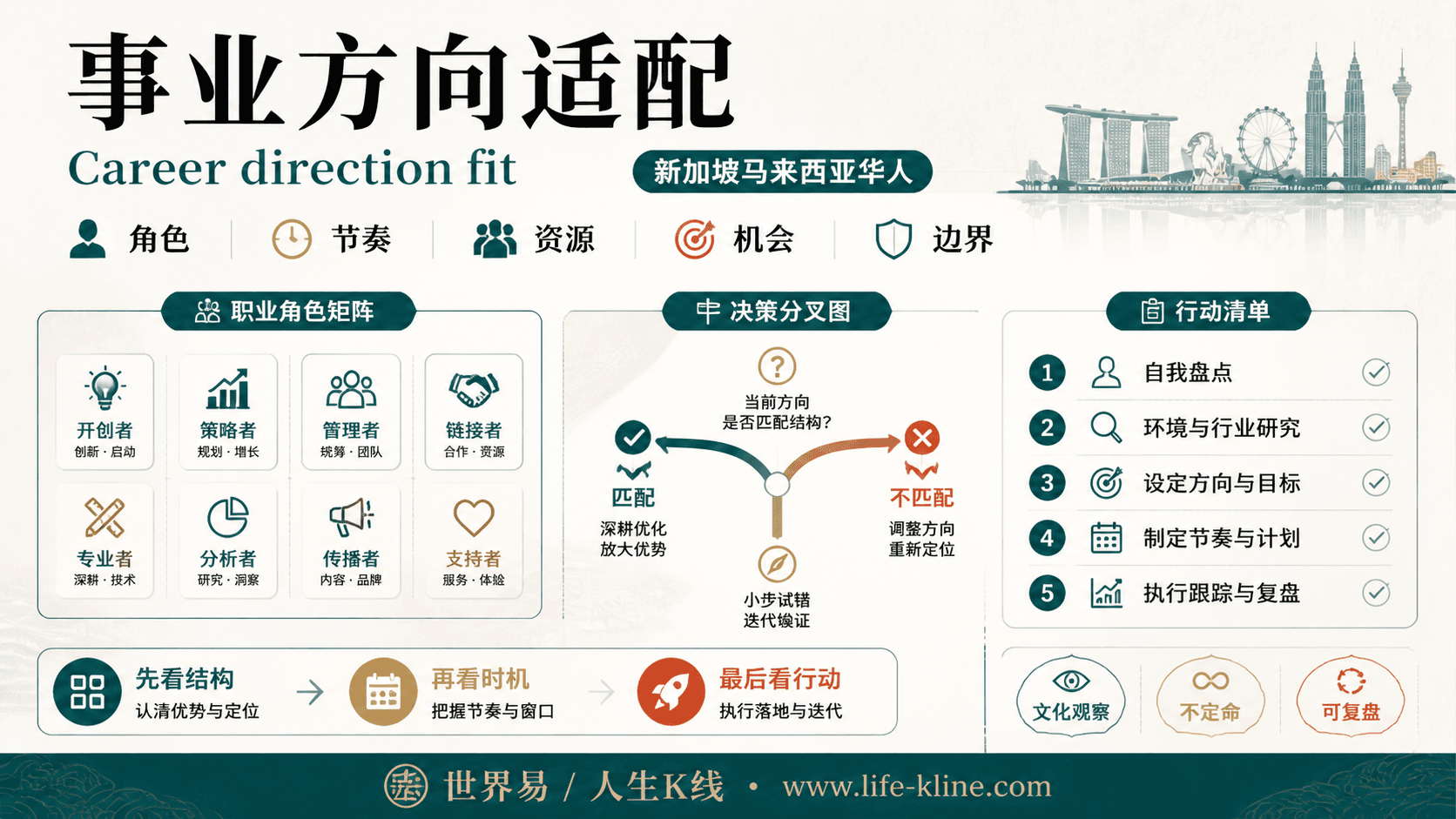
事业方向适配|新加坡马来西亚华人
这张图把《BaZi Rhythms and Key Windows Analysis for Singapore Identity Path Transitions》里的命理概念转成关系、边界和应用场景,适合先看图建立结构,再回到知识文章正文理解细节。
事业方向适配不应被写成固定结论。更适合新加坡马来西亚华人的读法,是把传统术语翻译成结构、时机、环境、行动和复盘。
查看图片解读