Tian Yi Gui Ren: Analysis of the Premier Auspicious Deity and Its Supportive Role in Fate
把这篇文章落到自己身上验证:先看结构,再进入个人分析,不做泛泛阅读。
Concept Definition
Tian Yi Gui Ren is one of the most important Shen Sha (spiritual stars) in Chinese metaphysics, regarded as the premier auspicious deity specifically representing the auspicious power of nobleman support. Its core function is to help the Day Master receive assistance from noble people in life and career, resolving difficulties and bringing smoothness and good fortune.
According to fate rules, Tian Yi Gui Ren is derived by matching the Day Master’s Heavenly Stem to corresponding Earthly Branches. The specific rule is: Jia (甲) and Wu (戊) Day Masters correspond to Chou (丑) and Wei (未) Earthly Branches; Yi (乙) and Ji (己) correspond to Zi (子) and Shen (申); Bing (丙) and Ding (丁) correspond to You (酉) and Hai (亥); Geng (庚) and Xin (辛) correspond to Wu (午) and Yin (寅); Ren (壬) and Gui (癸) correspond to Mao (卯) and Si (巳). This correspondence determines the position of Tian Yi Gui Ren in the natal chart.
When Tian Yi Gui Ren appears, it usually indicates that the Day Master is likely to receive nobleman assistance, helping to turn misfortune into fortune and transform danger into safety. However, if it encounters Kong Wang (Void) or Xing Chong (Punishment and Clash), the auspicious effect of Tian Yi Gui Ren will be weakened or even nullified.
Fate Characteristics and Symbolic Meaning
As the premier auspicious deity, Tian Yi Gui Ren symbolizes that the Day Master can receive nobleman support at critical moments and have someone to assist when facing difficulties. It concretely manifests the 'nobleman luck' in fate. The presence of this auspicious deity often makes the Day Master’s life path smoother and reduces obstacles.
Within the Five Elements and Yin-Yang system, Tian Yi Gui Ren’s function is reflected through the combination of the Day Master’s Heavenly Stem and specific Earthly Branches, representing the interaction between the person and environment as well as the supportive factors in destiny. It not only symbolizes external help but also represents the Day Master’s ability to seize opportunities at crucial times.
However, Tian Yi Gui Ren is most averse to Kong Wang (Void) or Xing Chong (Punishment and Clash). These two conditions weaken the power of nobleman support. Kong Wang means the noble star cannot exert its influence, while Xing Chong represents conflict and destruction, both negatively impacting Tian Yi Gui Ren’s positive role.
Practical Configuration and Interpretation
In practical fate interpretation, the first step to determine the position of Tian Yi Gui Ren is to find the corresponding Earthly Branch based on the Day Master’s Heavenly Stem. For example, if the Day Master is Jia (甲) or Wu (戊), Tian Yi Gui Ren falls on Chou (丑) or Wei (未); if Yi (乙) or Ji (己), it corresponds to Zi (子) or Shen (申). If these Earthly Branches appear in the natal chart without Xing Chong or Kong Wang, Tian Yi Gui Ren is considered present.
For instance, if a person’s Day Master is Yi (乙) and the natal chart contains the Shen (申) Metal Earthly Branch, then Shen is Tian Yi Gui Ren. This indicates the person has nobleman assistance and is likely to receive help when facing difficulties, leading to career success. However, if the Shen Earthly Branch is afflicted by Clash or Punishment, the nobleman luck is affected and must be analyzed together with other fate factors.
Moreover, the presence of Tian Yi Gui Ren positively influences the Day Master’s career, marriage, health, and other aspects, especially playing a role in turning adversity into safety. Therefore, in practice, attention should be paid to the activity of Tian Yi Gui Ren and whether it encounters Xing Chong or Kong Wang.
Common Misconceptions
Many people mistakenly believe that the mere presence of Tian Yi Gui Ren guarantees great fortune. In fact, Tian Yi Gui Ren is most averse to encountering Kong Wang (Void) or Xing Chong (Punishment and Clash). These adverse factors weaken or even negate its auspicious effect, so one cannot simply regard its presence as wholly auspicious.
Another misconception is ignoring the correspondence between Tian Yi Gui Ren and the Day Master’s Heavenly Stem. Incorrect identification of the Earthly Branch leads to errors in determining Tian Yi Gui Ren’s position, thereby affecting the accuracy of fate analysis. Correct application of the rules is the premise for understanding the function of Tian Yi Gui Ren.
FAQ
Question: How is Tian Yi Gui Ren determined? Answer: Tian Yi Gui Ren is determined by finding the corresponding Earthly Branch based on the Day Master’s Heavenly Stem. For example, Jia (甲) and Wu (戊) Day Masters correspond to Chou (丑) and Wei (未) Earthly Branches; Yi (乙) and Ji (己) correspond to Zi (子) and Shen (申); Bing (丙) and Ding (丁) correspond to You (酉) and Hai (亥); Geng (庚) and Xin (辛) correspond to Wu (午) and Yin (寅); Ren (壬) and Gui (癸) correspond to Mao (卯) and Si (巳).
Question: What happens if Tian Yi Gui Ren encounters Kong Wang or Xing Chong? Answer: Kong Wang (Void) and Xing Chong (Punishment and Clash) weaken the auspicious effect of Tian Yi Gui Ren, reducing the power of nobleman support. This makes it difficult for the Day Master to receive the expected help and the effect of turning adversity into safety.
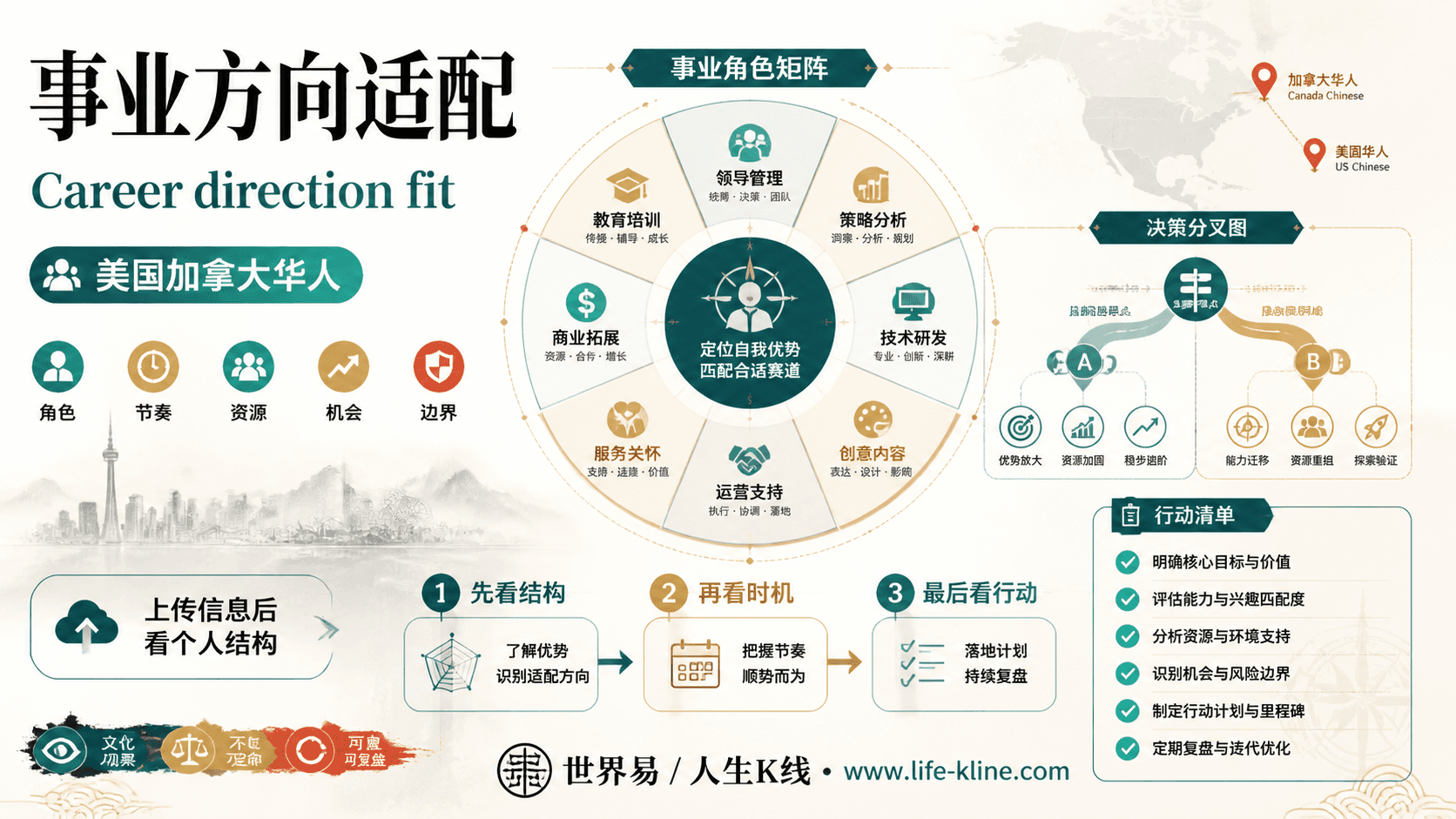
事业方向适配|美国加拿大华人
这张图把《Tian Yi Gui Ren: Analysis of the Premier Auspicious Deity and Its Supportive Role in Fate》里的命理概念转成关系、边界和应用场景,适合先看图建立结构,再回到知识文章正文理解细节。
事业方向适配不应被写成固定结论。更适合美国加拿大华人的读法,是把传统术语翻译成结构、时机、环境、行动和复盘。
查看图片解读