Detailed Explanation of Hua Gai Shen Sha: Symbol of Artistic Talent and Religious Affinity
把这篇文章落到自己身上验证:先看结构,再进入个人分析,不做泛泛阅读。
Concept Definition
Hua Gai is a type of Shen Sha in metaphysics characterized by artistic, religious, and solitary qualities. According to metaphysical principles, the formation of Hua Gai depends on specific Earthly Branch (Di Zhi) combinations, specifically Shen (申, Shen)-Zi (子, Zi)-Chen (辰, Chen) with Chen as Hua Gai; Yin (寅, Yin)-Wu (午, Wu)-Xu (戌, Xu) with Xu as Hua Gai; Si (巳, Si)-You (酉, You)-Chou (丑, Chou) with Chou as Hua Gai; and Hai (亥, Hai)-Mao (卯, Mao)-Wei (未, Wei) with Wei as Hua Gai. This rule defines which Earthly Branches in a natal chart can form the Hua Gai Shen Sha.
In metaphysics, Hua Gai often symbolizes an individual's artistic talent and religious affinity, manifesting a unique solitary and lofty temperament. This Shen Sha is commonly seen among scholars, artists, and spiritual practitioners, reflecting their profound inner world and pursuit of the spiritual realm.
Additionally, Hua Gai implies that the Day Master may have tendencies toward late marriage or solitary living. This sense of solitude is both an expression of inner cultivation and a distinctive lifestyle. Overall, Hua Gai is one of the most symbolically rich Shen Sha in metaphysics.
Metaphysical Characteristics and Symbolic Meaning
The artistic attribute of Hua Gai is reflected in the Day Master’s strong creativity and aesthetic ability, often possessing talent or unique insights in artistic fields. Its religious nature indicates that the Day Master may have a deep interest in religion, philosophy, or spiritual cultivation, seeking inner peace and transcendence.
Solitude is a key symbol of Hua Gai, meaning the Day Master’s personality tends to be independent and introverted, preferring solitude or late marriage, with a lifestyle that is more self-contained and reserved. This solitude is not mere loneliness but a manifestation of a rich inner world and strong spiritual pursuit.
In metaphysics, Hua Gai is more than just a natal chart characteristic; it is a spiritual symbol representing the Day Master’s distinctive temperament and life trajectory. Its unique nature often enables those with Hua Gai to demonstrate extraordinary artistic talent and profound religious insight throughout their lives.
Practical Configuration and Interpretation
The appearance of Hua Gai in a natal chart must comply with the rules of Shen-Zi-Chen with Chen as Hua Gai; Yin-Wu-Xu with Xu as Hua Gai; Si-You-Chou with Chou as Hua Gai; and Hai-Mao-Wei with Wei as Hua Gai. For example, if the Earthly Branches include Shen, Zi, and Chen forming a San He (Three Harmony) with Chen as Hua Gai, or Yin, Wu, and Xu forming a San He with Xu as Hua Gai, then Hua Gai Shen Sha can be identified.
Common Hua Gai combinations, such as the presence of the Shen-Zi-Chen San He with Chen as Hua Gai, often indicate that the Day Master achieves high accomplishments in artistic creation or academic research, with a personality that is quiet and introverted, suitable for professions requiring independent thinking.
Similarly, in the Yin-Wu-Xu combination with Xu as Hua Gai, the Day Master often has religious affinity or a tendency toward spiritual cultivation, possibly placing more emphasis on spiritual life in later years, with late marriage or solitary living as common life states. Through these combinations, metaphysicians can accurately assess Hua Gai’s influence on the Day Master’s life and personality.
Common Misconceptions
Many mistakenly believe Hua Gai only represents loneliness or social alienation. In fact, Hua Gai emphasizes a kind of lofty solitude and inner spiritual pursuit rather than simple social difficulties. The solitude of Hua Gai is at the spiritual level, reflecting focus on art and religion.
Another misconception is ignoring the combination rules of Hua Gai and erroneously identifying certain Earthly Branches individually as Hua Gai. Hua Gai must strictly conform to the Shen-Zi-Chen with Chen as Hua Gai; Yin-Wu-Xu with Xu as Hua Gai; Si-You-Chou with Chou as Hua Gai; and Hai-Mao-Wei with Wei as Hua Gai combination rules to exert its true metaphysical effect.
FAQ
Question: In which aspects is Hua Gai Shen Sha mainly manifested? Answer: Hua Gai mainly manifests in personal artistic talent, religious affinity, and solitary personality, commonly seen in scholars, artists, and spiritual practitioners, expressing independence and spiritual pursuit.
Question: How to determine if Hua Gai is present in a natal chart? Answer: It must be based on the combination rules of Shen-Zi-Chen with Chen as Hua Gai; Yin-Wu-Xu with Xu as Hua Gai; Si-You-Chou with Chou as Hua Gai; and Hai-Mao-Wei with Wei as Hua Gai. Only when these Earthly Branch combinations are met does Hua Gai Shen Sha exist.
Question: Does Hua Gai necessarily mean late marriage? Answer: Hua Gai governs tendencies toward late marriage or solitary living, but it is not absolute. It more reflects the Day Master’s inner lofty temperament and emphasis on spiritual life.
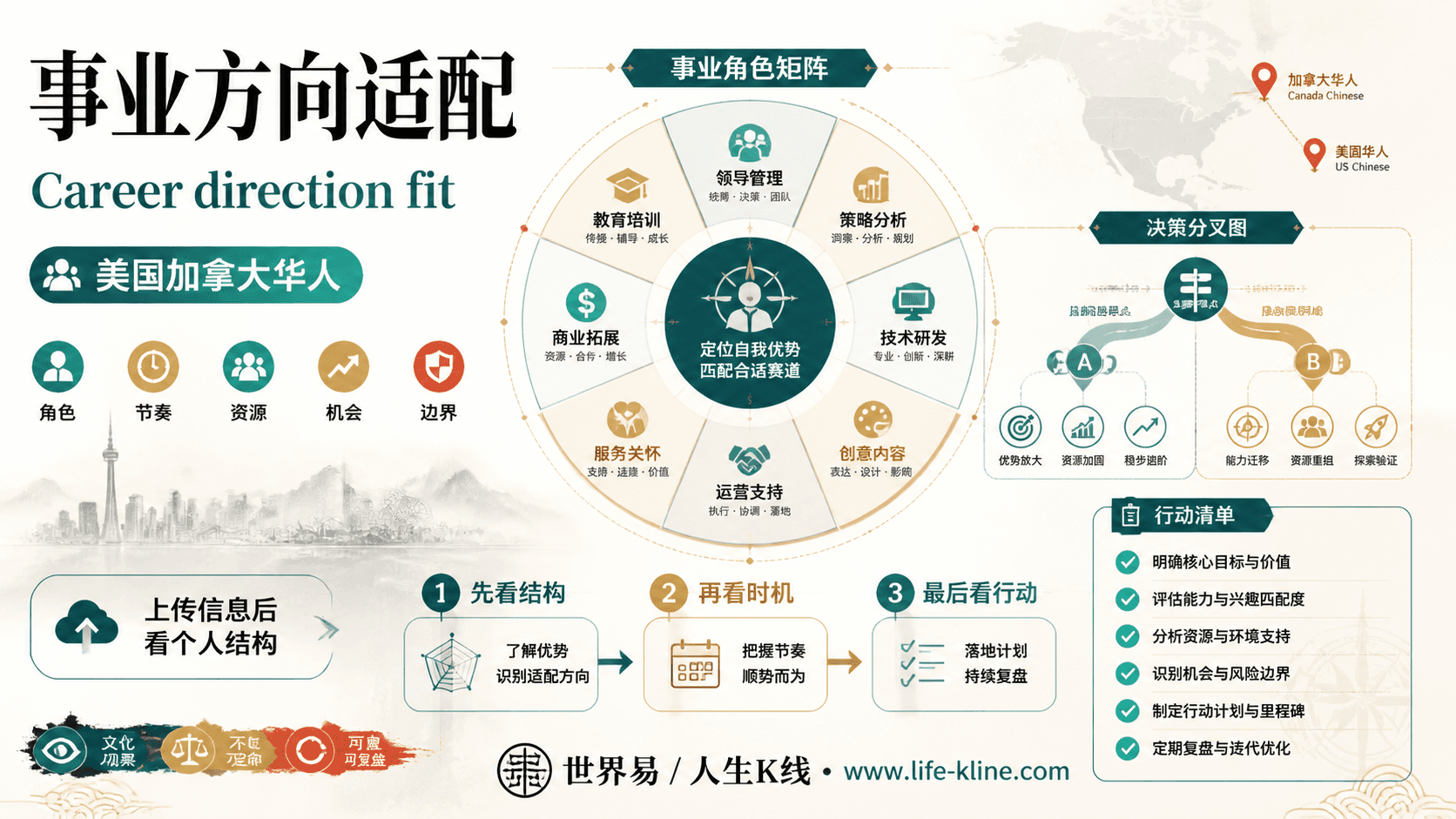
事业方向适配|美国加拿大华人
这张图把《Detailed Explanation of Hua Gai Shen Sha: Symbol of Artistic Talent and Religious Affinity》里的命理概念转成关系、边界和应用场景,适合先看图建立结构,再回到知识文章正文理解细节。
事业方向适配不应被写成固定结论。更适合美国加拿大华人的读法,是把传统术语翻译成结构、时机、环境、行动和复盘。
查看图片解读