Judging the Timing of Parental Intervention Amid Academic Anxiety: Analysis of Natal Chart Structure and Parenting Decisions
把这篇文章落到自己身上验证:先看结构,再进入个人分析,不做泛泛阅读。
Why This Decision Is Particularly Difficult in This Scenario
Academic pressure and anxiety often become the core sources of intra-family competition and mismatched capabilities. When facing their children's academic performance and psychological state, parents often hesitate between 'immediate intervention' and 'further observation.' Conflicting parent-child goals exacerbate this uncertainty, as parents hope for excellent academic results while fearing that excessive intervention might suppress their children's autonomy development.
In parenting dynamics, attachment needs and autonomy demands often exist in tension. Early parental intervention may trigger rebellion or psychological decline in children; delayed intervention might miss critical support windows, leading to accumulated anxiety. Cognitive biases such as confirmation bias cause parents to over-focus on negative signals while overlooking potential positive changes, increasing anxiety.
BaZi structure provides rhythmic auxiliary references for parenting decisions. The Day Master’s strength reflects the child’s intrinsic energy state; Yin stars (印星, representing nurturing environment protection and support), Shi Shen and Cai stars indicate the child's ability expression and external resources. The interaction of Da Yun and Liu Nian reveals current external timing pressures and opportunities, helping parents assess the risks and benefits of intervention timing.
Therefore, the difficulty of this decision lies in integrating psychological dynamics with BaZi rhythms, avoiding both over-intervention and missed timing, balancing parenting anxiety and child mental health, and preventing negative impacts caused by misjudgment.
Three Core Dimensions of BaZi Judgment
First, the relationship between the Day Master and Shi Shen (Eating God) is an important dimension to observe the child's energy output and learning performance. A relatively strong Day Master supported by Shi Shen often indicates the child has strong learning motivation and expressive ability, possibly requiring moderate freedom to support autonomous development; conversely, a weak Day Master with restricted Shi Shen may indicate capability mismatches, requiring close parental attention.
Second, the role of Yin stars (印星) is particularly critical. Yin stars represent the parental nurturing environment and attachment support. A Zheng Yin (正印) pattern usually implies the child receives good protection and nurturing, with strong psychological security, which helps alleviate academic anxiety. Bi Jian (比肩) and Jie Cai (劫财) reflect resonance and competition in the parent-child relationship, potentially intensifying internal competition pressure and anxiety, requiring parents’ keen identification.
Finally, Guan Sha (官杀) stars reflect authority and rule constraints, while the clash and combination relationships between Liu Nian and Da Yun reveal changes in the external environment. When Guan Sha is strong, the child may bear heavy rule pressure, manifesting as intensified academic anxiety. Favorable Liu Nian and Da Yun transitions aid smooth progression; adverse transitions suggest caution and avoidance of hasty decisions.
By integrating these three dimensions, parents can combine BaZi rhythms to judge the nature of their child's current academic pressure and its impact on mental health, accurately grasping the timing for intervention or waiting.
Three Real Natal Chart Cases
Case 1: The Day Master is Ji (己, Earth), relatively strong, with a Zheng Yin pattern. The Yong Shen (favorable elements) are Wood and Water; the Ji Shen (unfavorable element) is Fire. Currently in the 6th year of the Ren Xu (壬戌) Da Yun, with Bing Wu (丙午) Liu Nian. The overall Da Yun is auspicious and the Liu Nian is favorable. This structure shows the child possesses stable internal energy and good nurturing support. A strong Yin star indicates a relatively stable attachment relationship and high psychological security. Under academic pressure, the child may demonstrate self-regulation ability; parents can moderately observe and avoid premature intervention that may cause pressure rebound. However, if significant Shi Shen restriction or intense Guan Sha signals appear, timely communication is necessary to prevent anxiety accumulation. Recommended judgment sequence: first confirm the child's emotional changes, then combine with external academic environment, and intervene with psychological counseling if needed.
Case 2: The Day Master is Geng (庚, Metal), balanced, with a Pian Cai (偏财) pattern. The Yong Shen is Fire. Currently in the 2nd year of Wu Shen (戊申) Da Yun, with Bing Wu (丙午) Liu Nian; the luck is stable. Pian Cai pattern typically represents strong demand for external resources and ability expression, but the balanced Day Master means the child's internal energy and external challenges are in equilibrium. Fire as Yong Shen suggests parents should monitor whether academic pressure causes emotional fluctuations or energy depletion. Stable Da Yun advises continued observation, but vigilance is required if Bi Jian or intense Guan Sha appear, as internal competition pressure may escalate. The recommendation is to focus on observation combined with timely psychological guidance, avoiding excessive intervention that may provoke rebellion.
Case 3: The Day Master is Ding (丁, Fire), relatively strong, with a Yang Ren (羊刃) pattern. The Yong Shen are Water and Metal; the Ji Shen is Wood. Currently in the 10th year of Jia Chen (甲辰) Da Yun, with Bing Wu (丙午) Liu Nian; the Da Yun is stable. Yang Ren pattern indicates the child may have strong self-will and drive but also emotional volatility risks. Yong Shen Water and Metal point to the need for rational and emotional regulation to balance academic anxiety. Excessive Ji Shen Wood may increase psychological burden. This chart is prone to irritability or anxiety signals under academic pressure. Parents should closely monitor emotional changes and intervene immediately with professional help if emotional loss of control or self-harm tendencies arise. Recommended judgment sequence: prioritize assessing psychological health risks, intervene promptly when necessary, and coordinate with professional psychological treatment.
Common Misjudgments and Blind Spots in This Scenario
One common misjudgment is parents interpreting a relatively strong or dominant Day Master in BaZi as the child being fully capable of self-regulating academic pressure, neglecting the multidimensional manifestations of emotions and mental health, leading to delayed necessary psychological intervention.
Another blind spot is over-reliance on simple auspicious or inauspicious judgments of Liu Nian and Da Yun, ignoring individual differences and the complexity of the family nurturing environment, resulting in one-sided timing choices for intervention.
Additionally, the Bi Jian and Jie Cai relationships between parent and child are often misunderstood as mere competition, overlooking their potential emotional dependence and interaction patterns, which may exacerbate internal competition pressure and cause parents to apply inappropriate efforts, backfiring.
Finally, parents often neglect that BaZi is only a rhythmic auxiliary tool and cannot replace professional psychological counseling and family therapy. Especially when self-harm, depression, or violent tendencies appear, delaying professional intervention poses great risks.
Practical Judgment Sequence
Step one: Parents should assess the child's current internal energy and external resource match by combining the Day Master and Yong Shen states, identifying any risk signals of capability mismatch or energy depletion. This stage focuses on observation, emphasizing the child's self-regulation performance.
Step two: Focus on the expression of Yin stars and Bi Jian/Jie Cai, judging whether the parent-child attachment relationship is stable and whether internal competition pressure is escalating. If obvious parent-child conflicts or emotional fluctuations occur, timely communication should be conducted to avoid pressure accumulation.
Step three: Combine Guan Sha stars and the interaction of Liu Nian and Da Yun to evaluate changes in external environmental pressure. If Liu Nian is adverse and Guan Sha is strong, parents should be alerted to intensified academic anxiety and intervene early with professional psychological support to safeguard the child's mental health.
Throughout the judgment process, parents should avoid relying solely on BaZi conclusions for decisions, but treat BaZi as an auxiliary reference combined with professional psychological counseling, family therapy, and other means to form a multidimensional parenting support system.
FAQ
Question 1: How does BaZi assess the severity of academic anxiety? Answer: Mainly through the interaction of Day Master strength, Shi Shen, and Guan Sha to judge the child's internal energy and external pressure, while Yin star strength reflects nurturing support. Severe anxiety often accompanies restricted Shi Shen or strong Guan Sha and insufficient Yin stars, indicating the need for timely intervention combined with professional psychological support.
Question 2: Can BaZi replace psychological counseling and family therapy? Answer: No. BaZi is only a rhythmic auxiliary tool that helps grasp intervention timing and risk assessment; it cannot replace professional psychological counseling and therapy. In cases of self-harm, depression, or violence, professional help should be prioritized.
Question 3: What if BaZi shows auspicious Da Yun but the child is still anxious? Answer: Auspicious Da Yun means the external environment is favorable but does not guarantee the child is free from psychological pressure. Parents should pay attention to emotional changes, communicate timely, and combine professional guidance to avoid neglecting potential mental health issues.
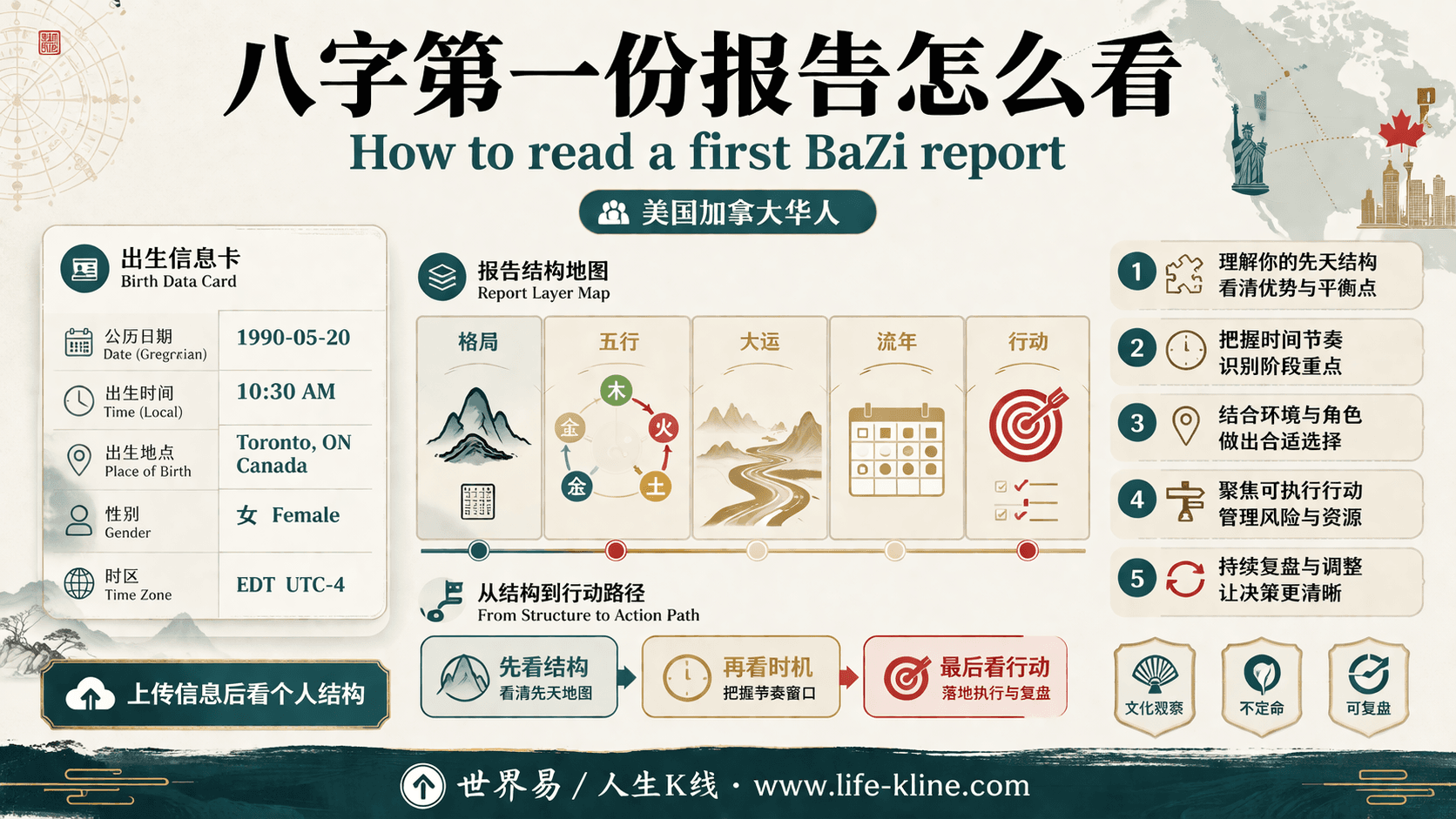
八字第一份报告怎么看|美国加拿大华人
这张图把《Judging the Timing of Parental Intervention Amid Academic Anxiety: Analysis of Natal Chart Structure and Parenting Decisions》里的命理概念转成关系、边界和应用场景,适合先看图建立结构,再回到知识文章正文理解细节。
八字第一份报告怎么看不应被写成固定结论。更适合美国加拿大华人的读法,是把传统术语翻译成结构、时机、环境、行动和复盘。
查看图片解读