Metaphysical Assistance Analysis of Strict Discipline and Empowered Companionship under Academic Anxiety
把这篇文章落到自己身上验证:先看结构,再进入个人分析,不做泛泛阅读。
Why This Decision Is Especially Difficult in This Scenario
Academic anxiety and study pressure are common and serious psychological burdens in contemporary families. Parents often vacillate between strict discipline and empowered companionship. The competitive pressure (内卷, neijuan) leads parents to impose rigid boundaries to control their children’s studies. However, mismatches in children’s abilities and their need for autonomy often cause excessive control to exacerbate conflicts, resulting in parent-child goal clashes.
From the perspective of parenting psychodynamics, parents expect to guide their children through authority but also worry that excessive intervention may harm the child’s mental health and self-identity. Academic anxiety often triggers anxiety transmission; if children perceive their parents as overly rigid, attachment disorders or rebellious psychology may arise, further increasing the risk of psychological decline.
In metaphysics, Qi Sha (Seven Killings) symbolizes authority and discipline, Yin Stars represent attachment and support, and Bi Jian reflects peer competition and autonomy. The combination and strength relationships of these three mirror the balance of authority intensity and emotional support in parent-child interactions, directly influencing the suitability of strict discipline or flexible companionship.
Moreover, Da Yun (decade luck cycles) and Liu Nian (annual fortune) changes reflect the rhythm fluctuations of the family environment. Certain periods are suitable for maintaining stability, while others require adaptive responses to avoid rigid parenting decisions and prevent the accumulation of psychological health risks. Overall, this decision requires multidimensional weighing to prevent children from being overwhelmed by competitive pressure while maintaining family order and parent-child trust.
Three Core Dimensions of Metaphysical Judgment
First, the Day Master (日主) and Shi Shen (食神, Eating God) represent the child’s personality and desire for expression. The strength of the Day Master affects the child’s psychological endurance and autonomy needs, while Shi Shen reflects creativity and emotional expression. A relatively weak Day Master often requires more dependence and support, whereas a relatively strong Day Master desires more autonomous space. Parents should differentiate their discipline strategies accordingly.
Second, Yin Stars symbolize parental protection and attachment. A chart with strong Yin Stars indicates that the child relies more on emotional support during upbringing, and flexible companionship can effectively alleviate pressure. When Yin Stars are weak, the child is more independent, and rigid boundaries can be moderately reinforced to establish stable order but should not be excessively harsh.
Third, Qi Sha reflects authority and disciplinary power. A strong Qi Sha structure suggests the child may feel pressured under authoritative environments, so the discipline intensity must be carefully managed to avoid psychological burden. Bi Jian represents competition and cooperation among peers or within the parent-child relationship. In charts with strong Bi Jian, empowered companionship helps stimulate the child’s autonomy and stress resistance.
Finally, the interaction of Da Yun and Liu Nian reflects external environmental and psychological rhythms, corresponding to the timing for adjusting parenting strategies. Stable Da Yun periods are suitable for maintaining existing strategies, while volatile or inauspicious periods require vigilance against emotional loss of control and flexible adjustment of discipline and companionship balance. Integrating these three dimensions aids in scientifically defining the balance point between rigid boundaries and flexible companionship.
Three Real BaZi Chart Cases
Case 1: This female chart has a relatively weak Day Master 癸水 (Gui Water), with a Bi Jian (Peer) pattern. The Yong Shen (favorable element) is Fire, and the Ji Shen (unfavorable element) is Wood. She is currently in the 4th year of the 己亥 (Ji Hai) Da Yun, with the Liu Nian being 丙午 (Bing Wu). The Bi Jian pattern indicates strong self-awareness and competitiveness, but the weak Day Master suggests limited psychological endurance. Yin Stars are not strong, and Qi Sha is limited, indicating relatively insufficient attachment support and potential significant pressure from authoritative environments.
Under the background of academic anxiety, this child is more suited to flexible companionship because although she has strong self-awareness, her psychological capacity is limited. Strict discipline may trigger rebellion and psychological decline. Parents should focus on emotional support, set appropriate rigid boundaries, but avoid excessive pressure. The recommended judgment sequence is: first assess the child’s stress responses (emotions and behaviors), then adjust the ratio of companionship and discipline, and seek psychological counseling intervention if necessary.
Case 2: This female chart has a relatively strong Day Master 庚金 (Geng Metal) with a Shang Guan (伤官, Hurting Officer) pattern. The Yong Shen is Water, and the Ji Shen is Earth. She is in the 4th year of the 戊辰 (Wu Chen) Da Yun, with the Liu Nian being 丙午 (Bing Wu). The Shang Guan pattern reflects strong desire for performance and creativity. The relatively strong Day Master shows strong autonomy, but the 戊辰 Da Yun is an inauspicious period, requiring caution regarding major changes and psychological fluctuations.
The chart has a heavy Qi Sha presence and relatively insufficient Yin Stars, indicating significant authoritative pressure and limited attachment support. This structure tends to provoke rebellion due to strict parental discipline under enrollment anxiety and may also restrict the child’s ability if empowerment is insufficient. The comprehensive parenting strategy should balance rigid boundaries with moderate empowerment, closely monitor stress signs and parent-child conflicts, and adjust discipline intensity as needed with open communication.
The suggested judgment sequence is to confirm the child’s autonomy expression and stress endurance, monitor risks from Da Yun and Liu Nian changes, and support parent-child communication through family therapy to reduce enrollment anxiety burdens.
Case 3: This male chart has a relatively strong Day Master 壬水 (Ren Water) with a Yang Ren (羊刃, Yang Blade) pattern. The Yong Shen are Earth and Fire, and the Ji Shen is Metal. He is in the 1st year of the 辛卯 (Xin Mao) Da Yun, with the Liu Nian being 丙午 (Bing Wu). The Yang Ren pattern symbolizes strong vitality and drive. The relatively strong Day Master reflects strong autonomy and good stress resistance. The Qi Sha structure is moderate, and Yin Stars are adequate, indicating a balanced authoritative pressure and emotional support.
Under academic pressure, this child is more suited to a combination of moderate rigid boundaries and flexible companionship. Rigid boundaries can stimulate his potential, while flexible companionship ensures psychological health and attachment needs. Parents should establish clear rules while respecting the child’s autonomy to prevent excessive competitive pressure.
The specific judgment sequence is to continuously observe the child’s emotional fluctuations and behaviors, consolidate parenting strategies during stable Da Yun and Liu Nian periods, promptly adjust companionship intensity upon stress signals, and cooperate with professional psychological counseling when necessary.
Common Misjudgments and Blind Spots in This Scenario
Many parents under academic pressure easily fall into the trap of “the more control, the worse it gets,” overly relying on rigid discipline for quick results but neglecting the child’s personality and psychological endurance. This leads to intensified rebellious emotions and strained parent-child relationships. In metaphysics, a strong Qi Sha should not be simply equated with the necessity for harshness; it must be weighed alongside Yin Stars and Bi Jian.
Another blind spot is equating empowered companionship with permissiveness, ignoring that empowerment must be based on clear boundaries and trust. If the chart has weak Yin Stars but strong Bi Jian, empowerment without necessary support and guidance may cause the child to lose direction, increasing psychological health risks.
Some parents also overlook the rhythm influence of Da Yun and Liu Nian changes, keeping parenting strategies unchanged and failing to adjust discipline and companionship proportions according to timing and circumstances. This can exacerbate the child’s burden during inauspicious or stressful periods, missing intervention opportunities.
Finally, relying solely on metaphysical judgment while neglecting professional psychological counseling can lead to misjudgments. Metaphysics is only an auxiliary tool. For serious psychological issues such as self-harm, depression, or violence, professional help must be prioritized. Parenting decisions should never be entirely dependent on metaphysical conclusions.
Practical Judgment Sequence
First, parents should evaluate the child’s psychological endurance and autonomy needs based on the strength of the Day Master and chart pattern types. A weak Day Master requires more emotional attachment and support, while a strong Day Master benefits from moderate rigid boundaries to stimulate potential.
Second, combine the strength of Yin Stars and Qi Sha to judge the balance of attachment support and authoritative pressure in the current parent-child relationship. Avoid psychological burden caused by excessive Qi Sha and prevent dependency issues from weak Yin Stars.
Third, pay attention to the rhythm of the current Da Yun and Liu Nian. Stable periods are suitable for maintaining steady parenting strategies, while volatile or inauspicious periods require flexible adjustments, increasing companionship intensity or appropriately relaxing discipline boundaries to prevent psychological decline from academic pressure.
Finally, observe the child’s behavioral and emotional changes, cooperate with psychological counseling and family therapy, and make dynamic adjustments based on metaphysical references. This ensures parenting is neither overly rigid nor neglectful of necessary discipline, fostering healthy parent-child relationship development.
FAQ
Question 1: Does a strong Qi Sha in metaphysics necessarily require strict discipline? Answer: Not necessarily. Qi Sha represents authority and control, but without sufficient Yin Star support, strict discipline may increase the child’s pressure and rebelliousness. Discipline intensity should be flexibly adjusted based on Yin Stars and Day Master strength.
Question 2: Is empowered companionship suitable for all children? Answer: Empowered companionship must be based on clear boundaries and emotional support. Children with weak Day Masters or insufficient Yin Stars need more flexible companionship and emotional dependence, while children with strong Day Masters are more suitable for moderate empowerment to stimulate autonomy.
Question 3: Can metaphysics replace psychological counseling and family therapy? Answer: Metaphysics is only an auxiliary reference tool and cannot replace professional psychological counseling or therapy. For serious issues such as self-harm, depression, or violence, professional help should be sought first.
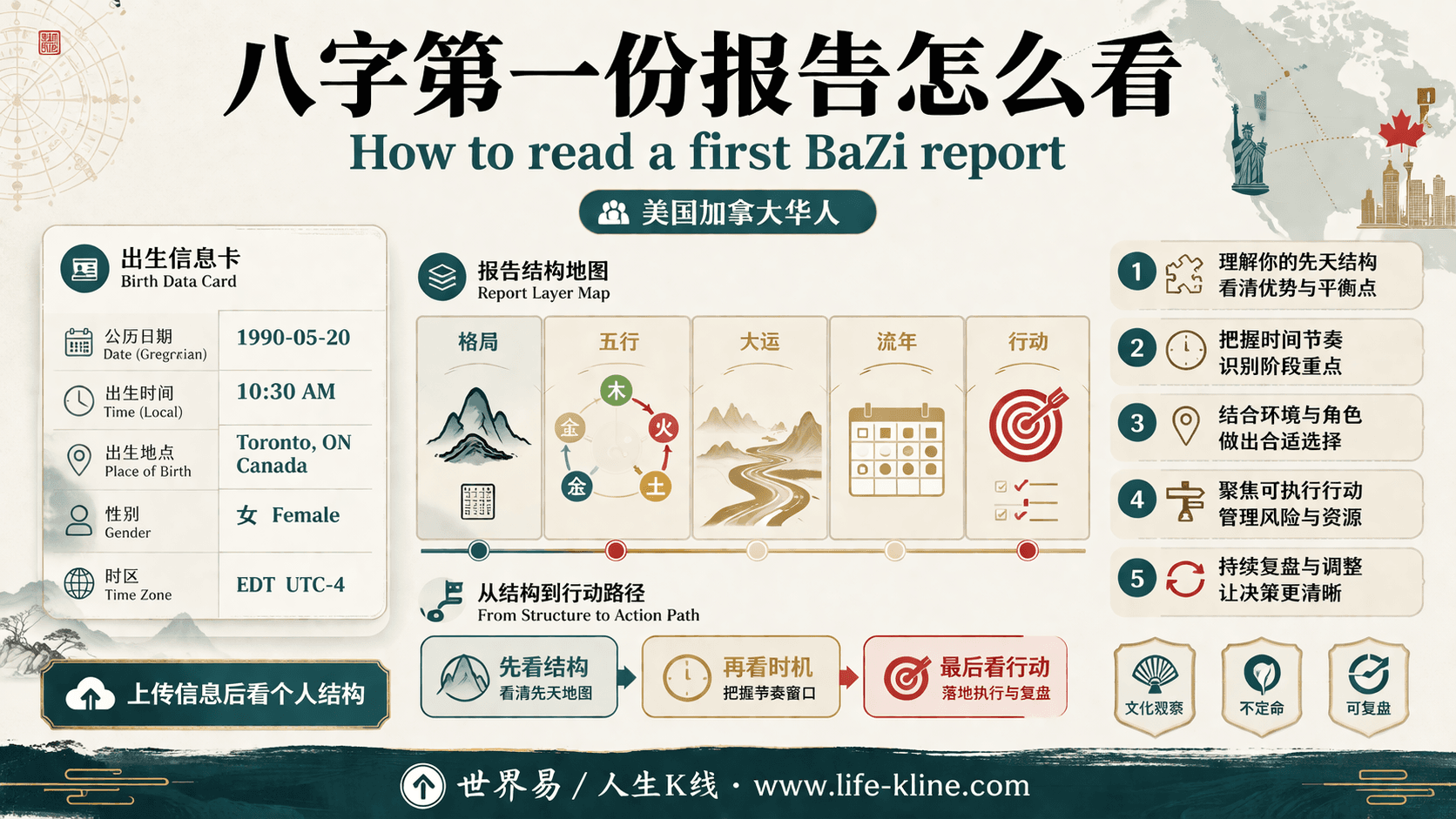
八字第一份报告怎么看|美国加拿大华人
这张图把《Metaphysical Assistance Analysis of Strict Discipline and Empowered Companionship under Academic Anxiety》里的命理概念转成关系、边界和应用场景,适合先看图建立结构,再回到知识文章正文理解细节。
八字第一份报告怎么看不应被写成固定结论。更适合美国加拿大华人的读法,是把传统术语翻译成结构、时机、环境、行动和复盘。
查看图片解读