Astrological Analysis and Practical Guide for Timing Job Changes and Career Transitions in Sales
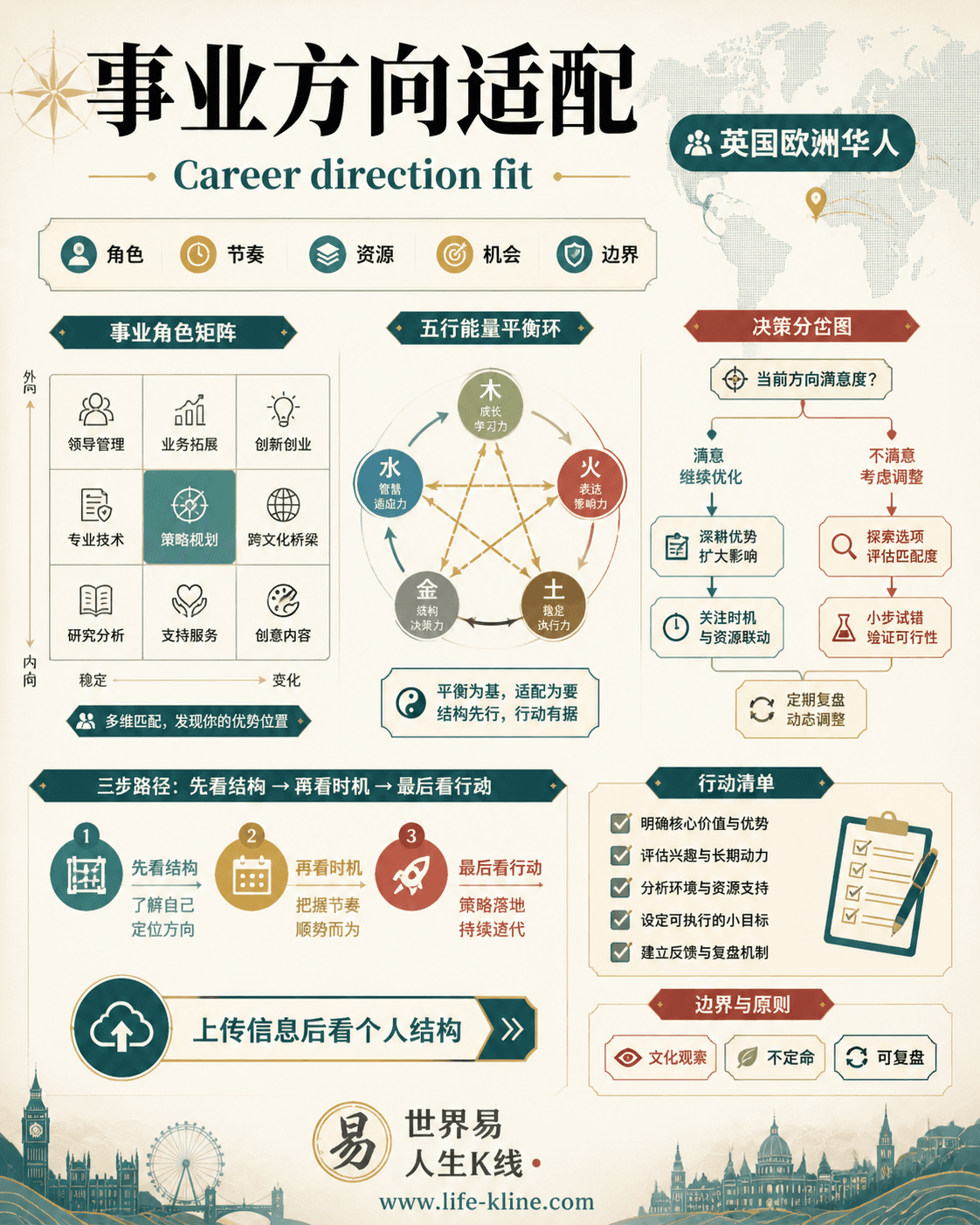
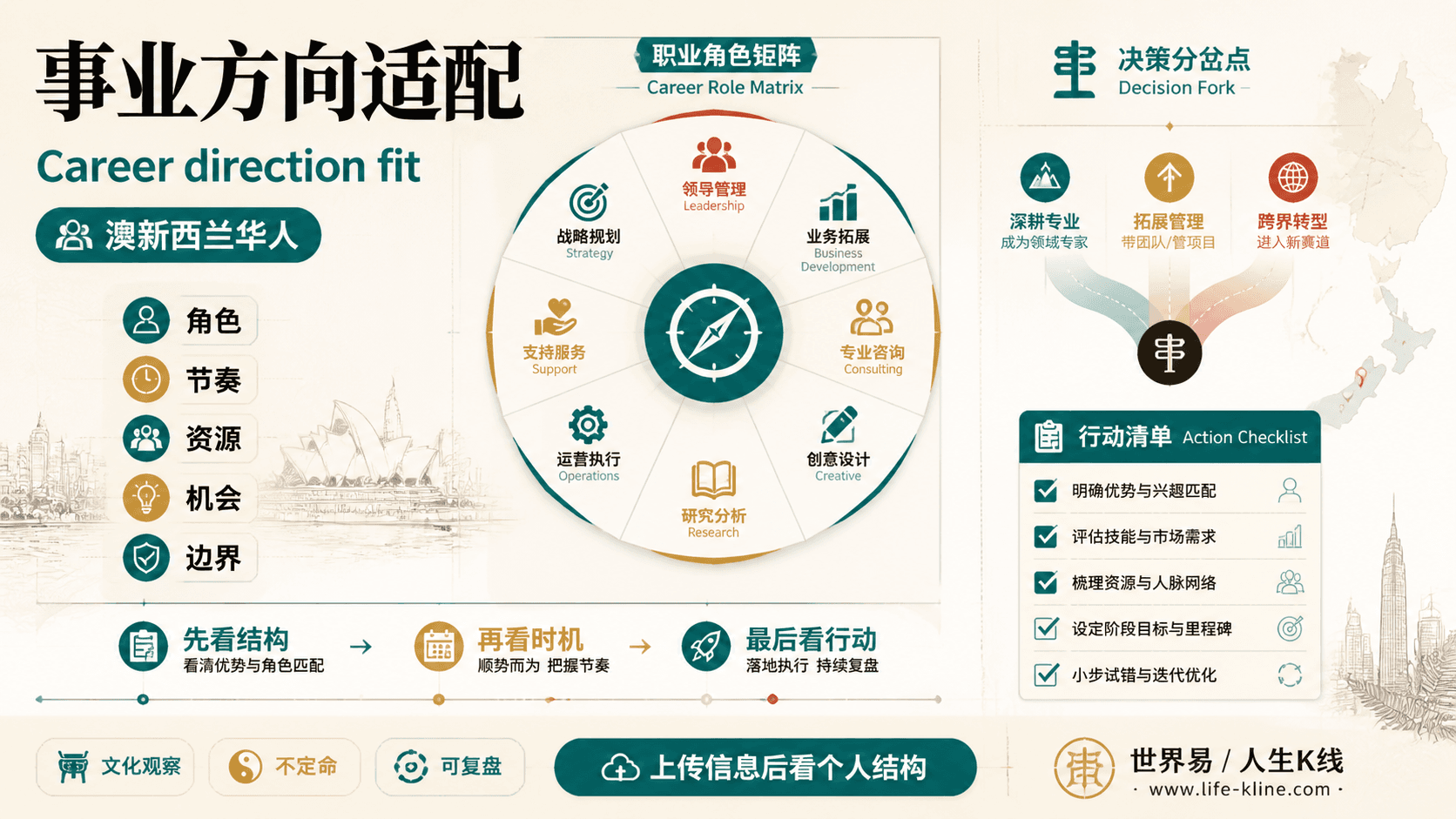
把这篇文章落到自己身上验证:先看结构,再进入个人分析,不做泛泛阅读。
Why This Decision Is Especially Difficult in This Industry
The difficulty of job changes and career transitions in the sales industry stems from its unique work pressure and income structure. Sales positions typically face strict performance targets, frequent client rejections, high interpersonal interaction demands, frequent business trips, and a fast, unstable pace. Income heavily depends on performance results and fluctuates significantly, which substantially increases the risks associated with job changes and transitions.
Moreover, the complex interpersonal relationships in sales, where client resources and team collaboration directly affect performance, mean that changing jobs or transitioning requires rebuilding networks and trust. This places high demands on personal psychology and professional adaptability. Conflicts between family and career, especially with frequent travel, further complicate decision-making.
From a BaZi perspective, the common Ten Gods main lines in sales are Zheng Cai (Direct Wealth) and Qi Sha (Seven Killings). Zheng Cai represents stable income and resource acquisition, while Qi Sha reflects intense competition and pressure. The strength of the Day Master and the configuration of Yong Shen (favorable elements) significantly influence an individual's capacity to endure and succeed during job changes and transitions.
Da Yun (decade luck cycles) and Liu Nian (annual fortune), as temporal variables, amplify or suppress the potentials and risks within the natal chart. In sales, these timing changes directly relate to performance fluctuations, client relationship shifts, and psychological states, determining whether it is suitable to act or better to hold steady. Therefore, accurately grasping the Da Yun and Liu Nian combinations is especially critical for sales professionals considering job changes or transitions.
Three Core Dimensions of Astrological Judgment
The first core dimension is the Day Master and its pattern. In sales, the strength of the Day Master reflects personal inner strength and ability to handle pressure. Day Masters that are relatively strong, such as Ren Shui (壬, Yang Water) or Jia Mu (甲, Yang Wood), usually have strong adaptability and resilience, while weaker Day Masters may face more external disturbances. Patterns like Yang Ren (羊刃格), Jie Cai (劫财格), and Zheng Cai (正财格) represent different energetic fields of drive, resource competition, and wealth accumulation, respectively, profoundly influencing sales decisions.
The second dimension is Yong Shen (favorable elements) and Ji Shen (unfavorable elements). Yong Shen represents the balancing elements needed in the chart that help the Day Master alleviate pressure and enhance energy. For example, Wood as Yong Shen supports a Water Day Master, and Water supports a Wood Day Master, promoting career success. Ji Shen are unfavorable elements in the chart that, when excessive, bring obstacles. Understanding the relationship between Yong Shen and Ji Shen guides sales professionals in choosing the right timing for transitions.
The third dimension is the interaction between Da Yun and Liu Nian. Da Yun represents environmental changes over a longer period, while Liu Nian reflects annual fortune fluctuations. A weak Da Yun combined with a Liu Nian carrying Xiong Sha (凶煞, inauspicious stars) often indicates major challenges or upheavals. Conversely, a stable Da Yun with supportive Liu Nian offers good opportunities for maintaining status or making minor adjustments. Sales personnel need to combine these two to assess risks and opportunities for job changes or transitions.
Additionally, although not elaborated here, the combinations of Ten Gods and palace (宫位) placements further refine personal strengths and weaknesses in specific charts. Considering these dimensions comprehensively provides a scientific basis for decision-making in sales job changes and career transitions.
Three Real BaZi Chart Cases
Case 1: This female sales professional has a Ren (壬, Yang Water) Day Master, relatively strong, with a Yang Ren (羊刃) pattern. Her Yong Shen is Wood, and Ji Shen is Metal. She is currently in the Xin You (辛酉) Da Yun (an unfavorable luck cycle requiring caution against major incidents) in its 10th year, with the Liu Nian being Bing Wu (丙午). The Yang Ren pattern indicates strong drive, and the relatively strong Ren Water Day Master shows good internal adaptability. However, the Xin You Da Yun is weak, and the Bing Wu Liu Nian brings additional pressure. Under the high-intensity sales rhythm, this chart suggests she must be extremely cautious about timing job changes or transitions, especially avoiding rash moves during weak Da Yun periods. It is recommended she closely observe whether the Da Yun and Liu Nian bring an increase in Wood elements, supporting her Yong Shen, before considering transitions; otherwise, she should maintain her current resources and proceed steadily.
Case 2: This male sales professional has an Yi (乙, Yin Wood) Day Master, relatively weak, with a Jie Cai (劫财) pattern. His Yong Shen is Water, and Ji Shen are Fire and Earth. He is currently in the Ji Mao (己卯) Da Yun (a stable luck cycle suitable for maintaining status) in its 9th year, with the Liu Nian being Bing Wu (丙午). The Jie Cai pattern reflects resource competition and pressure, and the weak Day Master indicates limited stress endurance. The Ji Mao Da Yun is stable, and the Bing Wu Liu Nian offers opportunities for adaptability, making it suitable to adjust strategies on the existing foundation rather than making drastic job changes. His chart advises against pursuing drastic transitions but rather consolidating networks and client resources during stable Da Yun periods, gradually exploring transition possibilities.
Case 3: This female sales professional has a Jia (甲, Yang Wood) Day Master, relatively weak, with a Zheng Cai (正财) pattern. Her Yong Shen is Water, and Ji Shen are Fire and Earth. She is currently in the Yi Chou (乙丑) Da Yun (a stable luck cycle suitable for maintaining status) in its 2nd year, with the Liu Nian being Bing Wu (丙午). The Zheng Cai pattern indicates strong wealth accumulation ability, while the weak Day Master requires Yong Shen Water to nurture it. The current Da Yun is stable, and the Bing Wu Liu Nian brings some pressure but does not disrupt the overall pattern. In the sales industry, her chart favors steady progress. Job changes or transitions should be undertaken in years when Yong Shen Water is well supported. It is recommended to prioritize observing whether the Liu Nian favors interpersonal relationships and resource accumulation, making small adjustments at appropriate times and avoiding blind risks that could cause losses.
Common Misjudgments and Blind Spots in This Industry
Sales professionals often misjudge job change and transition decisions by over-relying on short-term performance fluctuations as the basis for transitions, neglecting the long-term influence of Da Yun and Liu Nian on overall fortune. Such shortsightedness often leads to frequent job changes, which weaken the accumulation of core client resources and interpersonal networks.
Another blind spot is ignoring the balance of Yong Shen and Ji Shen. Some sales personnel fail to correctly identify the balancing elements their charts require when under pressure, leading to transitions in unsuitable years and resulting in failures or setbacks. For example, acting rashly when Ji Shen is excessive in the Da Yun often triggers major misfortunes.
Furthermore, the high-intensity interpersonal consumption and travel pace in sales greatly impact patterns like Yang Ren and Jie Cai in the chart. Many fail to adjust their work rhythm according to their BaZi characteristics, causing both psychological and physical exhaustion, which subsequently affects decision-making.
Finally, neglecting the interaction between Da Yun and Liu Nian and simply judging actions based on the annual fortune alone is a major error. The correct approach is to comprehensively analyze the trend of Da Yun together with the specific manifestations of Liu Nian, combined with personal patterns and Yong Shen, to formulate reasonable job change and transition plans.
Practical Judgment Sequence
Step one: Confirm the strength of the Day Master and the pattern type, clarifying the inherent advantages and pressure points in one’s chart. Understand Yong Shen and Ji Shen to identify which elements need support or avoidance, laying the foundation for subsequent Da Yun and Liu Nian analysis.
Step two: Combine the current Da Yun to judge whether the overall fortune trend is strong, stable, or weak. A strong Da Yun indicates an environment supportive of transitions; a weak one calls for caution. Pay special attention to whether Yong Shen is supported by the Da Yun and whether Ji Shen is suppressed.
Step three: Analyze the interaction between the current Liu Nian and Da Yun. Determine if the Liu Nian forms a supportive or conflicting relationship with the Da Yun, affecting the specific fortune of the year. If the Liu Nian strengthens Yong Shen or weakens Ji Shen, it is a good opportunity for transition; otherwise, maintaining status or waiting is advisable.
Finally, based on the above steps, make a comprehensive judgment and formulate an action plan. Allow buffer time before acting to avoid impulsiveness. It is recommended to initiate job changes or transitions in years when both Da Yun and Liu Nian are favorable and Yong Shen is strong. Conversely, when Da Yun is weak and Ji Shen is strong, one should remain in the current position, optimize internal resources, and wait for a better timing.
FAQ
Question 1: How can sales personnel judge whether the current Da Yun is suitable for taking action during a job change? Answer: First, confirm the level of support the Da Yun provides to the Day Master. If the Da Yun supports Yong Shen and suppresses Ji Shen, the overall fortune is rising and it is suitable to act. Conversely, if the Da Yun is weak and Ji Shen is strong, caution is advised to avoid major misfortunes.
Question 2: Should job changes or transitions always be avoided during Liu Nian with severe Xiong Sha (inauspicious stars)? Answer: Not necessarily, but it must be considered together with Da Yun. If the Da Yun is stable and Yong Shen is supported, flexible strategy adjustments can mitigate Liu Nian pressure. If the Da Yun is also weak, it is better to maintain status and wait for Liu Nian improvement.
Question 3: In sales careers, how can BaZi be used to judge the success rate of transitions? Answer: Focus on the strength of the Day Master, pattern type, and the balance of Yong Shen and Ji Shen, combined with analysis of Da Yun and Liu Nian trends. High success rates usually occur when both Da Yun and Liu Nian favor Yong Shen, Ji Shen is controlled, and the pattern’s energy is stable or strengthening.
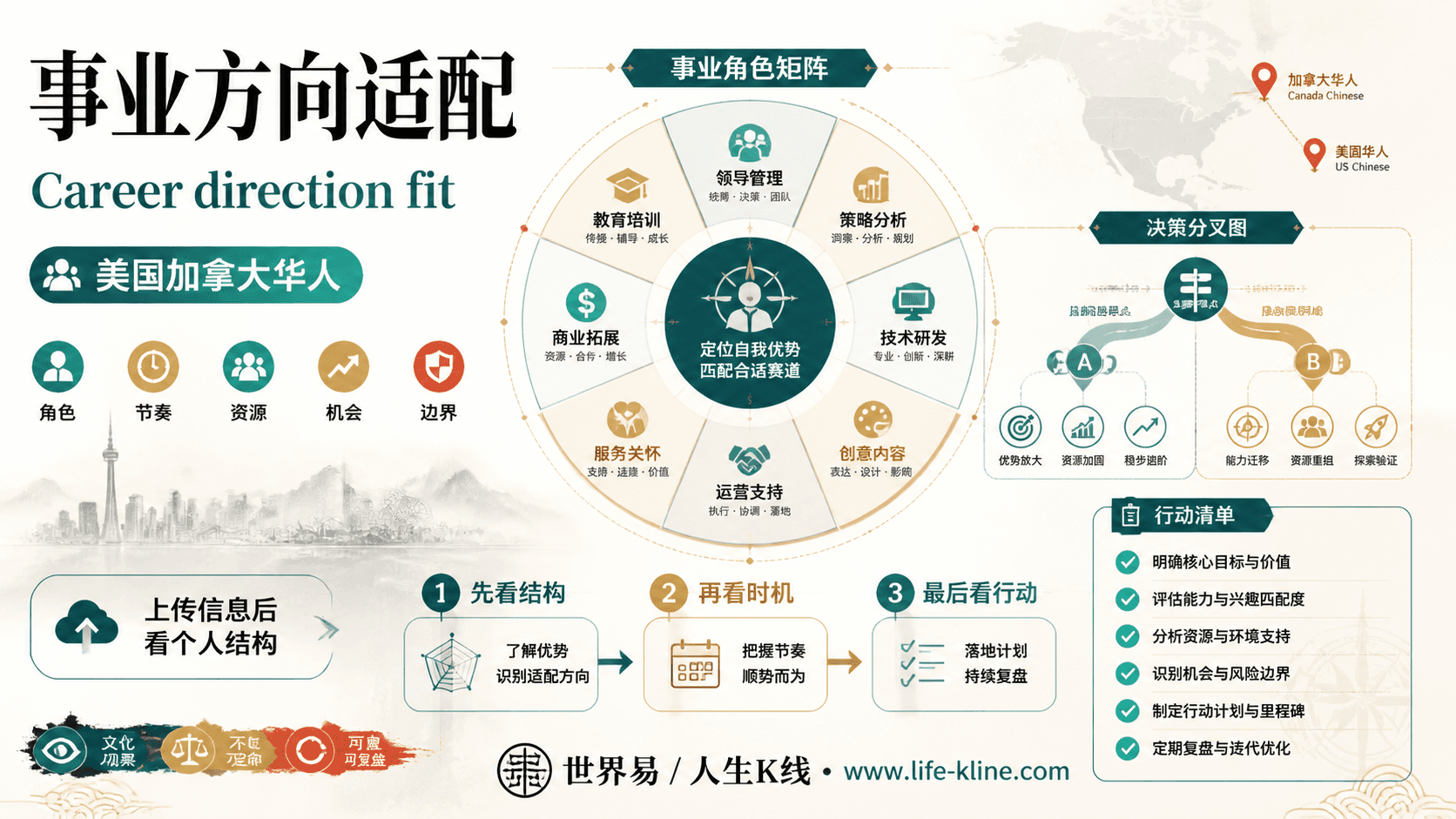
事业方向适配|美国加拿大华人
这张图把《Astrological Analysis and Practical Guide for Timing Job Changes and Career Transitions in Sales》里的命理概念转成关系、边界和应用场景,适合先看图建立结构,再回到知识文章正文理解细节。
事业方向适配不应被写成固定结论。更适合美国加拿大华人的读法,是把传统术语翻译成结构、时机、环境、行动和复盘。
查看图片解读