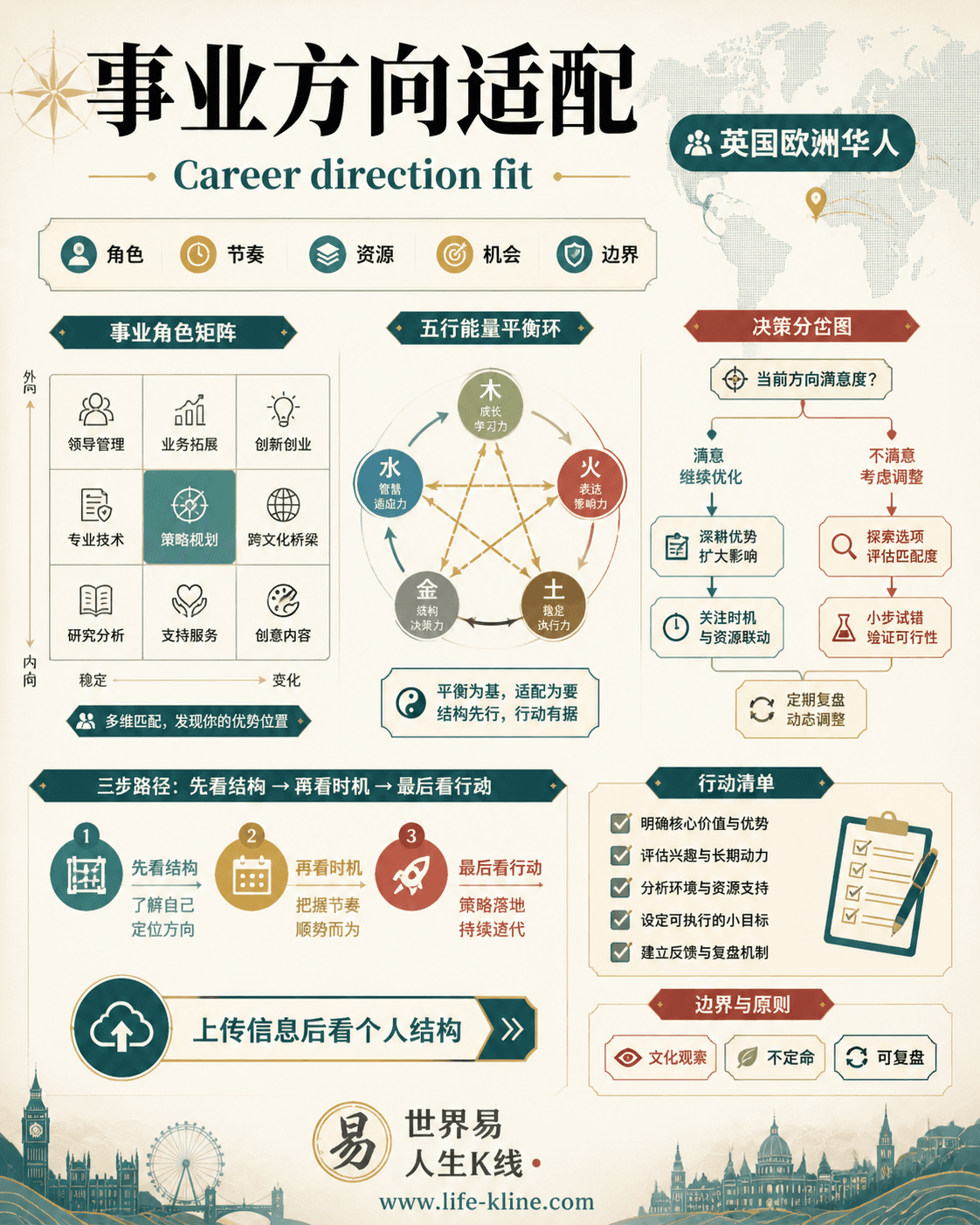
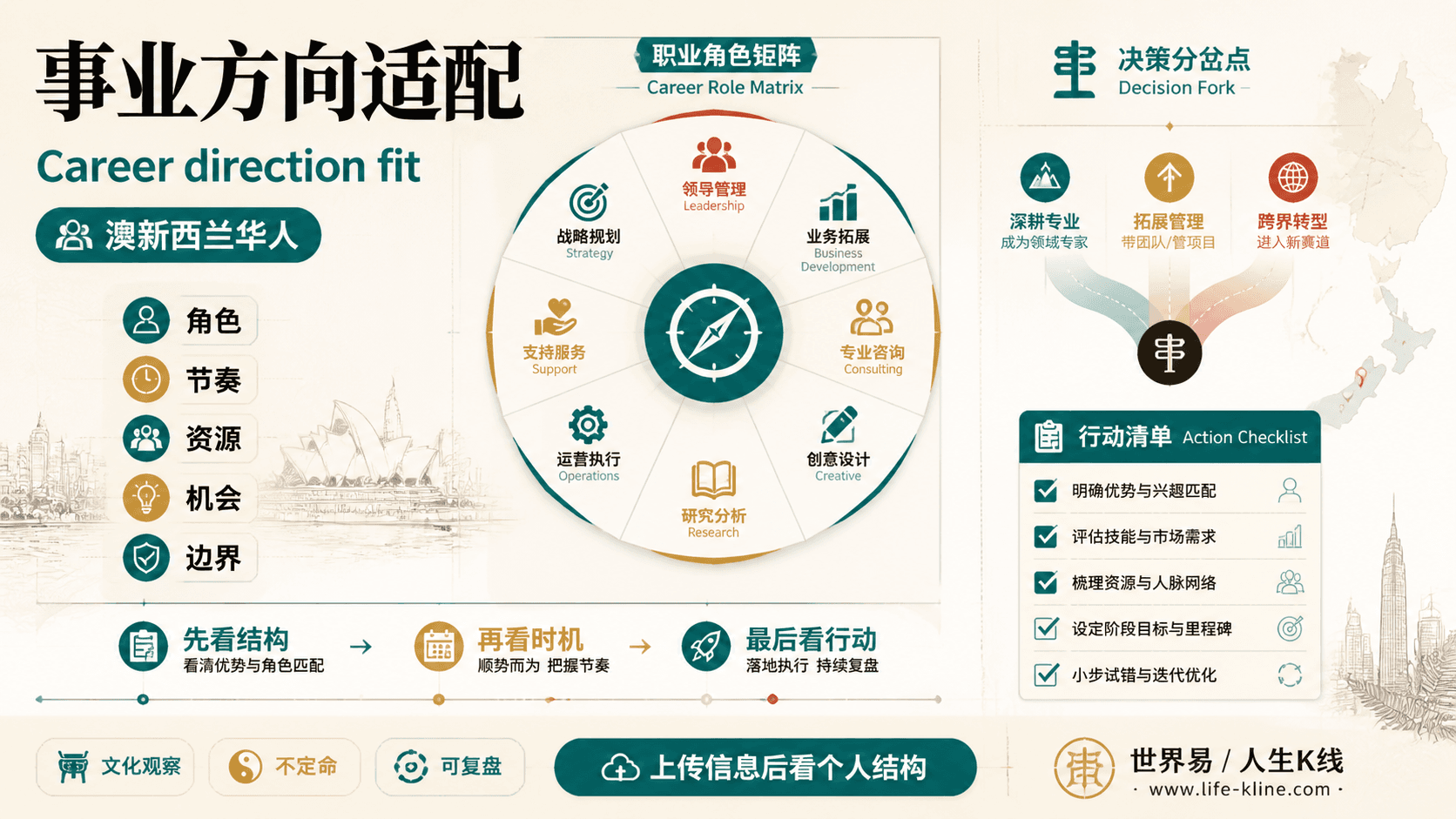
Metaphysical Assistance Analysis for Optimal SaaS Startup and Expansion Rhythm
把这篇文章落到自己身上验证:先看结构,再进入个人分析,不做泛泛阅读。
Why This Decision Is Especially Difficult in This Industry
One of the core operational difficulties in the SaaS industry lies in the long customer acquisition cycle and the complexity of customer success management. The time from customer awareness to paid subscription is relatively long, resulting in slow capital return, which affects cash flow and expansion rhythm. This business model emphasizes stable growth of ARR (Annual Recurring Revenue), requiring entrepreneurs to precisely control the input-output rhythm during startup and expansion stages to avoid excessive cash burn or overly rapid expansion leading to accumulated technical debt.
Moreover, SaaS products require continuous iteration and upgrades to cope with maintenance costs from technical debt and market competition pressure. Entrepreneurs often have the psychological bias of rushing rapid expansion to seize market share but neglect the long-term compounding effects of technology and customer success, which easily triggers subsequent operational risks. Under this industry structure, decisions are influenced not only by the business environment but also by the entrepreneur’s own decision rhythm.
BaZi structure provides a cyclical rhythm auxiliary reference, especially through the combination of Da Yun, Liu Nian, and Yong Shen, revealing the entrepreneur’s energy state and adaptability during specific periods. For the SaaS industry, reasonably matching one’s metaphysical rhythm with expansion plans helps reduce risks of financing failure and market expansion resistance. By combining industry characteristics with metaphysical cycles, entrepreneurs can scientifically arrange startup and expansion timing.
However, it must be emphasized that metaphysics is only an auxiliary tool and cannot replace thorough business due diligence and financial analysis. Entrepreneurs need to integrate industry dynamics, cash flow status, and team execution capability to comprehensively judge the best timing for action, thereby advancing steadily in the complex and ever-changing SaaS market.
Three Core Dimensions of Metaphysical Judgment
First, the attribute and strength of the Day Master determine the entrepreneur’s core energy and decision-making center. For SaaS entrepreneurship, a relatively strong Day Master usually means strong personal execution and resource integration ability, which is beneficial for initiating and continuously driving projects. Conversely, a weak Day Master suggests the need for external resources and cooperative support, requiring more cautious risk and partnership evaluation in decisions.
Second, the combination of Cai Xing (wealth stars), Bi Jian/Jie Cai (peer and competitor stars), Guan Sha (official and killing stars), and Yin Xing (resource/support stars) reflects the complex interaction of cash flow, competitive pressure, cooperative relationships, and support systems. Cai Xing represents capital and profit, suitable for financing and business expansion; Bi Jian/Jie Cai reflect partners and competitors, which if too strong may cause internal friction or resource dispersion; Guan Sha symbolize pressure and challenges, which if used properly help push project breakthroughs; Yin Xing symbolize support and resources, helping to stabilize the foundation.
Third, the interaction between Liu Nian and Da Yun reveals the cyclical changes of metaphysical energy. A stable or auspicious Da Yun combined with a favorable Liu Nian often indicates a favorable timing for entrepreneurial actions, especially in controlling customer acquisition and financing rhythm; whereas a weak or clashing Da Yun-Liu Nian combination signals caution to avoid blind expansion and capital chain breaks. For SaaS, which involves long-term compounding and intensive technical iteration, accurately grasping metaphysical rhythm can effectively reduce decision-making errors.
In summary, the reasonable combination of the Day Master and structure, the balance of Yong Shen and Ji Shen (unfavorable elements), and the harmonious or conflicting relationship between Da Yun and Liu Nian are the three key metaphysical dimensions to analyze the optimal startup and expansion rhythm for entrepreneurs in the SaaS industry.
Three Real BaZi Chart Cases
Case 1: This BaZi chart has a relatively strong Yi Wood (乙, Yi) Day Master, belonging to the Yang Ren (羊刃) structure. The Yong Shen are Metal and Earth, with Water as the Ji Shen. Currently in the 8th year of the Jia Shen (甲申, Jia Shen) Da Yun, which is a stable luck cycle, and the Liu Nian is Bing Wu (丙午, Bing Wu). The strong Yi Wood Day Master has vigorous growth and breakthrough power, and the Yang Ren structure enhances personal execution and innovation ability. Metal and Earth as Yong Shen indicate that reasonable allocation of capital and resources is especially important, while Water as Ji Shen warns of liquidity risk needing control. In the SaaS industry, the conservative nature of the Jia Shen Da Yun combined with the adaptability of the Bing Wu Liu Nian suits a steady startup phase focusing on product refinement and core customer accumulation. The expansion rhythm should prioritize stability, avoiding overly rapid financing that pressures the capital chain. It is recommended to proceed with market expansion gradually after business due diligence confirms customer lifetime value and technical architecture stability.
Case 2: This BaZi chart has a relatively strong Wu Earth (戊, Wu) Day Master, with a Zheng Cai (正财, Direct Wealth) structure. The Yong Shen are Wood and Water, with Fire as the Ji Shen. Currently in the 4th year of the Bing Xu (丙戌, Bing Xu) Da Yun, which is a relatively weak luck cycle, and the Liu Nian is also Bing Wu (丙午, Bing Wu). The Wu Earth Day Master represents solidity and reliability, and the Zheng Cai structure indicates relatively stable capital flow and income. However, the weak Da Yun and Ji Shen Fire suggest intense market competition and internal pressure, easily causing resource consumption. In the SaaS industry, the cautious atmosphere of the Bing Xu Da Yun requires entrepreneurs to be more conservative with financing and expansion, prioritizing optimization of the customer success system and technical platform. The expansion rhythm should not be rushed but focus on customer retention and repeat purchases to avoid capital chain strain caused by blind expansion. It is advised that entrepreneurs gradually increase ARR based on financial budgeting and market feedback, ensuring cash flow safety before considering large-scale financing.
Case 3: This BaZi chart has a relatively strong Ren Water (壬, Ren) Day Master, with a Yang Ren (羊刃) structure. The Yong Shen are Earth and Fire, with Metal as the Ji Shen. Currently in the 9th year of the Bing Wu (丙午, Bing Wu) Da Yun, which is a very auspicious luck cycle, and the Liu Nian is also Bing Wu (丙午, Bing Wu). The strong Ren Water Day Master combined with the Yang Ren structure indicates strong adaptability and transformation ability, capable of flexibly responding to market changes. Earth and Fire as Yong Shen help stabilize the foundation and stimulate motivation, while Metal as Ji Shen warns to guard against external competition and resource loss. In the SaaS industry, this very auspicious Da Yun and Liu Nian combination is very suitable for aggressive expansion and increasing financing, especially investing resources in technological iteration and customer success to seize market opportunities. The expansion rhythm should be fast rather than slow, but still closely monitor financial health and team execution to avoid technical debt accumulation from overly rapid expansion. It is recommended that entrepreneurs leverage capital to drive rapid growth while maintaining sensitivity to market changes, ensuring product and service quality.
The above three BaZi cases all incorporate SaaS industry characteristics such as long customer acquisition cycles, ARR models, and technical debt management, demonstrating differences in startup and expansion rhythms under different metaphysical rhythms, providing practical judgment references for entrepreneurs.
Common Misjudgments and Blind Spots in This Industry
One common misjudgment among SaaS entrepreneurs is ignoring the length of the customer acquisition cycle, overly pursuing rapid expansion and financing, leading to capital chain tightness and a surge in technical debt. Metaphysically, blindly acting without considering Da Yun and Liu Nian rhythms easily triggers the negative effects of Ji Shen, exacerbating operational risks. In practice, neglecting customer success and product stability while rushing expansion aggravates user churn and reputation decline, forming a vicious cycle.
Another blind spot is over-reliance on the strength of Bi Jian/Jie Cai (partners or team peers), especially when these stars are overly strong in the BaZi chart, which often causes internal friction and resource dispersion. In the SaaS industry, team collaboration and technical accumulation are extremely critical; if decision-making is unbalanced, it affects product iteration and customer support, ultimately restricting expansion rhythm. Metaphysics advises balancing Yong Shen and Ji Shen in alignment with team structure and cooperative relationships.
Additionally, entrepreneurs’ psychological biases often overlook the interaction between Liu Nian and Da Yun, failing to act according to the trend. For example, blindly financing or launching large-scale market campaigns in a weak Da Yun or a Liu Nian showing Ji Shen leads to significant subsequent risks. The long-term compounding effect of the SaaS industry requires entrepreneurs to steadily control rhythm, avoiding short-term decision errors that impact long-term development.
In summary, industry misjudgments and blind spots mostly arise from failure to integrate actual operational structure with metaphysical rhythm, lacking systematic risk identification and rhythm awareness.
Practical Judgment Sequence
Step one: Accurately assess the strength and structure of your Day Master, clarify Yong Shen and Ji Shen, and combine with the current Da Yun and Liu Nian to judge personal energy state and risk tendency. In SaaS entrepreneurship, confirm whether you have stable execution and resource integration ability, which determines the input rhythm and expansion speed at the startup stage.
Step two: Combine industry operational structure, focusing on investigating customer acquisition cycle, customer success system, and technical debt status. If the current Da Yun and Liu Nian are favorable and Yong Shen is strong, it is recommended to gradually increase market investment and financing; otherwise, prioritize optimizing product and customer experience to avoid blind expansion causing capital chain breaks.
Step three: Dynamically monitor the interaction changes between Liu Nian and Da Yun, and adjust expansion rhythm in a timely manner. Combine financial data and market feedback to flexibly respond to external competition and internal pressure, ensuring cash flow health and synchronous technical capability improvement. Metaphysical rhythm provides a decision-making rhythm reference but must be combined with business due diligence and professional financial advice to avoid sole reliance on metaphysics.
In conclusion, SaaS entrepreneurs should establish a scientific judgment sequence: first understand metaphysical rhythm, then map it to industry operational reality, and finally integrate data and team execution to ensure startup and expansion rhythm aligns with personal energy state and market environment.
FAQ
Question 1: How does metaphysics help determine the financing timing for SaaS startups? Answer: Metaphysics reveals the entrepreneur’s energy strength and external environment’s favorability through Da Yun and Liu Nian. When Da Yun is smooth and Yong Shen is strong, the financing success rate is relatively high; when Da Yun is weak or Ji Shen appears, financing should be cautious, prioritizing consolidation of customers and product foundation. This should be combined with financial status and market feedback for comprehensive judgment.
Question 2: Why can’t SaaS expansion rhythm be decided solely by metaphysics? Answer: The SaaS industry involves complex customer lifecycle, technical iteration, and capital management. Metaphysics can only provide rhythm reference and cannot reflect market changes and team execution. Actual decisions must combine business due diligence, financial analysis, and industry dynamics to avoid risks from blindly relying on metaphysics.
Question 3: What is the difference between a strong and weak Day Master in SaaS entrepreneurship? Answer: A strong Day Master usually represents strong execution and resource integration ability, suitable for rapid project advancement; a weak Day Master suggests the need for external support and cautious planning, suitable for steady development. Different Day Master states determine the rhythm and risk tolerance of startup and expansion and should be analyzed comprehensively with Yong Shen and Da Yun/Liu Nian.
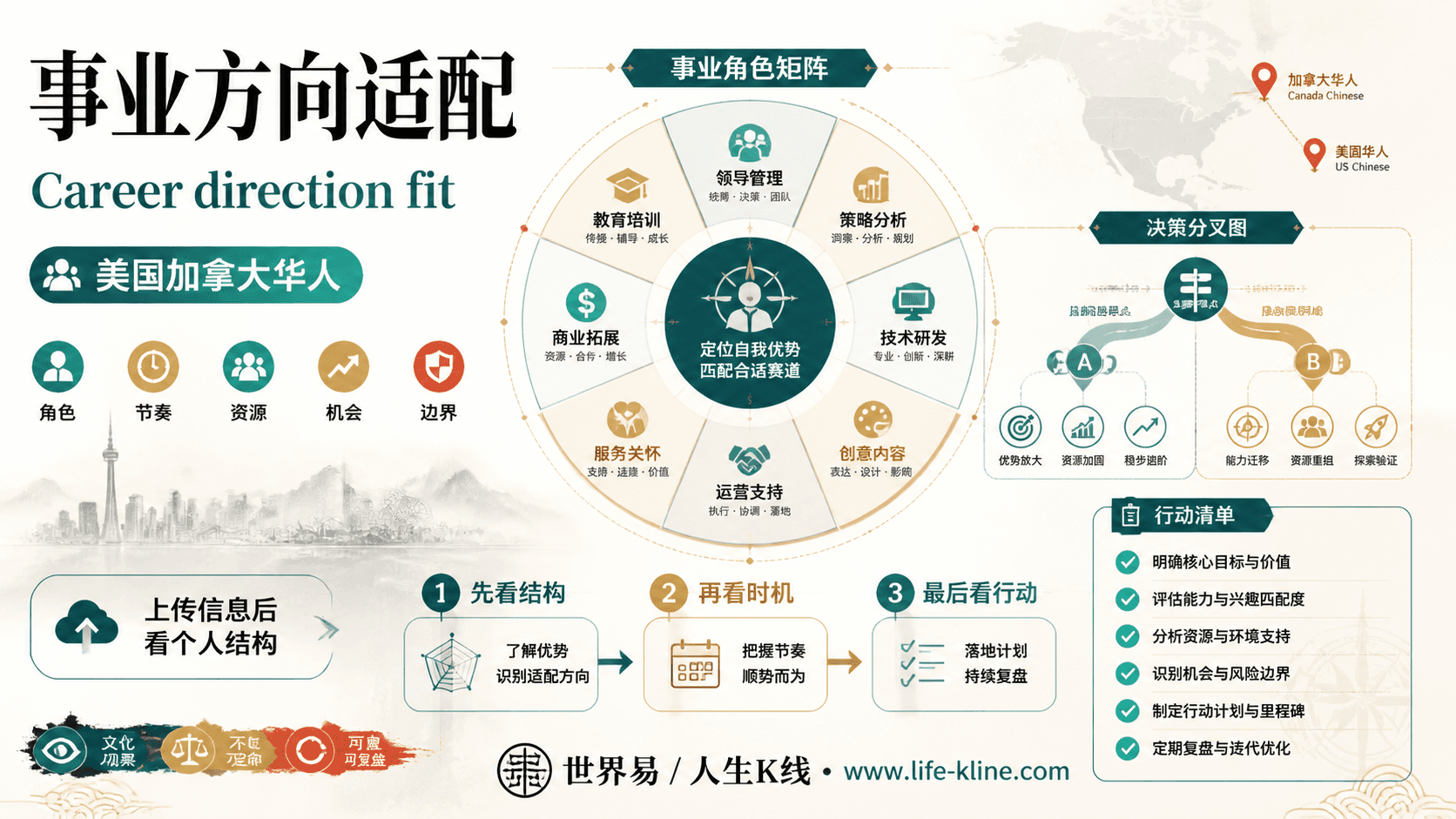
事业方向适配|美国加拿大华人
这张图把《Metaphysical Assistance Analysis for Optimal SaaS Startup and Expansion Rhythm》里的命理概念转成关系、边界和应用场景,适合先看图建立结构,再回到知识文章正文理解细节。
事业方向适配不应被写成固定结论。更适合美国加拿大华人的读法,是把传统术语翻译成结构、时机、环境、行动和复盘。
查看图片解读